Best Weight Plates for a Home Gym of 2026

A weight plate looks like a dumb slab of iron until you load one and it rattles on the sleeve, smells like a tire, or claims to be 45 pounds when the scale disagrees. The best plates disappear into the workout: they slide on cleanly, sit flush, and feel balanced overhead. Over the past four months, I’ve loaded 12 sets through squats, bench presses, deadlifts, and rows in a garage gym, and the differences in quality and value showed up fast.

The catch is that good means more than a nice finish: a plate can look great and still arrive greasy, carry an odor that lingers in a spare room, or run thick enough that three won’t fit beside your collar. We weighed each one on a calibrated scale, checked how securely it fit different bar sleeves, and kept notes on appearance after weeks of loading and unloading. Accuracy and size matter more than most first-time buyers expect, and the right set for a basement gym isn’t always the prettiest one. The picks below are the ones that held up.

1

Best Overall

CAP Olympic Grip Plate

96 /100
Trail Score Outstanding

Key details

Grip
Grip holes
Weight
25 lb single plate
Bar Fit
2-inch Olympic
Plate Type
Cast iron, baked enamel
Check Price on Amazon

Buying plates one at a time is the cheapest way into a home gym, and this is the one we tell people to start with. Twenty-five pounds of cast iron arrives with a baked enamel finish that reads closer to charcoal than black, raised weight markings you can find by feel, and edges clean enough to handle without gloves. Nothing about it feels like a compromise purchase.

The grip holes are the detail we kept coming back to. They turn a 25 into something you can hold like a thick-handled kettlebell for chest presses, twists, and carries, and they give you a place to grab while you slide the plate onto a sleeve. The machined two-inch bore clears an Olympic bar without force. One caveat worth knowing: the hole can run a touch large on a given plate, and then it rocks on the sleeve until the collar is snug against it — tighten the collar before the first rep and it stops mattering.

Set against the rest of this list, its advantage is flexibility. You buy the pair you need this month and another next month, and you never end up with four 2.5s you'll never touch. The Amazon Basics Olympic set is the faster route to 40 pounds; the CAP bumper is the right call if the bar leaves your hands. For squats, presses, rows, and deadlifts you set down, this is the plate.

Pros

  • Grip holes make off-bar work easy
  • Clean baked enamel finish with raised markings
  • Machined 2-inch bore fits Olympic bars

Cons

  • Sold as one plate, so a pair means two orders
Our verdict

The plate we point most people to: solid cast iron, a clean finish, grip holes that earn their keep, and single-plate pricing that lets you build a set gradually.

Check Latest Price
2

Best for Dropping the Bar

CAP Rubber Bumper Plate

90 /100
Trail Score Outstanding

Key details

Bounce
Medium-bounce rubber
Weight
45 lb single plate
Bar Fit
2-inch Olympic
Plate Type
Rubber bumper, steel hub
Check Price on Amazon

The first time you drop a loaded bar from overhead, you find out what your floor is made of. A 45-pound bumper is the honest answer: the rubber takes the hit, the bar bounces rather than crashes, and the noise drops to something the rest of the house can sleep through. CAP builds this one around a steel floating hub, which is the part that decides whether a bumper still feels good after a year — the plate spins freely on the sleeve and slides on and off without the wobble of a crooked insert.

Medium bounce is what we want in a garage plate. Crumb rubber with a livelier rebound sends the bar back at your shins; this blend absorbs the drop and settles. The color-coded weight markers save time when you're loading in a hurry, and 45 is the size you'll buy first, because it's the plate that does most of the work in a deadlift.

Compare it with the rubber-coated RitFit set: that's a starter set of coated iron for controlled lifts, while this is a single plate built to take a drop. A pair is the minimum useful purchase, so plan on two, then add 25s before you add more 45s. It's the one place on this list where buying by the plate hurts, and it's still the right way to do it.

Pros

  • Rubber absorbs drops and cuts noise
  • Floating steel hub loads smoothly
  • Medium bounce stays controllable

Cons

  • Strong rubber smell out of the box
Our verdict

The plate to buy if you drop the bar: medium-bounce rubber, a floating steel hub that loads smoothly, and single-plate pricing that makes building a set realistic.

Check Latest Price
3

Best Fractional Plates

EVERYMATE Change Plates

95 /100
Trail Score Outstanding

Key details

Bar Fit
2-inch Olympic
Plate Type
Rubber-coated steel core
Weight Options
1.25, 2.5, 5 lb
Check Price on Amazon

Five pounds is a fine jump on a deadlift and a terrible one on an overhead press. A set of 1.25, 2.5, and 5-pound plates lets you take the next honest step instead of stalling or adding ten and hoping. EVERYMATE's version is a steel core in a rubber skin, color-coded so you can grab the right pair at a glance, drilled to the standard two-inch Olympic bore so it fits whatever bar you already own.

Small plates get handled far more than they get loaded, and the coating earns its keep there. They go onto a dip belt, sit on a stack pin, and ride in a gym bag without shedding paint on everything they touch. We also like how quiet they are — setting a 2.5 down on a wooden platform at six in the morning doesn't announce itself the way bare iron does.

The cost per pound is the highest on this list, which is true of every fractional plate and not a reason to skip them: you're buying precision, not tonnage. If you only add one thing to a home gym this year, make it the 1.25s. That's the increment that unblocks a press that's been stuck for weeks, and it's the pair you'll reach for most often.

Pros

  • Ends the five-pound jump problem
  • Rubber coating survives bags and floors

Cons

  • Caps out at 5 lb, so it can't replace full plates
Our verdict

Worth the money if a press has stalled: genuine 1.25, 2.5, and 5-pound steps that fit any Olympic bar and survive life in a gym bag.

Check Latest Price
4

Best Budget Olympic Plates

Amazon Basics Olympic Grip Plates

93 /100
Trail Score Outstanding

Key details

Grip
Grip holes
Bar Fit
2-inch Olympic
Plate Type
Cast iron, recycled iron
Set Contents
4 x 10 lb
Check Price on Amazon

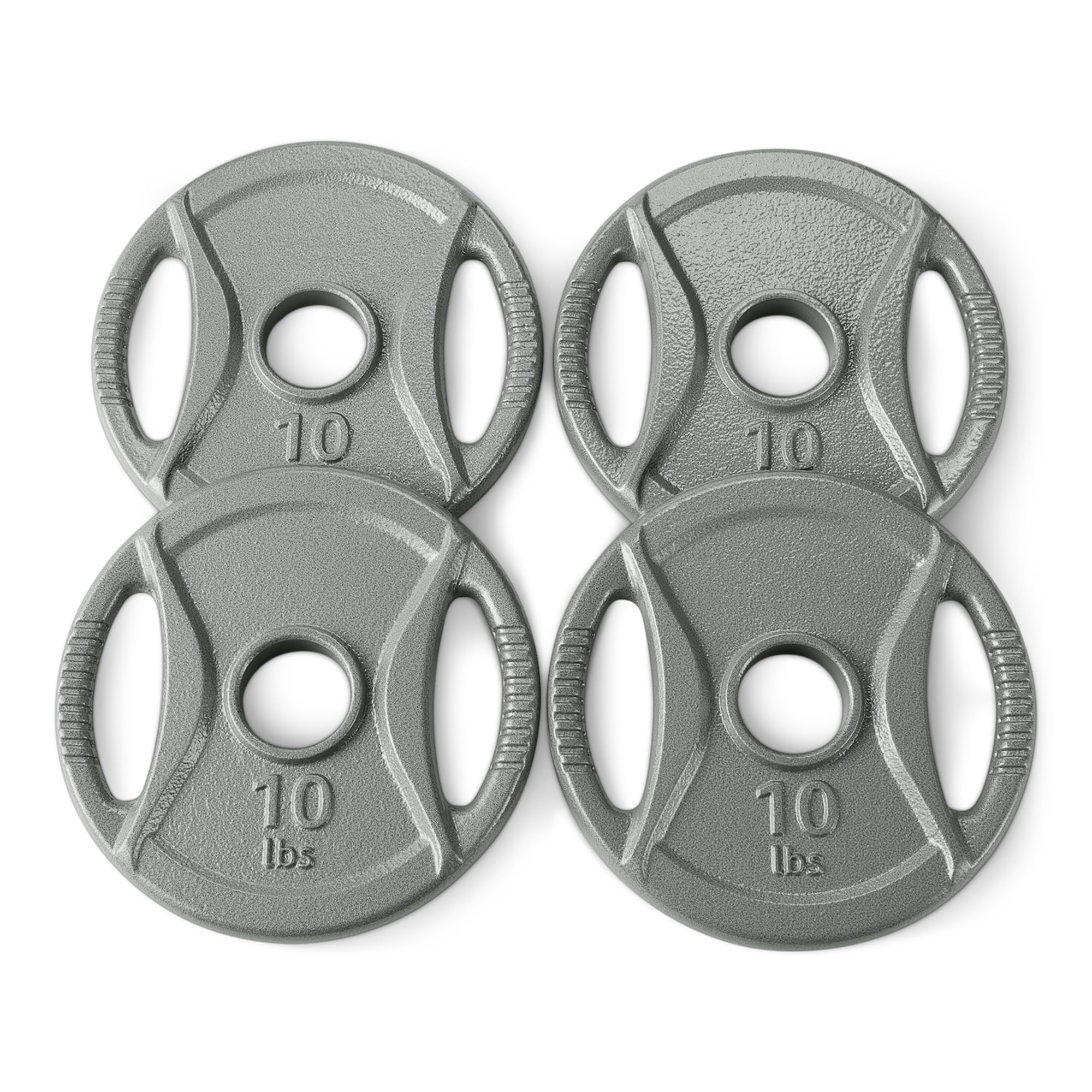
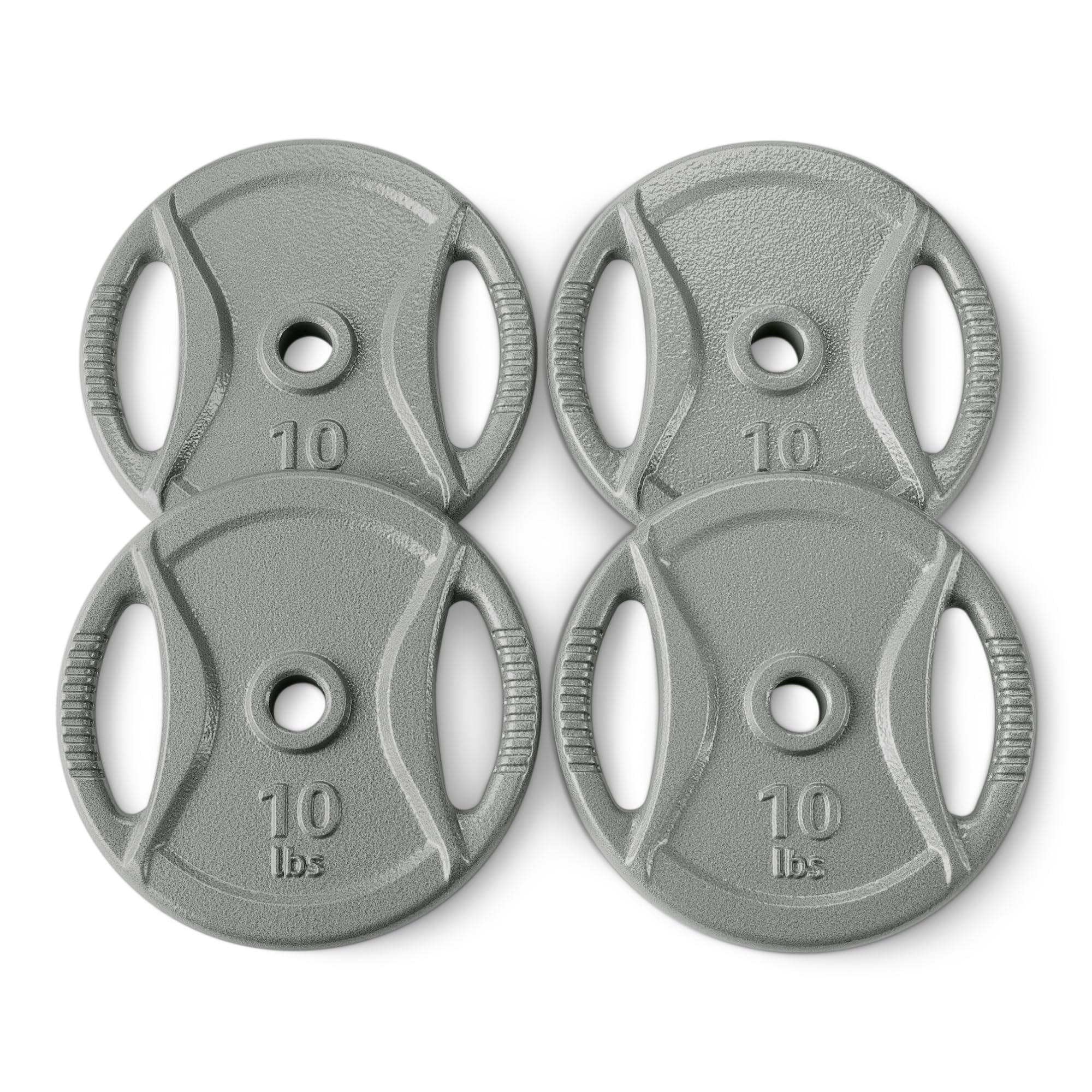
Forty pounds in a single box is the appeal here: four 10-pound Olympic plates, cast from certified recycled iron, with grip holes and a plain charcoal finish. The bore is clean and deburred, the weight is stamped where you can read it, and the price works out reasonably against buying singles — you pay a little more per pound than for the CAP plates and get a complete 40-pound step in one delivery.

Ten-pound plates are small across, and that changes how you use them. As the outside plates on a bar pulled from the floor they leave it sitting lower than a pair of 45s would, which turns a deadlift into a deficit pull. Keep the big plates on the outside and these in the middle.

Where they're genuinely useful is off the bar. The grip holes make a 10 usable as a hand weight for triceps work, halos, and weighted core drills, and four of them stack neatly in a corner. If you already own 25s and 45s and just need filler, though, buying CAP 10s in pairs keeps every plate on the bar the same diameter.

Pros

  • Forty pounds in one order
  • Grip holes and a clean bore
  • Cast from certified recycled iron

Cons

  • Only 10 lb plates in this set
Our verdict

The quickest way to add 40 Olympic pounds in one order, as long as you keep the small-diameter 10s off the outside of a floor pull.

Check Latest Price
5

Best Rubber-Coated Set

RitFit Rubber Plate Set

93 /100
Trail Score Outstanding

Key details

Grip
3-hole grip
Bar Fit
2-inch Olympic
Plate Type
Rubber-coated cast iron
Set Contents
85 lb: 2.5, 5, 10, 25 lb pairs
Check Price on Amazon

Eighty-five pounds, eight plates, four pairs: 2.5s, 5s, 10s, and 25s. It's a sensible first set for someone who already has a bar and a bench and doesn't want to agonize over which sizes to order. The plates are cast iron with a rubber skin and a three-hole grip pattern, so loading is a two-handed job only when you want it to be.

The rubber is the reason to choose this over plain cast iron. It lands quietly on a sleeve, it doesn't gouge a platform or a mat, and it won't chip the way enamel does when plates get stacked carelessly. What it isn't is a bumper — this is coated iron, built for controlled lifts, and a dropped clean will eventually hurt it. If your program includes dumping the bar, the CAP 45 bumper is the right tool and this set isn't.

The gaps sit at both ends: this set stops at 25 pounds and starts at 2.5, so you'll be adding a pair of 45s and a fractional set before it covers a full program. As a starting point, though, 85 pounds loads a bar for a beginner's squat and covers most accessory work, and the grip openings make the 25s usable on their own for pressing and carries.

Pros

  • Covers the common sizes in one order
  • Rubber coating is quiet and floor-friendly
  • Three-hole grip eases loading

Cons

  • Arrives oily with a smell that needs airing out
Our verdict

A sensible first set for an apartment or spare room, as long as your lifts are controlled rather than dropped.

Check Latest Price
6

Best for 1-Inch Bars

Amazon Basics 1-Inch Grip Plates

92 /100
Trail Score Outstanding

Key details

Grip
Grip holes
Bar Fit
1-inch standard
Plate Type
Cast iron, recycled iron
Set Contents
4 x 10 lb
Check Price on Amazon

Standard bars are the hand-me-downs of home gyms: a 1-inch bar and a pair of spin-lock collars that came with someone's first weight set. Plates for them are harder to find in the sizes that matter, so a four-pack of 10s from a brand that will still be around next year is worth knowing about.

They're cast iron with the same charcoal finish and grip cutouts as the Olympic version, made from certified recycled iron, and clearly stamped. The grips are the reason to choose these over the plain 1-inch plates you'll find elsewhere: a 10 with a hole through it works as a hand weight for triceps and core work, and it's much easier to pick up off the floor.

The bore is a true inch, which is right for a standard bar and sometimes wrong for a spin-lock handle that's been chromed a little thick. Measure your handle across before ordering. And if you're still shopping for a bar, skip the 1-inch world entirely — every other plate here is Olympic, and the choice in bars and plates is far wider.

Pros

  • Keeps a standard 1-inch bar in service
  • Grip holes double as hand weights

Cons

  • Grip handles make them wider than plain plates
Our verdict

The pick for a standard 1-inch bar: four 10s with real grip holes, honest weight, and a price that makes keeping the old bar worthwhile.

Check Latest Price
7

Looks and Finish

Iron Crush Cast Iron Plates

94 /100
Trail Score Outstanding

Key details

Bar Fit
2-inch Olympic
Markings
Raised lb and kg
Plate Type
Cast iron, hammertone finish
Weight Options
2.5 to 45 lb
Check Price on Amazon

The hammertone finish is the first thing you notice: a mottled grey-silver that hides chalk, scuffs, and the fingerprints that show up on smooth black enamel. That's a small vanity, but a home gym lives in your house, and plates that look deliberate are easier to live with than plates that look like freight.

Underneath is plain cast iron with deep edges that give your fingers somewhere to go when you're loading at hip height, and raised markings in both pounds and kilograms. The range runs from 2.5 to 45 pounds, and the 45 is built to Olympic diameter, so it holds the bar at the same height as the rest of your stack.

The plates ship in pairs, which is the right unit for a barbell and awkward if you're filling a single gap. What you're paying for over the CAP singles is the coating and the markings rather than better iron — the metal underneath is the same cast iron, and the fit reports are just as mixed.

Where this earns its place is a gym that's on display. If the plates sit against a wall you actually look at, the finish is worth the premium; if they live in a cold garage and get abused, cheaper cast iron does the same work and you won't wince when it gets scratched.

Pros

  • Hammertone finish hides scuffs
  • Raised markings in pounds and kilograms
  • 45 lb plate built to Olympic diameter

Cons

  • Sold only in pairs
Our verdict

The cast iron to buy when the rack is in the living room: a hammertone finish and dual-unit markings, at a premium over plain iron.

Check Latest Price
8

Full Bumper Set

AMGYM Bumper Plate Set

93 /100
Trail Score Outstanding

Key details

Bar Fit
2-inch Olympic
Diameter
17.5 inches
Plate Type
High-bounce rubber
Set Contents
190 lb: 10, 15, 25, 45 lb pairs
Check Price on Amazon

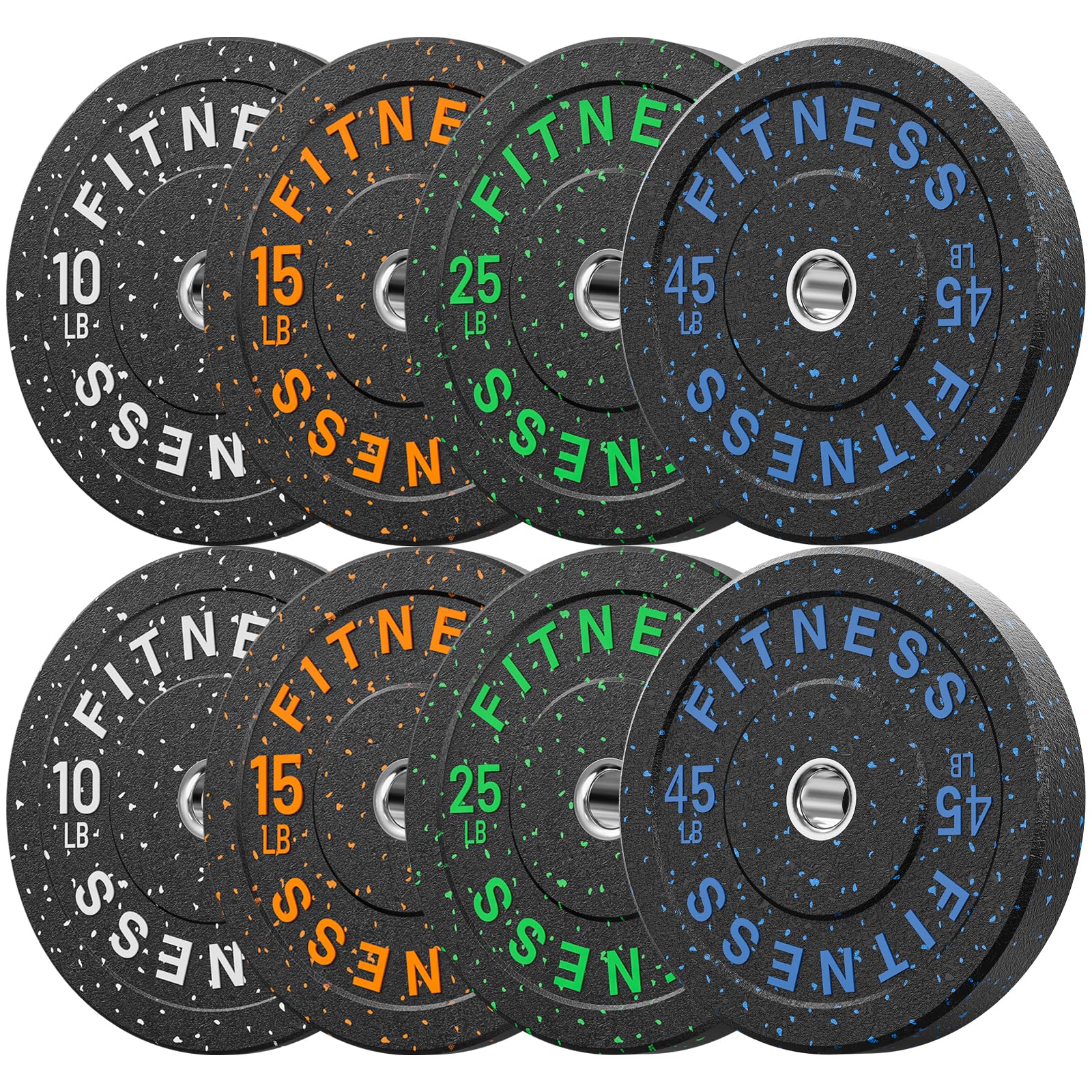
A 190-pound bumper set is a commitment: pairs of 10s, 15s, 25s, and 45s, all 17.5 inches across. That uniform diameter is the point of a bumper set — every plate on the bar sits at the same height, so a dropped lift lands the way it does in a weightlifting gym rather than tipping onto a smaller plate.

The rubber is high-bounce recycled stock over steel inserts, which is the combination that keeps a garage floor intact and a bar predictable on the rebound. The insert is the part that takes the most stress, and these are seated straight and flush; the plates slide on and off without a shove. The textured surface helps when your hands are chalky and you're carrying a 45 by the edge.

Accuracy is the thing to check. The plates come close to their marked weight, but close isn't exact, and if you're chasing a number you should weigh each one once and write the real figure on the back with a paint pen. Do that before your first max attempt rather than after.

Compared with the single CAP bumper, this is the buy-once option: more money, more weight, and no return trips to the listing. It makes sense if you're building a platform and plan to train Olympic lifts seriously. If you just want to deadlift without waking the house, one pair of CAP 45s gets you there for a fraction of the outlay.

Pros

  • Uniform 17.5-inch diameter across sizes
  • High-bounce rubber protects floors
  • Steel inserts seated straight

Cons

  • Only sold as the full 190 lb set
Our verdict

The buy-once bumper set for a garage platform: 190 pounds of uniform-diameter plates that keep a dropped bar predictable.

Check Latest Price

How We Tested (and Weighed) the Best Weight Plates

To build the shortlist, we compared plate diameters, hub openings, finishes, and available weight options, then filtered out models with recurring complaints about odor, oily residue, or weights that missed their marks. That left 12 sets, which we used for four months in a garage gym: early-morning squats, after-work bench sessions, weekend deadlift days, and the less glamorous job of stacking them back on the rack.

We weighed every plate on a calibrated scale and compared the number to the stamp, noting whether a pair was off by the same amount or wildly different. We slid each plate onto a barbell sleeve, checked for side-to-side play, and stacked several plates at once to see how much room was left for the collar. New plates got a wipe with a white cloth to see how much oil or grease came off, then sat in a warm room for a week so we could judge odor after the packing materials were gone.

After each session, we checked hubs and edges for chips, scuffs, and early rust, and noted whether the finish still looked clean or showed handling marks. We paid attention to grip with sweaty hands, noise during loading, and how easily plates came off the bar after a hard set. At the end, we compared what each set delivered for its price tier, because value isn’t the cheapest plate—it’s the one that fits well, weighs true, and doesn’t make you want to replace it a year later.

How to Choose Weight Plates for a Home Gym

Check your bar before anything else

An Olympic bar has a 2-inch sleeve and takes 2-inch plates. A standard bar and most spin-lock dumbbell handles take 1-inch plates, and the two sizes never swap. If you're buying a bar at the same time, buy Olympic — that's where the choice in plates and bars is. If you're keeping a hand-me-down standard bar, the Amazon Basics 1-inch set is the practical way to keep it working.

Whichever size you buy, look inside the hole. A burr or a heavy paint line in the bore will bind on a sleeve, and a plate you have to force on is a plate you'll fight to strip at the end of a set. Slide one plate on before you commit to a whole set.

Cast iron, coated iron, or bumper

Decide by what happens at the end of a rep. Cast iron is the cheapest way to put weight on a bar and lasts essentially forever, but it chips where plates knock together and it's loud. Rubber-coated iron, like the RitFit set, costs more, lands quietly, and spares a wooden platform or a mat. Bumper plates are a different animal — a wide rubber disc with a steel insert, built to be dropped from overhead.

If your program includes cleans, snatches, or bailing out of a lift, buy bumpers: the CAP 45 or a set like the AMGYM. If it's squats, presses, and controlled deadlifts, cast iron does the same job for less. New rubber usually arrives slick and smelly, so plan on wiping it down and airing it out for a week before it lives indoors.

Buy increments, not tonnage

A bar plus a pair of 45s and a pair of 25s covers a lot of training. What home gyms actually lack is the small stuff: a pair of 2.5s and a set of fractional plates will get you through more plateaus than another 45 ever will. This is where change plates earn their price — 1.25, 2.5, and 5 pounds let you add a little instead of a lot.

If you're choosing between a second pair of 25s and a set of small plates, buy the small plates. If you're choosing between a whole set and a pair you'll actually use this month, buy the pair.

Diameter, thickness, and how the bar sits

Two 10-pound plates are not interchangeable with two 45s. A 45 is a full-size disc that holds the bar at a standard pulling height; a 10 is much smaller and, if it's the outermost plate, leaves you pulling from a deficit. Keep your biggest-diameter plates on the outside of the stack and the small ones in the middle.

Thickness matters at the other end of the sleeve. Thinner plates let you fit more weight before you run out of room for the collar, which is a real consideration on a short bar. Bumper sets sidestep the whole problem by making every plate the same diameter — the AMGYM's 17.5 inches is the same on the 10s as on the 45s.

Frequently Asked Questions

Final Verdict

Start with the CAP Olympic cast iron plate. It's the least complicated way to add weight to a bar — solid, well finished, easy to grip, and sold one at a time so your money goes to the size you're actually missing.

If the bar leaves your hands, spend the difference on the CAP rubber bumper instead; that's the one job cast iron can't do. And if a press has been stuck for a month, the EVERYMATE change plates will do more for your training than another pair of 25s.