Best Waterproof Bandages of 2026

You stick one on a sliced finger before you do the dishes, and by the time the plates are dry the edges have lifted, the pad has gone soft, and water has found its way underneath anyway. A waterproof bandage is meant to solve exactly that: a seal that keeps water, dirt, and germs out of a cut while you wash your hands, shower, garden, or chase a kid around a pool. The problem is that "waterproof" is doing a lot of heavy lifting on those boxes, and some give up at the first sinkful of suds.

I have been patching kitchen injuries for years, and over the past four months my team worked through 14 boxes of waterproof bandages, wearing them through hand-washing, showers, dishes, and one very determined round of yard work. What separated the good ones wasn't the film so much as the seal around the pad and how the strip behaved where skin bends. A bandage that won't flex over a knuckle is only waterproof until you make a fist. The ones below earned their place on real cuts, not on the package claims.

1

Best Overall

Nexcare Waterproof Clear Bandages

93 /100
Trail Score Outstanding

Key details

Seal
360-degree seal around pad
Count
100 bandages
Sizes
Assorted sizes
Backing
Clear, flexible
Check Price on Amazon

One design decision earns this box its place at the top: the adhesive runs in a full ring around the pad instead of two strips down either side, so water has no straight path to the wound. On a finger, a knuckle, or the back of a hand, that ring is the difference between a bandage that survives a shower and one that gets replaced after it.

In use, the seal is the part you have to get right. These hold through a shower and through a working day of handwashing, and the thin film stays put on a knuckle that keeps bending. What undoes them is a rushed application: if the border wrinkles, or you press it down over damp skin or a smear of hand lotion, the ring breaks and the bandage is compromised from the first minute. Wash the area, dry it completely, then peel the backing without touching the sticky side.

The film is clear enough to nearly disappear, which we appreciate on a hand you are using in front of people all day, and the nonstick pad lifts off a cut that is still oozing without tugging at it — the detail we noticed most at the second change of the day. The backing takes two hands and decent light, so keep a box somewhere you have both.

Pros

  • Ring seal keeps water away from the pad
  • Holds through showers and handwashing
  • Clear film nearly disappears on skin
  • 100 bandages in assorted sizes

Cons

  • Largest strips won't cover a broad scrape
  • Adhesive can pull at skin on removal
Our verdict

Our default box holds 100 clear strips whose ring seal survives showers and handwashing, provided you start with genuinely dry skin.

Check Latest Price
2

Best for Knees and Elbows

Nexcare Waterproof Knee & Elbow

92 /100
Trail Score Outstanding

Key details

Pad
Cushioned
Size
2 x 4 in
Count
20 bandages
Adhesive
Sticks to damp or sweaty skin
Check Price on Amazon

A scraped knee is not a finger cut. A standard strip lands in the middle of it, leaving the graze bare on both sides, and you end up taping two bandages together to cover one wound. This Nexcare pad measures 2 by 4 inches, wide enough to sit over the whole scrape, and the adhesive is shaped to seal around the pad on all four sides. It is the one we reach for when the injury is wider than a strip.

The detail that earns it a place is the adhesive, which is made to grab damp or sweaty skin. That is the state of a knee you have just rinsed off, or an elbow under a sleeve on a warm afternoon, and it is exactly where an ordinary bandage gives up. The cushioning matters too: the pad is thick enough to take pressure off a raw scrape, which makes this the one to use on a heel blister or a knee that will be under trousers all day.

That thickness is also the trade-off — it shows under slim clothing and takes a moment longer to seat flat. Removing it deserves patience, since the seal you wanted is the seal you have to peel; soak it first and it comes away with far less pull. If your skin reacts to adhesive, try a short first wear before committing to a full day.

Pros

  • Covers a graze a strip can't
  • Adhesive grips damp or sweaty skin
  • Cushioned pad over a raw scrape
  • Sealed on all four sides

Cons

  • Bulky under snug clothing
  • Pad won't sit flat on a knuckle
Our verdict

For a scraped knee, an elbow, or a heel blister — anything wider than a strip — the big cushioned pad and damp-skin adhesive justify the higher cost per bandage.

Check Latest Price
3

Best for Fingers and Knuckles

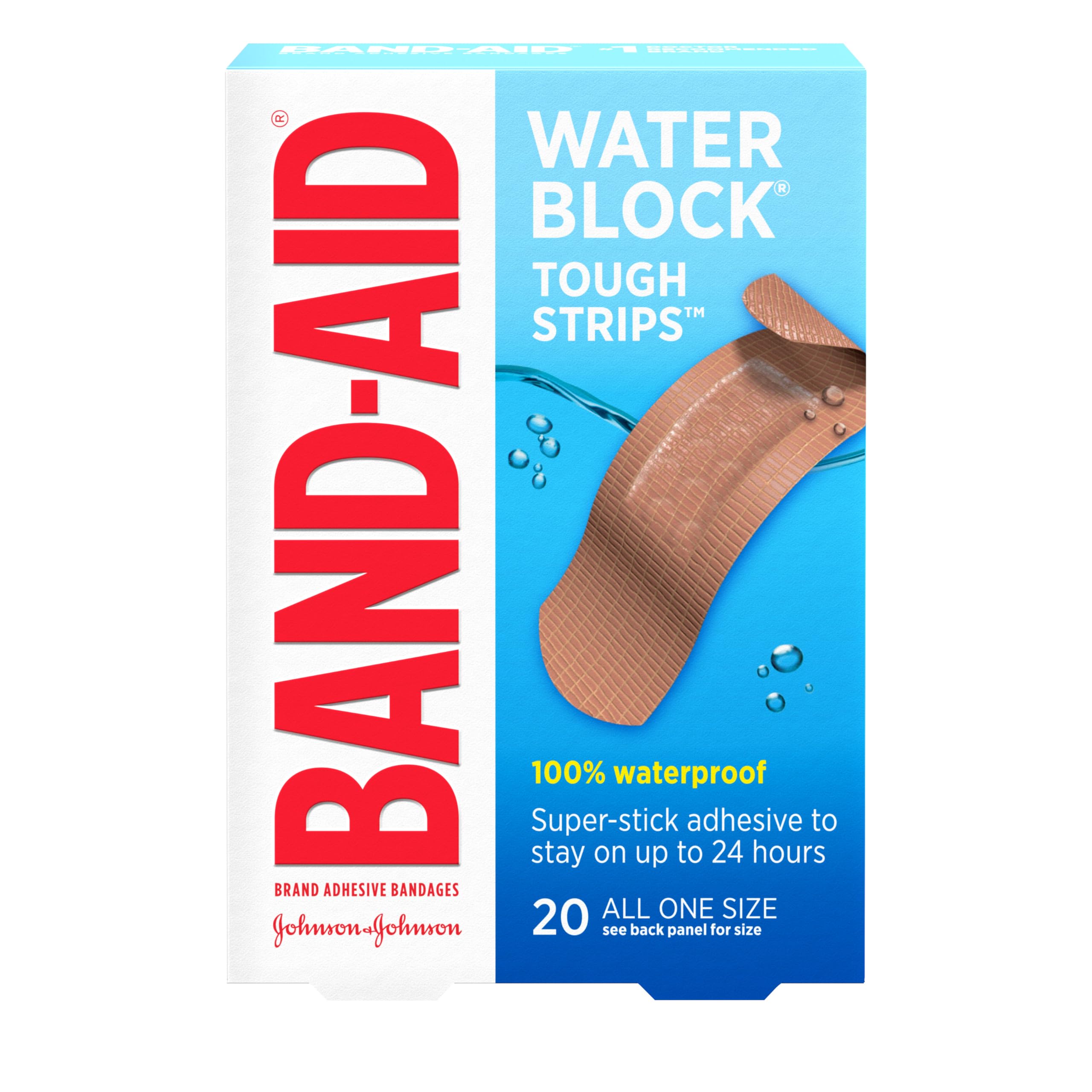
Band-Aid Water Block Tough

91 /100
Trail Score Outstanding

Key details

Size
1 x 3.25 in
Count
20 bandages
Material
Dura-Weave waterproof
Wear Time
Up to 24 hours
Check Price on Amazon

Where our top pick feels like thin film, this Band-Aid feels like tape. The strip is a woven Dura-Weave material measuring 1 inch by 3.25 inches, with a four-sided seal and a Quilt-Aid pad down the middle, and the difference shows up the moment your hands get wet.

That is the reason to buy it. Paper and cloth strips go soft and shred when you keep using your hands; this one holds its shape, which is why it is our pick for a cut on a finger, a knuckle, or the side of a hand that goes into dishwater. The box promises up to 24 hours of wear, and a border pressed firmly onto dry skin stayed put through a working day of handwashing.

At an inch wide it wraps a finger once without overlapping into a lump, and that is the difference between a bandage you forget about and one you pick at all afternoon. It comes in a single size, so a broad graze is not its job. The woven face is also rougher against clothing than clear film — noticeable under a tight cuff, irrelevant inside a glove.

Pros

  • Woven strip resists shredding when wet
  • Holds a pressed border through handwashing
  • 1-inch width wraps a finger without bulk
  • Cushioned Quilt-Aid pad

Cons

  • All one size, so no bigger strip in the box
  • Border can lift after a long soak
Our verdict

Buy this one for hand injuries: a tough woven strip that survives dishwater and a working day, in a width that wraps a finger cleanly.

Check Latest Price
4

Best for All-Day Comfort

Band-Aid Water Block Flex

91 /100
Trail Score Outstanding

Key details

Pad
Quilt-Aid Comfort Pad
Count
20 bandages
Sizes
All one size
Material
Fabric-like flex
Check Price on Amazon

Comfort is the entire argument for these, and it is a real one. The fabric-like material bends with a finger instead of standing off it, and the Quilt-Aid pad cushions a cut that hurts every time you type or grip something. If you have ever pulled a stiff waterproof strip off after an hour because it was driving you mad, this is the version you finish the day wearing.

The cost is water. The box says 100% waterproof, but these are the least consistent of the strips here at blocking it once an edge lifts — and on a bending finger, an edge will eventually lift. Sealed properly onto dry skin they are fine for handwashing and a quick shower. They are not the strip for a long swim, a hot tub, or a shift with your hands in water.

What we keep coming back to is how little there is to notice while one is on. There is no stiff ridge catching on a sleeve, no edge standing proud of the skin, and the pad does not bunch when you make a fist. That is a modest thing to praise a bandage for, and it is the reason this box lives in the drawer next to the tougher strips.

Pros

  • Flexes with a bending finger
  • Quilt-Aid pad cushions tender cuts
  • Comfortable enough to forget
  • Four-sided adhesive holds when sealed

Cons

  • Wrappers are hard to open
  • All one size, and a small one
Our verdict

The comfort pick: we wear these when a stiff strip is unbearable, and we save the tougher options for swimming and long soaks.

Check Latest Price

How We Tested Waterproof Bandages

We started with roughly 40 boxes sold in drugstores and online and narrowed from there, dropping anything labeled only water-resistant as well as any option that came in a single size too small for a knuckle or too large for a fingertip. From there we filtered by pad dimensions, count per box, cost per bandage, and whether the materials were listed as latex-free, which landed us at 14 boxes to test over four months.

Those boxes went into the places bandages actually live: kitchen drawers, bathroom cabinets, a glove compartment, a pool bag. We applied them to knife nicks, a popped blister on a heel, a scraped knee from the park, and the spot where a wedding ring rubs, then washed our hands a dozen times a day, did dishes without gloves, showered, and swam with them on.

Each one got the same treatment. We soaked a bandage for five minutes, then blotted the pad with a tissue to see whether water had crept under the seal. We timed how long the edges stayed flat and noted where they curled first, then wore a set for two full days to check whether they were still stuck at hour 48. On fresh cuts we watched whether the pad absorbed blood or let it run, and how much pressure it took to stop the bleeding. Finally, we opened wrappers one-handed with wet hands, peeled backings while holding a finger still, and measured each pad against the wound it was covering, because a seal that doesn't clear the cut isn't protecting anything.

How to Choose Waterproof Bandages

Match the shape to the wound

Buy for the injury your household actually gets. A one-inch strip is right for a cut on a finger, the side of a hand, or a toe. A 2 x 4 inch padded patch is right for a scraped knee, an elbow, or a heel blister that has to take friction. A square spot suits a small patch of flat skin and little else.

Here is the trap: assortments skew small. The biggest strip in a hundred-count box still lands in the middle of a grazed knee, so if that is your usual injury, buy a box of pads alongside the strips rather than expecting one box to do both jobs.

The seal lives at the border

Water does not get through the pad; it gets in at the edge. That makes the border the only part worth fussing over. Anything sitting between the adhesive and your skin — a damp patch, a film of lotion or sunscreen, a smear of ointment — gives water a route in.

So clean and dry the area, put ointment on the pad rather than on the surrounding skin, then press the border down and hold it for a few seconds so body heat sets the adhesive. A carefully applied bandage survives far more water than a hurried one, and that difference is bigger than the difference between brands.

Hands, joints, and sweaty skin

Where the bandage goes decides how long it lasts. Fingers and knuckles bend constantly, so a narrower strip that wraps once beats a wide one that pleats and lifts — the Band-Aid Water Block Tough is sized for exactly that. Knees and elbows are the opposite: broad, flattish, and often damp from sweat or a rinse, which is why the cushioned Nexcare pad earns a place in the cupboard.

On hairy forearms, expect less grip at the corners. Choose a larger patch so the border lands on flatter, barer ground, and give the edges a firm press rather than a quick rub.

Count, size mix, and cost per bandage

Judge a box by what each bandage costs and whether you will use that size, not by the number printed on the front. Large counts are a false economy when half the strips are too small for the scrapes you get; a modest box of big pads is cheap per use if a knee is what you keep covering.

Two boxes — clear strips for everyday cuts, cushioned pads for bigger ones — handle almost everything a household meets. If you have a latex sensitivity, read the front panel rather than assuming, because only some boxes state it.

Frequently Asked Questions

Final Verdict

A hundred-count box of the clear Nexcare strips is the answer for most households. The ring of adhesive around the pad holds where ordinary strips give up, and the cost per bandage is the lowest here, which matters in a product you use a few at a time and replace without thinking.

Buy the cushioned Nexcare pad instead if the scrapes you treat land on knees, elbows, or heels, and the Band-Aid Water Block Tough if your hands are in water all day. Keep the soft Band-Aid Flex strips for the days when comfort decides whether the bandage stays on at all.