Best IFAK Kits of 2026

A trauma kit has one job: be there when something goes wrong. But the kits that are truly complete tend to be bulky, and the ones that slip into a glovebox often skip the pieces that matter most. Over the years, the difference between a kit you trust and one you forget about comes down to a few details: a tourniquet you can apply with one hand, gauze that hasn't crumbled in its wrapper, and a pouch that stays closed until you need it. A good IFAK closes that gap—critical bleeding-control supplies in a package you'll actually keep within reach.

Over nine months, my team and I put 12 kits through their paces—on range days, weekend hikes, and a stop-the-bleed class. The best kits aren't the ones with the longest contents list; they're the ones where every item earns its place and the pouch still fits where you need it. We repacked and restocked each to see what it costs to keep ready. Below are the ones worth carrying in a range bag, truck, or backpack.

1

Best Overall

EVERLIT Emergency Trauma Kit

96 /100
Trail Score Outstanding

Key details

Pouch
MOLLE, black camo
Splint
36-inch
Weight
1.8 lb
Tourniquet
CAT GEN-7
Check Price on Amazon

The 1.8-pound EVERLIT kit is the one we reach for when we want a single pouch to cover the three trauma jobs: stopping bleeding, immobilizing a fracture, and handling the respiratory and hypothermia pieces that compact kits often skip. The CAT GEN-7 is the headline, but the 36-inch splint is the detail that separates this kit from the bleed-only packs here. Add the compression bandage, gauze, and triangle bandage, and it has the working parts of a field trauma kit rather than a dressed-up boo-boo bag.

That combination makes it our best default for most buyers. It's light enough to live in a daypack or truck console, and the 6.5 x 4 x 8-inch pouch has enough give for a few extras—there's room for a pair of shears and an extra hemostatic dressing without wrestling the zipper shut.

What we appreciate most is that EVERLIT didn't pad the kit with a hundred adhesive bandages. The contents are aimed at serious bleeding and limb injury, and the MOLLE backing means it can ride on a pack or stay in the car. The black camo shell is understated enough for a range bag, and the stitching feels sturdy rather than display-case neat.

If you already carry a separate boo-boo kit, this is the trauma layer to add. If you want a smaller pouch for a cargo pocket, look at the Adventure Medical Trauma Pak; this one is a full kit, not a pocket backup.

Pros

  • CAT GEN-7 tourniquet included
  • 36-inch splint adds fracture care
  • Compact 1.8-pound pouch with MOLLE backing
  • Room for a few extra supplies

Cons

  • Bulkier than a bleed-only pouch
Our verdict

For a personal trauma kit, the EVERLIT Emergency Trauma Kit is our top recommendation: it pairs a CAT GEN-7 and a 36-inch splint in a 1.8-pound pouch, with room for a few extras.

Check Latest Price
2

Best Premium

EVERLIT Advanced Trauma Kit

95 /100
Trail Score Outstanding

Key details

Splint
36-inch
Weight
1.8 lb
Compliance
TCCC compliant
Tourniquet
CAT GEN-7
Check Price on Amazon

The Advanced is the kit we point to when the question changes from finding the best all-around IFAK to finding the closest thing to a unit-issued kit. The jump over the standard EVERLIT buys a TCCC-compliant kit, a laser-cut mil-spec nylon pouch, and a more deliberate layout.

The contents are the same story as the top pick's: CAT GEN-7, 36-inch splint, compressed gauze, compression bandage, chest seals, and a naso airway. The chest seals and airway are the meaningful additions; they let the kit address penetrating chest trauma and an obstructed airway, not just bleeding. The pouch is the other upgrade. The laser-cut nylon is tougher and more squared-away than the soft shell on the standard kit, and the internal organization keeps the tourniquet and gauze from migrating.

We think the Advanced is worth the premium for a dedicated vehicle kit, a range bag, or a pack that sees hard use. What we don't love is the weight penalty: at 1.8 pounds it's still carryable, but the stiffer pouch and extra airway supplies make it feel more like a kit you stow than one you forget on your belt.

The stiffer pouch is the other trade-off: it feels more at home strapped to a pack or stowed in a truck than worn on a belt. For a kit that stays put, that's fine; for a true every-day-carry IFAK, the softer standard pouch is easier to live with.

Pros

  • TCCC-compliant kit with CAT GEN-7
  • Includes chest seals and naso airway
  • Laser-cut mil-spec nylon pouch
  • 36-inch splint for fractures

Cons

  • No hemostatic gauze in the listed contents
Our verdict

We recommend the EVERLIT Advanced for buyers who want a TCCC-compliant kit with a mil-spec pouch, chest seals, and a naso airway, and who don't mind the extra bulk.

Check Latest Price
3

Best Compact with a CAT

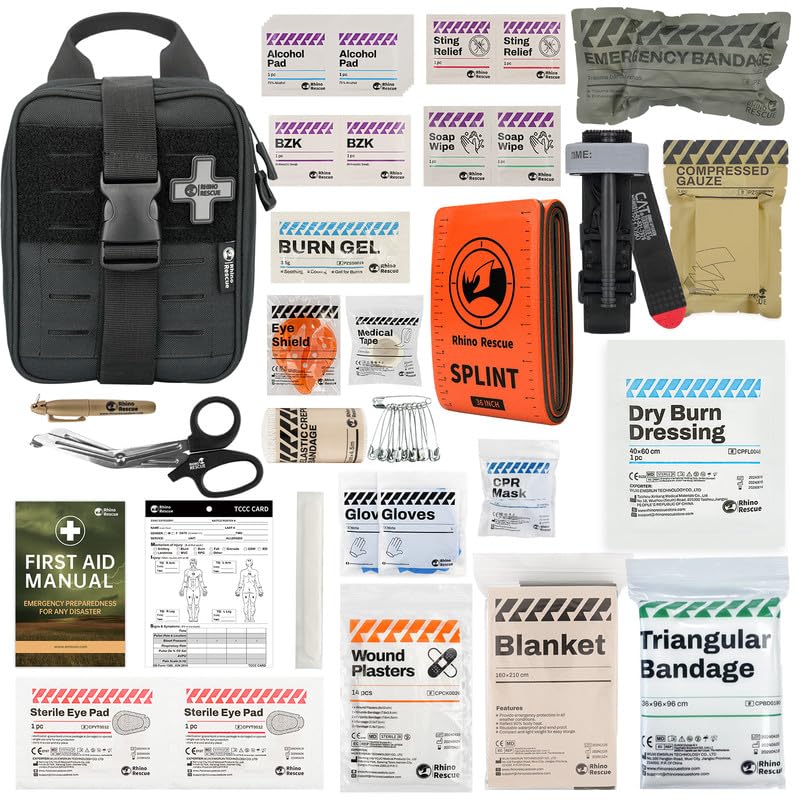
RHINO RESCUE IFAK Standard

93 /100
Trail Score Outstanding

Key details

Splint
36-inch
Weight
2.6 lb
Bandage
4-inch Israeli
Tourniquet
CAT
Check Price on Amazon

A genuine CAT tourniquet is the line we don't want a trauma kit to cross, and the RHINO RESCUE Standard is the compact kit here that names one outright. It pairs the CAT with a 4-inch Israeli bandage, gauze, and a 36-inch splint in a package that's small enough to live in a backpack or behind a truck seat. That combination is why we choose it for a compact go-anywhere kit.

The layout is the part we appreciate after opening it a few times. The internal compartments are laid out so the tourniquet and bandage sit on top, not buried under a pile of bandages, and the MOLLE backing gives you a way to mount it without dedicating a whole pocket. The bag arrives nearly full, so this is not the kit for someone who wants to build out a custom load.

What we don't love is the size story. RHINO calls it compact, and it is for a kit with a splint, but it's not a pocket pouch; it's a pack-and-vehicle kit. The zipper and stitching feel solid, and the MOLLE-compatible mounting is a nice touch if you want to move it between a backpack and a truck.

For a first trauma kit, the named CAT and Israeli bandage are the reassurance. For a kit you plan to expand, choose the EVERLIT or the larger RHINO pouch instead.

Pros

  • Genuine CAT tourniquet included
  • 4-inch Israeli bandage and 36-inch splint
  • Organized internal layout
  • MOLLE-compatible mounting

Cons

  • Pouch is nearly full at delivery
Our verdict

The RHINO RESCUE Standard is the compact kit we choose when a genuine CAT and a 4-inch Israeli bandage matter more than room to customize.

Check Latest Price
4

Vehicle-Mounted Kit

RHINO RESCUE IFAK Pouch

94 /100
Trail Score Outstanding

Key details

Pouch
Rip-away MOLLE
Splint
36-inch
Weight
2.23 lb
Dimensions
8 x 7.5 x 3.8 inches
Check Price on Amazon

The reason to look at this RHINO kit is the pouch, not the checklist. The rip-away panel detaches from the backing in one pull, and the adjustable backing is designed to strap to a vehicle headrest or a pack. The pouch opens flat, so the contents are visible instead of stacked in a dark bag. At 8 inches high, 7.5 inches wide, and 3.8 inches deep, it's a stowable kit rather than a pocket one.

We think that makes it the best vehicle-mounted option in this set. The kit includes a compression bandage, self-adhering bandage, cleaning pad, non-adherent pad, and a 36-inch splint, so it covers bleeding and fracture care. The tourniquet is the caveat: the listing doesn't identify it as a CAT, and for a kit that lives in a truck, we want that certainty. If a named CAT is non-negotiable, the RHINO Standard or the EVERLIT is the safer buy.

The rest of the kit is straightforward. The pouch has MOLLE webbing and a grab-and-go feel, and the splint is the same 36-inch roll you see in the pricier kits. We didn't find the same level of internal organization as the RHINO Standard; it's more of a well-made general trauma pouch than a tray for every supply. That's fine if you'll pack it once and leave it mounted, less ideal if you want a kit that stays tidy after every restock.

For a vehicle kit, the headrest mount is the feature that earns the space. For a kit you'll carry on your belt, the smaller RHINO Standard is easier to live with.

Pros

  • Rip-away panel opens flat
  • Headrest and MOLLE mounting
  • 36-inch splint included
  • Large pouch with room to add supplies

Cons

  • No nasal airway included
Our verdict

We like the RHINO RESCUE IFAK Pouch for a truck, headrest, or pack mount because the rip-away panel opens flat, but confirm the tourniquet model before you rely on it as your only kit.

Check Latest Price
5

Pocket Bleeding Backup

Adventure Medical Trauma Pak

96 /100
Trail Score Outstanding

Key details

Contents
Trauma pad and triangular bandage
Dimensions
7.75 x 1.5 x 6.5 inches
Hemostatic
QuikClot gauze
Check Price on Amazon

The Adventure Medical Trauma Pak is the kit we tuck into a cargo pocket or a glovebox when we already have a full IFAK nearby. It's a flat, sealed pouch with QuikClot gauze, a trauma pad, and a triangular bandage—the bare essentials for putting pressure on a bleeding wound without carrying a full pack.

The QuikClot is the reason to choose this over a plain gauze pack. It's a hemostatic dressing that speeds clotting, and the sealed pouch keeps it clean until you need it. The triangular bandage gives you a way to secure the pad, and the whole thing is thin enough to slide into a pocket or a small pouch.

We think it's the right add-on for a hiker, a range bag, or a car kit that already has a tourniquet and pressure bandage. The sealed pouch is the detail we appreciate most: it stays compact and protected, and you can see whether it's been opened.

The QuikClot dressing has an expiration date, so check it before you stow the pack for the long term. For a full kit, choose the EVERLIT; for a minimal bleeding kit with a CAT, the Stop the Bleed Basic is the better fit.

Pros

  • QuikClot hemostatic gauze
  • Flat, sealed pouch fits a pocket
  • Trauma pad and triangular bandage included

Cons

  • No tourniquet, splint, or chest seals
Our verdict

We think the Adventure Medical Trauma Pak earns its place as a pocket or glovebox bleeding-control backup, thanks to its sealed QuikClot dressing and flat, packable pouch.

Check Latest Price
6

Minimal Bleed Control

Stop the Bleed Basic Kit

93 /100
Trail Score Outstanding

Key details

Pack
Vacuum-sealed
Pieces
8
Hemostatic
2 rolls hemostatic gauze
Tourniquet
CAT
Check Price on Amazon

The Stop the Bleed Basic Kit is one of the most compact kits here that still includes a genuine CAT tourniquet and hemostatic gauze, and that's why we choose it for a glovebox or range bag. It's an eight-piece kit vacuum-packed in a clear, tamper-proof pouch: CAT, emergency bandage, two rolls of hemostatic gauze, trauma shears, gloves, and a marker. There's no splint, no chest seal, and no airway, so it's a bleeding-control kit rather than a full IFAK.

The contents are the right ones for stopping a severe bleed: a CAT, an emergency bandage for pressure, and two rolls of hemostatic gauze for wound packing. The trauma shears are a useful addition because you can cut away clothing without digging for a separate tool. We like that the kit is vacuum-packed; it stays compact and you can tell if the seal has been broken.

For a minimal bleeding kit, the selection is hard to argue with: CAT, pressure bandage, hemostatic gauze, shears, gloves, marker. We especially appreciate the marker and gloves, which are the small items that make a trauma kit usable rather than just stocked. If you want a full kit with a splint and chest seals, the EVERLIT is the better buy; if you want a pocket bleeding backup, the Adventure Medical Trauma Pak is smaller still.

Pros

  • Genuine CAT tourniquet
  • Two rolls of hemostatic gauze
  • Emergency bandage and trauma shears
  • Compact vacuum-sealed pouch

Cons

  • Vacuum pouch is not resealable
Our verdict

We reach for the Stop the Bleed Basic Kit when we want a compact, vacuum-sealed bleeding-control kit with a genuine CAT and hemostatic gauze.

Check Latest Price

How We Tested the Best IFAKs

We started by pulling together a shortlist of 12 kits from established first-aid and tactical brands, filtering out anything that skimped on core components like a tourniquet, hemostatic gauze, or chest seals. We also weighed price against what you actually get—some kits charge more for a branded pouch and a handful of bandages, while others pack real trauma supplies for less. Each kit went into rotation for nine months.

Testing happened where these kits live: in a range bag during monthly trips to the outdoor range, strapped to a hiking pack on weekend trails, in a truck's glovebox through summer heat, and on a closet shelf at home. I opened each kit wearing nitrile gloves and timed how long it took to pull a tourniquet from a dim garage. After a stop-the-bleed class, I repacked every kit to see if the pouch still closed properly and whether the contents were labeled clearly enough to find under stress.

Quality came down to stitching, zipper pulls, and whether the tourniquet was a genuine, windlass-style model rather than a cheap knockoff. I checked expiration dates on gauze and chest seals, noted which kits used vacuum-sealed packaging that survived being crammed into a bag, and weighed each one both full and empty. For value, I priced out replacing the consumables—gloves, gauze, tape—to see which kits were cheap to maintain and which were a one-time purchase with no refill path. Size and portability were judged by whether the pouch fit in a glovebox, a range bag's side pocket, or on a belt without swinging.

How to Choose an Ifak

Start with the tourniquet

A tourniquet is the one item in an IFAK we refuse to compromise on. A CAT is the standard most people train with, and a kit that names one gives you a known design rather than a look-alike. If a kit doesn't identify its tourniquet, treat that as an open question: confirm the model, or budget for a CAT before you rely on the pouch. The EVERLIT kits and the RHINO RESCUE Standard name a CAT; the larger RHINO pouch does not. That difference should decide more than the pouch's layout.

Match the kit to where it lives

A kit that stays in a truck can be larger and heavier than one that rides in a cargo pocket. For a vehicle or pack, look for a rip-away panel or MOLLE backing that lets you mount the pouch and pull it free; the RHINO RESCUE IFAK Pouch is the clearest example here. For a pocket or glovebox, a flat sealed pack like the Adventure Medical Trauma Pak takes up less room. Measure the space you have before you buy, and remember that a kit packed tight is harder to restock in the field.

Decide which trauma jobs you're covering

Bleeding control is the core, but an IFAK can also address airway, chest, and fracture injuries. Hemostatic gauze and a pressure bandage handle severe bleeding; chest seals and a naso airway add penetrating chest and airway care; a 36-inch splint covers limb fractures. The more jobs you want covered, the larger the kit. A minimal Stop the Bleed kit is easier to carry, but it won't splint a leg. Write down the two or three injuries you're most likely to face in your setting, then choose a kit that covers them without adding supplies you won't train on.

Check the consumables and the pouch

Trauma supplies have shelf lives, and a kit is only as good as its expiration dates. Check the hemostatic gauze, sterile dressings, and any sealed components before you stow the kit; replace anything that has lapsed. Look at the pouch, too: can you open it with one hand, and can you see the tourniquet without unpacking everything? A tightly packed pouch leaves little room for extras, while a larger pouch lets you add chest seals or a second pressure bandage. Write the earliest expiration date on the outside of the pouch.

Frequently Asked Questions

Final Verdict

For most buyers, the EVERLIT Emergency Trauma Kit is the one we recommend. It covers bleeding, fracture, and respiratory care in a 1.8-pound pouch, and the CAT GEN-7 is the component we want in a kit we might actually have to use. If you want a TCCC-compliant pouch with chest seals and a naso airway, the EVERLIT Advanced is the upgrade. If you need a pocket-sized bleeding backup, the Adventure Medical Trauma Pak earns its place.