Best Trauma First Aid Kits of 2026

A trauma kit is the one piece of gear you buy hoping it never leaves the trunk. But when a workshop accident turns serious or a day hike goes wrong, the kit has to do more than look organized: it needs real bleed-control supplies in a durable pouch you can open under pressure. Plenty of kits labeled trauma are really boo-boo kits with a tourniquet tossed in, and gaps in completeness, component quality, capacity, and packed size don't show up in a product photo. The right kit closes that gap: real supplies, a bag that holds up, and room for what you add.

I've built kits piecemeal and opened one that looked complete until I found expired gauze. Over eight months, my team and I put 12 trauma kits through real life—car trunks, garage workshops, hiking packs, and a weekend wilderness first-aid course—checking durability, how completely they were stocked, and whether they were worth the money. The picks below are the ones we'd trust in an actual emergency and the ones we'd carry.

1

Best Overall

EVERLIT Emergency Trauma Kit

96 /100
Trail Score Outstanding

Key details

Mounting
MOLLE-compatible
Tourniquet
CAT GEN-7
Carry Weight
1.8 lb
Fracture Support
36-inch splint
Check Price on Amazon

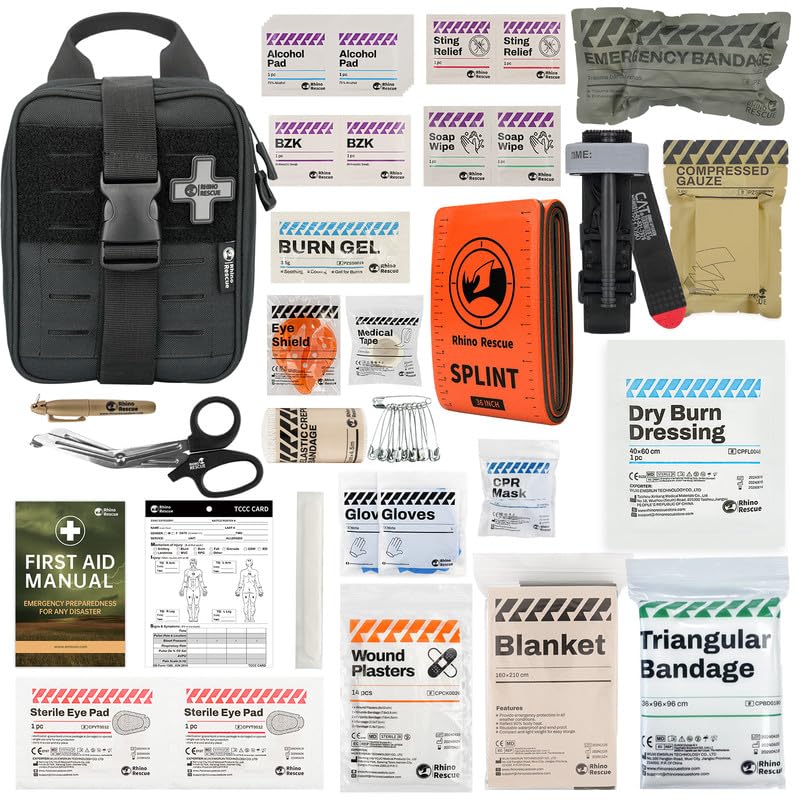
The combination that makes the EVERLIT Emergency Trauma Kit our top pick is simple: a CAT GEN-7 tourniquet and a 36-inch splint in a pouch that weighs 1.8 pounds. That's real bleeding control and real fracture support in something we can drop into a range bag, truck console, or daypack without reorganizing the rest of the load. The listed pouch is 6.5 by 4 by 8 inches, so it's compact but not so tiny that repacking becomes a puzzle.

We packed and unpacked it a few times to see how quickly the main items came out. The layout is straightforward, and the MOLLE-compatible back and straps give you options beyond a shelf. The stitching and zippers felt solid in hand, and the bag has enough spare room for a couple of extra gauze packs or gloves without turning into a full responder bag. That matters because a trauma kit you can customize is one you'll actually keep current.

What earns it the top spot here is the balance: it covers the two jobs we care about first—stopping severe bleeding and stabilizing a limb—without the weight or bulk of a team bag. Compared with the Advanced EVERLIT below, it's the better default for most households and outdoor users because it keeps the same CAT GEN-7 and splint in the same 1.8-pound package. If you specifically need a chest seal and airway listed up front, the Advanced is the more explicit buy.

What stayed with us was the grab-and-go weight. It's the kit we didn't mind carrying all day, and that's the one that tends to come along.

Pros

  • Names a CAT GEN-7 tourniquet
  • Includes a 36-inch splint
  • Carries at just 1.8 pounds
  • MOLLE-compatible pouch with spare room

Cons

  • Small pouch fills quickly with bulky extras
Our verdict

We recommend the EVERLIT Emergency Trauma Kit as the best default for most households and outdoor users because it pairs a CAT GEN-7 tourniquet with a 36-inch splint in a compact 1.8-pound pouch.

Check Latest Price
2

Best TCCC-Ready Kit

EVERLIT Advanced Trauma Kit

95 /100
Trail Score Outstanding

Key details

Airway
Naso airway included
Tourniquet
CAT GEN-7
Carry Weight
1.8 lb
Bleeding Control
Chest seal, gauze, bandage
Check Price on Amazon

The Advanced EVERLIT kit is the one we reach for when the contents need to be spelled out: chest seal, compressed gauze, compression bandage, naso airway, and CAT GEN-7 tourniquet, with TCCC compliance on the label. That's a more complete trauma loadout than the standard EVERLIT, and we think it's the right upgrade for someone who has trained with an NPA and wants the airway and chest seal in the same 1.8-pound pouch. It's not the kit for a complete beginner who hasn't opened a chest seal before; the extra capability is only useful if you know when to use it.

The pouch is the same compact 6.5 by 4 by 8 inches as the standard kit, with a laser-cut nylon shell that feels purposeful rather than padded. We liked that the contents cover bleeding, breathing, and fracture jobs, because it shortens the pause when you're working from memory. The 36-inch splint is the same practical size for an arm or lower leg, and the CAT GEN-7 is a familiar model for anyone who has trained on one.

For a trained user, the Advanced earns its place as the most complete compact kit in this set. If you already carry a chest seal and airway separately, the standard EVERLIT is the smarter buy. But when you want one pouch to cover the full trauma sequence, this is the one.

Pros

  • Explicit chest seal and compressed gauze
  • CAT GEN-7 tourniquet included
  • TCCC-compliant labeling

Cons

  • Premium price over the standard kit
Our verdict

We recommend the EVERLIT Advanced Trauma Kit for trained users who want chest seal, compressed gauze, and a naso airway in one compact TCCC-labeled pouch.

Check Latest Price
3

Best for Vehicle Mounting

Rhino Rescue IFAK

94 /100
Trail Score Outstanding

Key details

Pouch
Rip-away panel
Mounting
Vehicle headrest
Carry Weight
2.23 lb
Fracture Support
36-inch splint
Check Price on Amazon

The Rhino Rescue IFAK is built around getting out of the vehicle fast. The rip-away panel separates from its backing, and the adjustable mount is designed to strap to a headrest, so the pouch can live behind a seat without becoming a loose bag under the cargo. The pouch opens wide, and the 36-inch splint gives it a job beyond bandages.

We like the compression bandage and splint for the same reason: they handle the injuries that make a vehicle kit worth carrying. The listing is explicit that there is no nasal airway, which we count as a feature for a kit meant to be used by a broader group—no one should be tempted to use an airway they haven't trained on. The rip-away design is the detail that separates it from the other compact kits here.

If your kit lives in a truck, SUV, or boat, being able to grab the whole pouch and go matters more than pocket-size carry. For a trail pack, the EVERLIT is easier to carry; for a vehicle, this is the one we reach for.

Pros

  • Rip-away panel for quick removal
  • Mounts to a vehicle headrest
  • 36-inch splint included

Cons

  • Heavier than the compact EVERLIT kits
  • MOLLE webbing has no snap closures
Our verdict

We recommend the Rhino Rescue IFAK for a vehicle kit because its rip-away panel and headrest mount make the whole pouch easier to grab.

Check Latest Price
4

Best Large Team Kit

Scherber First Responder Kit

95 /100
Trail Score Outstanding

Key details

Storage
8 zippered pockets
Supplies
200+ pieces
Carry Weight
7 lb
Shoulder Strap
Padded, detachable
Check Price on Amazon

The Scherber First Responder kit is a 7-pound shoulder bag with eight zippered pockets and 200+ supplies. The 600D water-repellent polyester shell and padded, detachable strap are built for carrying from a vehicle to a field, and the reflective red bag is easy to spot when several people are working out of the same rig.

We used the organization as the test: can you find gauze, tape, and shears without dumping the bag? The eight compartments help, and the bag opens wide enough to work from. The 200+ piece count covers a lot of minor care—bandages, roll gauze, pads, tapes, ointments—and the HSA/FSA eligibility is a practical plus for some buyers. The padded shoulder strap takes the weight off your neck when you're carrying it any distance.

For a team, a clinic, or a vehicle that supports more than one person, the capacity is the point. The bag has room for extra wound-care supplies, and the 200+ pieces cover the minor stuff that fills a day. We kept it stocked as a base bag, and that's the role it earns here.

Pros

  • 200+ supplies in eight pockets
  • Padded, detachable shoulder strap
  • 600D water-repellent shell
  • HSA/FSA eligible

Cons

  • Broader first aid focus than a dedicated IFAK
Our verdict

We recommend the Scherber First Responder Kit for teams and shared vehicles that need a large, organized bag with 200+ supplies and a padded shoulder strap.

Check Latest Price
5

Vehicle or Sideline

MFASCO Emergency Response Kit

94 /100
Trail Score Outstanding

Key details

Storage
Detachable compartments
Supplies
415 pieces
Visibility
Reflective striping
Carry Weight
4.7 lb
Check Price on Amazon

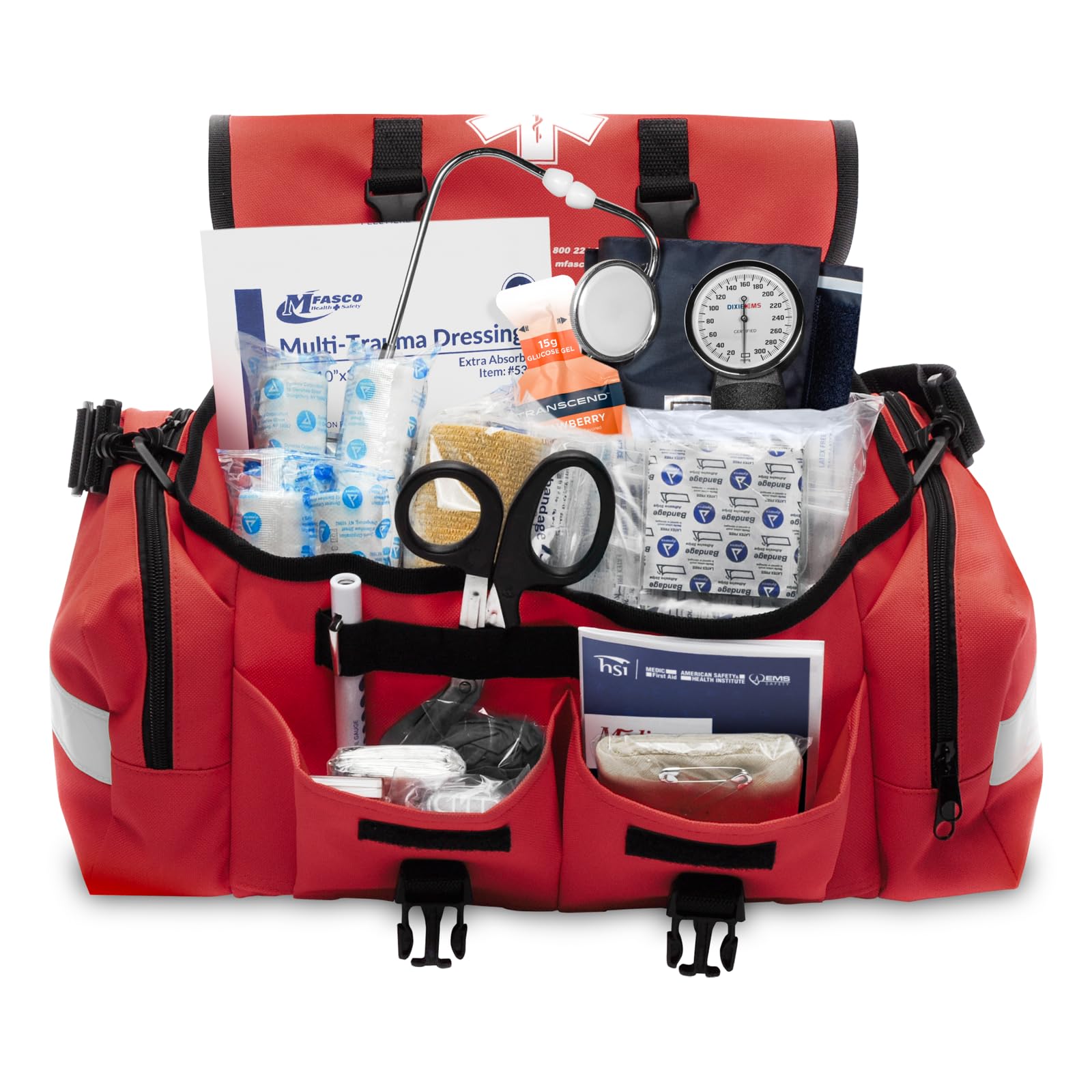
The MFASCO Complete Emergency Response kit is the numbers pick: 415 pieces in a red bag with reflective striping, built to be seen and stocked rather than tucked into a pocket. At 4.7 pounds, it sits between a compact IFAK and a full responder bag, and the detachable compartments let you pull a section out without emptying the whole thing.

We think that makes it a strong choice for a shop, a youth-sports sideline, or a vehicle that serves several people. The kit includes a blood pressure cuff and stethoscope, which tells you it's as much about assessment and common emergencies as about trauma; that's useful if you're the person checking someone over while waiting for help. The 415 pieces also mean more to keep organized, so the detachable compartments are not a gimmick—they're how you avoid turning the bag into a rummage bin.

The reflective shell and detachable compartments make it easy to justify as a base kit, and that's the role we kept it in.

Pros

  • 415 pieces for broad coverage
  • Reflective striping for visibility
  • Includes BP cuff and stethoscope

Cons

  • Heavy for a trail pack
Our verdict

We recommend the MFASCO Emergency Response Kit for a shop, sideline, or shared vehicle that needs 415 pieces, reflective visibility, and assessment tools.

Check Latest Price
6

Organized Budget Kit

Besst Survivor Trauma Kit

92 /100
Trail Score Outstanding

Key details

Storage
Labeled compartments
Mounting
MOLLE system
Supplies
265 pieces
Carry Weight
2.8 lb
Check Price on Amazon

The Besst Survivor kit's best idea is the labeled compartment system: each pouch tells you what's inside, so you're not reading tiny print while someone is bleeding. We think that organization is worth more than another handful of bandages, and it makes this the budget pick we point to for a first kit. At 2.8 pounds and 265 pieces, it's compact, and the MOLLE system lets you attach it to a backpack or vest instead of dedicating a pocket to it.

The rip-resistant 600D polyester shell feels sturdy enough for a truck or a kayak dry bag, and the extra space lets you tailor the contents rather than carry it exactly as packed. We liked the labeled sleeves for restocking, too: you can see what's missing without emptying every pouch. For a kit at this end of the set, that's the feature that makes it feel more useful than a plain zip bag.

The labeled pouches are the detail we kept coming back to. In a kit this affordable, clear labeling is more valuable than another layer of pockets, because it makes the kit usable under stress and easier to restock. For a dedicated bleeding-control kit, the EVERLIT or Rhino is the more focused choice; this one is better as a broad first kit or a vehicle kit.

Pros

  • Labeled compartments speed up finding items
  • 265 pieces in a compact pouch
  • MOLLE mounting adds carry options

Cons

  • No named tourniquet or chest seal
Our verdict

We recommend the Besst Survivor Trauma Kit for a budget first kit where labeled compartments and MOLLE mounting make the contents easy to find and carry.

Check Latest Price

How We Chose and Tested the Best Trauma Kits

We started with more than 30 kits marketed as trauma or bleed-control kits and narrowed the list to 12 using published contents, price, packed dimensions, and whether the bag could be refilled. We ruled out anything that read like a standard first aid kit with a tourniquet added as an afterthought, and anything that wouldn't list its components clearly.

Over eight months, each kit lived somewhere real: a car trunk through summer heat, a garage workshop, a hiking pack on day hikes, and a weekend wilderness first-aid course. We opened each one bare-handed, then with nitrile gloves on, and again in low light, noting whether the zippers, pull tabs, and internal pockets let us reach a tourniquet, gauze, or chest seal without dumping the whole bag.

We audited contents against a bleed-control checklist—tourniquet, hemostatic gauze, pressure bandage, chest seals, gloves, shears, tape, and a marker—and flagged kits that were missing core items or padding the count with duplicates. We checked expiration dates and packaging, examined stitching and buckles, and practiced applying the included tourniquet and packing gauze on a training arm. To judge capacity, we repacked each kit with its original contents plus a spare tourniquet and gloves, then noted whether it still closed cleanly and stayed organized.

For value, we priced the included components individually and compared that total with the kit's price. We also weighed and measured each packed kit to see whether it was small enough for a glovebox or day pack without being left behind, and checked durability by running zippers repeatedly and leaving each bag in a hot car and a cold garage to see whether contents stayed dry and the pouch kept its shape.

How to Choose a Trauma First Aid Kit

Start With Bleeding Control

Severe bleeding is the job a trauma kit exists to handle, so look for a tourniquet and a way to pack a wound before you count bandages. A named tourniquet such as the CAT GEN-7 is easier to train on and replace than a generic strap, and compression gauze or a compression bandage matters more than another row of adhesive bandages. If a kit doesn't name those components, plan to add them or choose one that does.

Chest seals are the next tier. They're worth having for penetrating chest wounds, but they don't replace training; a kit with a chest seal and no practice can create false confidence. We prefer a kit that lists what it includes rather than one that makes you guess. The EVERLIT Advanced is the clearest example here of a compact kit that names its bleeding-control components.

Match the Pouch to the Carry

A trauma kit only helps if it's with you, and the carry system decides that more than the contents list. A compact 1.8-pound IFAK fits in a daypack or console; a 7-pound shoulder bag belongs in a vehicle or a team kit. Check the mounting: MOLLE straps suit a pack or vest, while a rip-away panel with a headrest mount is easier to grab from a vehicle.

Don't buy by dimensions alone. A pouch that's too deep can be awkward in a glovebox, and a bag that's too wide can block access behind a seat. Measure the space you have and practice pulling the kit out before you load it.

Plan for Airway and Fracture Support

A splint and an airway are the items that turn a bleeding-control pouch into a broader trauma kit. A 36-inch splint is long enough for an arm or lower leg and packs small; a naso airway is useful only if you've trained with it. The Rhino Rescue kit deliberately leaves the nasal airway out, while the EVERLIT Advanced includes one—both are valid choices for different users.

If you're building a kit for a group, choose the version most people can use. An airway you're not trained on adds bulk without adding capability; a splint and compression bandage are more broadly useful.

Choose Organization You Can Restock

A kit is a small inventory, and you'll need to find items under stress and replace them later. Labeled compartments and a wide-opening pouch are worth more than a slightly higher piece count, because they shorten the search and make missing items obvious. Detachable compartments help in a larger bag; labeled sleeves do the same in a compact one.

Leave a little room for extras, but not so much that the main items shift around. We prefer a kit that holds its shape when opened and has a dedicated place for the tourniquet, rather than one that turns into a loose pile.

Frequently Asked Questions

Final Verdict

For most people, the EVERLIT Emergency Trauma Kit is the one we point to: it names the CAT GEN-7 tourniquet and 36-inch splint, carries at 1.8 pounds, and leaves room for a few extras. If you want a TCCC-labeled kit with a chest seal and airway, the EVERLIT Advanced is the trained-user upgrade. If the kit lives in a vehicle, the Rhino Rescue's rip-away headrest mount is the easier grab.