Best Water Test Kits for Home of 2026

Clear water isn't proof of clean water — lead, nitrate, hardness, and bacteria can all run through a tap that tastes perfectly ordinary. A home water test kit turns that guesswork into a number you can act on, whether that means calling a plumber, buying a filter, or finally confirming the well out back is fine. I spent a year wiping chalky rings off my own kitchen faucet before I stopped wondering, and over the past four months my team has run 14 kits through the same kitchen-sink routine.

One thing worth knowing before you buy: strips and lab kits answer different questions. Strips are cheap enough to repeat every few months, but the result lives or dies on how you read the color chart — the same strip can look like two different numbers under warm kitchen light and at a window. Lab kits are slower but catch what a strip can't see, so we ran both kinds side by side, timing each one and comparing charts, and the picks below are the ones that held up.

1

Best Overall

Tap Score Advanced Water Test Kit

87 /100
Trail Score Excellent

Key details

Format
Mail-in lab kit
Bacteria
Coliform and E. coli included
Parameters
116 analytes
Return Shipping
Prepaid
Check Price on Amazon

A test strip gives you a colour to argue with. This kit gives you a lab number. Inside the box are sampling bottles, instructions, and a prepaid return label: you fill, seal, hand it to the carrier, and read the results in an online dashboard once the lab has finished. That swap — from squinting at a pad to a certified measurement — is why it leads this list.

The panel covers 116 analytes, among them lead, arsenic, nitrate, copper, iron, hardness, alkalinity, and disinfection byproducts, plus coliform and E. coli. Short of its own bigger sibling, that is the most complete picture in this group. The breadth matters because the result decides something: a lead figure here is the difference between buying a filter and calling a plumber, and it is the only reading on this list we trust enough to plan a repair around.

Results are laid out to be read rather than decoded, and they live in a dashboard you can open on a phone or pass to a contractor.

What you trade for that certainty is speed and repetition. A sample goes to a lab, and one kit tests one moment in time. For a baseline, an annual check, or a house purchase that is a fair exchange; if you want to watch a softener or a new filter month to month, keep a strip kit alongside and save this one for the tests that matter.

Pros

  • Certified lab analysis of 116 analytes
  • Lead, arsenic, nitrate and bacteria covered
  • Prepaid return shipping and results dashboard
  • Works for city water and private wells

Cons

  • Sample goes to a lab, so no same-day result
  • One sample only; a retest means another kit
Our verdict

We recommend this one when the result has to hold up: a certified lab reading on 116 analytes, worth the wait for a new well or an older home.
Check Latest Price
2

Best Budget Strip Kit

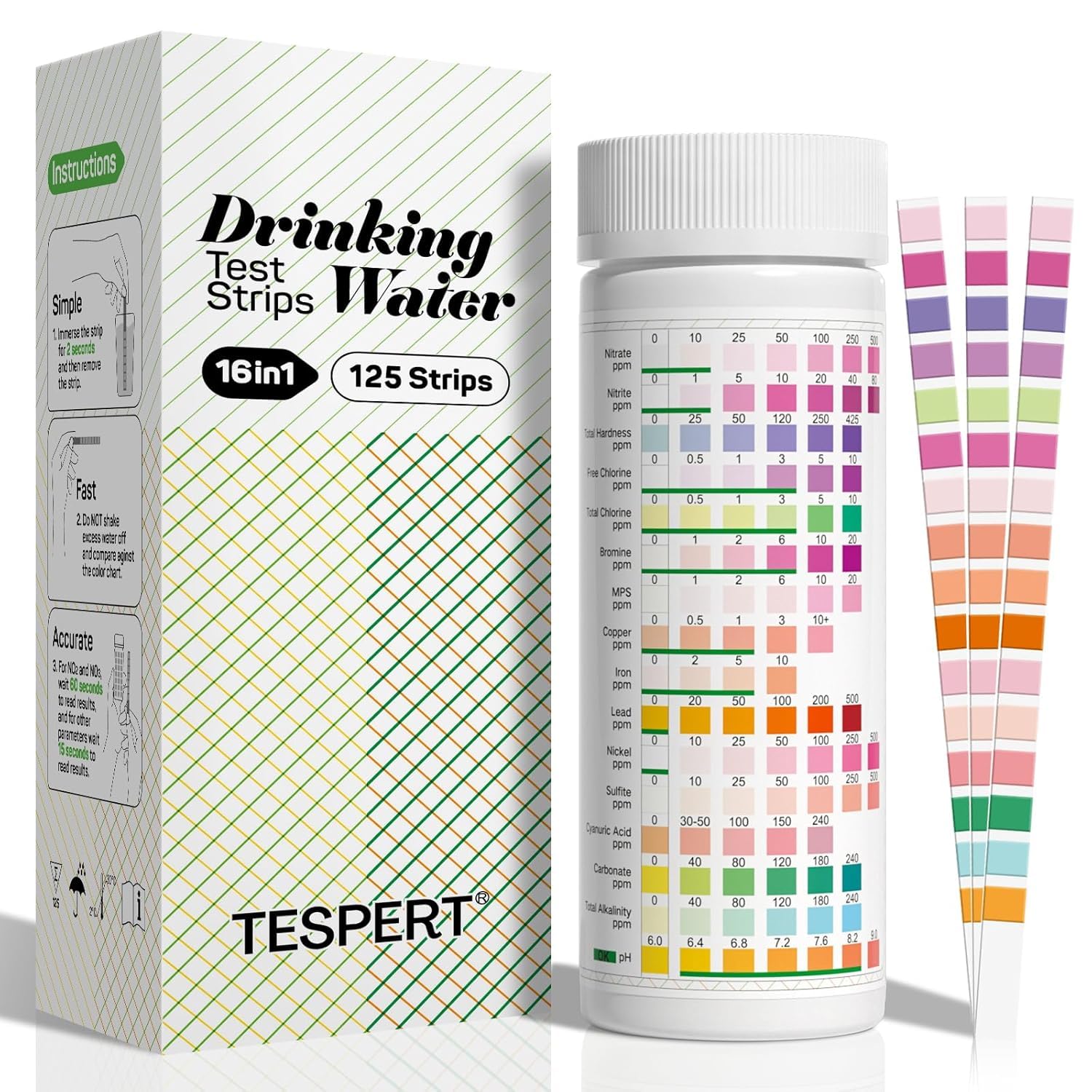
TESPERT 16-in-1 Water Test Kit

89 /100
Trail Score Excellent

Key details

Strips
125
Read Time
30 seconds
Parameters
16
Water Sources
Tap and well
Check Price on Amazon

Sixteen pads, thirty seconds, and a bottle of 125 strips. This is the kit we point people to when they want a rough answer today, and among the strip kits here it carries the most consistent accuracy record of the lot — not perfect, just steadier than the rest.

The instructions do something we wish every kit did: they tell you to read in daylight or under a 6500K LED, and to keep wet fingers away from the pads. Those two lines do more for your results than anything printed on the bottle, because lighting and timing are where strip readings go wrong. Follow them and the chart is legible; skip them and every shade looks the same.

Coverage runs to lead, pH, hardness, chlorine, nitrate, copper, iron, and alkalinity, and stops there — there is no bacteria vial in this box, which is the one reason to look at the HEVEIS instead if you are on a private well. Treat the lead pad as a prompt rather than a verdict: if it shifts at all, send a sample to a lab before you buy anything. On city water, this is the bottle we reach for between proper tests.

Pros

  • 125 strips for repeated checks
  • Reads in about 30 seconds
  • Lighting and handling guidance printed with the kit
  • Steadiest accuracy record among the strip kits here

Cons

  • No bacteria test in the box
Our verdict

Our pick for a cheap, fast screen: we trust its pads more than the other strip kits here, and 125 strips let you re-check without overthinking it.

Check Latest Price
3

Best for Well Water

HEVEIS 21-in-1 Water Test Kit

87 /100
Trail Score Excellent

Key details

Strips
120
Included
Sample vial
Parameters
21
Bacteria Tests
4
Check Price on Amazon

Four separate bacteria vials is the reason to look at this one. Coliform and E. coli are the results anyone on a private well loses sleep over, and no strip pad answers them — you need the vial, the wait, and a colour change you don't have to interpret through a chart.

Around those vials sits a 21-parameter strip covering lead, copper, iron, fluoride, pH, hardness, and the rest, along with 120 strips. That is enough for a weekly kitchen-tap check for a couple of years. For a household on a private well this is the pick that covers both halves of the job without a lab bill, and it is why it outranks the cheaper strip kits here for well water.

The one bit of arithmetic to plan around: four vials against 120 strips means the bacteria side runs out long before the pads do. Spend them deliberately — one after the spring melt, one after heavy rain, one after pump or filter work, one spare — and the pack covers a full year of well checks. The strip chart is the same eye strain as everything else here, so read it in daylight.

Pros

  • Four bacteria tests included
  • 120 strips for frequent well checks
  • Sample vial included for cleaner testing

Cons

  • Only four bacteria vials in the pack
Our verdict

Buy it if you're on a well: four bacteria vials plus 120 strips cover the two things a private supply actually needs checking for.

Check Latest Price
4

Best for Repeat Testing

bestprod Home Water Test Kit

89 /100
Trail Score Excellent

Key details

Strips
120
Included
Data sheet
Parameters
17
Bacteria Tests
2
Check Price on Amazon

The label says 21-in-1, the model number says 17-in-1, and the product copy describes seventeen strip pads plus two separate bacteria tests. We counted the pads rather than the marketing and treated it as a 17-parameter kit with bacteria cover added on.

What sits in the bottle is generous: 120 strips, a colour chart printed on the wrap so there is no loose insert to lose, and a data sheet for logging what you find. The dip-and-match routine is about as simple as this category gets — three steps, a timer, and a row of pads to compare against the range printed beside them.

The data sheet is the small thing that changes how you use the kit. Log the numbers and you can watch a softener lose its edge or a filter reach the end of its life, which a single test never shows. That is the difference between owning a test kit and keeping a record of your water.

Pros

  • Log sheet turns readings into a record
  • Chart printed on the bottle
  • 120 strips plus two bacteria tests

Cons

  • Colour pads can bleed into one another
Our verdict

We like it for households that want to track changes — the log sheet and 120 strips make repeat testing a habit rather than a project.

Check Latest Price
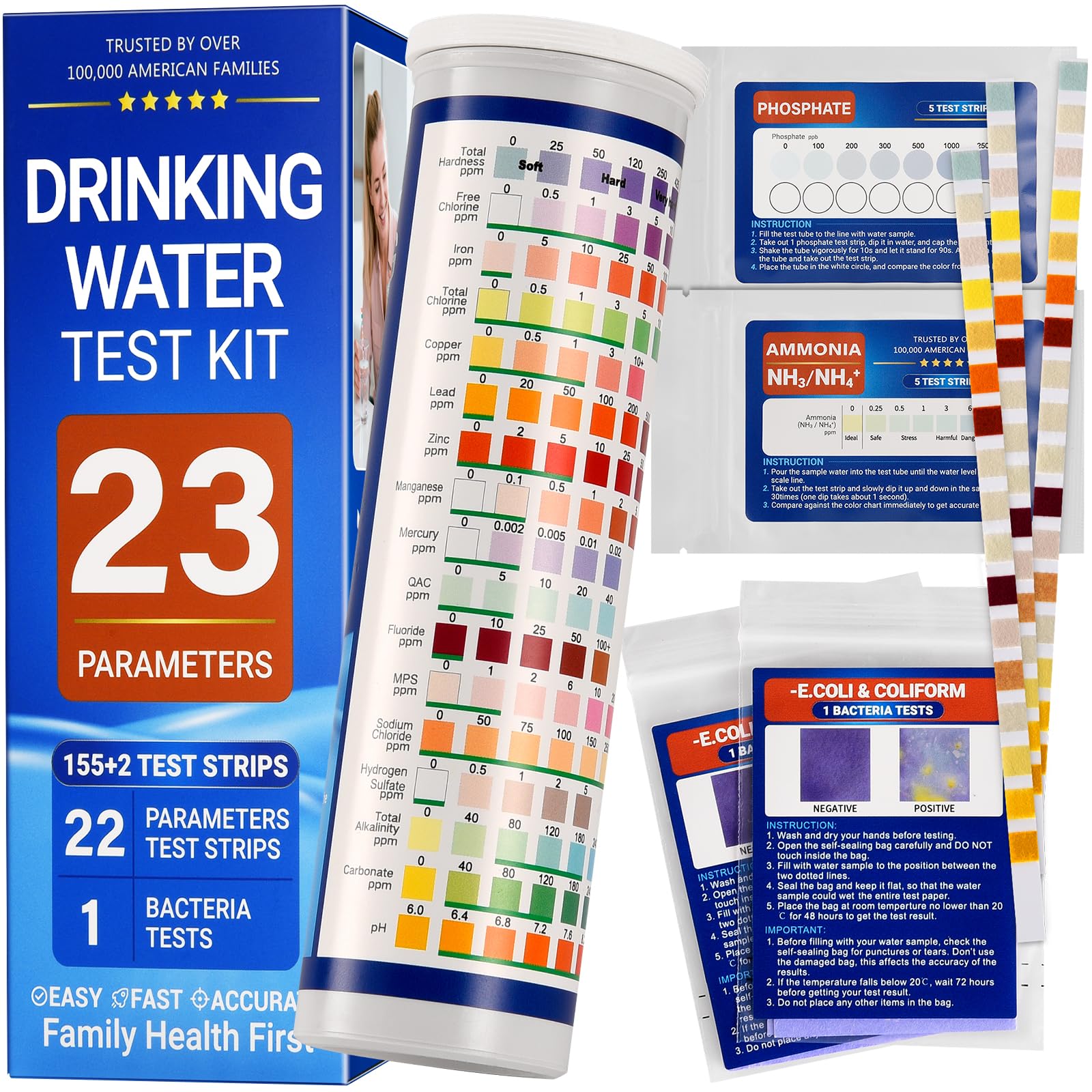
5

Long-Term Monitoring

VibeEsece 23-in-1 Water Test Kit

85 /100
Trail Score Excellent

Key details

Chart
Printed on bottle
Strips
155
Parameters
23
Bacteria Screening
Included
Check Price on Amazon

155 strips is the headline, and it is the largest count in this group: a weekly check of the same tap for something close to three years, or a first season of testing every outlet in a new house before deciding what to treat.

The rest of the package is ordinary but well chosen — 23 parameters, a colour chart printed on the bottle so there is no loose card to misplace, and instructions that walk a first-timer through the dip and read. It also includes a bacteria screen, which the cheapest kits here leave out.

Where it lands is long-haul monitoring. Buy it if your goal is to keep testing the same supply for a year and watch a filter or softener do its job, and accept that the numbers are a screen rather than a verdict. If you need a bacteria result you can act on, the HEVEIS vials are the better tool; if you want the least outlay, the AESCULIX kit comes in lower. This one sits between them.

Pros

  • 155 strips, the most in this set
  • Chart printed on the bottle
  • Bacteria screening included

Cons

  • Curved bottle chart makes pad matching fiddly
Our verdict

Keep this one for long-term monitoring: the biggest strip count here makes weekly checks of the same tap painless.

Check Latest Price
6

Awkward Tap Sampling

AESCULIX 20-in-1 Water Test Kit

81 /100
Trail Score Excellent

Key details

Strips
123
Included
Test tubes and pipettes
Read Time
30 seconds
Parameters
20
Check Price on Amazon

A test tube and a pair of pipettes come in the box, which sounds like packaging filler until you are sampling from an outdoor spigot or a tank you can't dip a strip into. At the lowest outlay of anything here, this is the kit we point to for a first look at an unfamiliar supply.

Twenty parameters, 123 strips, a 30-second dip, and a chart on the bottle. The tube also makes repeat testing tidier: draw a sample, dip, and read without leaving a glass of water sitting on the counter for the rest of the afternoon.

The caveat is range. This strip is sold for drinking water, spring water, spa water, and aquariums in the same breath, and pads calibrated across that spread are not the ones to trust with a low-level lead question at a kitchen tap. Use it to spot the obvious — hard water, high iron, chlorine that shouldn't be there — and move up to a lab kit for anything you would act on.

Pros

  • Test tube and pipettes included
  • Lowest outlay of the kits here
  • 20 parameters across 123 strips

Cons

  • Ranges cover pools and aquariums as well as drinking water
Our verdict

The kit we suggest for a first look at an unfamiliar water supply, with a tube and pipettes that make awkward taps easy to sample.

Check Latest Price
7

App-Guided Reading

Droplytix 20-in-1 App Test Kit

82 /100
Trail Score Excellent

Key details

Strips
10
Reading
App-scanned strip
Parameters
20
Check Price on Amazon

Every kit on this list eventually asks you to decide whether a pad is nearer the third shade or the fourth. Droplytix tries to take that judgement away: dip the strip, scan it with the app, and let the phone name the colour.

Twenty parameters cover lead, hardness, chlorine, nitrate, and fluoride, and the app keeps a history of your readings — more than a paper chart manages. For anyone who has stared at two nearly identical purples and given up, that is a real improvement.

The catch is what you get for the outlay: a very small strip count, so this is a kit for a handful of checks rather than a year of monitoring. And when the app and your own eyes disagree, you are back to making the call yourself. The software narrows the guess; it doesn't remove it.

If colour matching is the part you dread, or you are testing on someone else's behalf and want a record you can screenshot, it earns its place. If you want volume and don't mind reading a chart, the strip kits above hand you far more tests for the money.

Pros

  • App names the colour for you
  • Keeps a history of readings
  • Covers lead, nitrate, fluoride and hardness

Cons

  • Small strip count for the outlay
  • A phone is required for every reading
Our verdict

Worth it if colour matching defeats you — the app reads the strip and keeps a record, as long as you accept a small strip count.

Check Latest Price
8

Widest Contaminant Panel

Tap Score Ultimate Water Test Kit

87 /100
Trail Score Excellent

Key details

Format
Mail-in lab kit
Bacteria
Coliform and E. coli included
Parameters
256 analytes
Return Shipping
Prepaid
Check Price on Amazon

Same lab, same bottles, same prepaid label as our top pick — with a panel that runs to 256 contaminants and analytes instead of 116.

The extra breadth is aimed at a specific household: a private well near farmland or industry, a purchase where you want documentation, or a taste and smell nobody has explained. It is the panel you order when the question is what exactly is in this water rather than whether it is fine.

Sampling is the same fill-and-mail routine, and results arrive in the same online dashboard, so the step up buys coverage rather than convenience. Nothing about handling it is harder than the cheaper kit.

For most homes the 116-analyte kit already covers lead, bacteria, nitrate, and disinfection byproducts, and the extra analytes here answer worries most people don't have. Order this one when the wide panel is the point — a first test on a farm-adjacent well, or a second opinion on a treatment quote.

Pros

  • 256 analytes across one panel
  • Bacteria and metals included
  • Same prepaid sampling workflow as the top pick

Cons

  • Extra analytes rarely change a household decision
  • Same lab wait as the cheaper kit
Our verdict

Order this when the wide panel is the point: 256 analytes through the same trusted lab, though most homes can stop at our top pick.

Check Latest Price

How We Tested the Best Home Water Test Kits

Each kit started as a candidate pulled from spec sheets, EPA lab listings, and the fine print on how many parameters it actually measures — parameter count is where a lot of kits inflate, tallying things no household will test twice. We bought 14 kits ourselves and ran them for four months, from my kitchen tap and the fridge dispenser to a hard-water well at a colleague's place and a line a plumber had just replaced.

Every kit got the same handling. We ran the cold tap for two minutes, filled a clean glass, then followed the instructions exactly — dipped or held in the stream, counted the seconds, and read the strip at the stated time rather than whenever we got to it. Expiry dates got checked on arrival. Each strip was read twice, once under warm kitchen light and once by a bright window, since color accuracy is where this format breaks down; when two of us disagreed on a match, the kit lost points. Results went up against our utility's published water quality report, and the mail-in kits against their own lab report for the same sample.

Speed and ease of use came down to counting: minutes from opening the box to a confident reading, and whether the instructions worked on a first try without second-guessing. We tracked cost per test, too, because a kit with 150 strips and 10 useful parameters beats a 20-parameter kit with 30 strips and an unreadable chart. Functionality mattered most when the chart lived in an app — whether it loaded, whether the lighting correction changed the reading, and whether we'd trust it with a second sample.

How to Choose a Home Water Test Kit

Strips or a Lab Kit

A strip is a row of reagent pads that change colour; you hold it against a chart and get a range in under a minute. A lab kit is a bottle of your water, a prepaid envelope, and a certified instrument at the other end. Strips suit routine monitoring and catching change. Labs suit a baseline, a new well, a home purchase, or any result you plan to spend real money on — send a lead question to a laboratory, because a strip can only raise it.

Read the Parameter List, Not the Number

A 23-in-1 isn't better than a 16-in-1; the totals aren't counting the same thing. Some kits count each bacteria vial as an extra parameter, some count one pad twice for two ranges, and some count a chemistry you will never act on. Ignore the total and look for six at a kitchen tap: lead, nitrate, bacteria, hardness, chlorine, and iron. On a private well, bacteria and nitrate are the two that change what you do. Everything past that is context.

Colour Matching Is Where These Kits Fail

Pads keep developing after the read window, adjacent shades on a hardness chart can be nearly identical, and a warm kitchen bulb shifts every colour you see. All three turn up in the strip kits here to some degree. Read in daylight or under a 6500K lamp, time the read with your phone, keep wet fingers off the pads, and re-dip a second strip when a pad lands between two shades. A pad that never changes is a failed test, not a zero.

Count the Tests You Actually Get

Strips per pack set how often you can re-check, but the one-shot items set how often you can do a complete round: four bacteria vials means four full checks, however many strips are left. Match the pack to your habit — monthly on a new well, once or twice a year on city water — and compare kits by cost per full test rather than by strip count alone. Store strips sealed and dry; a pad left open in a humid bathroom is guesswork.

Frequently Asked Questions

Final Verdict

The Tap Score Advanced is what we tell people to buy when the answer changes something: a certified lab reading on 116 analytes, lead and coliform included, delivered in results you can hand to a plumber or a buyer.

It costs more than any strip kit here, and it is the only pick that hands you a measurement rather than a shade. Pair it with the TESPERT kit if you want to watch your water between lab tests — the strips catch change, the lab confirms it.