Best TDS Meters for Drinking Water of 2026

You buy a TDS meter for one reason: you want a number. Maybe the tap water tastes off, maybe the fridge filter is overdue, maybe the reverse-osmosis system under the sink cost enough that you'd like proof it's working. A tester that answers with a drifting figure — or that arrives with no instructions on how to calibrate it — is worse than no tester at all, because you'll believe whatever it tells you. What the pen actually does is simple: it measures how well the water conducts electricity, which climbs as dissolved minerals and salts accumulate, and reports the total in parts per million.

One thing I wish more people knew before they start comparing: TDS is not a safety verdict. It won't tell you anything about lead, bacteria, or a boil-water notice, and a low number doesn't mean the water is clean — it means it's low in dissolved solids. Over the past four months my team has put 16 meters through everyday kitchen water, and the gaps in accuracy, readability, and temperature tracking were wider than the prices would have you guess. The ones below are the testers whose numbers I'd actually trust.

1

Best Overall

HoneForest HFTDS-M7

91 /100
Trail Score Outstanding

Key details

Probe
Titanium alloy
Range
0-9990 ppm
In The Box
Meter, leather pouch, instructions
Measurement Modes
TDS, EC, temperature (°F/°C)
Check Price on Amazon

A small leather pouch is the first thing out of the box, and it sets the tone: this is a meter meant to live in a kitchen drawer and come out once a week rather than sit on a bench. The HoneForest pen reads TDS, EC, and temperature in Fahrenheit or Celsius on a backlit screen, locks the number when it settles, and switches itself off. It takes the top spot on accuracy, which is the only thing that really counts in a tool like this: a TDS pen is worth owning only if the same glass gives you the same number twice, and this one has the most convincing showing on that in the group.

Six and a quarter inches of body turns out to be a feature. It reaches into a tall pitcher or the reservoir of a countertop filter without your knuckles going in, and at 1.62 ounces it is gone the moment you put it away. The pouch keeps the probe out of the cutlery, and the auto-off has saved us a battery more than once.

Households that check tap, fridge-filter, and bottled water in the same sitting are the ones we point here. The EC and temperature modes are a real bonus if you also keep an aquarium or a hydroponic reservoir, and harmless if you do not. If you want a printed tolerance before you buy, the HM Digital TDS-3 puts plus or minus 2 percent on its listing; the HoneForest asks you to trust the readings instead.

Pros

  • Three readings from a single dip
  • Backlit screen with auto-lock
  • Leather pouch keeps the probe clean
  • Long body reaches into pitchers

Cons

  • Can return the same figure across different water types
Our verdict

This is the meter we point most households to: three readings, a backlit screen, a leather case, and the steadiest accuracy showing in this group.

Check Latest Price
2

Best for Precision

HM Digital TDS-3

90 /100
Trail Score Outstanding

Key details

Case
Carrying case with belt clip
Range
0 - 9990 ppm
Resolution
1 ppm
Readout Accuracy
+/- 2%
Check Price on Amazon

Two percent is the number to start with. HM Digital puts plus or minus 2 percent readout accuracy on the TDS-3, the tightest tolerance stated by anything in this group, and backs it with 1 ppm resolution below 1,000 ppm, fine enough to watch a reverse-osmosis membrane slide from 8 to 15 instead of just reading low. When a number has to be defensible, this is the pen we reach for.

The rest of it is built for field work. The case clips to a belt, two LR44 cells come installed, and the hold function freezes a reading so you can pull the probe out of the water and read it in better light. We ended up using the hold more than we expected; a dripping probe over a dark sink is no place to squint at a display.

It does one thing. There is no EC and no temperature readout, which is the trade you make for a tighter tolerance and the finest resolution here. If you want a combo meter, the HoneForest hands you three readings for about the same money and the MEXYBE does it for less; if you want a TDS figure you can quote in an argument, this is the one.

Pros

  • Tightest stated accuracy here at plus or minus 2 percent
  • 1 ppm resolution at drinking-water levels
  • Carrying case with a belt clip
  • Hold function freezes the reading

Cons

  • No backlight on the display
Our verdict

Buy it if you want a printed plus or minus 2 percent tolerance and 1 ppm resolution in a case that clips to your belt; nothing here states a tighter figure.

Check Latest Price
3

Best for Two Locations

Varify 4-in-1 (2-Pack)

90 /100
Trail Score Outstanding

Key details

Pack Size
2 meters
In The Box
Extra batteries, quick-start chart
Response Time
3 seconds
Measurement Modes
TDS, EC, temperature (°C/°F)
Check Price on Amazon

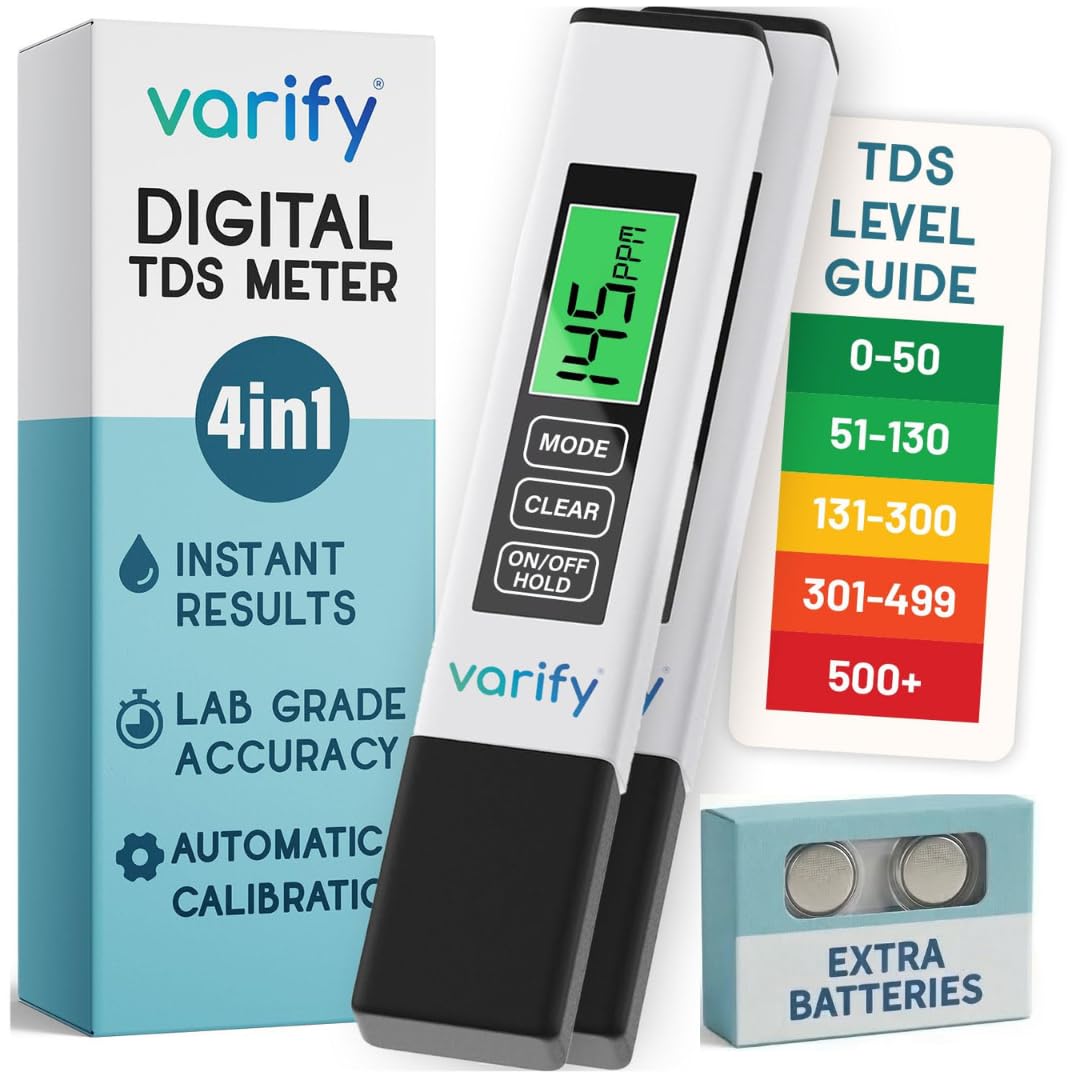
Two meters arrive in one box, and that is the entire pitch: one lives beside the filter, the other lives in a bag. The Varify pen reads TDS, EC, and temperature in Celsius or Fahrenheit, settles in about three seconds, and runs a titanium sensor with an auto-off.

We like it best for the paperwork. Every pen here hands you a number with no context, 110 from the tap and 89 from the fridge, and Varify includes a quick-start chart plus a downloadable guide that explains what the figures mean. For anyone who has stood at the sink wondering whether 240 is a problem, that is the most useful thing in the box.

The travel case is real: a second meter in a toiletry bag turns is this tap water okay into a ten-second check, and the spare batteries mean you are not hunting for a coin cell in a hotel room. It is compact enough to disappear in a jacket pocket, which is more than the heavier pens here can claim.

Pros

  • Second meter for travel or a second tap
  • Spare batteries in the box
  • Chart and guide explain the numbers
  • Readings settle in about three seconds

Cons

  • Most expensive route to a single reading
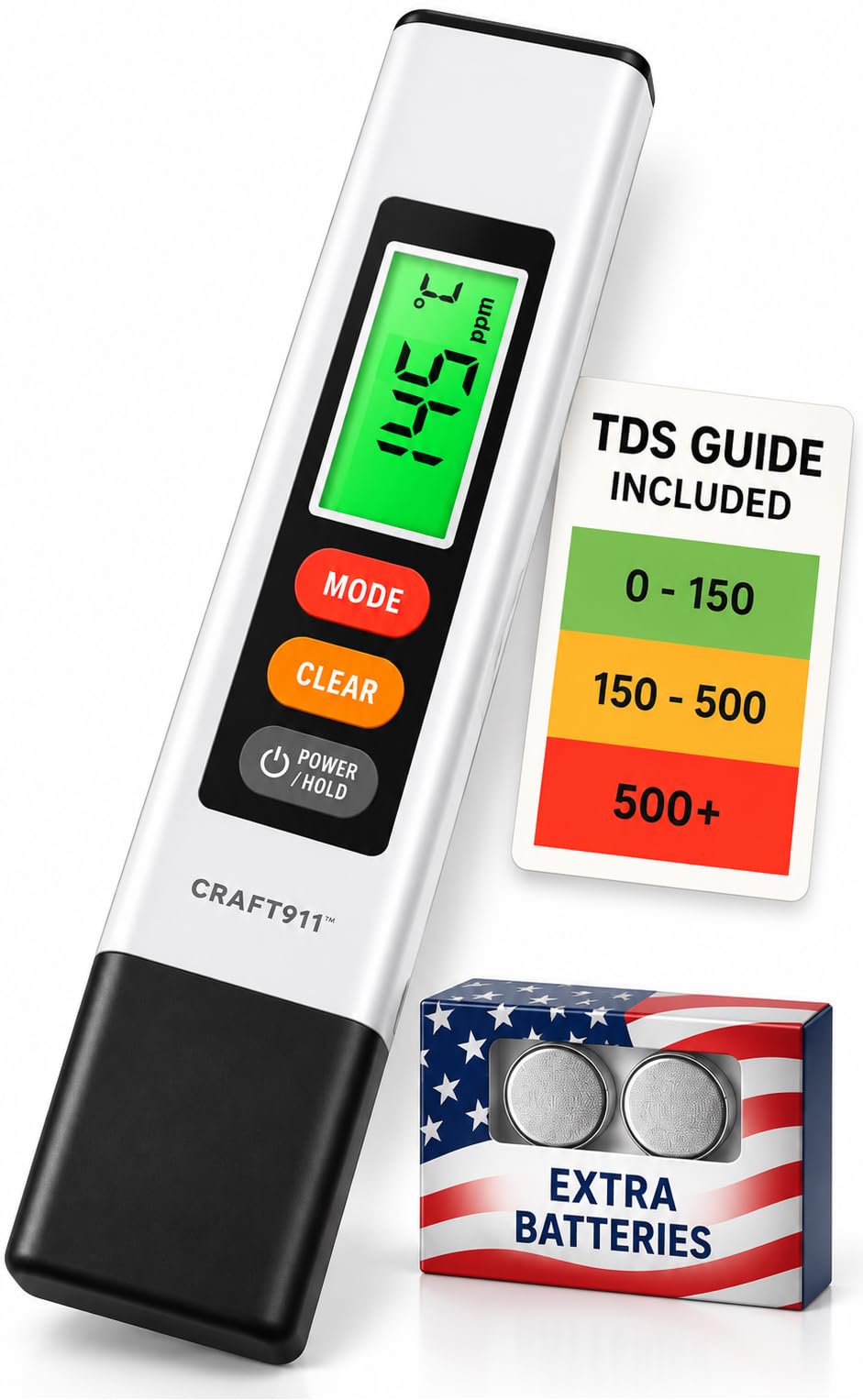
  • Can sit 40 to 50 ppm off a competing meter
Our verdict

Two pens, spare batteries, and a chart that finally explains your number make this the pick for anyone testing a second tap or a hotel glass.

Check Latest Price
4

Best Warranty

Craft911 3-in-1

89 /100
Trail Score Excellent

Key details

Display
Backlit LCD with auto-lock
Warranty
3 years
Readout Accuracy
+/- 3%
Measurement Modes
TDS, EC, temperature
Check Price on Amazon

Three years is an unusually long warranty on a meter this small, and it is the reason this one made the list. A TDS pen usually fails by drifting or by quitting outright, and a three-year replacement promise plus a 90-day money-back window covers both.

What we appreciate is that the coverage is the differentiator rather than the electronics. A titanium probe and a plus or minus 3 percent readout are ordinary for this group; the three-year term is not. It reads TDS, EC, and temperature on a backlit screen, holds the reading once it settles, and weighs 2.08 ounces, so it stores as easily as the pens costing more.

For a household that wants one meter, wants it to work, and would rather have a replacement than an argument, this is the sensible buy. The 90-day window covers the stretch in which a bad unit would show itself, and the backlit display is the same size you get anywhere else in this bracket.

Pros

  • Three-year warranty with a 90-day refund
  • Backlit LCD with auto-lock
  • Titanium probe with 3-in-1 readings
  • Light 2.08-ounce body

Cons

  • Accuracy is the weakest part of its case
Our verdict

The warranty is the reason to choose it: three years of coverage on a backlit 3-in-1 pen, with a 90-day refund if it disappoints.

Check Latest Price
5

Best Large Display

MEXYBE A2

89 /100
Trail Score Excellent

Key details

Range
0-9999 ppm
Weight
3.53 oz
Display
25% larger backlit LCD
Measurement Modes
TDS, EC, °C/°F
Check Price on Amazon

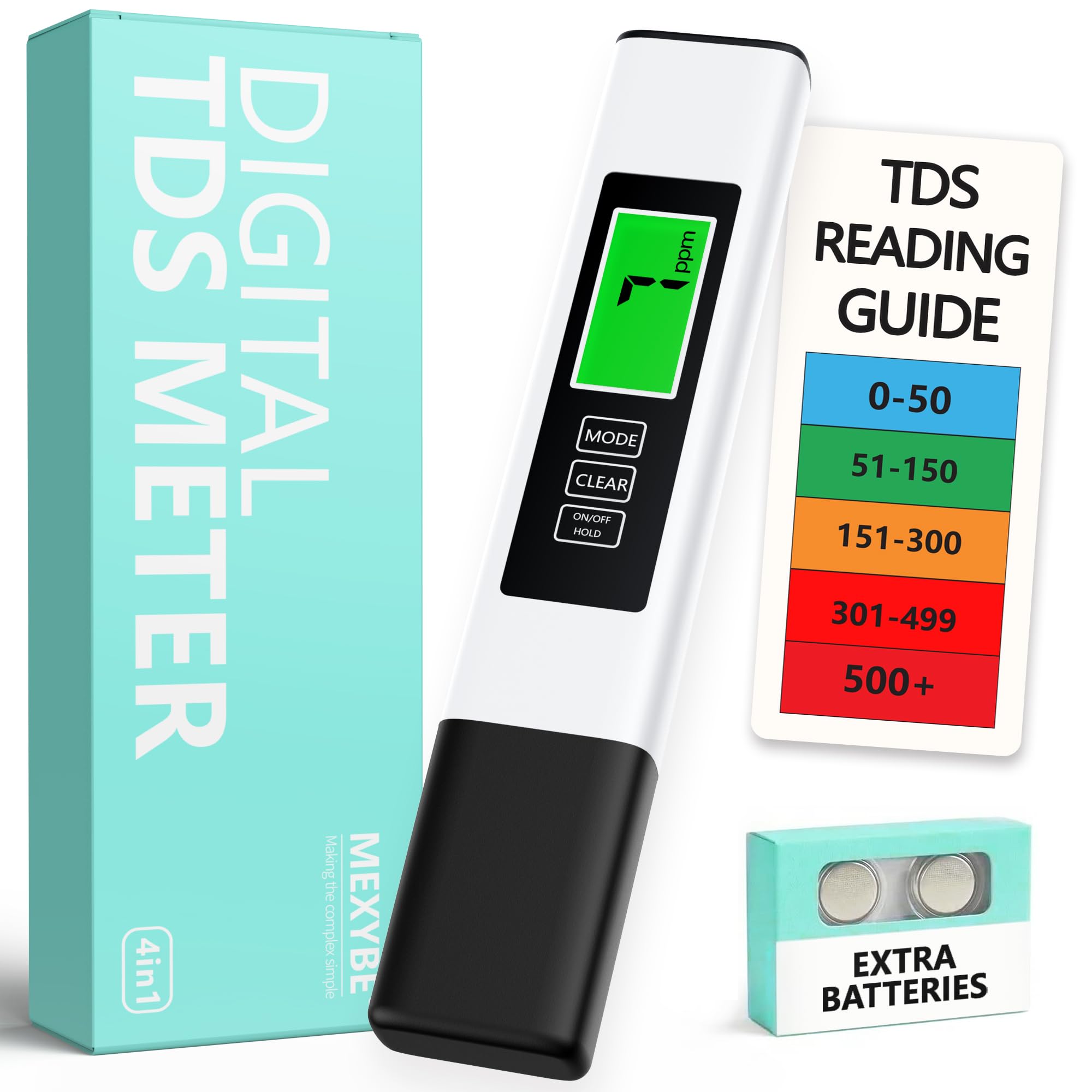
The temperature reading is the part to discount. On the A2 the TDS and EC numbers come up quickly, while the thermometer takes its time and can settle well below the true temperature, which only matters if temperature was the reason you were buying. Everything else here is faster than the pen's size suggests.

The 4-in-1 label deserves a footnote: the four modes are TDS, EC, and temperature in Celsius and Fahrenheit, so it is really a three-reading meter with two temperature scales. The screen is the genuine upgrade, 25 percent larger than the 3-in-1 pens it replaces, backlit, with digits you can read at arm's length.

We keep coming back to that display. A meter gets used standing at a sink with wet hands, and reading it without leaning in is worth more than an extra mode. At 3.53 ounces it is the heaviest of the pen-style meters here, so it lives in a drawer rather than a pocket, and the 0 to 9999 ppm range covers hard well water that would peg a narrower meter.

Pros

  • Largest, clearest screen here
  • One-button operation with quick results
  • Widest range in this group

Cons

  • Readings can shift between dips on the same water
Our verdict

Take it for the biggest, brightest screen here and one-button simplicity, and treat the slow temperature mode as a bonus rather than a feature.

Check Latest Price
6

Pocket Carrying

Pmlilb TDS Tester

87 /100
Trail Score Excellent

Key details

Probe
Titanium alloy
Range
0-9990 ppm
Weight
1.13 oz
Calibration
Automatic, temperature-compensated
Check Price on Amazon

At 1.13 ounces this is the lightest meter here, and it is the one that disappears into a jacket pocket and stays there. It reads TDS and nothing else: 0 to 9990 ppm on a plain LCD, with a titanium probe and automatic calibration that compensates for water temperature.

Simple is the point. Turn it on, dip the probe, and the number appears; there are no modes to cycle through and no second button to learn. The body is small enough to live in a gadget drawer without claiming the space a combo meter wants.

Accuracy is the quiet strength: this is the plainest meter in the set and one of the steadier ones on repeat readings, which is the thing budget pens usually get wrong. What it will not do is give you temperature or an EC figure, so if you are tracking how well a membrane rejects solids rather than just watching a number drift, a 3-in-1 like the HoneForest is worth the step up.

Pros

  • Lightest meter in this group
  • One button, no modes to learn
  • Titanium probe with temperature compensation

Cons

  • TDS only, with no EC or temperature
Our verdict

For plain TDS and nothing else, this is the pocket pick: 1.13 ounces, one button, and steady numbers without a menu in sight.

Check Latest Price
7

First Meter

EKOOTIMO 4-in-1

88 /100
Trail Score Excellent

Key details

Range
0-9999 ppm
Battery
1 CR2032 (included)
Display
Dual-color backlit LCD
Measurement Modes
TDS, EC, °C/°F
Check Price on Amazon

The backlight changes color with the reading, which is either the most useful thing about this meter or the most irritating, depending on how much you enjoy being told your water is questionable by a glowing screen. It is the least expensive 4-in-1 here, and it does not feel like it: the ABS shell has non-slip grips and the LCD is easy to read at a glance.

The modes cover TDS, EC, and temperature in Celsius or Fahrenheit across a 0 to 9999 ppm range, the same trio the mid-priced pens offer. Readings appear as soon as the probe touches the water, which is the claim every listing makes and one this meter largely lives up to.

Power comes from a single CR2032 coin cell with auto-shutoff, and the listing claims twice the runtime of the 1.5-volt pens in its class. We did not run that comparison, so treat the multiplier as marketing; a coin cell is still a sensible choice for a drawer meter that sits for weeks between uses.

For a first meter, or a second one for a garage or a rental, this is the pick. It does what the mid-priced 4-in-1s do, and the color cue is genuinely handy in a house where nobody remembers whether 250 is a problem or not.

Pros

  • Color-changing backlight reads at a glance
  • Four modes for the least money here
  • Non-slip body with a clear LCD

Cons

  • Takes a CR2032, not the common LR44
Our verdict

It does what the mid-priced 4-in-1 pens do, adds a color cue you can read across a room, and asks the least of your wallet.

Check Latest Price
8

Matching Standards

YINMIK YK-E01A

76 /100
Trail Score Very Good

Key details

Display
Horizontal LCD
TDS Standards
500 ppm and 700 ppm
Measurement Modes
TDS, EC, temperature
Conductivity Units
µS/cm and mS/cm
Check Price on Amazon

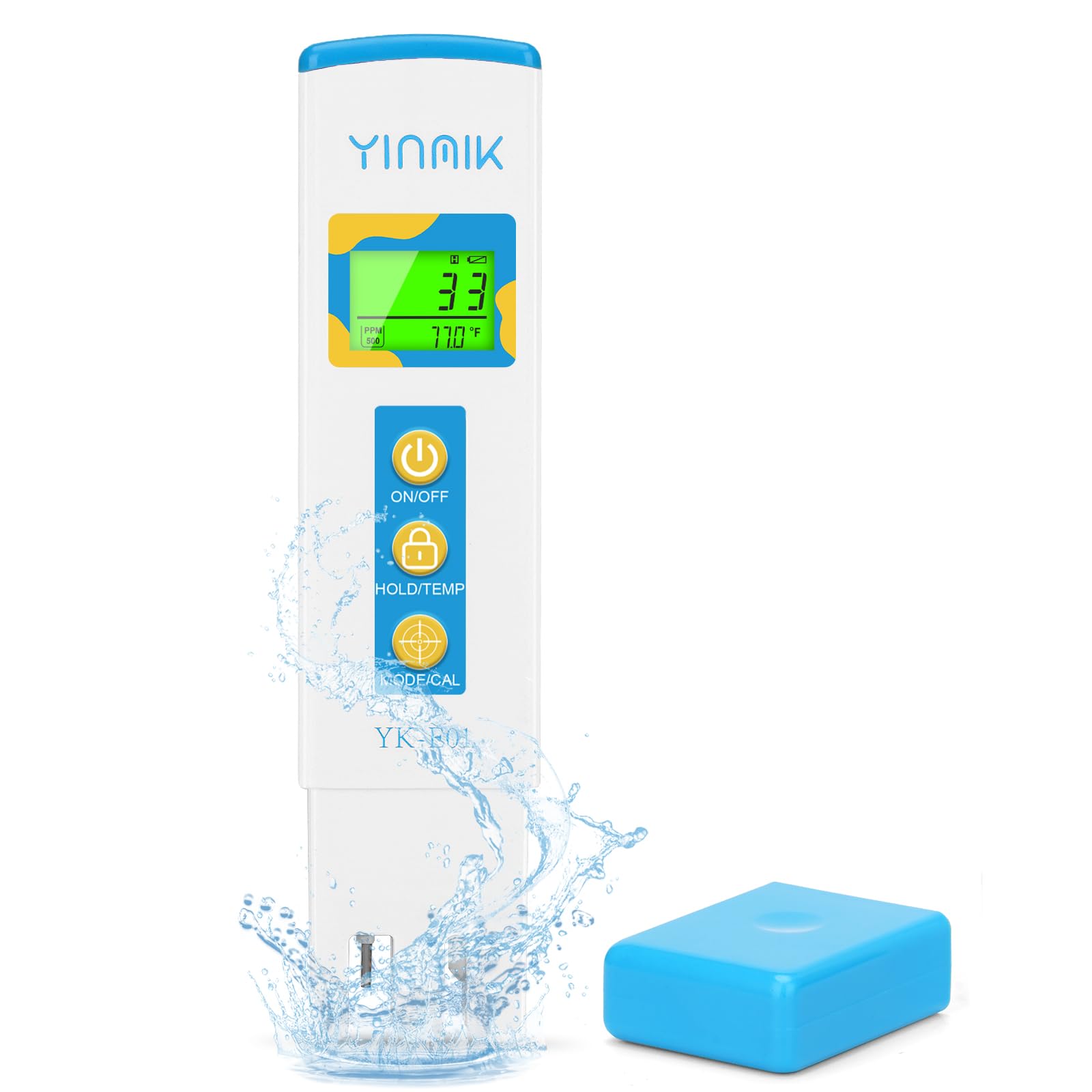
A switch on the side is the reason to look at this one: the YK-E01A lets you choose a 500 ppm or a 700 ppm TDS standard, and nothing else here offers that. It sounds like a technicality until you compare two pens on the same glass and get figures that disagree by design, since different meters convert conductivity to ppm on different conventions and this is the only one that lets you match someone else's.

It also reads conductivity directly, in both microsiemens per centimeter and millisiemens per centimeter, which is what a TDS figure is calculated from in the first place. If you keep a reef tank or a hydroponic reservoir, EC is the number those communities quote, and having it on the same pen saves buying a second instrument.

The screen sits horizontally, so you read it while the probe is still in the water instead of tilting the pen toward your face, a small thing you notice every single time. Automatic temperature compensation is built in and there is no calibration ritual; the pen is meant to be right from the first dip.

What gives us pause is the rating. This is the lowest-rated meter in the set, and the design does not explain why, since the specifications are the most interesting here. Buy it if the dual standard or the direct EC readout solves a real problem for you; if you just want a trustworthy TDS number, the HoneForest is the safer call.

Pros

  • Selectable 500 and 700 ppm standards
  • Direct EC readout in two units
  • Horizontal screen reads in place
  • Automatic temperature compensation, no calibration

Cons

  • Lowest buyer rating in this set
Our verdict

Choose it if you need switchable 500/700 ppm standards or a direct EC readout, and accept the lowest rating in this set to get them.

Check Latest Price

How We Tested TDS Meters in a Working Kitchen

We built the shortlist from scratch: every handheld meter sold for drinking-water use, then filtered by measurement range, resolution, stated accuracy, whether it reads temperature as well as TDS, and price. Anything with a range too narrow for well water, or an accuracy claim with no number attached to it, got cut. That left 16 meters, which we bought ourselves and lived with for four months.

Testing happened at kitchen counters rather than on a bench. I filled cups from the tap, a filtered pitcher, an under-sink RO system, and a jug of distilled water, dipped each probe, and timed how long the reading took to settle instead of flickering. Every sample got run twice with the same meter and once with a second unit, which is how we caught the ones that disagreed with themselves between dips, and every reading was checked against a reference solution.

We also tried calibrating each meter cold, without opening the manual, then again with it, and counted how many actually explained the procedure in enough detail to follow. Temperature mode got compared against a digital kitchen thermometer. Readability came down to whether I could see the display in dim light, at arm's length, with wet hands, and we noted whether the packaging implied the number was a guarantee of safety rather than a mineral count.

Instructions, or the lack of them, separated the field more than price did: several meters shipped with one folded slip and nothing on calibration, while a few cheap pens read within a hair of the reference. Value, in the end, was about whether a meter gave a steady number you could repeat, not about what it cost.

How to Choose a Tds Meter for Drinking Water

Start With the Job, Not the Feature List

Three jobs account for most household water testing: watching a filter or reverse-osmosis membrane lose efficiency over months, checking a glass when you are traveling or eating out, and settling an argument about whether bottled water is cleaner than what comes out of your tap. The first wants repeatability and fine resolution at the low end. The second wants something that rides in a bag, which is the whole reason the Varify two-pack exists. The third wants nothing more than a number.

Buy for the job you will do weekly, not the one you will do once. If a pen leaves the kitchen twice a year, spend the difference on resolution rather than on extra modes.

Why Two Meters Disagree on the Same Glass

Nearly every meter here calculates TDS from electrical conductivity, and that conversion is a convention rather than a measurement. Some pens use a 500 ppm sodium chloride standard, others 700, and the choice moves the figure substantially before accuracy even enters the conversation. Add a stated tolerance of plus or minus 2 to 3 percent and the effect of temperature, and two meters on one glass can sit tens of ppm apart with nothing wrong with either.

The practical move is to pick one meter, note what your tap water reads, and watch that number move over time. Only the YINMIK lets you switch standards to line its figure up with someone else's.

Resolution Matters More at the Low End

Most drinking water sits well under 1,000 ppm, and that is where resolution earns its keep. A meter stepping in 1 ppm increments, as the HM Digital TDS-3 states, can show a filter creeping from 8 to 15; a coarser pen shows low either way. Above 1,000 ppm the steps typically coarsen to 10 ppm and the display flags the shift.

Almost nothing you drink from a tap approaches four digits, so put your attention at the bottom of the range and ignore the headline maximum.

Calibration, Backlight, and the Details You Live With

Most of these pens arrive factory calibrated and expect you to trust that; ones with an adjustment screw or a calibration mode want a 342 ppm reference solution you buy separately. If you are the sort who checks, budget for the solution at the same time as the meter.

Beyond that, buy for the conditions you test in. A backlit screen matters if you read it inside a cabinet or a basement, a case matters if the pen rides in a bag, and a hold function matters if you would rather not balance a dripping probe over the sink. Coin cells and LR44s both last months; keep the right spare on hand.

Frequently Asked Questions

Final Verdict

The HoneForest HFTDS-M7 is the meter we point most people to: three readings from one dip, a backlit screen, a leather pouch, and the most consistent accuracy in this group. It is the safe default for a household that wants to know what its water is doing and whether the filter is still earning its place.

If you want a printed tolerance before you commit, the HM Digital TDS-3 gives you plus or minus 2 percent and 1 ppm resolution. If two locations need meters, the Varify pair solves that in one purchase. And if this is your first pen and you just want to see the numbers, the EKOOTIMO does the full 4-in-1 job for the least.