Best Water Distillers for Home Use of 2026

A water distiller does one thing: it boils water into steam and condenses it back, leaving minerals, fluoride, and nearly everything else behind in the boiling chamber. The spec sheets all quote output and capacity, but they skip the parts that decide whether you keep using the thing — where that leftover residue ends up, how loud the fan runs in the next room, and whether the chamber is something you'll still be willing to scrub in month three. What you're actually buying is water that tastes clean, that doesn't leave a film in your kettle or your humidifier, and that ends the bottled-water haul.

We've put seven distillers through six months of daily pouring, and the split came down to maintenance more than purity — the water itself was, frankly, similar across the lot. First-time buyers rarely anticipate how concentrated the gunk in the boiler gets, which is why a wide stainless chamber beats a digital display every time. The picks below are the ones still earning counter space.

1

Best Overall

Megahome Countertop Water Distiller

89 /100
Trail Score Excellent

Key details

Power
580 watts
Capacity
1 gallon per batch
Steam Path
Stainless steel to glass bottle
Distilling Time
5.5 hours per gallon
Check Price on Amazon

The stainless here isn't a trim detail. The boil chamber, the steam dome, and the condensing coils are all 304 steel, and the finished water drops into a glass bottle, so metal and glass are the only things the water touches from tap to storage. That's why this is our top pick. Distilling is hard on materials — hours of hot vapor, then a descaling scrub, then the same again tomorrow — and a machine whose entire steam path is built for that cycle is the one we trust to still be doing it in a few years.

A gallon takes about 5.5 hours at 580 watts, the slowest cycle in this group. That sounds worse than it is, because the run is unattended: fill it, switch it on, and there's a full bottle by morning. The rhythm that works is one batch overnight and a second during the day if someone is home. No distiller here gives you water on demand, and this one keeps up with a gallon-a-day household as long as you plan the night before.

The water is the part we keep coming back to. It comes out with no aftertaste and nothing registering on a TDS meter, and the glass bottle means you aren't undoing that by pouring it into plastic. Cleaning is the other quiet win: the chamber opens wide, scale lifts off after a citric acid soak, and the steel wipes back to new rather than holding a stain.

At 7 pounds and roughly 10 inches square, it moves between a kitchen counter and a laundry shelf without a fuss — more than we can say for the widest unit on this page. Nothing about it is fiddly, which is the nicest thing you can say about an appliance that runs for five hours while you sleep.

Pros

  • All-stainless steam path, coil included
  • Glass bottle keeps finished water out of plastic
  • UL listed for the U.S. market
  • Scale lifts off without heavy scrubbing

Cons

  • One-year warranty at the highest price tier
Our verdict

Our default for a kitchen that wants a gallon of pure water a day: an all-steel steam path and a glass bottle, with the slowest cycle here as the price of admission.

Check Latest Price
2

Best Premium Build

H2oLabs 300SS Water Distiller

87 /100
Trail Score Excellent

Key details

Power
565 watts
Capacity
1 gallon per batch
Collection
Glass carafe
Daily Output
Up to 16 liters
Check Price on Amazon

Five hundred sixty-five watts looks like a step down from the 750- and 900-watt units further down this page, and H2oLabs argues that's the point: a bigger element drives a rolling boil that splashes into the condensing coil and carries volatiles over with it. A gentler boil leaves more behind. Distillation is a separation process, and anything thrown into the coil doesn't get separated, so the reasoning holds up — it's the most specific design argument any distiller here makes.

The materials back it up. Stainless evaporator and condensing coil, food-safe plastic only where plastic is unavoidable, a porcelain insert at the nozzle, and a glass carafe to collect into. We came away thinking the money went into metal rather than features, which is the right trade for an appliance whose only job is purity, and build quality is the strongest single impression this one makes.

It ships with six carbon pods and a large jar of cleaning crystals, and the pods are the difference between water that tastes like nothing and water that tastes faintly of the inside of a machine. Auto shut-off ends the batch for you, and output is listed at up to 16 liters a day, which you will only see if you are home to refill.

One thing to settle before ordering: returns are not free. The policy lists a restocking fee on unopened units, a larger refurbishing fee on opened ones, and return shipping on you, so be sure this is the machine you want before the box arrives. Strict, yes — but it is a small maker protecting itself, and the machine it is protecting is very good.

Pros

  • Deliberately gentle 565-watt boil
  • Stainless coil and glass carafe
  • Six carbon pods and cleaning crystals included
  • Build quality draws the strongest reactions

Cons

  • Twenty inches wide, the broadest footprint here
  • Glass carafe needs careful handling
Our verdict

For the buyer who wants the most careful build in this group, the gentle-boil design and glass carafe justify the premium — as long as the counter is wide enough.

Check Latest Price
3

Best for Large Batches

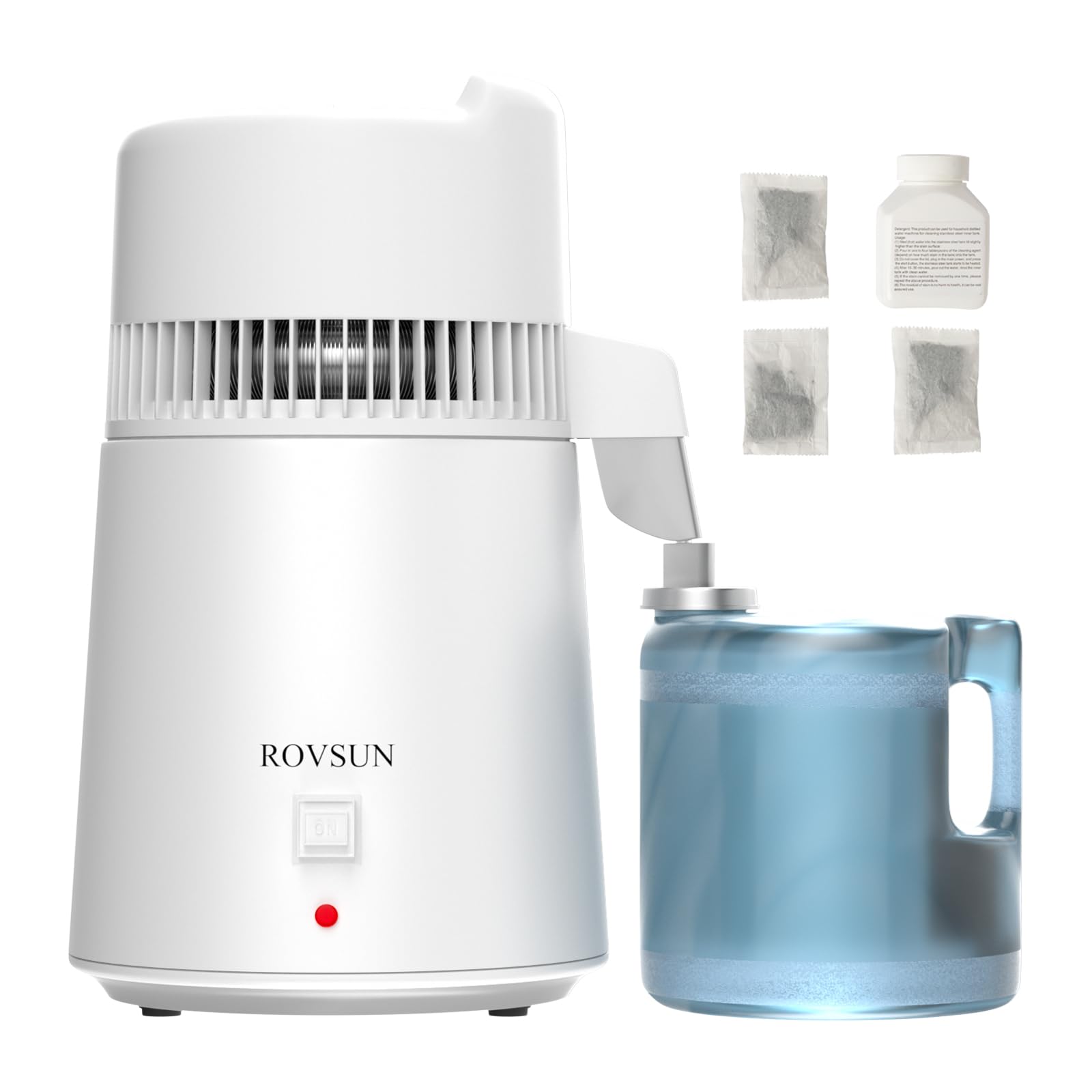
ROVSUN 6L Water Distiller

87 /100
Trail Score Excellent

Key details

Power
900 watts
Capacity
6 liters (1.6 gallons)
Batch Time
4 hours
Source Water Limit
1200 ppm TDS
Check Price on Amazon

Six liters in a single tank is the reason to look at this one. Most distillers here stop at a gallon, and a gallon disappears fast when a humidifier, a CPAP reservoir, and a shelf of houseplants all want distilled water. The 900-watt element fills that tank in about four hours — the fastest large batch in this group — so starting it before bed means a full tank with breakfast.

It is also rated for source water up to 1200 ppm total dissolved solids, the highest ceiling stated on this page, and that is the number that matters on a well or in a hard-water city. Hard water does not stop a distiller; it just means more scale, so a higher tolerance is a genuine advantage over the units capped at 500 ppm. Cleaning powder and charcoal sachets come in the box, so the first descale isn't an extra errand.

Where it lands for us: this is the volume pick, and it is the one to buy if the household genuinely goes through a gallon a day, because nothing else here keeps up at that pace. We found it loud enough to notice and warm enough to change the room, so a utility counter or a laundry room suits it better than the kitchen island. Neither trait is unusual for 900 watts and an aluminum fan.

Auto shut-off at 320 degrees ends a batch without a timer, and the wide chamber opening makes the monthly deep clean less of an event than it sounds. For a household with both a humidifier habit and a plastic-jug habit, this is the one that ends the hauling.

Pros

  • Six liters in about four hours
  • Highest stated source-water tolerance here
  • Cleaning powder and charcoal sachets included
  • Auto shut-off at 320 degrees

Cons

  • Plastic collection tank instead of glass
  • Cap can leak if the seal isn't square
Our verdict

We point volume buyers here: six liters in four hours keeps a gallon-a-day household supplied, and the plastic tank is the compromise you accept.

Check Latest Price
4

Best Budget

VEVOR 1.1 Gallon Water Distiller

85 /100
Trail Score Excellent

Key details

Power
750 watts
Chamber
304 stainless steel
Capacity
4 liters (1.1 gallons)
Output Rate
1.3 liters per hour
Check Price on Amazon

This is the least expensive distiller in this guide, and it is reasonably honest about what that buys: a 750-watt element, a 4-liter 304 stainless chamber, a BPA-free plastic jug, and a stated 1.3 liters an hour. One button, auto shut-off, and distilled water at the other end. If the goal is to stop hauling gallon jugs home for a humidifier or an iron, the arithmetic works here faster than anywhere else on the page.

We think it is a fair first distiller and an even better second one — the laundry room, the basement, the shop where the water goes into a battery or a humidifier and nobody is drinking it. For a household's main drinking water, we point people up the page. The stainless chamber is the part that counts, and it is the same 304 steel the expensive units use.

The quirk worth knowing is the jug. It sits low relative to the spout, so it needs propping up to sit level and catch the stream instead of splashing past it. A short stack of books or a block of wood under the jug solves it, and it is the sort of thing no product photo will tell you. The included citric acid and four carbon packs get you through the first few months of descaling and deodorizing, and for water headed to an iron or a humidifier, that is enough.

Pros

  • Lowest-priced route into distilling
  • 304 stainless boiling chamber
  • Citric acid and four carbon packs included
  • One-button start with auto shut-off

Cons

  • Water can escape from the base mid-run
  • Some units quit within months
Our verdict

We see it as the cheapest way to find out whether distilling fits your routine: best for appliance water in a laundry room, not for the family's drinking supply.

Check Latest Price
5

Best Stovetop Option

Kitchen Crop Little Creek Distiller

87 /100
Trail Score Excellent

Key details

Type
Stovetop double boiler
Capacity
2 gallons
Warranty
5 years
Output Rate
Up to 1 quart per hour
Check Price on Amazon

Three stainless pans, a silicone hose, and whatever burner you already have — that is the whole machine. The Little Creek makes distilled water without a cord, a fan, or a heating element to burn out, and it works on gas, electric, ceramic, or induction. After a row of countertop units that all hum for hours, the silence is the point, and the five-year warranty is the longest on this page by a wide margin.

The setup is simple: water in the bottom pan, cold water in the condenser pan on top, and the distillate collecting in between and draining out through the hose into a jar. Every piece is 18/8 stainless and every piece is dishwasher safe, which matters more than it sounds. Cleaning is what retires most distillers, and being able to put all three pans in the machine removes the excuse.

Its real home is the household that wants water when the grid is iffy, or the one that already keeps a big pot on the stove. We like that it earns cabinet space twice — the same pans render fat and do ordinary double-boiler work — and the listed 2-gallon capacity is the largest here, though how much you get out of a run depends on your burner and your patience.

What it asks in return is stove time, and how much that costs you depends on your kitchen. A gas range and a free afternoon make this the most satisfying pick on the page; a household that wants a gallon by seven in the morning will find it slow. For the price and the warranty, though, it is the only distiller here with a realistic shot at a decade of service.

Pros

  • No cord, no fan, no element to fail
  • Five-year warranty, the longest here
  • Every piece is dishwasher safe
  • Listed 2-gallon capacity is the largest here

Cons

  • No auto shut-off, so someone has to stay with it
  • Three pans to store between batches
Our verdict

Three stainless pans and a burner beat a corded machine if you want water during an outage, and the five-year warranty backs the simplicity.

Check Latest Price

How We Tested the Best Water Distillers

We started with everything sold by the major retailers and directly from manufacturers, then narrowed by capacity, chamber material, whether replacement carbon filters and descaler were actually in stock, and the real cost per gallon over a year of use. Seven models made the cut, and each ran for six months on a kitchen counter beside the sink, producing batches overnight for coffee, on weekend mornings for a humidifier, and after dinner when someone needed water for a CPAP machine. Our test kitchen has hard water, which turned out to be useful — the chambers scaled up fast enough to expose real differences.

For every machine, we timed a full cycle from the flip of the switch to the shutoff and recorded the yield against the fill line. We took decibel readings at arm's length and again from the next room, since these things run for hours while you're trying to live your life. After each batch we checked the seam, the base, and the counter underneath for weeping or drips, then cleaned the chamber with the maker's descaler, counting the minutes and noting whether it took a scraper or a soak. Ease of use got judged on the boring stuff: filling without unplugging anything, lifting a full tank, pouring without a runnel down the front of the carafe.

Value we worked out in dollars per gallon, carbon filters and descaler included, because a cheap unit with pricey consumables isn't cheap. Durability got its own check at the six-month mark, when we ran a fresh batch and listened for a louder fan, a longer cycle, or scale that no longer lifted off. The units that survived all of it are the ones below.

How to Choose a Water Distiller for Home Use

Match the Batch to Your Habits

Batch size and cycle time only make sense together, because nothing in this category is on demand. A countertop unit runs four hours for the ROVSUN's six liters, five and a half for the Megahome's gallon, and a stovetop unit trades wattage for a burner and your afternoon. We found the cycle time shapes daily use more than the tank size does.

So count what you actually go through. A winter humidifier, a CPAP reservoir, and a shelf of plants can add up to a gallon a day, while coffee and the occasional iron might be two gallons a week. Land at a gallon a day and you buy capacity; land at a gallon a week and you can afford to buy materials and quiet instead.

Follow the Steam Path, Not the Shell

Stainless on the outside is easy to print on a box. What matters is the metal the vapor actually touches — the boil chamber, the steam dome, the condensing coil — and what the finished water lands in. The Megahome and the H2oLabs both run metal end to end and collect into glass; the ROVSUN and the VEVOR use stainless chambers but ship a plastic collection tank.

That difference matters enormously if the water is going into a kettle or a CPAP you will taste it from, and barely at all if it is going into an iron. We put more weight on the wetted parts than on wattage. Read the parts list specifically for the coil and the collection vessel before you assume stainless steel covers the whole machine.

Plan the Descaling Before You Buy

Distilling leaves everything behind, and everything left behind becomes scale on the chamber floor. How hard your water is decides how often you are soaking that chamber in citric acid, which is why nearly every unit here ships with cleaning powder or crystals — it is a routine, not an occasional repair.

Two details make the routine shorter: a wide chamber opening you can get a cloth into, and a descaling agent included in the box. The Kitchen Crop's dishwasher-safe pans and the Megahome's wide opening are the two easiest cleanups in this group. Narrow-necked machines turn a ten-minute job into one you postpone.

Noise, Heat, and Where It Lives

These are small appliances with a fan and a heating element, and they run for hours at a stretch. Expect a hum in the range of a microwave or an air fryer, plus real warmth in the room — nobody here is quiet enough for a bedside table, and the 900-watt units run hottest.

We prefer to see a distiller on a utility counter, in a laundry room, or on a basement shelf rather than beside the coffee maker. Keep it off laminate seams, since a hot overflow can lift them, and check clearance: most of these stand about 18 inches tall, and footprints run from roughly 10 inches square to 20 inches across.

Warranty, Power, and the Long Game

Coverage in this group runs from one year on the Megahome and the H2oLabs to five on the Kitchen Crop, and that spread is worth weighing against a lower purchase price. A distiller has one heating element and one fan, and when either goes the machine is done.

The ongoing costs are small but real: electricity, descaling agent, and the carbon pods that polish taste. The bigger investment is attention. These machines need filling, emptying, and cleaning on a schedule, and the households happiest with them built that into a weekly routine rather than treating it as a surprise.

Frequently Asked Questions

Final Verdict

Our pick for a normal kitchen is the Megahome. The all-stainless steam path and the glass bottle are the parts that hold up over years of hot vapor and citric acid soaks, and it has the deepest record on water quality in this group. Accept the five-and-a-half-hour cycle and it keeps a household supplied without fuss.

Two changes push you elsewhere. If a gallon a day is the reality, the ROVSUN's six-liter tank and four-hour cycle are worth the plastic collection jug. And if there is no outlet to spare, or the power goes out often enough that you plan for it, the Kitchen Crop makes the same water on a burner and backs it with five years.