Best Wall-Mounted Pull-Up Bars of 2026

The worst sound in home fitness is a wall-mounted pull-up bar letting go mid-rep — a crunch of drywall, a puff of dust, and a sudden, personal relationship with your floor. A good bar is supposed to erase that doubt completely, turning a strip of wall you never used into the most-used corner of the house, and letting the only thing that ends your set be your grip. It also has to work with the wall you actually have: exposed studs in a garage, poured concrete in a basement, or painted drywall in a spare bedroom you'd rather not open up.

I've put up a dozen of these over the past six months — some with a stud finder and a level, some with a friend holding the bracket and a lot of muttering — and the lesson never changes: the bar is almost never the weak link. The hardware and the wall behind it are. A modest bar with the right anchors beats a heavy-duty one lag-bolted into nothing, every time. What follows are the ones that stayed dead steady through slow pull-ups, long dead hangs, and the occasional ill-advised kip.

1

Best Overall

OneTwoFit Wall Mounted Pull-Up Bar

91 /100
Trail Score Outstanding

Key details

Extras
Dip and leg-raise station
Max Weight
440 lb
Wall Footprint
37.4 x 30.3 inches
Mounting Surface
Concrete or solid brick
Check Price on Amazon

A free-standing power tower owns a patch of floor forever, and you walk around it every time you cross the room. This bar asks for a rectangle of wall about 37 inches wide and 30 inches tall; the pull-ups, the dips, and the knee raises all happen in the air in front of it. In a spare bedroom or a garage bay that has to work as a gym and something else, that's the whole case.

Sturdiness is where it separates itself from the rest of the group. We hung from it expecting a little give from a frame this compact and found none. The padded back and arm cushions make the dip station somewhere you'll actually spend time, and the dip arms take real weight without complaint — for a bar that also has you upside down doing knee raises, that composure matters more than any single number on the box.

The fasteners in the box are the part to change. Buy masonry anchors rated for the load, drill for those, and keep the supplied ones as spares; for concrete you want a hammer drill with a 15/32-inch bit. Assemble the frame loose, level it against the wall, and tighten last — a bracket set slightly out of line shows up later as a lean when you hang off one side.

What it doesn't do is pack down. Once it's up, that wall belongs to it, and the dip arms mean you need clear floor in front as well as wall behind. Decide that before you drill, not after.

Pros

  • A dip station and pull-up bar in one wall panel
  • Rigid under load with no give
  • Padded arms and back pad for dips and raises

Cons

  • Needs concrete or solid brick, not drywall
Our verdict

It's the one we tell most people to buy: a pull-up bar, dip station, and leg-raise stand bolted into 37 inches of wall instead of taking over a corner of the room.

Check Latest Price
2

Best for Dips and Leg Raises

Luckyone Wall Mounted Pull-Up Bar

89 /100
Trail Score Excellent

Key details

Max Weight
440 lb
Unit Weight
23 lb
Wall Footprint
37.4 x 30.3 inches
Mounting Surface
Concrete, solid brick or tile
Check Price on Amazon

Set this beside our top pick and the numbers barely move: the same 37.4 by 30.3-inch wall panel, the same 440-pound rating, the same padded dip arms and multi-grip bar. What changes is the money — this one asks less — and the company behind it. For a shopper who wants the station more than the name on it, that is a trade we're happy to call.

Assembly is quick and the frame goes up flat, which is what you want from a panel this size. The catch is depth: the bar sits close to the wall, close enough that neutral-grip pull-ups can put your knees into the plaster. Lean back into the movement or switch to a wider grip, and the close mount stops mattering.

Where it beats a straight bar is the exercise list — pull-ups, chin-ups, dips, leg raises, and a padded back rest that makes the last two comfortable rather than punishing. The grips are high-density and non-slip, and the rating matches the top pick pound for pound. As a first wall-mounted station, it's the easier of the two to justify.

Pros

  • Same station layout as our top pick
  • Quick to assemble and mount
  • Padded dip arms and multi-grip bar

Cons

  • Mounts to solid masonry, not hollow brick
Our verdict

If you want the full station but not the full price, this is the version we point to — same layout, same rating, slightly different company behind it.

Check Latest Price
3

Best Adjustable Depth

Jusgym Wall Mounted Pull-Up Bar

85 /100
Trail Score Excellent

Key details

Bar Depth
19 or 27 inches
Max Weight
500 lb
Unit Weight
21.6 lb
Bar Thickness
1.27 inches
Check Price on Amazon

Depth is the setting most wall bars don't let you touch, and here it's the whole point: 19 inches from the wall for standard pull-ups, or 27 inches when you want room to swing your legs or keep your knees clear on raises. Nothing else in this group gives you that much air. Nothing else takes up that much room in front of the wall, either.

The bar is 1.27-inch steel with a 500-pound rating under a black powder coat, and there are two steel rings at the ends for resistance bands, gymnastic rings, or a heavy bag. Mounting is into solid concrete or a wooden wall, and the brackets are fixed — once it's up there is nothing to adjust and nothing to rattle loose.

What we keep coming back to is the depth choice. It makes this the bar for a tall lifter, for a garage with space to spare, or for anyone whose knees complain about a close mount, and it makes the cost of that comfort obvious: 27 inches of reach is a lot of room to give up. If the floor in front of your wall is a walkway, measure it before you fall for the adjustability.

Pros

  • Choose 19 or 27 inches of bar depth
  • 500-pound rating on 1.27-inch steel
  • Rings for bands, gymnastic rings, and bags

Cons

  • Center straight grip is interrupted and narrow
  • Mounting hardware has arrived incomplete
Our verdict

The pick for anyone whose knees keep finding the wall: two depth settings and 500 pounds of rating buy real clearance, as long as you have the floor space to spend.

Check Latest Price
4

Best with a Pulley System

LIONSCOOL Pull-Up Bar with Pulley System

88 /100
Trail Score Excellent

Key details

Extras
Two swivel pulleys
Bar Width
48 inches
Max Weight
450 lb
Mounting Surface
Cement or solid brick
Check Price on Amazon

Two swivel pulleys ride on the front of this bar, and with a set of handles and a cable they turn a 48-inch pull-up station into a lat pulldown, a face-pull station, and a triceps pushdown at the same time. That's a cable machine's job done from wall space, with no weight stack to walk around.

It's also the most solid bar in this group. Thirty pounds of steel, a 450-pound rating, and grip positions that give you genuinely different angles rather than cosmetic variations. Nothing about it flexes when you hang, and the pulleys run smoothly — the detail that would ruin the whole idea if it were done badly.

Installation is the honest catch. The frame wants a second pair of hands, and the drill size printed in the manual is worth checking against the anchors themselves before you commit to a hole. It's the priciest bar here, too, and if you only want pull-ups, most of what you're paying for will sit unused.

Pros

  • Pulleys add lat pulldowns and face pulls
  • Most rigid frame in this group
  • Grip positions at genuinely different angles

Cons

  • Drywall installs need added blocking
Our verdict

The one we recommend when the budget allows a cable machine too: two pulleys hang off a genuinely rigid 48-inch bar and cover the back work a bar alone can't.

Check Latest Price
5

Best for Heavy Bag Work

SELEWARE 48-Inch Wall Mount Pull-Up Bar

87 /100
Trail Score Excellent

Key details

Extras
Anchor rings for bands and heavy bag
Bar Width
48 inches
Max Weight
500 lb
Steel Thickness
4 mm
Check Price on Amazon

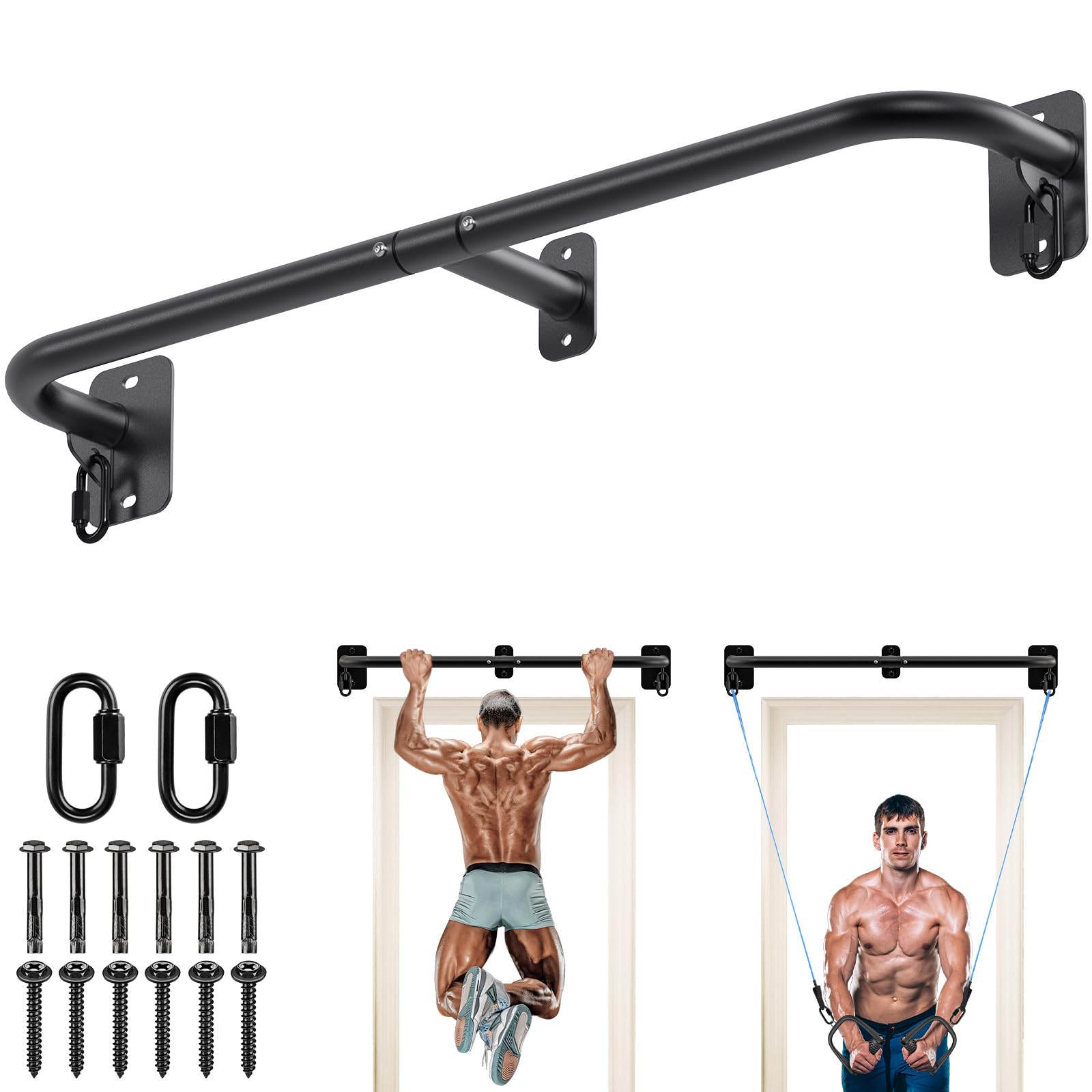
Round anchor points hang off both ends of this bar, built for a heavy bag, a suspension trainer, or a set of bands. That's an unusual amount of attachment for a pull-up bar, and it's what turns a 48-inch straight span into a small gym.

Everything behind the bar is serious. The tubing is four millimeters of alloy steel, the joints are welded rather than bolted together, and the rating is 500 pounds — the thickest steel in this group. It's the bar here that most feels like it belongs in a garage rather than a spare room.

Mounting is where you do the homework. The holes sit at the ends of the 48-inch span, so measure your studs and confirm those ends land on timber before you drill. A level, a socket set, and a second pair of hands are the rest of the kit.

We reach for it when the training is heavy and wide: a bag on one anchor, straps on the other, wide-grip pulls in between. It's the most steel you can put on a wall here, and it behaves like it.

Pros

  • Four-millimeter steel, fully welded
  • Anchor rings for a bag or straps
  • 500-pound rating with multiple grips

Cons

  • No knurling, so the bar gets slick
Our verdict

A serious piece of steel for people who hang more than themselves from it — a bag, straps, and bands all have somewhere to go on this one.

Check Latest Price
6

Best Budget

Yes4All Wall Mounted Pull-Up Bar

89 /100
Trail Score Excellent

Key details

Grip
Padded foam, multi-position
Bar Width
39 inches
Max Weight
300 lb
Unit Weight
8.3 lb
Check Price on Amazon

The lowest rating in this group, 300 pounds, belongs to the bar that's also the easiest to afford. That isn't a coincidence: less steel, thinner brackets, and a bag of fasteners you'll want to improve on. For a lighter lifter drilling into good studs, though, the trade is fair — the bar does the job, and it does it for very little.

Plan the install around the hardware. Buy lag bolts sized for your studs and drive those instead of the included ones, and hold the bracket against the wall before you commit to hole positions, because the mounting points don't leave much room for error. There's a little flex in the bracket under a hard pull, which is exactly where the heavier bars here earn their money.

The multi-position foam grips are comfortable and cover wide, neutral, and underhand work, and at 8.3 pounds the bar is easy to move and easy to hang alone — a small pleasure we hadn't expected to notice. It's a first bar, not a last one.

Pros

  • Cheapest bar in this group
  • Light enough to hang alone
  • Multi-position padded grips

Cons

  • 300-pound rating is the lowest here
  • Foam grips wear through
Our verdict

The bar we suggest for a first setup on a tight budget, provided you swap the fasteners and stay comfortably under its 300-pound ceiling.

Check Latest Price
7

Grip Training

Kipika Wall Mounted Pull-Up Bar

88 /100
Trail Score Excellent

Key details

Bar Width
40 inches
Unit Weight
10.5 lb
Grip Positions
5
Wall Clearance
6 inches
Check Price on Amazon

Five grip positions on a 40-inch bar, and one of them is a pair of steel balls set into the frame for finger and pinch strength. That ball grip is the reason to look at this one: it's the only bar here that treats your hands as a training project of their own, which matters if you climb or grapple.

The rest is a compact, cleanly finished bar — 1.3-inch tubing and a six-hole mounting pattern that spreads the load across more than one bolt line. Five distinct hand positions on a bar that takes up barely any wall is a lot of range for the size, and the hammer and neutral positions are the ones we kept coming back to.

Where it gives ground is installation. The mounting holes sit directly behind the bar, so a standard drill and bit fight for angle; a stubby bit or a right-angle adapter saves a frustrating hour. We think the grip variety justifies the fuss at this size — if you only want a straight wide bar, the bigger picks here are easier to hang.

Pros

  • Ball grip for finger and pinch strength
  • Five distinct hand positions
  • Compact 40-inch bar

Cons

  • Grips slide until you glue them down
Our verdict

Buy it if grip strength is part of your training rather than a side effect of it — nothing else here gives your fingers their own station.

Check Latest Price
8

Small Spaces

SELEWARE 32-Inch Wall Mount Pull-Up Bar

82 /100
Trail Score Excellent

Key details

Extras
Band hooks and buckles
Max Weight
450 lb
Bar Diameter
1.3 inches
Mounting Span
32 inches
Check Price on Amazon

Thirty-two inches is the number to check first. The mounting span is built to land on 16-inch stud centers, which makes this the bar for a narrow wall, a closet return, or a beam where a 48-inch span has nowhere to go. The bar itself runs about 35 inches, so it's compact without being a toy.

It's rated to 450 pounds and braced with a triangular plate at the mount, and the grip bar is 1.3 inches of powder-coated steel — the same diameter as the bigger bars here. Two hooks and a pair of connecting buckles let you hang a suspension trainer or bands, so a small bar still carries a full session.

Installation wants a serious drill and a slow hand. Run a nut down each bolt before you drive it, in case there's grit in the threads, and expect to lean on the drill going into masonry. The pay-off is a bar that takes up almost nothing and will hang from a header, a joist, or a stud wall.

Our take: this is the right bar when the wall decides the purchase rather than the training plan. It handles strict pull-ups, chin-ups, and band work without complaint, and it costs less than anything else here by a clear margin. On the right wall, that's the whole purchase.

Pros

  • Mounting span suits 16-inch studs
  • 450-pound rating in a compact bar
  • Band hooks and buckles included

Cons

  • 35-inch bar rules out a wide grip
Our verdict

The one to buy when the wall picks the bar for you: a short span that fits where nothing else will, at the lowest price here.

Check Latest Price

How We Tested the Best Wall-Mounted Pull-Up Bars

We started with roughly 40 wall-mounted bars, filtered for a stated weight rating of at least 300 pounds and hardware included in the box, then cut the field by bar diameter, mounting style, height options, and whether the footprint made sense in a garage, a basement, or a spare bedroom. Twelve made the cut. Each one was installed in a real home gym setup and used weekly for six months, by tall lifters and short ones, on studs, concrete, and drywall.

Installation came first, and we did it the way a buyer would: alone, on a Saturday, with a drill and a level. We timed each install from unboxing to first hang, counted how many times we had to re-mark and re-drill, and noted whether the included hardware actually matched the wall type it claimed to fit — lag bolts for studs, expansion anchors for masonry, toggles where drywall was the only option. Bars that needed a paper template, a second pair of hands, or a trip to the hardware store got marked down for it.

Then we loaded them. Dead hangs first, then slow controlled pull-ups, then kipping, then a weighted pack adding up to 100 pounds beyond body weight. At each stage we watched the brackets for flex, pushed the bar ends side to side for wobble, and re-checked every bolt after a week of use to see what had worked loose. We also measured ceiling clearance for chin-over-bar work and wall clearance for anything wider than a strict pull-up.

Over six months we tracked sweat, chalk, and garage humidity against the finish, looking for rust blooms at the welds and powder coat flaking at the grip, and checked whether foam or knurling rotated or smoothed out. Where a bar offered multiple grip widths or a second height, we used them all. The bars that held their torque, kept their finish, and left us forgetting they were there are the ones that earned a spot above.

How to Choose a Wall-Mounted Pull-Up Bar

Start With the Wall, Not the Bar

Decide what you are drilling into before you compare weight ratings. Solid concrete and solid brick hold masonry anchors reliably. Drywall over timber holds a bar only when the bolts reach the framing, and several bars here state plainly that they are not for drywall, plaster, or hollow block.

Find your studs, note their spacing, and work out where the holes will fall. If the answer is that they land over air, you are adding a cross-board. A stud finder and a spirit level cost very little and prevent the mistake we see most often.

Match the Bar Span to Your Studs

Wall bars come in spans of roughly 32, 35, 40, and 48 inches, and the mounting holes have to agree with your framing. A 32-inch span is built around 16-inch stud centers and suits a narrow wall or a beam; a 48-inch bar gives you wide-grip work but needs solid timber under both ends.

Span also decides the exercise. Forty-eight inches lets your hands travel wide, while 35 inches keeps them near shoulder width. Measure the studs first, then choose the bar that lands on them.

Work Out Your Clearance

The distance from the wall to the bar is the spec most shoppers skip and then notice every session. Six inches is compact and fine for strict pull-ups, but your knees come close to the wall on neutral-grip and knee-raise work. Nineteen inches or more gives you room to move and turns the bar into something you walk around.

Measure the floor in front of the wall, think about which grips you actually use, and let that decide how much reach you want.

Read the Weight Rating as a Limit

Ratings in this group run from 300 to 500 pounds, and they are ceilings rather than stiffness scores — a 500-pound bar and a 300-pound bar can feel completely different under the same lifter. Treat the number as a hard limit and move up if you are close to it.

Judge rigidity separately. Thicker tubing, welded joints, and a mounting plate that ties into two studs do more for a solid feel than another fifty pounds of claimed capacity.

Decide How Much Station You Want

A straight bar does pull-ups, chin-ups, and hanging leg raises. A station adds padded dip arms and a back pad, and the wall footprint is often no larger, which is why we lean toward stations for a first home setup.

The extras worth paying for are the ones you'll use weekly. Band hooks and anchor rings add range for very little, while a pulley system replaces a cable machine outright. Buy for the training you do now, not the gym you might build later.

Frequently Asked Questions

Final Verdict

Buy the OneTwoFit if you want one panel to cover pull-ups, dips, and leg raises. It's the most complete station here, and it's the one we put up first.

If the wall is the constraint rather than the budget, the Luckyone does the same job for less. If you want cable work in the same footprint, the LIONSCOOL's pulleys justify the step up. Otherwise, start with a straight bar and add the station later.