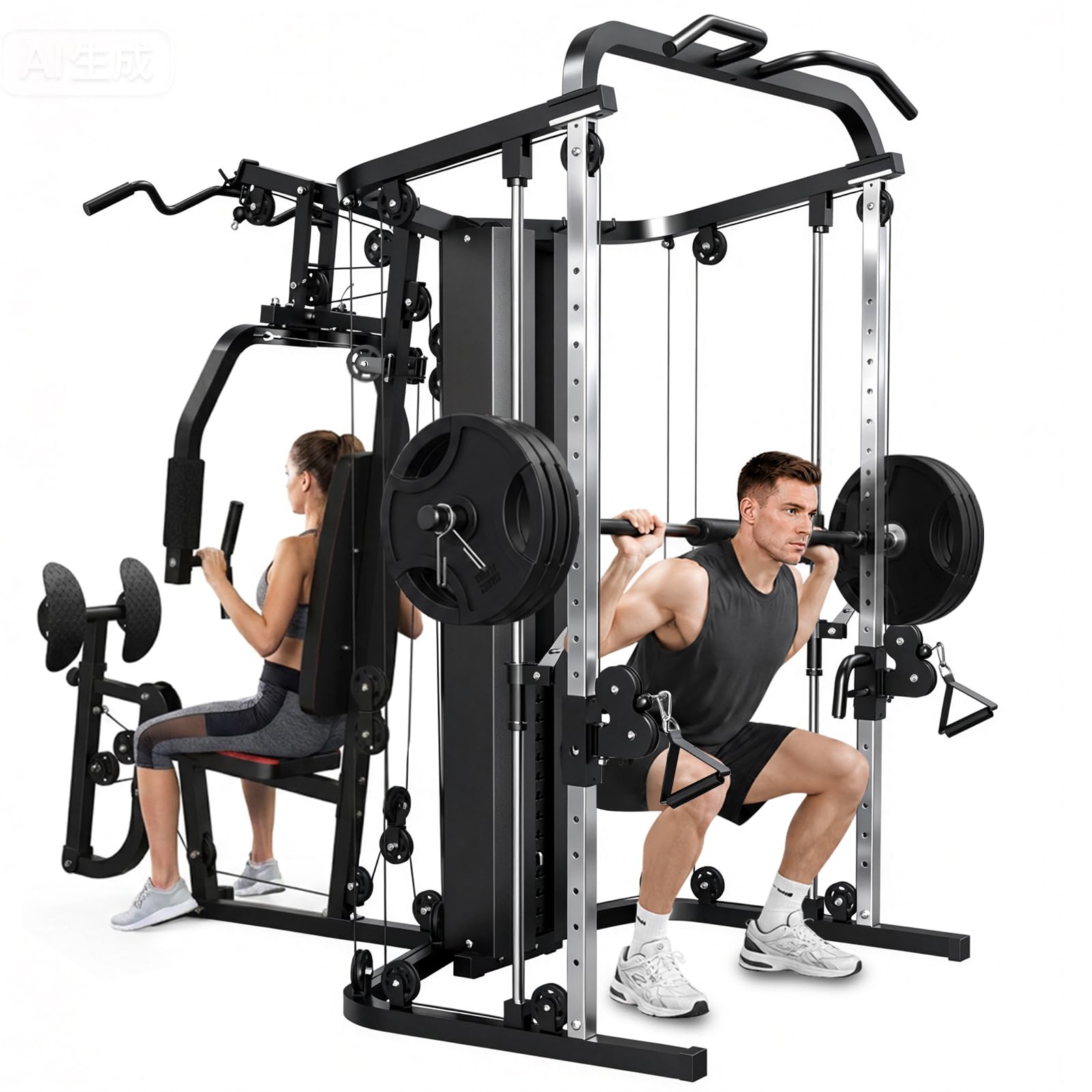
Best Smith Machines for Home Gyms

A Smith machine is the spotter you never have to ask for — the fixed bar path catches the weight when a rep stalls, so you can push closer to your limit at home. But that safety only works if the frame stays planted, the bar glides without hitching, and the catches land where you need them. A shaky upright or gritty bar path turns a confidence builder into a chore. The right machine fixes that: stable, repeatable lifts in a footprint that fits a garage or spare room, without the guesswork of free-weight spotting.

Over the past nine months, my team and I assembled and trained on six Smith machines, from compact frames to beefier rigs. We focused on what you'll notice after the novelty wears off: sturdiness under a heavy squat, smooth operation through every inch of the bar path, versatility from attachments and adjustable catches, and assembly instructions that don't leave you guessing. Value came down to what each machine included for the floor space it claimed. The picks below are the ones that earned their footprint.

1

Best Overall

DONOW DN-DS938 Smith Machine

89 /100
Trail Score Excellent

Key details

Capacity
2,240 lb
Footprint
54.7"D x 78.58"W x 88"H
Pulley Ratio
2:1
Cable Resistance
Two independent weight stacks
Check Price on Amazon

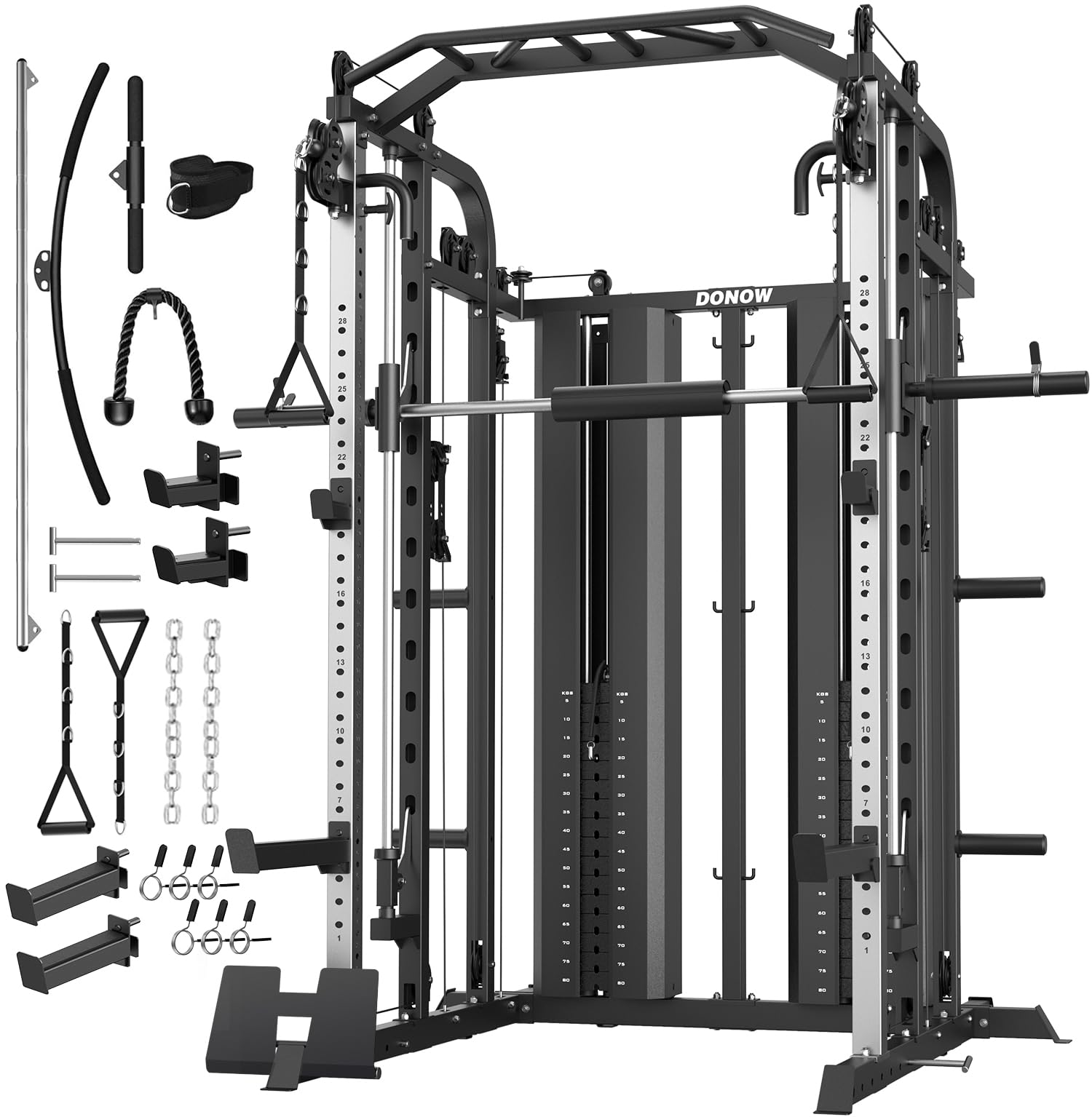
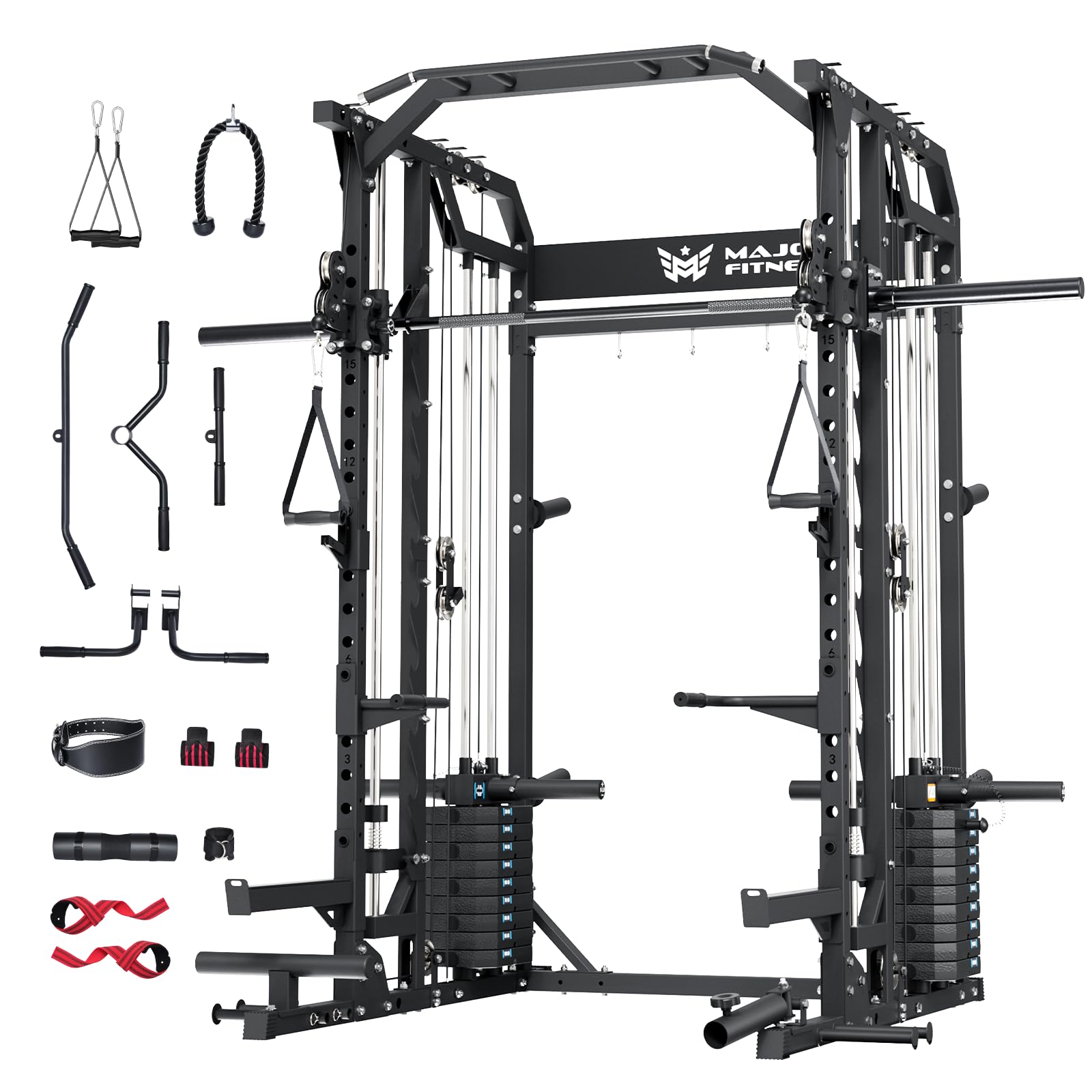
Two selectorized stacks are what separate the DONOW from most of this group. You slide a pin instead of dragging plates across the room, and because the two sides run independently, one person can pull lats while the other works cable flyes on the opposite column. That's the biggest quality-of-life difference in a home gym: cable work stops being a setup chore and becomes something you do between sets of something else.

The Smith bar runs on linear bearings, and the glide is the part we kept coming back to. Capacity is listed at 2,240 pounds, far more than any home lifter will load, but it explains why the frame doesn't flinch when you rack a heavy set. The rack half is a real power cage, with safety arms and a multi-grip pull-up bar, so squats and presses happen inside it too.

The 2:1 pulley ratio is worth understanding before you buy. It buys smoothness and cable travel at the cost of resistance per plate, so the number on the stack isn't the number in your hand. For face pulls and pulldowns we preferred the feel of 2:1; if you want maximum load on every rep, the Major Fitness below is the alternative.

Assembly is the honest caveat. It arrives in eight boxes, and the instructions are the least polished part of the package, so recruit a second pair of hands, keep a ratchet nearby, and plan a couple of evenings rather than one. Once it's square and standing, this is the machine that goes in our own garage.

Pros

  • Two independent stacks let two people train at once
  • Linear-bearing Smith bar glides and locks predictably
  • 2,240-lb capacity across cage and cables
  • No plate loading for any cable exercise

Cons

  • Widest frame here at 78.6 inches across
Our verdict

For a home gym that has to do everything, start here: two independent weight stacks, a linear-bearing Smith bar, and 2,240 pounds of capacity you'll never outgrow.
Check Latest Price
2

Best Splurge

Mikolo SM02 Smith Machine

86 /100
Trail Score Excellent

Key details

Steel
2" x 2"
Footprint
68"D x 56"W x 87"H
Pulley Ratio
2:1
Weight Stacks
Dual 128-lb stacks
Check Price on Amazon

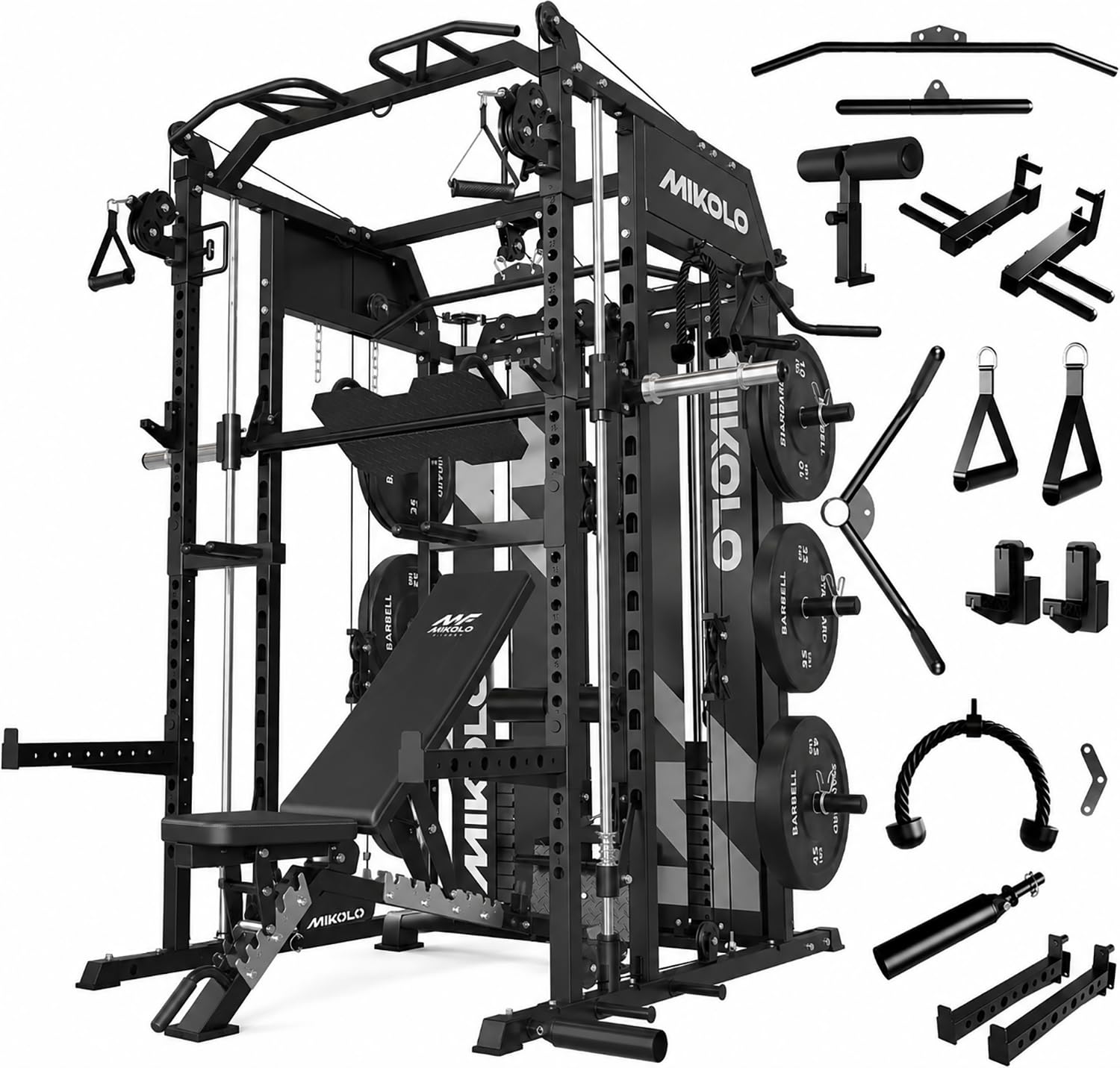
The 15-degree elevated cable on the Mikolo is a small thing that changes lat work. Instead of pulling straight down from the top of the cage, the high pulley sits forward of the uprights, and the same run doubles as a seated row. We noticed it most at the bottom of a pulldown, where the line of pull stays with your torso instead of drifting behind your head.

That detail is why this one earns its place near the top of this group. Two 128-pound stacks run independently, so a couple can train at the same time without one person's set changing the other's resistance, and the 2:1 ratio keeps the functional trainer light and quick. The uprights are the same 2-by-2 steel the top pick uses, and a bench is in the box, which saves a separate purchase.

What it doesn't do is go easy on the budget. The price buys the cable path, the two stacks, and the bench rather than raw capacity, and assembly takes an evening or two — better with the video than the paperwork. For a two-person household that lives on cables, though, nothing else here feels this close to a commercial gym floor.

Pros

  • Angled high cable doubles as a low row
  • Dual 128-lb stacks run independently
  • Bench and attachments included

Cons

  • 128-lb stacks cap resistance for strong cable lifters
Our verdict

Buy it if two people share the gym or you live on cables: independent stacks, an angled lat and row, and a bench in the box.

Check Latest Price
3

Best for Heavy Cable Work

Major Fitness Drone2

81 /100
Trail Score Excellent

Key details

Support
Lifetime after-sales
Capacity
2,000 lb
Uprights
2" x 2" steel
Pulley Ratio
1:1
Check Price on Amazon

A 1:1 pulley ratio means the weight you pin is the weight you pull. Much of this group runs 2:1, which halves the load at the handle in exchange for more travel and a silkier feel; the Drone2 gives you the resistance instead. For slow cable rows, presses, and flyes, that's the difference between a working set and a warm-up.

The pulleys are aluminum, the material you want if a consistent pull matters more to you than a low sticker, and the uprights are 2-by-2 steel with a 2,000-pound rating. Dip handles, a T-bar, and a solid set of attachments come in the box, so it's usable on day one instead of after a second order. We spent most of our time on the low cable, where the 1:1 feel is most obvious.

The ratio cuts both ways: light isolation work feels heavier than you may expect, and a face pull at ten pounds is genuinely ten pounds. That's the right trade for someone chasing cable strength rather than cable variety, and it's why this one sits behind the top pick for a general home gym.

Pros

  • 1:1 pulley puts the full selected load in hand
  • Aluminum pulley set for a consistent pull
  • Dip handles, T-bar, and attachments included

Cons

  • One-year warranty, shorter than several picks here
Our verdict

Pick this when cable work needs to feel heavy: the 1:1 ratio delivers the full load, and aluminum pulleys keep the pull consistent over years.

Check Latest Price
4

Best Value

SunHome SH-999 Smith Machine

86 /100
Trail Score Excellent

Key details

Steel
2 mm
Storage
6 plate posts, 1 bar post
Footprint
72"D x 60"W x 90"H
Unit Weight
440 lb
Check Price on Amazon

Six plate posts, a barbell post, and a set of storage hooks are the first thing we noticed, and they matter more than they sound. Plates live on the machine instead of the floor, which is the difference between a gym you use and a gym you step around.

The frame is 2-millimeter steel and the unit is listed at 440 pounds, so there's real mass under you before a single plate goes on. The pulley system uses rolling bearings rather than a plain slider, and the butterfly chest station adds a press you can't do on a bare cage. Weigh it against what the rest of this group asks and it's the most machine here for the money.

What you're buying is breadth. A Smith bar, a cable crossover, a chest station, and storage in one footprint, with none of it feeling like an afterthought until you reach the details. It's the pick for a first home gym where the goal is to stop paying for a membership, and it's the machine we point people toward when the budget is the first question.

One thing to practise: the auto-lock hooks want a deliberate turn of the wrist, and if the bar drifts at the end of a set, catching a hook can take a second pass. Set the spotter arms as your backstop and rehearse the lock with an empty bar before you load it.

Pros

  • Plate and bar storage built into the frame
  • Butterfly chest station adds a pressing option
  • 440-lb frame feels planted before loading

Cons

  • 90 inches tall; ceiling clearance is tight
  • Instructions are the weakest part of the build
Our verdict

The most machine for the money here: a Smith bar, a crossover, a chest station, and plate storage on one 440-pound frame.

Check Latest Price
5

Best for Small Rooms

RitFit Smith Machine Power Rack

84 /100
Trail Score Excellent

Key details

Steel
2 mm
Capacity
1,000 lb
Included
13 accessories
Footprint
44"D x 45.3"W x 82"H
Check Price on Amazon

Forty-four inches deep and 45.3 wide is the smallest footprint in this guide, and it's the whole reason this RitFit exists. It's a half rack rather than a full cage, so you squat inside a shorter frame with the Smith bar running on the uprights, and it tucks into a spare bedroom or the last free bay of a garage without eating the room.

For the money it does an enormous amount: a Smith bar, a lat pulldown, a landmine, safety hooks, and 13 accessories in the box. The frame is 2-millimeter steel rated to 1,000 pounds, which is honest for a machine this size, and the 36-month structural warranty is longer than several machines here that cost far more.

The frame is light enough that a hard set can shift it, so bolt it down or keep plates on the storage pegs; anchored, it settles into something that feels much bigger than its footprint. That's the trade for a machine you can fit into a room that was never a gym.

Pros

  • Smallest footprint here at 44 by 45.3 inches
  • Landmine, lat pulldown, and 13 accessories included
  • 36-month structural frame warranty

Cons

  • Lat pulldown only, with no cable crossover
  • 1,000-lb capacity is the lowest of these picks
Our verdict

The pick when floor space decides: a 44-inch-deep Smith rack with a lat pulldown, a landmine, and a 36-month frame warranty.

Check Latest Price
6

Shared Workouts

SunHome 925 Home Gym System

89 /100
Trail Score Excellent

Key details

Extras
Leg press and lat station
Stations
Two, independent
Footprint
96.85"D x 55.12"W x 86.61"H
Weight Stack
138 lb
Check Price on Amazon

The seat doesn't adjust. On a machine that includes a leg press and a lat station, that single fixed dimension decides whether the SunHome fits you: go much over six feet and the cable stations can run out of range before your arms do, go well under five and a half and the leg press may not line up. Measure yourself against it before you order.

Past that, it's a lot of gym for the money. A 138-pound selectorized stack means no plate loading for cable work, the two sides run independently so a couple can train at once, and the leg press attachment is one most machines here simply don't include.

We like it as a shared machine. Two stations and more than 100 exercises come out of one footprint, and the frame is steady enough to trust with a loaded bar. The stack is light for a strong lifter on its own, but the leg press and the lat station are where this one earns its place.

Pros

  • 138-lb selectorized stack needs no plate loading
  • Leg press attachment included at this price
  • Two stations run independently for shared sessions

Cons

  • Largest footprint here at nearly 97 inches deep
Our verdict

The cheapest way into a weight stack and a leg press here, with independent stations, provided the fixed seat suits your height.

Check Latest Price
7

Cable-Focused Work

pooboo P43 Power Cage

92 /100
Trail Score Outstanding

Key details

Included
20+ attachments
Footprint
62.9"D x 43.3"W x 82.6"H
Cable Rating
1,000 lb
Cage Capacity
2,000 lb
Check Price on Amazon

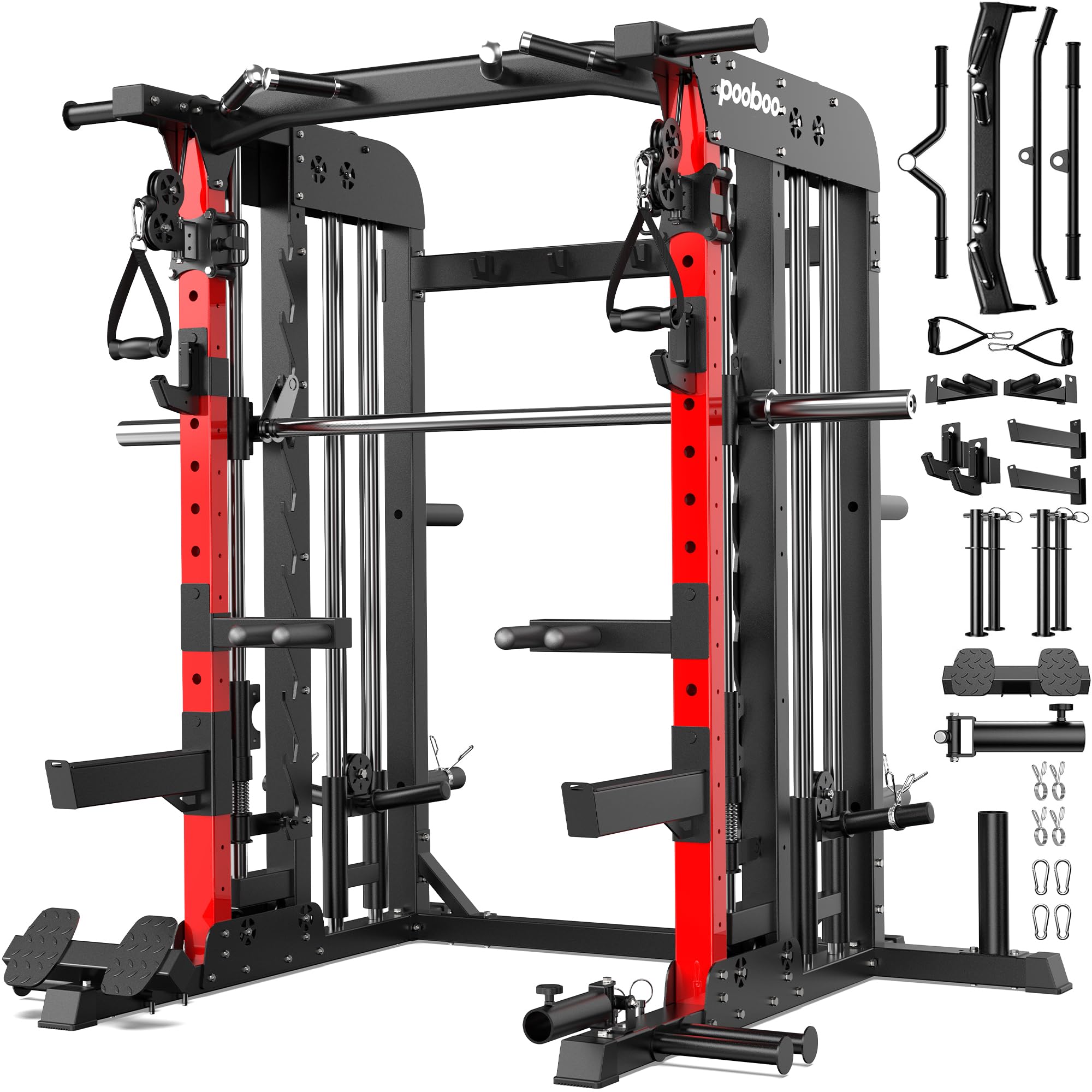
At 43.3 inches wide, the pooboo is the narrowest full cage here, and that's the number that decides whether a machine fits between a water heater and a wall. The trade is depth: 62.9 inches front to back, so it wants a long wall rather than a wide one.

What you get for it is a genuinely well-equipped cage. A dual-pulley cable crossover rated to 1,000 pounds, a lat pulldown, J hooks, spotter arms, dip bars, and more than 20 attachments in the box, all on a frame listed at 417 pounds — heavy enough that racking a bar doesn't skitter it across the floor.

Here's the honest boundary. pooboo sells this as a Smith machine, but what the listing actually describes is a power cage with a cable system and a free bar: J hooks and spotter arms rather than a track. If a guided bar is the part you care about most, the SunHome and the DONOW are the safer calls; if your training is cables plus a barbell, we struggle to name a better-equipped cage for the money.

Pros

  • Narrowest full cage here at 43.3 inches
  • Dual-pulley crossover rated to 1,000 lb
  • More than 20 attachments in the box
  • 2,000-lb cage rating on a 417-lb frame

Cons

No notable drawbacks to flag.

Our verdict

For cable-and-barbell training, this is the standout here: a dual-pulley crossover, 20-plus attachments, and the narrowest full cage in the guide.

Check Latest Price
8

Leg Press Training

ALL10 Smith Machine Home Gym

87 /100
Trail Score Excellent

Key details

Included
Leg press attachment
Footprint
68.7"D x 57"W x 80.7"H
Pulley Ratio
2:1 and 1:1
Weight Stacks
Two 175-lb stacks
Check Price on Amazon

Switchable pulley ratios are the ALL10's clever bit. You can run the cables at 2:1 for fast, smooth reps and switch to 1:1 when you want the stack to feel like its number, which is more flexibility than any other machine here offers.

The rest of the package aims at the same buyer: two 175-pound stacks, a leg press attachment, a lat pulldown seat, and 50-by-50-millimeter steel rated to 2,000 pounds. The leg press is the differentiator for us — it's the movement most of these machines make you improvise, and here it's a station.

It's also the shortest cage in this guide at 80.7 inches, which matters under ductwork or a low basement joist. Assembly is the tax: nine packages, instructions that are the weak link, and a weekend you should plan for rather than squeeze in. What you end up with covers leg day and cable day without two machines bolted together.

Pros

  • Switchable 2:1 and 1:1 cable ratios
  • 350 lb across two 175-lb weight stacks
  • Leg press attachment and lat pulldown seat included
  • Shortest cage here at 80.7 inches

Cons

  • One-year warranty, short for the price
Our verdict

If you want a leg press and cables that feel light or heavy on demand, this is the most flexible machine here.

Check Latest Price
9

Compact Cage

RitFit M1 Pro Smith Machine

83 /100
Trail Score Excellent

Key details

Capacity
1,850 lb
Warranty
Lifetime frame
Footprint
63"D x 47.8"W x 85.2"H
Unit Weight
360 lb
Check Price on Amazon

Just under 21 square feet is the number RitFit leads with, and it's a fair headline: a full-height cage with a Smith bar and a dual cable crossover, sized for a room that was never meant to be a gym.

The hardware is good. The Smith bar runs on linear bearings with spring protection, the pulleys are aluminum, and the frame is rated to 1,850 pounds, which puts it closer to the premium machines here than the price suggests.

For a spare room or a garage bay where every inch is spoken for, that combination is hard to beat: full cage, Smith bar, crossover, and the best warranty in this guide, with the structural steel and welds covered for life. It's a machine you buy for the cage and the footprint first and the cables second.

Pros

  • Full cage and crossover in under 21 square feet
  • 1,850-lb capacity on a 360-lb frame
  • Lifetime warranty on the structural steel

Cons

  • Cable trolleys can bind and drag on the rails
Our verdict

Best cage here for a tight room: full height, 1,850-pound rated, lifetime frame warranty, and under 21 square feet.

Check Latest Price

How We Tested Home Smith Machines

We started by gathering the Smith machines actually sold for home gyms, then filtered by footprint, frame gauge, bar system, attachment options, and price. That left six machines we could live with long enough to judge — enough variety to compare a compact budget frame against a beefier rig without pretending we'd tested the entire market.

Each arrived in flat boxes, so we timed the build with two people, checked the hardware against the manual, and noted where the instructions got vague or assumed a second set of hands. Once built, the machines went into a garage gym and a spare bedroom — the two places these things usually land — and we trained on them for nine months, usually early mornings before work and longer weekend sessions. We squatted, benched, rowed, and pressed, swapping the bar hooks and safety catches between sets to see how easy each machine was to use when you were already under load.

Sturdiness got judged on heavy squats and rack pulls: we watched for frame walk, foot lift, and any flex at the uprights. Smooth operation meant running the bar through slow reps and paused reps, feeling for catches or gritty spots. For machines with cable attachments, we tracked how the cables ran, whether they rubbed the frame, and where the handles parked. We also looked at welds, powder coat, and hardware up close, and compared what each machine included at its price — attachments, plate storage, and adjustability — against how solid it felt.

How to Choose a Smith Machine for a Home Gym

Measure the floor and the ceiling first

Start with three numbers: width, depth, and height. The machines here run from 43.3 to 78.6 inches wide and 44 to nearly 97 inches deep, which is the difference between a spare corner and half a garage. Add room to load plates on both sides and to step back from the bar without clipping a wall.

Height decides as much as floor space. Frames in this guide run 80.7 to 90 inches tall, and a pull-up bar needs clearance above it, so a low basement ceiling rules out the tallest machines before price enters the conversation. Mark the footprint on the floor with tape and stand inside it before you order anything.

Decide what the bar needs to do

A Smith machine's real value is the guided bar: it tracks in a fixed path, so you can press or squat without a spotter and park the bar on a hook when a rep fails. Look at how the bar travels and how the catches behave. Linear bearings glide; simpler tracks can drag. The hooks should engage with a deliberate wrist turn, and the safety arms should sit below your lowest rep.

Be honest about whether you need the guided track at all. If your training is mostly cables plus a free barbell, a power cage with a cable system does that job, and the pooboo here shows how much crossover you get for less than a full Smith setup.

Understand what the cables are pulling

There are two ways to resist a cable: hang plates on a carriage or slide a pin into a stack. Plate-loaded systems cost less and never run out of load; selectorized stacks change weight faster and keep plates off the floor. Two independent stacks also let two people train at once without stepping on each other's sets.

Then check the ratio. A 1:1 pulley gives you the load you selected, while a 2:1 halves it in exchange for more cable travel and a smoother feel. We prefer 1:1 for slow, heavy cable work and 2:1 for high-rep and isolation sets, and the ALL10 lets you switch between both, which is the most flexible arrangement in this group.

Plan for assembly, anchoring, and fit

Every machine here ships in several boxes and takes hours rather than minutes; one arrives in nine packages. Line up a second person, watch the video if there is one, and treat the printed instructions as a rough guide, because they're the weakest part of most of these kits.

Then think about how the machine stays put. Lighter frames need bolting down or ballast from stored plates, and a rack that shifts under a loaded bar is the one safety problem worth designing around. Finally, check the seat and bench: a fixed seat is fine at average height and a genuine limitation above or below it, which is the first thing to check on the SunHome 925.

Frequently Asked Questions

Final Verdict

Our pick for most home gyms is the DONOW. Two independent stacks and a linear-bearing Smith bar cover the two kinds of training most people actually do, and 2,240 pounds of capacity means you'll replace the room before you replace the machine.

If the room is the constraint, the RitFit half rack is the better buy: 44 inches of depth gets you a Smith bar and a lat pulldown where a full cage won't go. Otherwise, this is where to stop shopping.