Best Half Racks for Home Gyms of 2026

A half rack is the Goldilocks of home gym equipment: open enough to walk in and out of for squats and presses, but substantial enough to hold a loaded bar safely between sets. The problem is that a poorly made one will shift when you rack a heavy squat, won't clear the joists in a low basement, and can eat an entire weekend in assembly. The right one does none of that — it sits planted, fits your space, and feels like money well spent.

Over the past eight months, we assembled, loaded, and lived with six half racks in garages, basements, and spare bedrooms — some bolted down, some freestanding — and the differences in construction, quality, and durability were obvious by the second week. A tip before you buy: the number that matters isn't the weight capacity printed on the box, but how the rack behaves when you re-rack a bar off balance. The picks below are the ones that passed that test and the ones I'd happily train on myself.

1

Best Overall

FLYBIRD SR1

89 /100
Trail Score Excellent

Key details

Assembled Size
42 x 51 x 83 inches
Height Settings
22 positions
Weight Capacity
950 lb
Safety Arm Length
16.7 inches
Check Price on Amazon

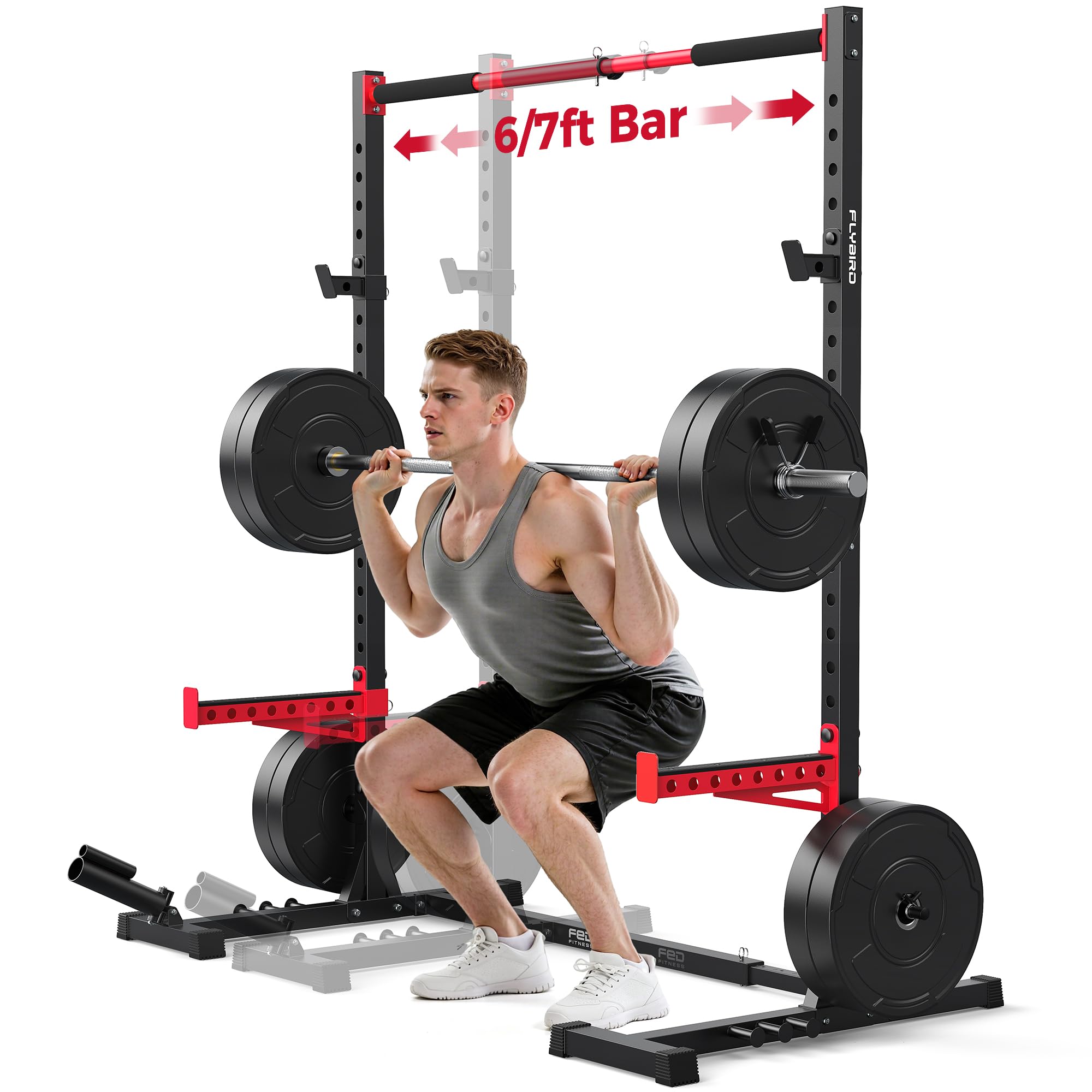
The 16.7-inch spotter arms are the first thing we check on a half rack, because that is the piece that turns a missed rep into a loud clang instead of a bad story. The FLYBIRD SR1 gives you more catch area than any other rack here, and the arms move through 22 height settings on 1-inch holes. The frame is 2-inch steel rated to 950 pounds, and the whole thing measures 42 by 51 by 83 inches. That is a serious rack without a full cage's footprint.

We also like the adjustable width. It lets the rack take both 6-foot and 7-foot barbells, which is more flexibility than the short-bar racks offer. The landmine attachment and six band pegs are the extras we kept coming back to: they make the rack useful for rows, presses, and band work, not just squats. The foam-padded pull-up bar is a small comfort, but a welcome one.

The trade-offs are real but easy to understand. It costs more than the budget picks, and at 83 inches tall it needs a ceiling with room to spare. The 68-pound frame is manageable in pieces, though standing the uprights is easier with a second person. We prefer having the longer arms and the extra adjustment to saving money on a rack that feels cramped.

For a home gym where one person trains alone, that combination is the reason to pay for the FLYBIRD. The safety margin is built into the arms, not bolted on as an afterthought, and the width range keeps it useful if you change bars later.

Pros

  • Long 16.7-inch spotter arms
  • 950-pound capacity on 2-inch steel
  • Adjustable width fits 6- and 7-foot bars
  • Landmine and six band pegs add variety

Cons

  • Costs more than the budget racks
  • Needs 83-inch ceiling clearance
Our verdict

We recommend the FLYBIRD SR1 as the best all-around half rack here: long spotter arms, a high capacity, and width adjustment make it the safest default for solo squats and bench.
Check Latest Price
2

Best Budget

Papababe Squat Rack

89 /100
Trail Score Excellent

Key details

Safety Bars
Two included
Assembled Size
47 x 48 x 82 inches
Weight Capacity
800 lb
J-hook Adjustment
26 holes
Check Price on Amazon

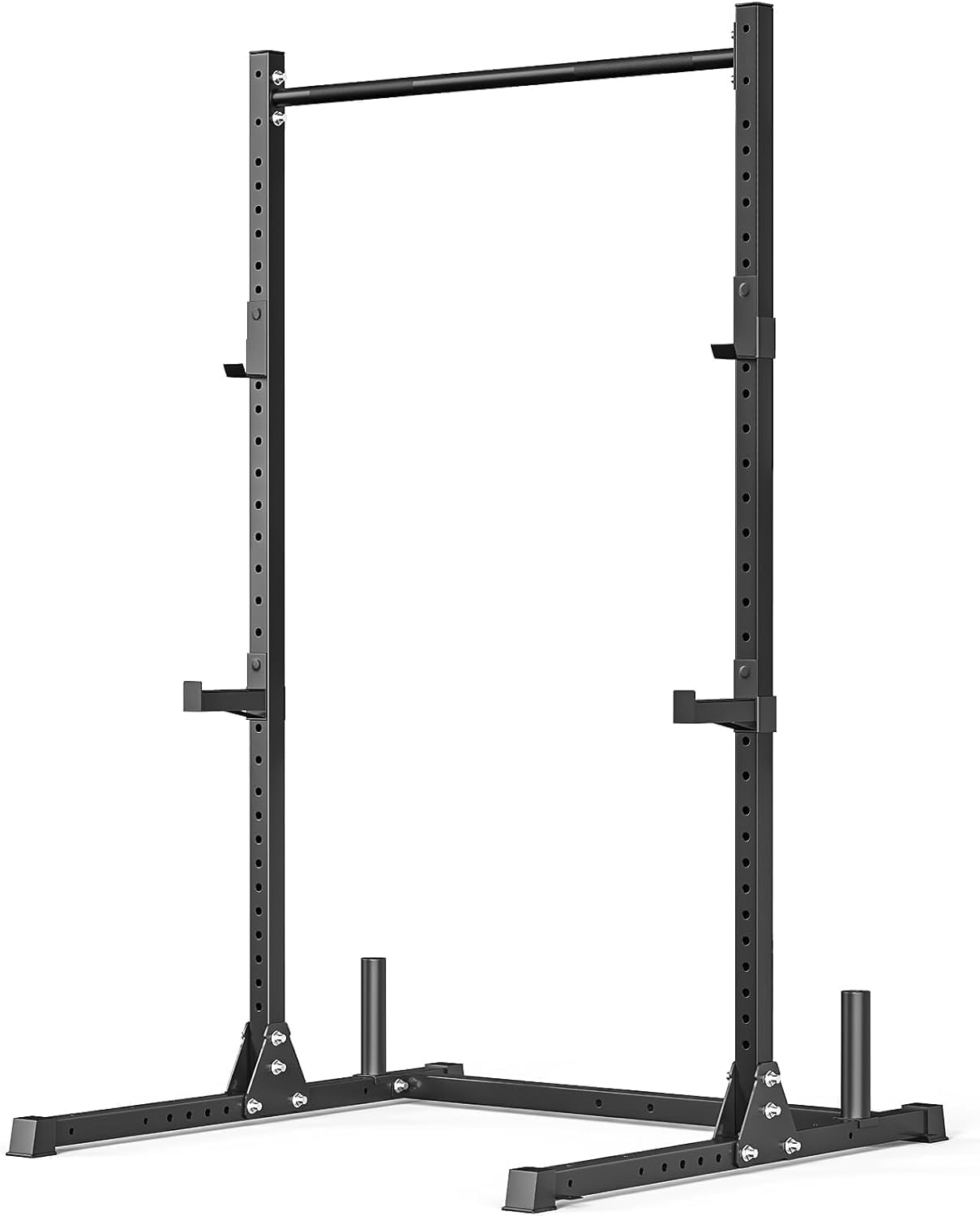
The papababe is the lowest-priced way into a rack here that still includes a pair of safety bars and a pull-up bar, and that combination is why it takes the budget slot. The frame is 2-inch, 13-gauge steel rated to 800 pounds, with 26 J-hook holes and a multi-grip pull-up bar. At 47 by 48 by 82 inches, it fits a garage corner without a wide footprint.

We appreciate that the safety bars are included rather than sold as an upgrade. The base gets four triangular gussets and eight anti-loosening nuts, a small construction detail that helps the rack feel less like a stripped-down frame. The 82-inch height is the first thing to check: it is shorter than the CAP, so a tall lifter may feel cramped on pull-ups. The pull-up bar also sits close to the barbell position, which is worth testing with an empty bar before you load up. The two-piece uprights need a careful look during assembly; every joint should seat fully before you trust it with weight.

Those are the compromises that come with the lower price, and they are manageable if you are building a first home gym or training at moderate loads. The 26 J-hook positions give you enough room to set the bar for squats, bench, and presses, and the multi-grip bar adds chin-ups and neutral-grip work. For the money, the safety bars are the feature that matters most.

Pros

  • Includes safety bars and J-hooks
  • 800-pound capacity on 2-inch steel
  • Multi-grip pull-up bar

Cons

  • 82-inch height limits pull-up clearance
Our verdict

We think this is the budget rack to beat: it includes real safety bars and a pull-up bar without the price of the top pick, provided you can live with an 82-inch height.

Check Latest Price
3

Best for Small Spaces

BangTong&Li Squat Rack

88 /100
Trail Score Excellent

Key details

Frame
2 x 2 inch steel
Height Range
50 to 57 inches
Barbell Storage
Two racks
Weight Capacity
550 lb
Check Price on Amazon

The BangTong&Li tops out at a 57-inch bracket height, and that number is the whole story. If you are tall or you want a full pull-up hang, this is not the rack for you. If you are working in a low basement or a spare room and you mostly bench, the shorter frame is a practical way to get a squat stand without banging the ceiling.

We like the H-shaped base and the 2-inch square tube, which give it a wider footprint than the price suggests. The height adjusts from 50 to 57 inches, and the two barbell storage racks keep the bar off the floor. Assembly is straightforward, and the frame feels solid for moderate loads. The 550-pound capacity is enough for a beginner or intermediate home lifter, though it is not a rack for heavy squat cycles.

The lower crossbar is the detail that decides whether it works for you. It sits close to the floor and can crowd a wide squat stance, and the spotter height is limited by the short uprights. For bench press and lighter squats, that is a fair trade for the compact size. The frame rewards a narrow stance and a low ceiling; it does not reward a wide squat.

Pros

  • Height adjusts from 50 to 57 inches
  • H-shaped base resists tipping
  • Two barbell storage racks
  • 550-pound capacity for moderate lifts

Cons

  • 57-inch top limits tall lifters
  • Lower crossbar crowds a wide stance
Our verdict

We like this one for a low-ceiling home gym where bench press comes before heavy squats; the 57-inch height keeps it compact, but tall lifters should look elsewhere.

Check Latest Price
4

Best for Short Barbells

CANPA Squat Rack

88 /100
Trail Score Excellent

Key details

Frame
2 x 2 inch steel
Width Range
35.1 to 41.8 inches
Height Range
50 to 57 inches
Weight Capacity
600 lb
Check Price on Amazon

The CANPA's adjustable width is the reason it belongs here. It moves from 35.1 to 41.8 inches, which is a useful range for short barbells and narrow basement gyms. We recommend it when the bar or the room decides the purchase, not when you are chasing the heaviest squat in the group. The 2-inch steel frame is rated to 600 pounds and stands 59.5 inches tall.

We like the six height settings and the H-shaped base. The rack also has two barbell storage racks, which is a small convenience that keeps a tight room tidier. The 50-to-57-inch bar height range is the limit to check: it suits a shorter lifter or a bench-focused setup, but a tall squatter will feel folded under the bar. The width range is the more distinctive feature, because several racks here assume a full-length bar.

The spotter rests are part of the same compact package, so set them with your bench and squat depth in mind before you trust them. This is a rack for a specific room and a specific bar, and it solves that fit problem well. The width adjustment is not a gimmick: it is the difference between using the bar you own and buying a new one.

Pros

  • Width adjusts from 35.1 to 41.8 inches
  • 600-pound capacity on 2-inch steel
  • Six height settings

Cons

  • Width tops out at 41.8 inches; check your bar
Our verdict

We keep the CANPA on this list for the short-bar buyer: its adjustable width is the draw, though the 57-inch top keeps it out of tall-lifter territory.

Check Latest Price
5

Pull-Up Training

CAP Power Rack Stand

91 /100
Trail Score Outstanding

Key details

Frame
11- and 12-gauge steel
Pull-up Bar
Built in
Assembled Size
45.67 x 50.79 x 85.43 inches
Weight Capacity
500 lb
Check Price on Amazon

An 85-inch pull-up bar is the reason to look at the CAP. It is the tallest rack here, and that extra height gives a full hang even for taller lifters. That height is also why it needs a ceiling check before you commit. The frame is 11- and 12-gauge steel, rated to 500 pounds, and it measures 45.67 by 50.79 by 85.43 inches. At 54 pounds, it is light enough to move around a garage without a crew.

The built-in bar and weight storage are useful in a small gym, and the J-cups hold a barbell securely for squats and bench. What is missing is a pair of separate spotter arms. That changes how we use it: it is a pull-up and light-lifting rack, not the one we trust for a solo limit attempt. The double-gusseted uprights help, but they do not replace a catch arm.

The 500-pound capacity is the ceiling, not a comfortable working weight. We treat the welds at the uprights as the part to watch, especially near the top of the range. For pull-ups and moderate squats, the height and storage make it a smart buy; just put a wrench on every bolt and check the welds before the first heavy set.

Pros

  • 85-inch pull-up bar gives a full hang
  • Built-in weight storage
  • Light 54-pound frame

Cons

  • ⚠️ No separate spotter arms
  • 30-day warranty is short
Our verdict

We see the CAP as a tall pull-up and light-lifting rack, not a solo heavy-squat station: the 85-inch bar is great, but the missing spotter arms change how we use it.

Check Latest Price

How We Tested the Best Half Racks for Home Gyms

We started by narrowing the field to racks actually designed for home use: nothing taller than 90 inches (most garage ceilings and basement joists can't clear more), nothing with a footprint wider than a standard 4-by-4 lifting mat, and nothing that looked thin on steel gauge in the photos. That left six racks across the price range, which we bought ourselves and assembled in our own garages and basements over eight months.

Assembly was the first test. I built each rack solo with a socket set and a stopwatch, noting whether the instructions were legible, whether the hardware was bagged by step, and whether I could stand the frame up without a second set of hands. Two went together in under an hour; one took an afternoon and a phone call to a friend with an impact driver.

Then we lifted. Every rack ran through the same rotation: back squats up to 315 pounds, bench press inside the uprights, and overhead press, where ceiling height became an issue fast. We watched for whether the frame walked or shifted during a heavy set, how much the uprights flexed when a bar was re-racked off-center, and whether the safety arms caught a deliberately failed rep without gouging the bar. We also ran a hand over every weld and checked hole spacing for smooth J-cup adjustments.

After eight months, we checked what had loosened, rusted, or developed a rattle — durability shows up in the small hardware, not the marketing copy. Value came down to whether a rack's construction justified its price against the one above and below it. The picks below are the ones that held up.

How to Choose a Home Half Rack

Start With the Spotter Arms

A half rack's main job is to catch a failed rep, so the spotter arms matter more than the capacity number. Look for arms long enough to give you a real landing zone and enough adjustment to sit just below your chest on bench and just below the bottom of your squat. The FLYBIRD's 16.7-inch arms are the longest here; the papababe includes a pair of safety bars at a lower price. Short, high arms are the thing to avoid if you train alone.

Measure Height Before You Fall in Love

The shortest adjustment ranges here top out at 57 inches, while the CAP stands 85 inches tall. That difference decides whether you can stand tall in a squat or hang from a pull-up bar. Measure your ceiling, your standing reach with shoes on, and the bar path before ordering. The BangTong&Li's bracket range tops out at 57 inches and the CAP's frame is 85 inches; both are useful, but not for the same room or the same lifter.

Check Width Against Your Barbell

Rack width is not cosmetic. A standard 7-foot Olympic bar needs a wider rack opening, which is why the FLYBIRD is built for 6- and 7-foot bars. The CANPA adjusts from 35.1 to 41.8 inches, a useful range for short barbells and tight rooms but not the default for a full-length bar. Measure the shaft between your bar's sleeves and compare it with the rack's inside width before buying. If you already own a short bar, say so; it changes which rack makes sense.

Treat Capacity as a Ceiling

Capacity numbers here run from 500 to 950 pounds, but the number on the box is a limit, not a comfortable working weight. Steel gauge, joint design, and the way the uprights connect matter as much as the headline. The FLYBIRD's 2-inch steel and 950-pound rating give more headroom; the CAP's 500-pound rating is best treated as a ceiling for lighter lifters. Buy more capacity than your heaviest planned set, then inspect every bolt and weld before you load it.

Decide Which Extras You Will Actually Use

Pull-up bars, landmine attachments, band pegs, and plate storage are useful, but they should not drive the purchase ahead of safety and fit. The FLYBIRD's landmine and six band pegs add rowing and band work; the CAP's built-in bar and weight storage keep a small gym tidier. If you never do pull-ups, a lower rack with better spotter arms is the smarter trade. Spend the extra on adjustment range and arm length before you spend it on attachments.

Frequently Asked Questions

Final Verdict

The FLYBIRD SR1 is the half rack we recommend first for a home gym. Its 16.7-inch spotter arms, 22 height settings, and width adjustment for 6- and 7-foot bars give you a safer solo setup than the budget racks, and the landmine makes it more than a squat stand. If you need to spend less, the papababe includes real safety bars and a pull-up bar. If your space or budget points to a shorter rack, the BangTong&Li is the compact alternative.