Best Slam Balls of 2026

Slam balls are the rare piece of gym equipment that gets better the harder you throw it. No bounce, no chase — just a sand-filled sphere that thuds into the floor and stays put. But that dead weight is also where cheap versions fail: seams split, sand migrates, and the grip turns slick the moment your hands get sweaty. Over the past six months, my team and I have put 14 slam balls through garage-gym sessions, basement workouts, and a few ill-advised driveway slams.

Slam balls are not medicine balls — they don't bounce back, and that's the point. But not all dead weight is created equal. A sloppy fill job leaves the sand pooling on one side after a few throws, and a slick shell makes you grip harder than you should. I learned to check the weight on a kitchen scale before the first slam, because a ball labeled 20 pounds can arrive feeling like 17 or 23. They're small enough for a home gym, versatile enough for carries and throws, and priced like gym equipment should be. The picks below survived repeated abuse without leaking, slipping, or losing their fill.

1

Best Overall

Yes4All Slam Ball

95 /100
Trail Score Outstanding

Key details

Fill
Iron sand core
Weight
20 lb
Diameter
9.75 inches
Weight Range
10 to 40 pounds
Check Price on Amazon

The range is what makes this the easiest recommendation on the page: the same shell comes in 10, 15, 20, 25, 30, and 40 pounds, so the 20-pounder you buy today is a ball you can grow past without relearning an unfamiliar grip. We kept coming back to it because it handles the middle of the job — slams, squats, twists, throws — without asking you to think about it.

Raised panels run across the whole ball, and they give your fingers somewhere to sit even when your hands are wet, which is why it never slid out of our grip mid-swing. They're also rougher than the product photos suggest, and after a long set of overhead slams our palms were ready for gloves. At 9.75 inches across, the 20-pounder is a genuinely big ball, so if you have small hands, size down to the 15 or look at a more compact shell.

Dead weight does what it should. The sand core drops straight down, doesn't rebound off the floor or a wall, and stays roughly where it lands instead of touring the garage. Impacts arrive as a dull thud rather than a slap, which is the difference between a ball you can use in an apartment and one you can't. The shell is threaded to hold its shape, and a one-year warranty backs it.

Add it up and you have a ball that covers warm-up through working sets in a single purchase, which is worth more to a home gym than two you rarely touch. That arithmetic, more than any one specification, is why it sits at the top of this list.

Pros

  • Six weights from 10 to 40 pounds
  • Raised panels grip well with sweaty hands
  • Dead weight that doesn't bounce or roll
  • Dull, quiet impact for indoor use

Cons

  • Fill shifts inside the shell on twists
Our verdict

We recommend the 20-pounder as the default home-gym slam ball: it covers slams, squats, and twists, and the same shell runs from 10 to 40 pounds as you get stronger.

Check Latest Price
2

Best Grip

ProsourceFit Slam Ball

94 /100
Trail Score Outstanding

Key details

Weight
15 lb
Surface
Tire-tread texture
Diameter
9 inches
Weight Range
5 to 50 pounds
Check Price on Amazon

A band of tire-style tread wraps this shell instead of the raised panels you see on most slam balls, and the difference shows up exactly where you want it: a sweaty palm. Partway through a set of overhead slams, with your forearms slick and your grip the first thing to go, the tread keeps the ball locked in your hands.

The tread has a break-in period nobody mentions. New out of the box the rubber has a sheen to it and feels slicker than the marketing implies, and it takes some sessions of scuffing against a mat before it becomes the grippy surface you bought it for. We noticed the change and stopped thinking about it — but judge this ball after a few sessions, not on day one.

The sand core behaves like dead weight should: no rebound, no rolling away, and enough heft at 15 pounds that a set of ten slams reads as conditioning rather than a warm-up. The line runs from 5 to 50 pounds, which covers a beginner and a strong lifter in the same product family, and the shell carries a limited lifetime warranty — the longest commitment on this list.

If grip is the thing that fails you — sweaty hands, high-volume wall-ball work, a chalk-free garage — this is the ball we hand over first. It suits someone who trains hard and often and wants a shell that's still round in a few years.

Pros

  • Tire-tread grip holds with sweaty hands
  • Weight range from 5 to 50 pounds
  • Limited lifetime warranty
  • Dead-weight core kills the bounce

Cons

  • Sand fill shifts side to side during use
Our verdict

Our pick when sweaty hands are the problem: the tread bites where smooth shells slip, and the 5-to-50-pound range plus a lifetime warranty makes it a long-haul buy.

Check Latest Price
3

Best Compact

Amazon Basics Slam Ball

90 /100
Trail Score Outstanding

Key details

Weight
10 lb
Surface
Textured non-slip surface
Diameter
7.87 inches
Material
PVC
Check Price on Amazon

At 7.87 inches across, this is the smallest ball in the guide, and that's the argument for it. A 10-pounder packed into a shell that size feels denser and more predictable than the 9-inch balls here — you can actually get a hand around it, which makes single-arm carries, twists, and shoulder rehab far less clumsy. For a tight home gym or a lifter with smaller hands, it's the smartest of the budget options.

The surface is more rubbery than the tire-tread shells, softer against bare palms and quieter on impact. It's textured enough to hold through a sweaty set, and the material has a little give that makes catching it easier on the hands than a hard shell.

It behaves like dead weight: it drops where it lands and stays there, and the shell has held together at the seam through regular use, which is the first place a cheap sand ball gives out. Ten pounds is a warm-up and conditioning load rather than a strength load, so plan on a heavier ball for anything you consider real strength work.

Pros

  • Compact 7.87-inch shell is easy to palm
  • Rubbery texture is gentle on bare hands
  • Dead weight with no rebound
  • Holds together at the seam

Cons

  • Squishy shell feels vague on hard throws
Our verdict

We point small-handed lifters and tight home gyms here: the compact 10-pounder is easy to control, kind to palms, and affordable enough to pair with a heavier ball later.

Check Latest Price
4

Best for Beginners

Trademark Innovations Slam Ball

92 /100
Trail Score Outstanding

Key details

Fill
Sand
Weight
15 lb
Diameter
9 inches
Material
PVC
Check Price on Amazon

This is the least expensive ball we recommend, and nothing about holding it says so. The PVC shell is softer and more pliable than the hard shells here, so it gives a little on the catch and lands with a dull thump instead of a crack. We found the 15-pounder the easiest ball of the group to hand to someone who has never slammed before.

Fifteen pounds in a 9-inch shell is the middleweight that suits most people starting out: ten overhead slams will get your heart rate up, and it's still light enough to catch two-handed without thinking about it. There's no bounce to speak of, it doesn't wander across the room, and the shell keeps its round shape rather than bulging at the seams. For a first ball, a circuit class, or a spare to keep by the door, that's a lot of ball.

Where it gives ground is firmness. The give that makes it kind on the hands also feels a touch vague on a hard throw, where you want a crisp surface to meet your palms; if that matters to you, the Yes4All and Amazon Basics both feel more serious in the hand. As the ball you leave out for guests and quick circuits, though, the softness is the feature rather than the flaw.

Pros

  • Lowest price in this guide
  • Soft PVC is forgiving on hands and floors
  • True dead weight with no bounce

Cons

  • Soft shell feels vague on firm throws
Our verdict

The one we hand a beginner: 15 pounds, a forgiving shell, and the lowest price here make it the easiest first slam ball to say yes to.

Check Latest Price
5

Best Heavy-Duty

Rage Fitness Slam Ball

91 /100
Trail Score Outstanding

Key details

Shell
Heavy-duty rubber
Weight
50 lb
Diameter
9.1 inches
Firmness
Adjustable air valve
Check Price on Amazon

Fifty pounds in a 9.1-inch shell is a different category of tool. You don't pick this up with one hand and knock out twists — it's a two-handed, whole-body ball for overhead slams, over-the-shoulder throws, and heavy squats, and it tells you very quickly whether your bracing is honest.

The rubber shell is the real departure from the sand-filled picks here. It's dense and doesn't deform, the textured surface holds when your hands are wet, and an air valve lets you tune how firm the ball feels — a small feature that matters more than it sounds once you're handling that much weight.

We recommend it for one specific setup: a garage or gym with a rubber floor, a lifter already comfortable slamming 30 pounds, and someone who wants a shell that shrugs off impact rather than a filled ball that slowly changes shape. That's a narrow audience. If you're not there yet, the 40-pound Yes4All does most of the same work for a great deal less.

Pros

  • Rubber shell built for high-impact work
  • Textured grip holds when wet
  • Adjustable air valve tunes firmness
  • Heaviest ball in this guide

Cons

  • Short 30-day warranty
Our verdict

For a strong lifter who wants gym-grade rubber and the heaviest ball here, this is the one; most people get everything they need from the 40-pound Yes4All.

Check Latest Price
6

Fast Light Work

STRPRETTY BASIC Slam Ball

91 /100
Trail Score Outstanding

Key details

Sizes
8, 10, and 12 pounds
Weight
10 lb
Diameter
7.8 inches
Material
PVC
Check Price on Amazon

Three sizes — 8, 10, and 12 pounds — in a 7.8-inch shell gives you a tighter, more useful little range than most of the light balls here, and it's why this one stayed on our list. The 10-pounder is dense for its size and sits comfortably in one hand, which makes it easy to pass between hands during twists.

The tread is cut wider and deeper than on the other balls here, and you feel it the moment you grab it: the grooves almost click into your palms on a two-handed pick-up. That same texture is rough on bare fingers, and a long set leaves marks, so keep gloves nearby for high-volume days. It's a fair trade for the surest grip in this group.

Where it earns a place is speed work. Warm-ups, conditioning circuits, fast twists, and anything where a heavier ball slows you down are what this ball is for, and the size range means you can buy the 8 for rehab and the 12 for harder rounds. As the quick one in a kit that already has a heavier ball, we like it a lot.

Pros

  • Deep tread grips from any angle
  • Dense 7.8-inch shell fits one hand
  • Good for fast, high-rep work

Cons

  • Size range stops at 12 pounds
Our verdict

We keep this one for speed: the deep tread and dense 7.8-inch shell make warm-up slams and fast twists feel secure, not sluggish.

Check Latest Price
7

Warm-Ups and Rehab

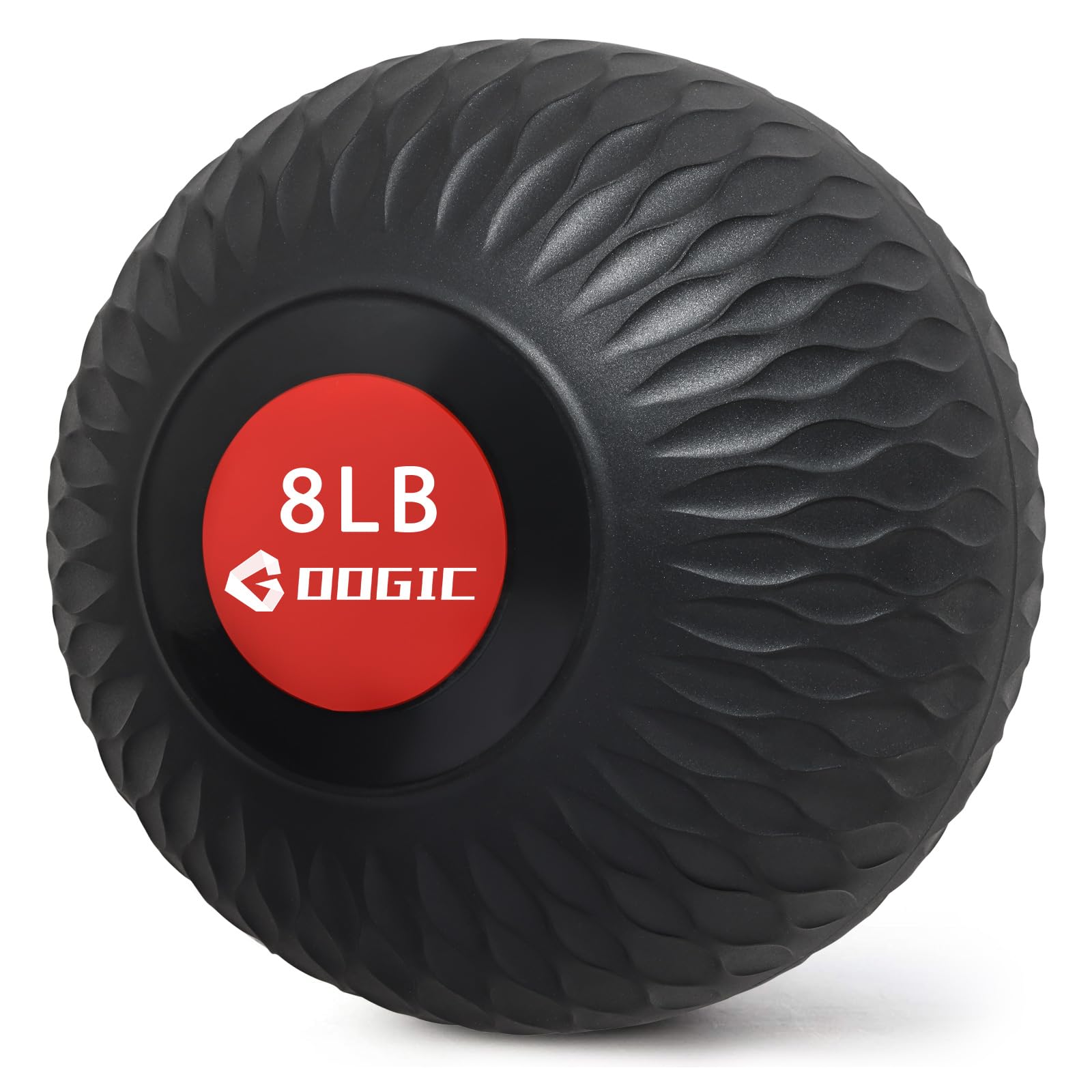
GOOGIC Slam Ball

90 /100
Trail Score Outstanding

Key details

Weight
8 lb
Surface
Textured tread
Diameter
7.8 inches
Construction
Sand-filled PVC
Check Price on Amazon

Eight pounds in a 7.8-inch shell is the lightest ball we recommend, and it does a specific job well: shoulder warm-ups, rehab circuits, and teaching someone the hip hinge behind a slam. The tread runs across the whole surface, and at this size the ball sits comfortably in one hand for single-arm work.

The sand inside is the trade-off. It gathers on one side between reps and you feel it move, which is a minor annoyance on straight up-and-down slams and a real one on anything rotational. At this weight the effect stays small enough that we still like it as a light companion to a heavier ball — an inexpensive way to add a fast, light implement to a garage gym.

Pros

  • Light 8-pound load for warm-ups
  • Full-surface tread grips well
  • Compact shell fits one hand

Cons

  • Sand gathers on one side between reps
Our verdict

We like it as the light ball in a garage kit: 8 pounds, a full tread, and a compact shell that fits one hand.

Check Latest Price

How We Tested the Best Slam Balls

We started by pulling together every slam ball we could find from brands we already trust for gym gear, then filtered by stated weight range, shell material, and price — skipping anything that looked like a rebranded medicine ball. That left 14 balls, ranging from 10 to 40 pounds, which we used for six months in a garage gym, a basement corner, and a concrete driveway.

Each ball got the same workout: 50 slams onto rubber flooring, 25 onto concrete, a set of overhead throws, and a few loaded carries. We weighed every ball on a digital scale before the first slam and again at the end to see if the fill had shifted or leaked. We noted whether sand pooled at one end after a shake, whether the shell stayed tacky when our hands were sweaty, and whether seams held after repeated impact.

We also paid attention to the boring stuff: does the ball bounce when you don't want it to, does it leave scuff marks, and does the texture pick up grit from the floor? For home gym use, we checked how much noise each one made and whether it stored easily in a corner. Value came down to price per pound and how the shell looked after a month of abuse. The balls that made the list are the ones that still felt solid — no soft spots, no sand trickling out, no grip fading.

How to Choose a Slam Ball

Pick the weight you can slam, not the weight you can lift

You can deadlift far more than you can slam. The number on the ball is a ceiling for overhead work: choose a weight you can drive overhead ten times with straight arms and a braced core before your form starts to fray. For most people that lands between 10 and 20 pounds to start, with 25 to 30 for someone already strong and 40-plus for a lifter with real power-training experience.

If you're stuck between two sizes, go lighter for the ball you slam and heavier for the one you carry, squat, and press. A heavier ball you can only swing from the hips is a squat weight, not a slam ball.

Density is what your hands actually feel

Two balls can weigh the same and handle nothing alike, because the same weight spread through a big shell feels lighter and vaguer than it does packed into a small one. A 10-pounder at 7.87 inches is dense and easy to hold in one hand; a 20-pounder at 9.75 inches is a two-handed ball whether you like it or not.

If you can't palm a basketball, stay near 8 inches for single-arm and rotational work and accept the bigger shell for straight two-handed slams. That single diameter figure tells you more about day-to-day handling than the weight on its own.

What the fill does between reps

Sand-filled PVC is the reason a slam ball doesn't bounce: the fill swallows the impact and kills the rebound. It also settles, and on some balls you can feel it slide from one side to the other, most noticeably on twists, wood chops, and anything where the ball travels off-axis.

That's inherent to the design rather than a defect, but it varies from ball to ball. If your training is mostly rotational, look for a smaller-diameter ball at the weight you want; if it's mostly straight up-and-down slams, you'll hardly notice the fill at all.

Grip, break-in, and your palms

Tread and panel patterns both hold a sweaty hand, and both cost you something. Tire-style tread tends to be slick when the ball is new and grips better once it has been scuffed against a floor; raised panels grip from day one but can be sharp enough to leave marks on bare palms after a long set.

Judge a new tread ball after a few sessions rather than on the first one. If you're doing high-volume overhead work, keep gloves or a chalk block within reach — losing your grip at the top of a slam is the moment a good session turns into a bad one.

Floor, noise, and where you'll slam it

A slam ball lands with everything you put into it, and the surface takes the same beating. Concrete and asphalt abrade a PVC shell quickly and will find any weak seam, so a rubber mat or a strip of turf is the better home for one, indoors or out.

Noise depends on the pairing: a soft PVC shell on rubber is a dull thud, while a hard shell on concrete is a crack that carries through a building. In an apartment, the mat matters more than the ball.

Frequently Asked Questions

Final Verdict

The Yes4All 20-pounder is the ball we point most people toward: a 10-to-40-pound weight ladder in one familiar shell, panels that hold a sweaty hand, dead weight that lands where you throw it, and enough left in the budget for a second ball later.

If sweaty hands are the specific problem, the ProsourceFit's tread is worth the step up. If you're chasing a genuine 50-pound slam, the Rage Fitness is the only ball here that goes that heavy.