Best Vertical Climbers of 2026

A vertical climber makes a simple bargain: you hang your weight off the handles, drive with your legs, and get a serious climbing workout out of a machine that takes up about as much floor space as an ironing board. The catch is that the bargain only holds if the frame is stable. Budget models shudder the moment you pick up speed, folding joints start to rattle within weeks, and a wobbly base is the fastest way to stop climbing altogether. What you're actually paying for is a machine that doesn't flinch when you push.

I've had a climber in my living room on and off for years, and the ones that stick around share more than a good sweat. Over the past six months, my team assembled, climbed on, and lived with 10 vertical climbers, and one thing first-timers never expect is how much of your body weight ends up in the handles — grip comfort matters as much as the frame. The picks below are the ones that felt sturdy at speed, stayed reasonably quiet, and were still set up and in use a month later.

1

Best Overall

MaxiClimber 2.0

86 /100
Trail Score Excellent

Key details

Storage
Folds for storage
Resistance
Elastic Resistance System (ERS)
Weight Capacity
250 lb
Assembled Dimensions
38.93"L x 27.95"W x 85.31"H
Check Price on Amazon

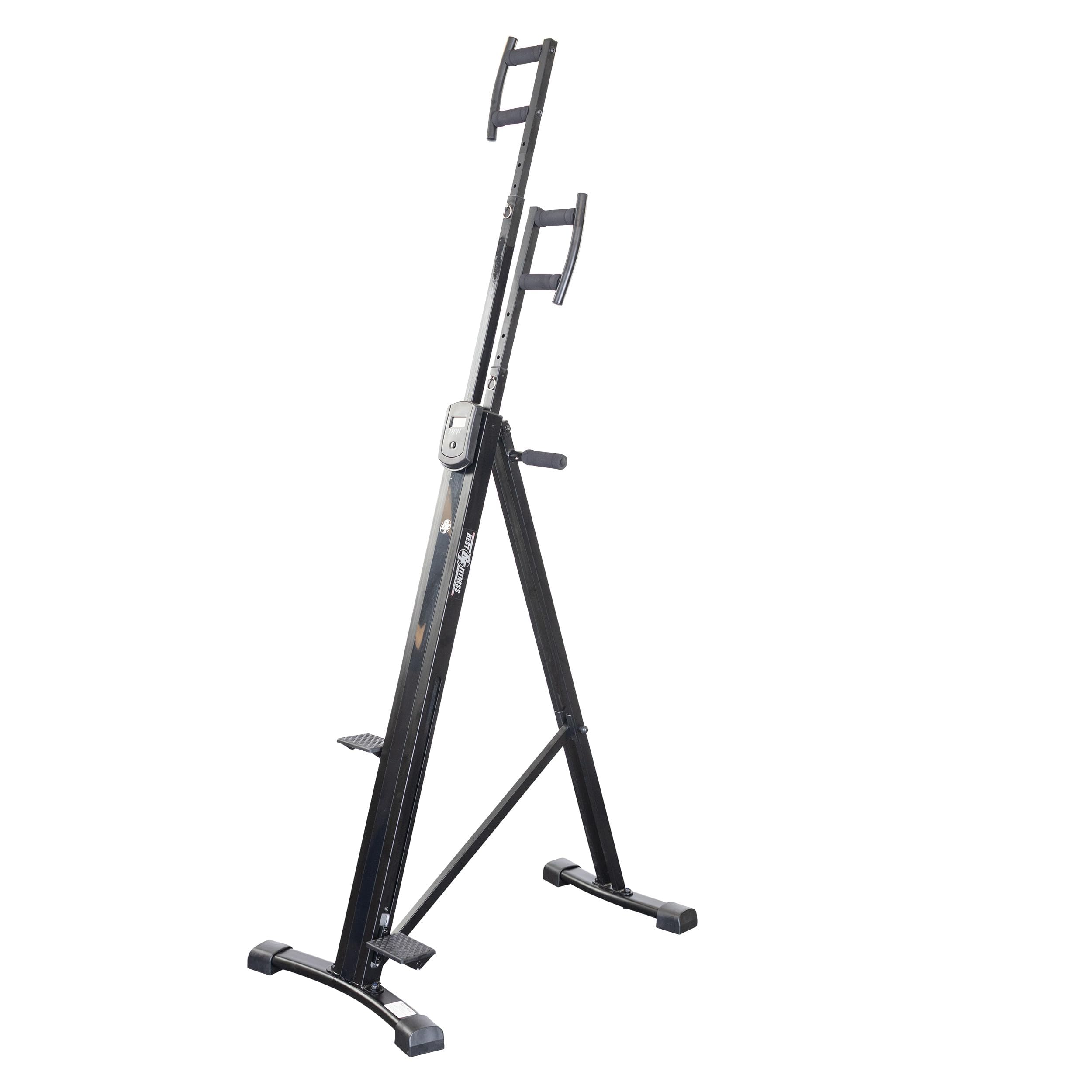
Folding is the feature that keeps this machine in the room rather than in a closet. The MaxiClimber 2.0 collapses for storage, weighs 33 pounds, and stands 27.95 inches wide, so it fits a corner or the end of a hallway. The climbing motion is the one the category promises: arms pulling while legs push, in a single continuous stroke. We like that the elastic resistance system lets a beginner climb on bodyweight alone and then add tension as the upper body gets stronger, so the machine doesn't top out in the first month.

Setup is about as painless as a cardio machine gets. It arrives 90 percent assembled, so the job is mostly unfolding, tightening, and setting the height, and the adjustable settings cover different users in a household. The free fitness app adds guided sessions for the days you don't want to think about pacing. We came away thinking the app matters far less than the fold.

The habit worth building early is your stance. This is a light frame, and leaning back into the handles can make the whole machine feel like it's coming up at you; keep your weight over the pedals and pull with your arms instead of hanging from them, and it settles down. That's a form correction rather than a fault, and it's the first thing to fix if the climber feels unsteady under you.

The rollers are the part to watch. They carry the pedals, they take every step you give them, and worn rollers are how this model fails: first a grind, then a session you can't finish. Check them for play once a month, treat the one-year warranty as your cover, and budget a replacement set as a running cost rather than a nasty surprise.

Pros

  • Folds away in a small room
  • Arms and legs work in one stroke
  • 90 percent pre-assembled
  • Free app adds guided sessions

Cons

  • Roller wear can end sessions early
  • Hard on knees and elbows over long sessions
Our verdict

The best default for most home gyms: it folds out of the way, assembles in minutes, and gives you the real arm-and-leg climbing stroke.
Check Latest Price
2

Best for Adjustable Resistance

Stamina Cardio Climber

80 /100
Trail Score Excellent

Key details

Storage
Wheels for easy storage
Coaching
müüv app
Resistance
8 levels of quiet magnetic resistance
Weight Capacity
300 lb
Check Price on Amazon

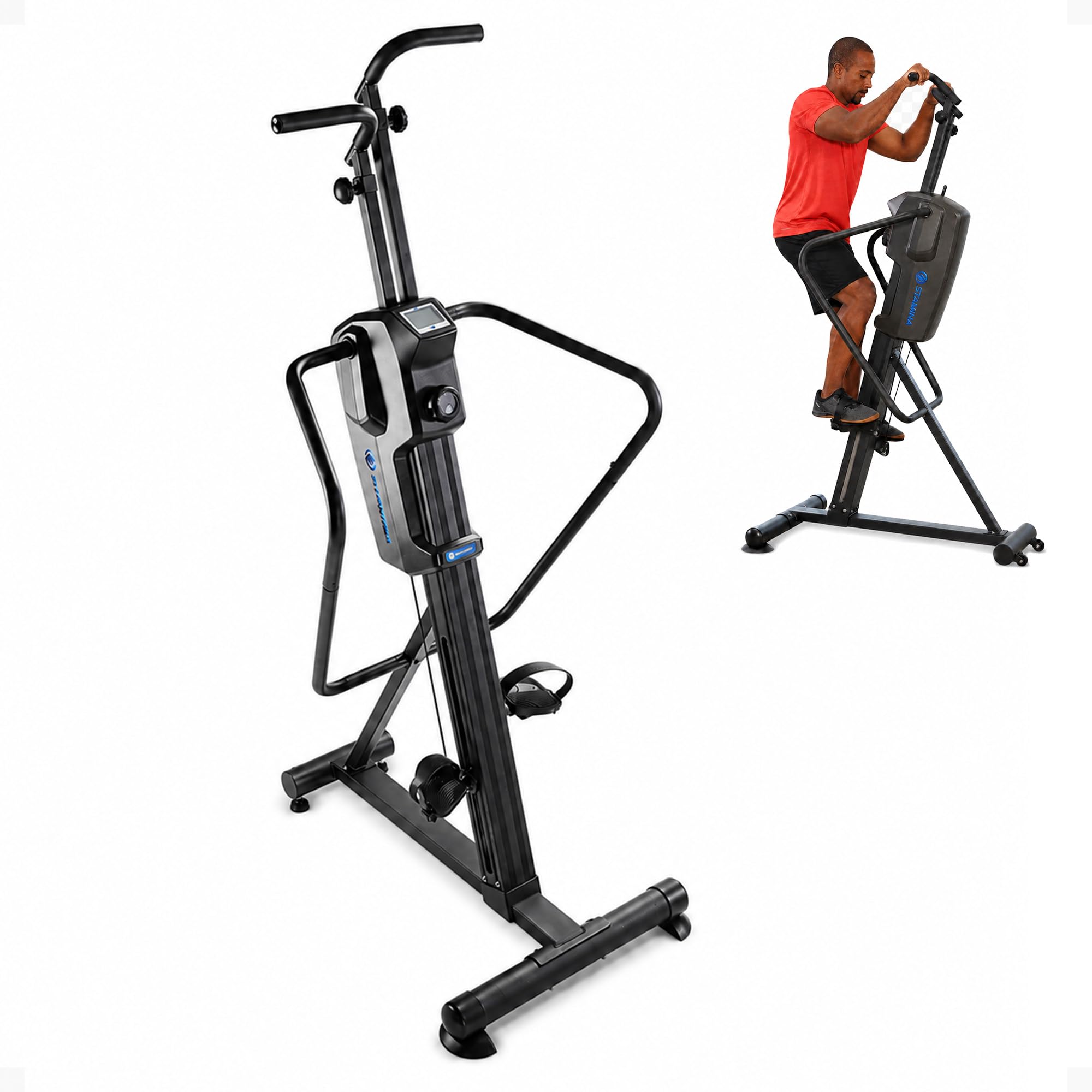
You can change the effort without getting off, and that's the whole argument for the Stamina. Eight levels of magnetic resistance are numbered and repeatable in a way elastic tension isn't: instead of guessing how much the bands are adding, you pick a level and the machine holds you to it. The climb is low-impact, with two separate handlebar sets so you can shift grip and stance as you fatigue, plus textured pedals and padded grips up top.

What the money buys is frame. This is the sturdiest of the three we recommend, rated to 300 pounds, and it behaves like gym equipment rather than a folding apartment gadget. The trade is that it's heavier and far less willing to be tucked away. Assembly is the easy part, with a straightforward sequence and the tools in the box. The difference shows up when you climb hard: nothing flexes, and the resistance doesn't change character as your pace rises.

Storage is handled by wheels rather than a fold, which works if the machine lives against a wall in a room you already use. The console is basic, the phone holder earns its place during guided sessions, and the müüv app adds coaching and demo videos if you want structure. We rate the resistance system as the reason to buy and the app as a bonus.

Pros

  • Eight magnetic levels, changeable mid-climb
  • 300-pound rating with real headroom
  • Gym-solid frame that doesn't flex
  • Wheels make it easy to push aside

Cons

  • Parts warranty covers only 90 days
  • Can rock slightly when you climb hard
Our verdict

Worth the premium if you want to train by resistance rather than pace: the magnetic dial, 300-pound frame, and quiet operation make it the most gym-like climber here.

Check Latest Price
3

Best Budget Option

Body-Solid Vertical Climber

77 /100
Trail Score Very Good

Key details

Frame
Heavy-duty alloy steel
Console
Time, distance, calories
Frame Warranty
3 years
Parts Warranty
1 year
Check Price on Amazon

There's no resistance dial on the Body-Solid, no app, and nothing on the console beyond time, distance, and calories, and that short list is exactly what makes it the value pick. What you're buying is the motion: an alloy steel frame, a wide non-slip foot platform, arms that move with your stride, and an adjustable height that lets a taller or shorter user set the reach. Effort comes from how hard and how fast you climb, which suits interval work better than slow grinding.

It's built light enough to move and store without a second pair of hands, and the warranty is the pleasant surprise: three years on the frame and one on parts, against a single year on the MaxiClimber. We read that split as a maker expecting the frame to outlast the moving bits, which is the right way round for a machine this simple. Re-torque the bolts after the first week and again whenever it starts to chatter; on a plain frame like this, a loose bolt is where the noise begins.

Pros

  • Real climbing motion at the lowest cost
  • Three-year warranty on the frame
  • Light and compact to store
  • Console tracks time, distance, calories

Cons

  • No resistance or tension adjustment
  • Assembly instructions are thin
Our verdict

Buy this one if you want the climbing motion and nothing else: it's the least expensive machine here and the frame is covered for three years.

Check Latest Price

How We Tested the Vertical Climbers

I started with a list of roughly 30 climbers and cut anything with a vague weight limit, a folding mechanism that looked like a pinch point waiting to happen, or a price that didn't match the frame you were getting. That left 10 machines from brands I'd buy from myself, and every one of them got assembled, climbed on, and parked in a room where I'd have to look at it for six months.

Assembly came first, timed solo and without power tools, because a machine you dread building is a machine you resent. A week in, I went back around and checked every bolt and joint to see what had worked loose. Then we climbed hard — the pace where you're hanging off the handles — paying attention to whether the frame rocked, whether the base crept across carpet, and how quickly we could fold it and tuck it away once the workout was over.

For noise, one of us climbed at a steady pace for ten minutes while the other listened from the next room, noting pedal clicks, joint squeaks, and any thud that would carry through a floor to the neighbors below. Comfort came down to handle shape and grip texture, how the pedals felt under a sneaker versus a bare foot, and whether the stride length suited anyone from about 5'3" to over 6'.

The last question was effectiveness, and it's the one that decided the ranking: after six months, which machines were we still climbing on without talking ourselves into it? Value followed from that — a climber that still felt solid and quiet in month six was worth far more than one that needed tightening every week.

How to Choose a Vertical Climber

Make Sure the Handles Actually Pull

On a true vertical climber your arms and legs work against each other, so the upper body contributes instead of just steadying you. A stepper moves the pedals and fixes the handles at hip or chest height, and plenty of listings blur the two. The tell is in the handlebar copy: if the only claim is that the bars adjust in height for different users or that they add balance and control, they're stationary.

Look for a named resistance system or an explicit arm-motion claim. The MaxiClimber's elastic system and the Stamina's dual handlebar sets both describe what the arms do; a bare full-body-workout line usually doesn't. If you can't tell from the listing, assume it's a stepper and keep looking.

Decide How You Want to Add Resistance

Three approaches show up in this group, and they change how you progress. A fixed machine like the Body-Solid makes you raise effort with pace and duration, which is fine for intervals. Elastic systems like the MaxiClimber's let you climb on bodyweight or add tension to the pull, a good middle ground that keeps the climbing feel.

Magnetic resistance, as on the Stamina, gives you numbered levels you can change mid-session and runs quiet. We think that's worth paying for only if you plan to train by resistance rather than by time; if you just want to sweat, pace is enough.

Match the Weight Rating to the Household

Capacities here run from 250 to 300 pounds, and the rating reflects how much frame you're getting as much as who can use it. A light machine used near its limit is where rocking and flex come from, so leave some headroom under the number rather than buying right at it.

If two people share the climber, size it for the heavier one and check that the handlebar height adjusts enough for the shorter one's reach. That single check prevents most of the complaints we'd expect from a shared machine.

Work Out Where It Lives Before It Arrives

Two storage designs do different jobs. A folding machine like the MaxiClimber gives you back floor space, but you still need clear wall height where it stands. Wheels, as on the Stamina, mean you push it aside rather than lift it, which suits a hard floor more than a thick carpet.

Weight decides who can move it at all. At 33 pounds the MaxiClimber is a one-person job for most adults; a gym-solid frame is not, and the wheels are doing the work there. Pick the design that matches your room, because a climber you dread shifting is a climber you stop using.

Read the Warranty as a Wear Map

Warranty splits tell you what the maker expects to fail. The MaxiClimber carries a single year. The Body-Solid gives three years on the frame and one on parts. The Stamina goes five years on the frame but only 90 days on parts.

A long frame with a short parts window is a bet that the moving bits, meaning rollers, bolts, and bearings, will need attention first, which is exactly what a climbing motion stresses. Match the coverage to how hard you'll use the thing: a daily half-hour on a one-year warranty is a different proposition from three sessions a week.

Frequently Asked Questions

Final Verdict

Start with the MaxiClimber 2.0. It folds into a corner, goes together in minutes, and gives you the arm-and-leg climbing stroke that separates this category from a stepper, with a 250-pound rating to keep in mind before you order.

If you want to train by resistance instead of pace, the Stamina's eight magnetic levels and 300-pound frame are the upgrade worth paying for. And if the machine only has to deliver the motion for the least money, the Body-Solid does that with three years of frame coverage behind a design with almost nothing to break.