Best Rowing Machines for Home of 2026

The real risk with a rowing machine isn't that it won't work — it's that you'll spend a weekend assembling something heavy, row a dozen strokes, decide the resistance feels nothing like actual water, and let it become the most expensive clothes rack in the house. A good rower fixes that: it delivers genuine cardiovascular work and pulling strength with zero impact on your knees, and it stores upright in a corner when you're done. The catch is that the category splits sharply between machines that feel smooth and honest through the whole stroke and machines that fight you from the first pull.

I've rowed on water and on plenty of gym ergs, so I know what a good drive should feel like — quiet, connected, and heavier the harder you pull. My team and I assembled nine machines ourselves over six months and rowed on them in garages, spare bedrooms, and one very patient living room, and the pattern came down to resistance and durability before anything else. The ones worth your money feel right at every stroke rate and hold together after weeks of daily use; the rest reveal themselves fast. Here's what earned a permanent spot on the floor.

1

Best Overall

Concept2 RowErg

98 /100
Trail Score Outstanding

Key details

Monitor
PM5 with Bluetooth and ANT+
Resistance
Air
Item Weight
57.3 lb
Max User Weight
500.4 lb
Check Price on Amazon

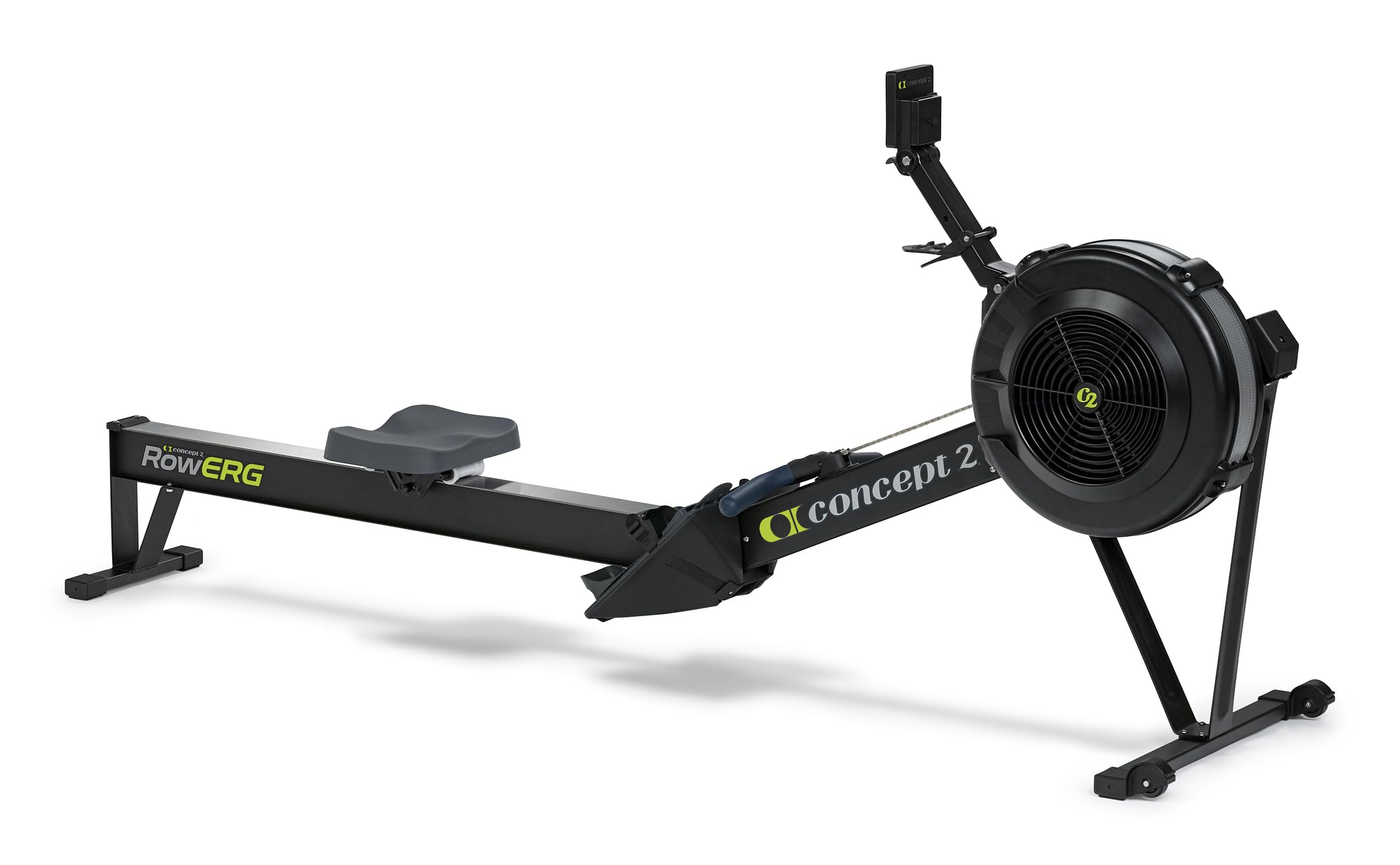
Every other machine on this list is a magnetic or hydraulic rower doing its best impression of rowing. The RowErg is the thing being imitated: a fan that moves air, a chain, and a frame that separates into two pieces when you need the room back. The front legs are aluminum, the rear legs are steel, and the whole thing rolls on caster wheels.

That difference is worth paying for. The Performance Monitor 5 is the reason: it pairs over Bluetooth and ANT+ with heart-rate straps and dozens of apps, and it reports pace, watts, and calories in a form you can compare from one session to the next. We judge a rower on whether the numbers mean anything, and this is the only monitor here that gives you figures worth writing down. It is also the most expensive machine in this group, and we think it's the right place to spend.

The rowing itself is smooth and the fit is generous. The seat sits 14 inches off the floor, the footrests adjust across a range of shoe sizes, and the handle sits in your fingers rather than across your palm. When the room is needed for something else, the frame comes apart in two pieces and the front section stands on its casters.

The trade-off is noise. Air has to move, and the whoosh rises with how hard you pull; keep the damper low and you can still hear the television, but this is not the machine for a wall shared with a nursery. What you get in exchange is the best monitor, the strongest frame, and a limited two- and five-year warranty.

Pros

  • Competition-grade PM5 monitor with Bluetooth and ANT+
  • Air flywheel gives the most realistic rowing feel here
  • Splits in two and rolls on casters for storage
  • Limited two- and five-year warranty

Cons

  • Needs a long wall while assembled
  • The most expensive pick here
Our verdict

We recommend the RowErg to anyone who will row seriously and wants one machine that lasts, and it's the pick we keep coming back to.
Check Latest Price
2

Best for Strength and Variety

Merach RS3 Scull

91 /100
Trail Score Outstanding

Key details

Footprint
60"D x 28.3"W x 29.5"H
Resistance
Magnetic, 16 levels
Max Resistance
88 lb
Max User Weight
350 lb
Check Price on Amazon

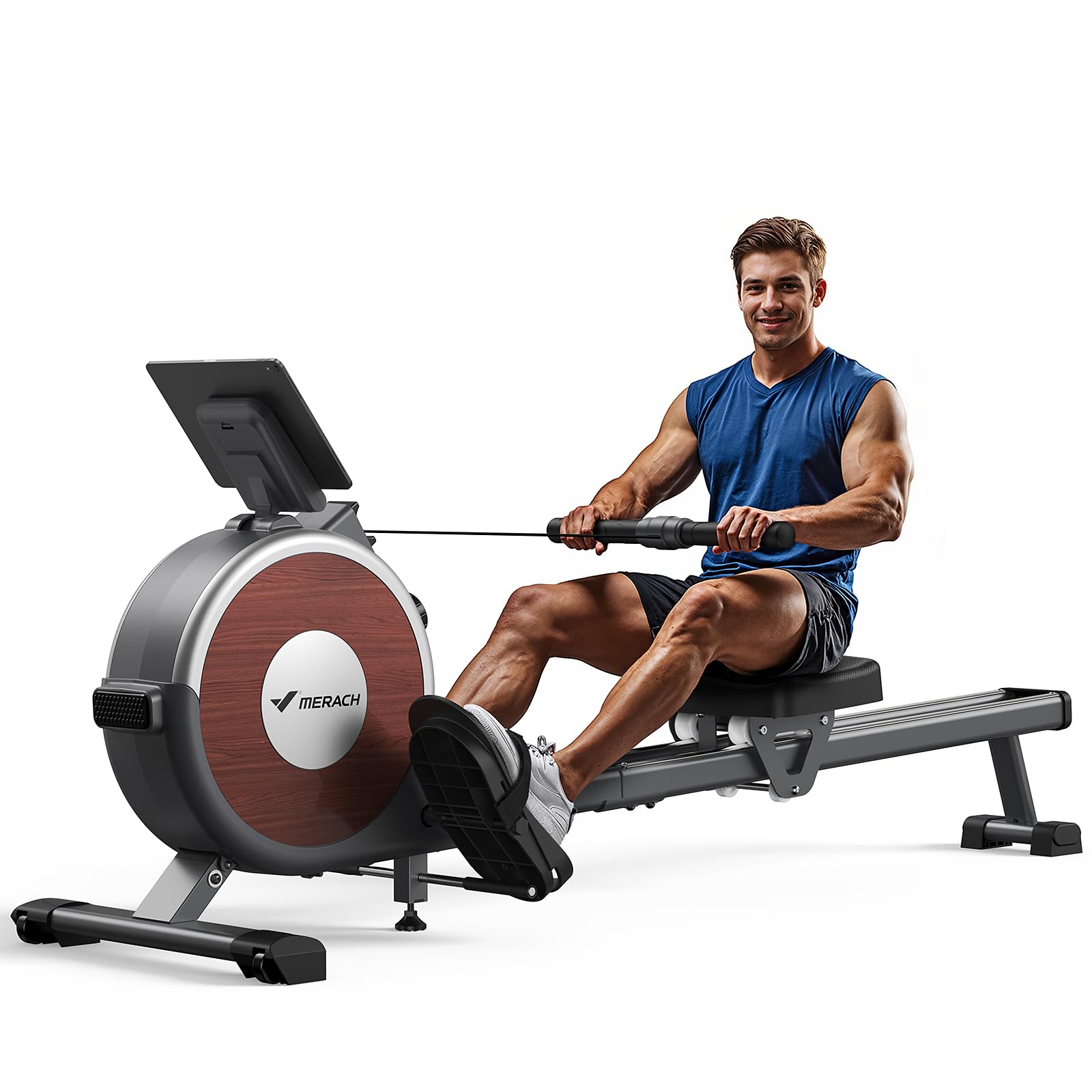
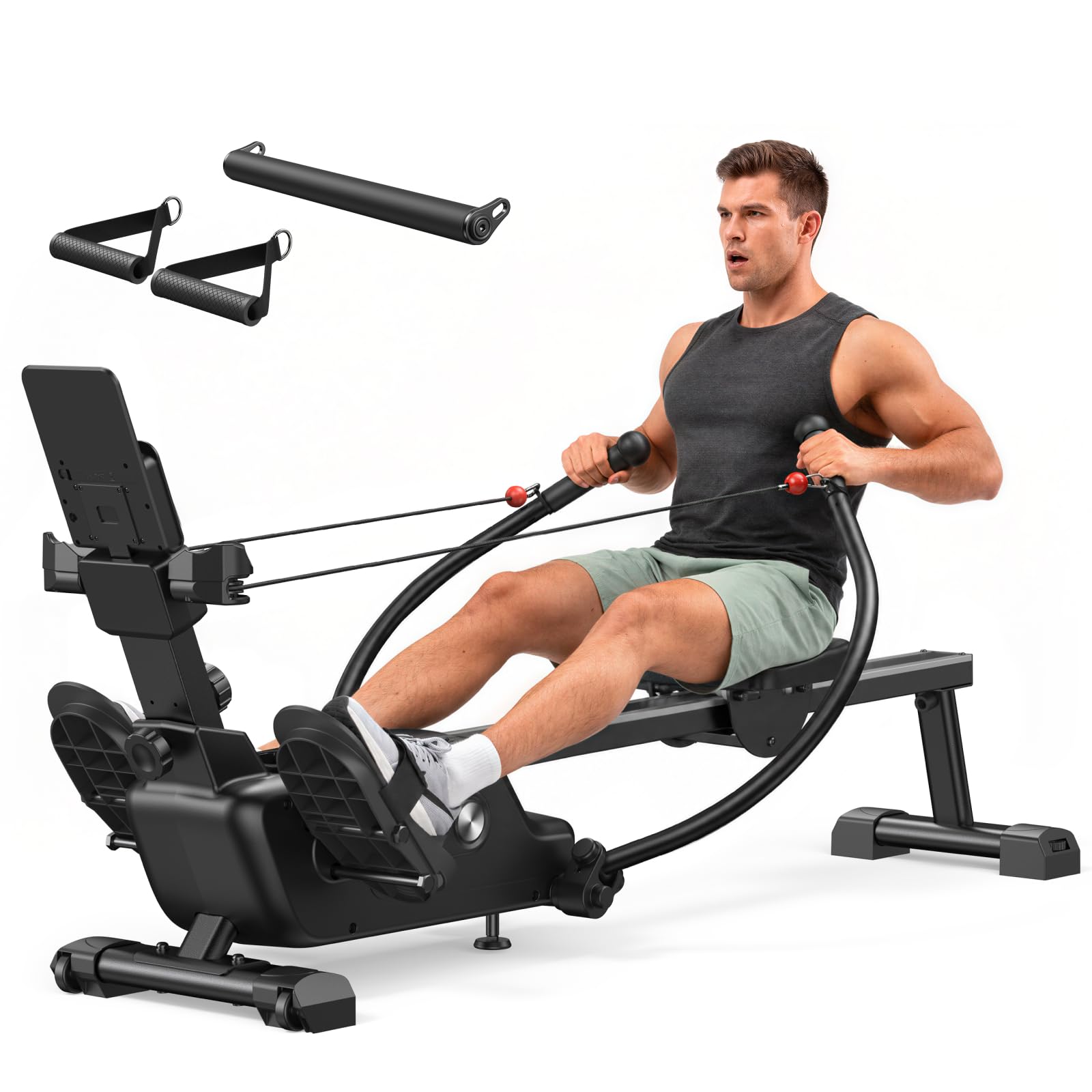
A pin holds the handle on the RS3's cable, and pulling it is the whole trick. Swap in a straight bar or a single grip and the rower becomes a cable station; Merach lists more than two dozen movements, from rows to squats, and standard gym handles clip into the same fitting.

The rowing is the more interesting part. Instead of one handle between two rails, the RS3 runs two oars through a 120-degree arc, so each arm travels independently and the finish feels closer to a boat than the single-chain machines do. The magnetic brake gives 16 levels and Merach quotes up to 88 pounds of resistance at the top, and the whole thing runs quietly enough for an apartment.

Where it earns its place is variety: if the reason your last rower gathered dust was boredom, this one has more to do. The cost is floor space — at 28.3 inches wide it's the widest machine here — and the app carries a lot of the guidance for those 26 movements. We put it in a room with a wall to spare and a screen within reach.

Pros

  • Swappable handles unlock 26+ strength movements
  • Dual-oar stroke feels closer to on-water rowing
  • Quiet 16-level magnetic resistance up to 88 lb
  • Rated to 350 lb on a 60-inch frame

Cons

  • Widest machine here at 28.3 inches
  • Monitor needs a well-lit room to read
Our verdict

We point anyone who gets bored on a rower to the RS3, because the handle swap turns one machine into a cardio and strength setup.

Check Latest Price
3

Best for Taller Rowers

YOSUDA H-185

90 /100
Trail Score Outstanding

Key details

Resistance
Magnetic, 16 levels
Slide Rail
50.2 in
Item Weight
54 lb
Max User Weight
350 lb
Check Price on Amazon

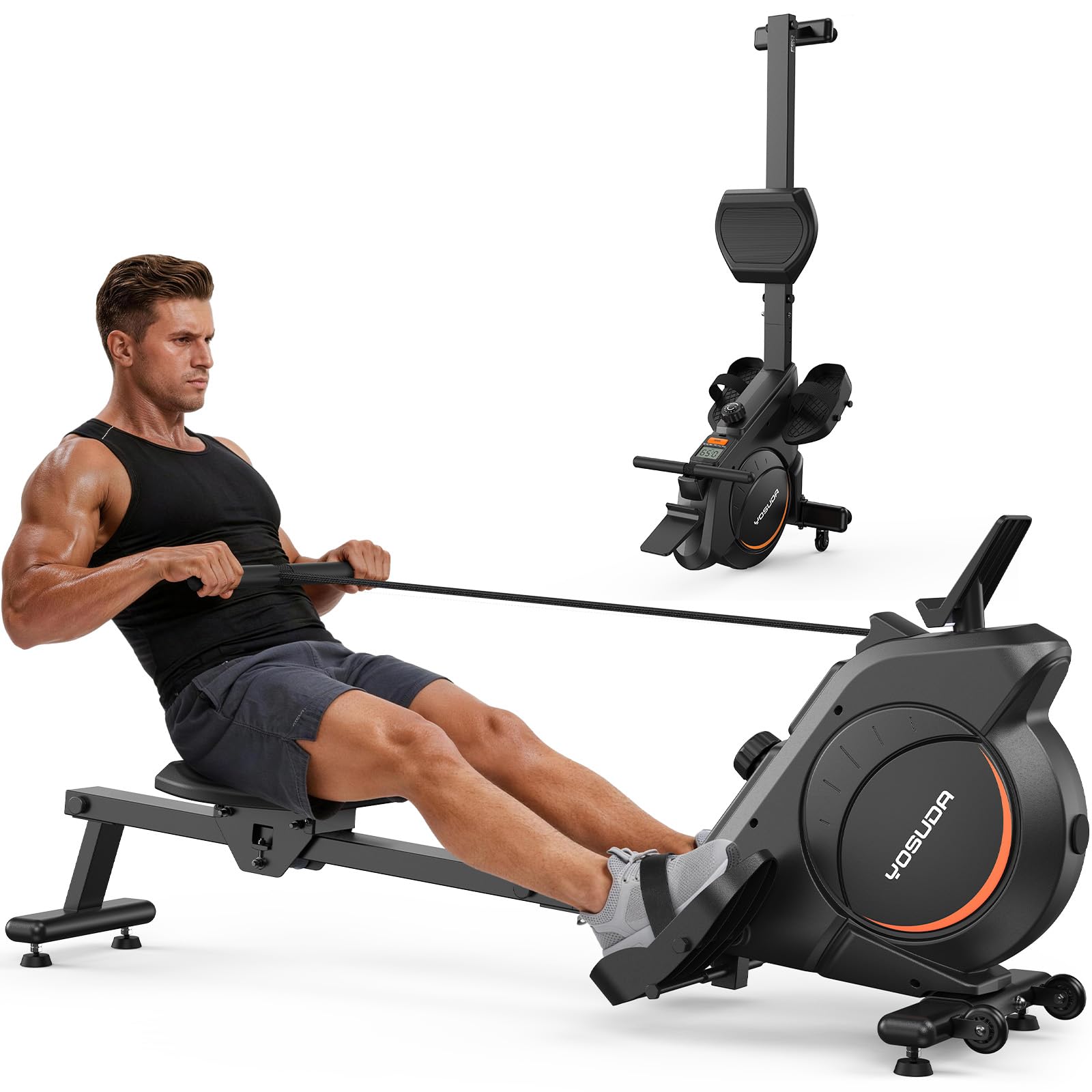
Fifty inches of rail doesn't sound like a selling point until you're six foot two and your knees are meeting your elbows at the catch. The H-185's 50.2-inch slide is the longest here, and YOSUDA rates it for rowers up to 6 foot 3 — which is why it's the machine we hand to tall rowers before any other on this list.

The rest of the package is built around that rail: a flywheel 66 percent heavier than its predecessor for momentum through the recovery, a mono-rail beam rated to 350 pounds, and 16 magnetic levels. At 54 pounds it stays planted under a hard pull, and because the rail and flywheel are the two main parts, assembly is short work.

Durability is the question we can't answer with a spec sheet. The tensioner is the component that has given trouble, and the coverage runs a single year, so the machine is a reasonable bet rather than a sure one. Buy it for the fit and the price, and go in knowing that a long warranty isn't part of the deal.

Pros

  • 50.2-inch rail fits rowers up to 6 ft 3
  • Heavier flywheel keeps the stroke smooth
  • Quiet enough for a shared room
  • Simple two-piece assembly

Cons

  • Top resistance feels soft for powerful rowers
Our verdict

If you're tall, this is the rower to shortlist, since the 50.2-inch rail gives long legs somewhere to go.

Check Latest Price
4

Best Budget Magnetic

Merach Q1S

88 /100
Trail Score Excellent

Key details

Footprint
65"D x 19.3"W x 24.8"H
Resistance
Magnetic, 16 levels
Item Weight
42 lb
Max User Weight
350 lb
Check Price on Amazon

One of the least expensive machines here is also one of the quietest, and that combination is why the Q1S ends up in bedrooms and spare rooms rather than garages. At 42 pounds it rolls on its wheels and tucks against a wall, and the dual slide rail — Merach copied the look of a wooden rower — keeps the seat from wobbling at the back of the stroke.

Sixteen magnetic levels are plenty for someone building a habit and enough for steady 20-minute sessions. Where the machine runs out is at the top: strong rowers who have used a gym machine will find the highest setting polite rather than hard, and we steer anyone chasing power toward the RowErg. For everyone else the resistance is honest, and the flywheel makes a soft whir instead of a whoosh.

Assembly takes about half an hour with the frame partly pre-built, and the MERACH app adds coached classes with Kinomap compatibility if you want a screen in front of you. The LCD is basic — time, distance, strokes, calories — which suits a machine meant for starting rather than training to a plan.

Pros

  • Quiet magnetic flywheel suits apartments
  • 42 lb frame rolls away on wheels
  • Dual slide rail feels stable under load
  • Half-hour assembly, partly pre-built

Cons

  • Handle sits low for long-armed rowers
  • Warranty runs only 12 months
Our verdict

We recommend the Q1S to beginners and apartment dwellers who want quiet rowing without committing much money.

Check Latest Price
5

Best for Small Spaces

Sunny SF-RW1205

89 /100
Trail Score Excellent

Key details

Footprint
58.1"D x 20.1"W x 24.8"H
Resistance
Hydraulic, 12 levels
Item Weight
22.4 lb
Max User Weight
300 lb
Check Price on Amazon

At 22.4 pounds this is the lightest rower here by a wide margin — light enough to lift over a sofa or carry up a flight of stairs without thinking about it. If your workout space is also your living room, or your bedroom, that matters more than any resistance spec on the box.

The design is unusual in a useful way. The rail slopes upward toward the front, so gravity and your own body weight add to the leg drive, and a turn knob dials the hydraulic cylinder through 12 levels. Sunny's free SunnyFit app connects over Bluetooth, the frame carries a three-year structural warranty, and assembly is closer to unpacking than to building.

What you're buying is convenience, not a training tool. Hydraulic resistance softens as the cylinder warms, so a long session feels lighter at the end than at the start; turning the knob up mid-row handles that. The stroke is short, too, which is fine at five foot six and cramped past six feet. For twenty minutes before work in a small apartment, none of that gets in the way.

Pros

  • 22.4 lb frame lifts and stores anywhere
  • Inclined rail adds leg drive
  • 12 hydraulic levels on a turn knob
  • Three-year structural frame warranty

Cons

  • Short stroke for taller rowers
  • 300 lb limit is the lowest in this group
Our verdict

We recommend this one to anyone whose workout space is also a living room, because 22.4 pounds changes how often you use it.

Check Latest Price
6

Shared Living Rooms

Wenoker Magnetic Rower

90 /100
Trail Score Outstanding

Key details

Resistance
Magnetic, 16 levels
Slide Rail
39 in
Max User Weight
350 lb
Vertical Storage
3.1 sq ft
Check Price on Amazon

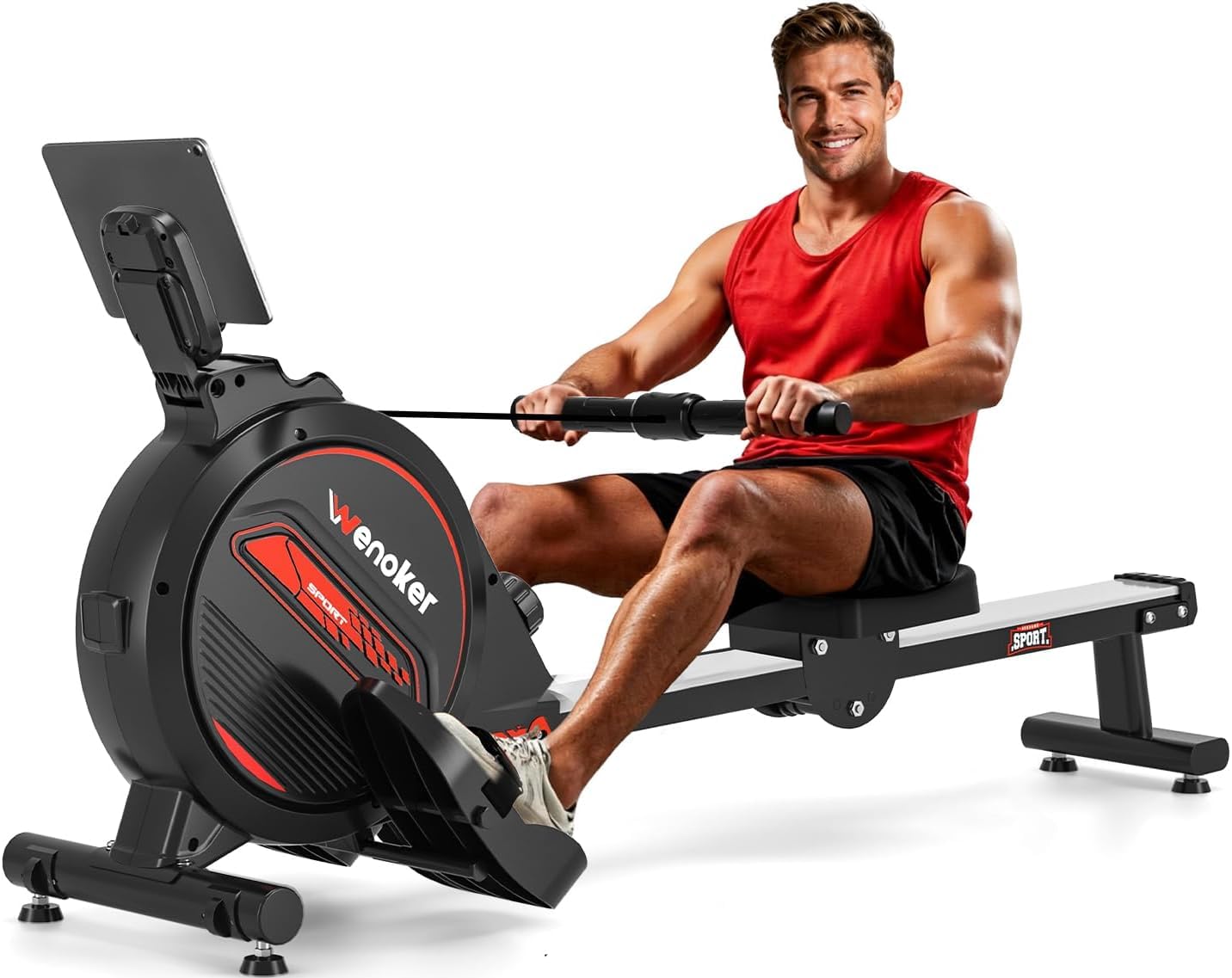
Stand the Wenoker on end and it takes a little over three square feet of floor, which is how a rowing machine ends up living in a living room instead of a basement — and of everything here, it's the one we put in a shared room. Transport wheels take it to the wall, and the reinforced steel rails keep the glide steady once it's down.

The rest of the machine backs that up. The magnetic flywheel is quiet enough that an early row doesn't carry through an apartment, the frame is rated to 350 pounds, and 16 resistance levels cover a warm-up or a sweat. Assembly is mostly done before it ships, and the LCD tracks time, stroke rate, distance, calories, and stroke count with app connectivity if you want more.

Where it lands in the group is as the value pick for a small space: it does the quiet, sturdy, easy-to-live-with part of rowing well and doesn't pretend to be a training tool. For steady twenty-minute sessions with a podcast on, that's the right trade.

Pros

  • Stands on end in about 3 square feet
  • Quiet flywheel for shared rooms
  • 350 lb frame rating on steel rails
  • Mostly pre-assembled out of the box

Cons

  • 39-inch rails shorten the stroke for tall rowers
Our verdict

We put this in a shared living room without hesitating, since it stores on end and rows quietly enough for company.

Check Latest Price
7

Heavier Households

Dripex Magnetic Rower

87 /100
Trail Score Excellent

Key details

Footprint
63.4"D x 16.5"W x 24"H
Resistance
Magnetic, 16 levels
Item Weight
46 lb
Max User Weight
360 lb
Check Price on Amazon

Two people sharing one rower usually means one of them is bigger, and the Dripex is built for that household: a 360-pound rating, the highest here apart from the Concept2, on a frame that's only 16.5 inches wide. That narrowness is genuinely useful in a spare bedroom, where the machine sits along a wall rather than across a doorway.

The 12-pound flywheel and 66 pounds of magnetic resistance give it more bite than most budget machines, and the dual slide rails keep the seat tracking straight when you pull hard. At 46 pounds it stays planted, and it stands on end to roll into a corner when the room goes back to being a room.

Assembly is straightforward: the parts are numbered, the tools come in the box, and the frame is ready to stand up when the last bolt is in. The hard part is the electronics, which are plain — a basic LCD and app connectivity that does the minimum.

At the top of the resistance range it's polite rather than punishing, which is the one place the Dripex shows its price. If you want to row hard, spend more. If you want a stable, quiet dual-rail machine that fits two people of different sizes into a small room, this is the value pick of the group.

Pros

  • 360 lb capacity at a budget price
  • Narrow 16.5-inch frame fits tight rooms
  • Dual rails stay stable under hard pulls
  • Numbered parts make assembly easy

Cons

  • Basic LCD and app compared with pricier picks
Our verdict

We recommend the Dripex to a two-person household where one rower is heavier, because 360 pounds of capacity costs very little here.

Check Latest Price
8

Casual Cardio

Sunny SF-RW524079

89 /100
Trail Score Excellent

Key details

Resistance
Magnetic
Slide Rail
45.7 in
Item Weight
41.4 lb
Max User Weight
300 lb
Check Price on Amazon

The level count isn't the interesting number on this rower; the ceiling is. Even at the top of the range the pull stays gentle, which is fine for steady half-hours in front of the television and frustrating for anyone who has used a gym rower and expects the last interval to hurt.

Everything around that is well thought out for the money. The dual rail gives a smooth, quiet glide, the padded seat and foam-covered handle are comfortable for longer sessions, and the LCD reports a 500-meter split alongside time, distance, calories, strokes, and stroke rate — more than most budget monitors bother with. The free SunnyFit app adds trainer-led rows.

Setup is manageable but not instant, and the final step is easier with two people. The rail measures 45.7 inches, a touch shorter than the YOSUDA's, and the whole machine slides out of the way without much effort when the session is done.

Our take: this is the rower for a household that wants quiet, low-impact cardio and will use it in short sessions, and it serves that household well. If anyone in the house starts training rather than exercising, the money spent on the RowErg buys resistance that actually escalates.

Pros

  • Quiet dual-rail glide
  • 500 m split and stroke rate on the LCD
  • Free SunnyFit app with guided rows
  • Three-year structural frame warranty

Cons

  • Long-term durability is the open question
  • Parts coverage runs only 180 days
Our verdict

We recommend this to a household that wants quiet, low-impact cardio without a learning curve, not to anyone chasing a hard 2K.

Check Latest Price

How We Tested the Best Rowing Machines for Home

We started by narrowing a long list of rowers down to nine based on resistance type, footprint and folded dimensions, monitor features, weight capacity, and whether the price was justified without a subscription. Every machine arrived flat-packed, so we built each one ourselves with only the included tools and a stopwatch, counting the minutes and noting any vague instructions, missing hardware, or steps that genuinely needed two people. We also timed how long it took to get from box to first stroke.

Once assembled, each rower lived where a real one would — a garage, a spare bedroom, a living room corner — and got used the way people actually use them: 20-minute steady sessions before work, hard intervals on weekend mornings, and a few long 5K pieces. We rowed at low and high stroke rates to see whether resistance ramped up smoothly or arrived in a jolt, watched whether the seat rolled without catching, and checked how quickly we could strap in with shoes on and start moving.

Durability was a running tally rather than a single test. Over six months we tracked chain and strap stretch, listened for new rattles, wiggled the seat rollers, checked for dust buildup on the flywheel, and noted whether the monitor held its settings between sessions. We also folded and unfolded each machine weekly and rolled it across carpet to judge how easy it really is to move and store.

Value got judged last, and strictly: what you get per dollar in resistance quality, frame solidity, and whether the display gives you a useful workout without a monthly fee.

How to Choose a Rowing Machine for Home

Start With the Resistance Type

Air, magnetic, and hydraulic rowers do not feel alike, and the difference decides where the machine can live. Air is the most convincing — the fan loads up as you pull harder — but it whooshes, and the Concept2 is the only air rower here. Magnetic is close to silent and cheaper to build, which is why most of this group is magnetic; the top of a budget magnetic brake can feel light to a strong rower. Hydraulic packs everything into a small cylinder and suits short sessions in tight rooms.

Don't compare level counts across types. Sixteen magnetic levels and an air damper are not the same scale, and the only number worth checking is what the top setting actually feels like. If you're strong and plan to train, buy air. If the rower shares a wall with a bedroom, buy magnetic and accept a gentler ceiling.

Measure the Floor, Not the Fold

Most of the magnetic machines here run 60 to 65 inches long in use, and the seat travels the length of the rail. Tape out the listed length plus room to step back from the catch and see where it lands in your space before you order.

'Compact' in a listing usually describes storage, not rowing. The Wenoker stands on end in about three square feet, the Concept2 separates into two pieces, and the Merach Q1S rolls on its wheels but doesn't shrink. Decide whether the machine has to disappear between sessions or just get out of the walking path — that answer picks the product for you.

Fit the Rail and the Weight Limit to Your Household

Rail length decides whether a rower fits a person, and it varies more than anything else here: 39 inches on the Wenoker, 50.2 on the YOSUDA. Taller rowers need travel at the back of the stroke or the catch gets cramped. If anyone in the house is over six feet, start with the longer rails and work back.

The weight rating matters for the stroke as much as for safety. The budget machines here are rated to 300 or 350 pounds; the Dripex goes to 360 and the Concept2 to 227 kg. A heavy rower on a light frame gets a skittish ride, so match the rating to the heaviest person who will use it, not the average.

What the Extra Money Actually Buys

Above the entry price you're paying for three things: flywheel mass, the monitor, and the warranty. A heavier flywheel keeps the stroke smooth through the recovery. A better monitor gives you pace and watts you can compare week to week instead of a stroke count. Coverage stretches from 180 days on parts to a five-year frame on the Concept2.

Our rule: if you'll row twice a week or more, spend on the monitor and the frame, because that's what you notice in month six. If the machine is for occasional 20-minute sessions, a quiet budget magnetic rower does the job, and the money you save is better spent on a mat and a tablet stand.

Frequently Asked Questions

Final Verdict

Buy the Concept2 RowErg if rowing is going to be a real part of your week. It costs the most here, and it's the only machine in the group where the monitor, the frame, and the warranty all hold up to hard use — plus the air flywheel is the closest thing here to a boat on water.

If the rower has to live in a bedroom, take the Merach Q1S: it's quiet, small, and cheap enough to try without regret. If you're over six feet, the YOSUDA's longer rail decides it before anything else does.