Best Car First Aid Kits of 2026

Car first aid kits are a tug-of-war: small enough that you'll actually leave one in the car, complete enough to be worth having when you need it. Most pick a side badly. The compact ones hold three gauze pads and a whistle; the thorough ones live in a crate that ends up in the garage beside the jumper cables. I've owned both, plus the kind that becomes an unsearchable pile the first time you open it on a highway shoulder. A good kit keeps what you need where your hands expect it, in a case about the size of a lunch bag.

We've spent the last four months with 14 kits, from palm-sized pouches to soft cases that eat half a trunk, and judged them the way you'd use one: one-handed, in the dark, with somebody bleeding. Box counts lie, and price tracks case quality more than contents. What separates a keeper is whether the bandages, gloves, and gauze are there in usable quantities and still sealed when you tear the zipper open. The ones worth your glovebox are below.

1

Best Overall

First Aid Only 313-Piece Kit

96 /100
Trail Score Outstanding

Key details

Pieces
313
Case Type
Soft zippered case
Dimensions
9.75 x 7.4 x 2.5 inches
Organization
Two layers of clear pockets
Check Price on Amazon

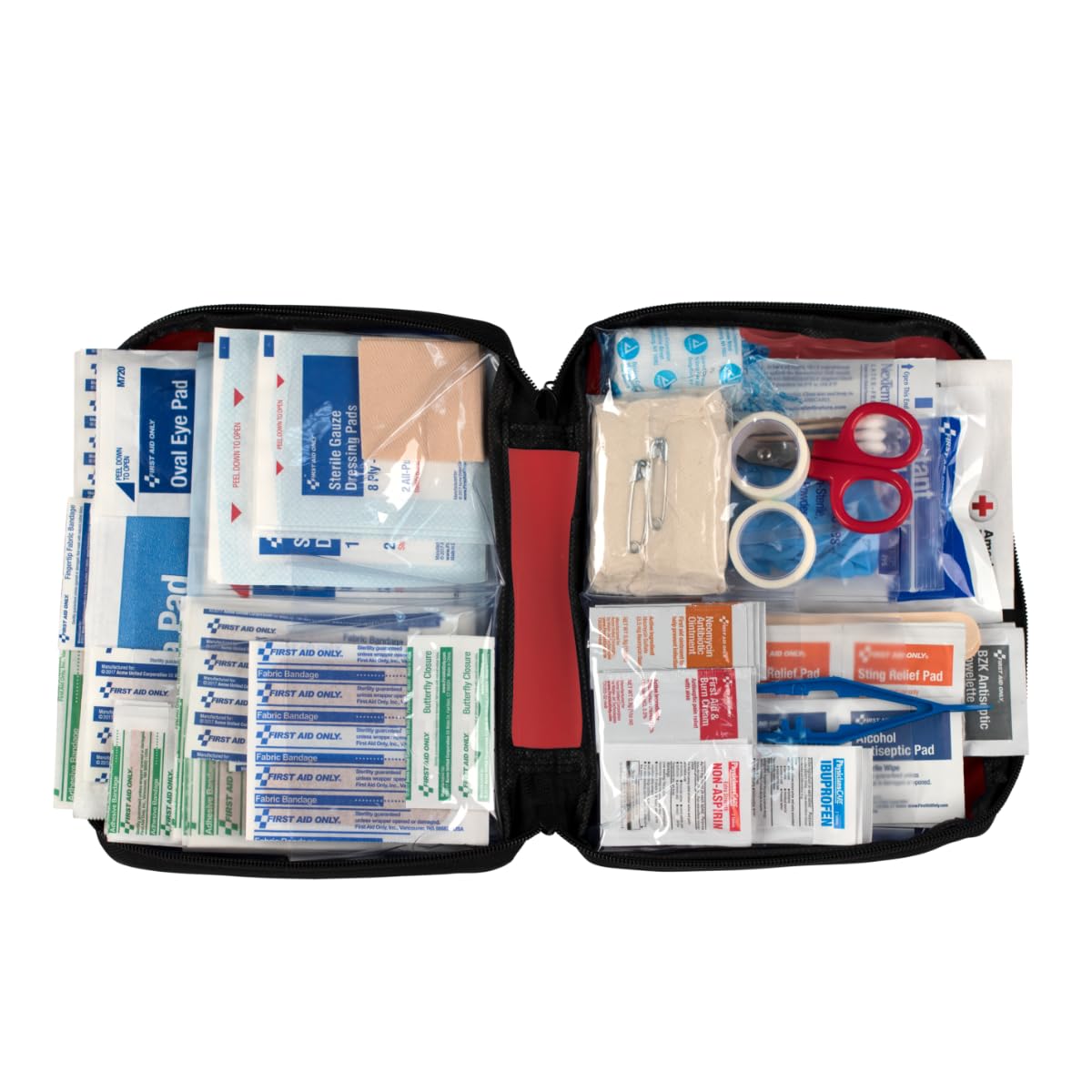
Clear plastic pockets, two layers of them, is what sold us on this kit for a car. Kneeling on a shoulder with one hand on a flashlight is not the moment to unpack a duffel, and these compartments let you spot gauze, tape, and wipes without emptying the case onto the pavement. Fabric and plastic bandages, antibiotic ointment, BZK antiseptic wipes, burn cream packets, a triangular bandage, and a gauze roll are all in there.

Closed, the case measures 9.75 by 7.4 by 2.5 inches, which slides under most seats and drops into a deep glove box; because it is soft-sided, it also squashes into the gap behind a cargo panel that a rigid box will not take. What convinced us it deserves the top spot is the balance: enough coverage to handle a burn or a turned ankle as well as a cut, in something flat enough to live in the car rather than on a garage shelf. The bandage variety matters more than the headline count, and you get several widths plus both fabric and plastic strips, which is what actually decides whether a cut gets covered properly.

Two honest limits. The soft case offers no crush protection, so do not bury it under a cooler. And the plastic bandages are the first thing to run thin, so plan to top that supply up after a season or two. Neither changes the recommendation: nothing else here puts this much coverage into a case this flat.

Pros

  • Two layers of clear pockets keep supplies findable
  • Wound, burn, and sprain supplies in one kit
  • Flat case slides under a seat

Cons

  • Soft sides give no crush protection in a packed trunk
Our verdict

Our pick for most cars: broad coverage, clear pockets you can read at a glance, and a flat soft case that fits where you will actually reach it.

Check Latest Price
2

Best with Brand-Name Medicines

Band-Aid All-Purpose 160-Piece

96 /100
Trail Score Outstanding

Key details

Pieces
160
Weight
1.19 lb
Case Type
Hard plastic case
Dimensions
9.5 x 7 x 3.25 inches
Check Price on Amazon

Neosporin, Benadryl, and Tylenol are the reason this kit earns a place. Most of the kits here hand you bandages and antiseptic wipes and leave the medicine cabinet to you; this one arrives with a tube of antibiotic cream, an antihistamine for bites and rashes, and a pain reliever, all in a hard plastic case that will not get crushed under a bag of groceries. For a car that does school runs and long weekends, that is a real difference.

The bandages are BAND-AID brand and made without natural rubber latex, so a latex-sensitive passenger is not a problem. At 9.5 by 7 by 3.25 inches and 1.19 pounds it is a shelf kit rather than a pocket one, and there is enough slack in the case to add your own supplies, a couple of doses of children's pain reliever, a spare pair of gloves.

Three and a quarter inches deep is the catch: measure your glove box before assuming this lives there. It is better suited to a cargo bin, a door pocket, or the space under a seat, and it carries fewer pieces than our top pick for about the same money. What you are buying is the branded contents and the rigid shell, and for a lot of households that is the trade worth making.

Pros

  • Neosporin, Benadryl, and Tylenol included
  • Rigid plastic case resists crushing
  • Latex-free BAND-AID brand bandages
  • Room left to add your own supplies

Cons

  • 3.25 inches deep, too tall for shallow glove boxes
  • Fewer pieces than kits at a similar price
Our verdict

We buy this one for the branded medicines and the hard case, so measure your glove box first, because it is a deep kit.

Check Latest Price
3

Best for the Glove Box

Protect Life Travel 100-Piece

95 /100
Trail Score Outstanding

Key details

Pieces
100
Weight
9.88 oz
Case Type
Waterproof hard case
Dimensions
7.5 x 5.2 x 1.5 inches
Check Price on Amazon

One and a half inches thick is what makes this kit the one to beat for a glove box. At 7.5 by 5.2 by 1.5 inches and just under 10 ounces, it slides into spaces the soft bags here cannot follow, and the hard shell is waterproof, which is worth having if your kit lives near a door that gets wet or in a boat locker half the year.

For 100 pieces the contents are more thoughtful than the count suggests: a thermal emergency blanket, gloves, scissors, gauze, bandages, antiseptic wipes, and a first aid guide written for someone who has not done this before. The case is genuinely packed, though. Finding one specific item takes a moment of digging, and getting everything back in after you have opened it is fiddly, so budget a minute for the repack rather than stuffing it closed.

Treat it as a base and add what your household actually uses: extra gauze pads, a couple of doses of your own pain reliever, a tick remover if you walk in tall grass. That is the right way to read any 100-piece kit, and this one gives you a better box to build on than most, which is why it stays near the top of this set despite the smaller count.

Pros

  • Flattest case here at 1.5 inches
  • Waterproof hard shell
  • Emergency blanket and first aid guide included

Cons

  • A base kit you will need to top up
Our verdict

Our choice when the glove box is shallow: the flattest case here, waterproof and tough, with room to add your own extras.

Check Latest Price
4

Best for a Family Vehicle

M2 Basics 300-Piece Kit

95 /100
Trail Score Outstanding

Key details

Pieces
300
Weight
1.5 lb
Dimensions
9 x 3.5 x 6.5 inches
Distinct Items
40
Check Price on Amazon

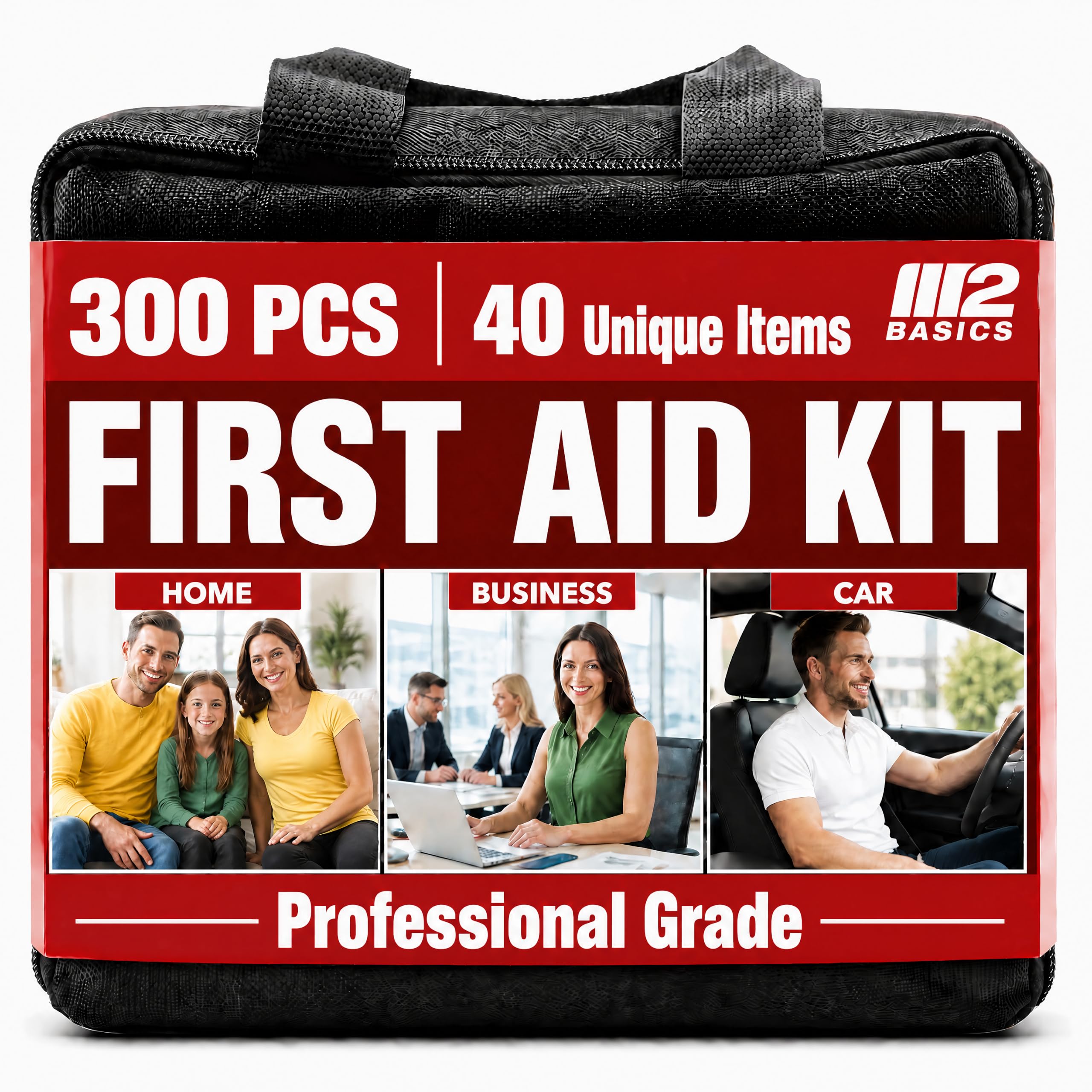
A CPR face mask and an instant cold pack are two items most car kits skip, and they are the reason this one stands out for a family vehicle. Wound care is well covered with bandages in several sizes, sterile gauze, tape, antiseptic wipes, gloves, scissors, and tweezers, but the extras are what turn a kit from cut-and-scrape duty into something you can use on a twisted ankle at a trailhead.

It is a 300-piece kit made of 40 distinct items, and that second number is the honest one. Three hundred tells you how many times you can bandage a finger; forty tells you how many different problems you can solve. For a car that carries kids the mix is right, with plenty of the small bandages that actually get used, plus an emergency blanket and a cold pack that stay untouched until the day they do not.

The case is soft-sided with multiple internal compartments, measuring 9 by 3.5 by 6.5 inches and weighing 1.5 pounds. That is a shape that stands upright in a cargo bin and wedges behind a seat, and it is not going into a glove box. We think that is the right trade for a family car, where the kit lives in the back and everyone knows where it is.

One thing to do when it arrives: the compartments are organized by type rather than by item, so spend five minutes going through it before you need it. Knowing which pocket holds the gauze is the difference between a thirty-second fix and a five-minute search at the side of a road.

Pros

  • CPR face mask and instant cold pack included
  • 40 distinct items, not just bandage volume
  • Multiple compartments keep supplies separated
  • Space left to add personal items

Cons

  • Stands 6.5 inches tall, so it is a cargo-bin kit
Our verdict

We recommend it for a family car: 40 distinct items including a CPR mask and cold pack, in a soft case built to live in the back.

Check Latest Price
5

Best for Kids

KEEP>GOING Kids Travel Kit

97 /100
Trail Score Outstanding

Key details

Pieces
130
Weight
9.6 oz
Case Type
Water-resistant fabric pouch
Dimensions
2 x 7 x 5 inches
Check Price on Amazon

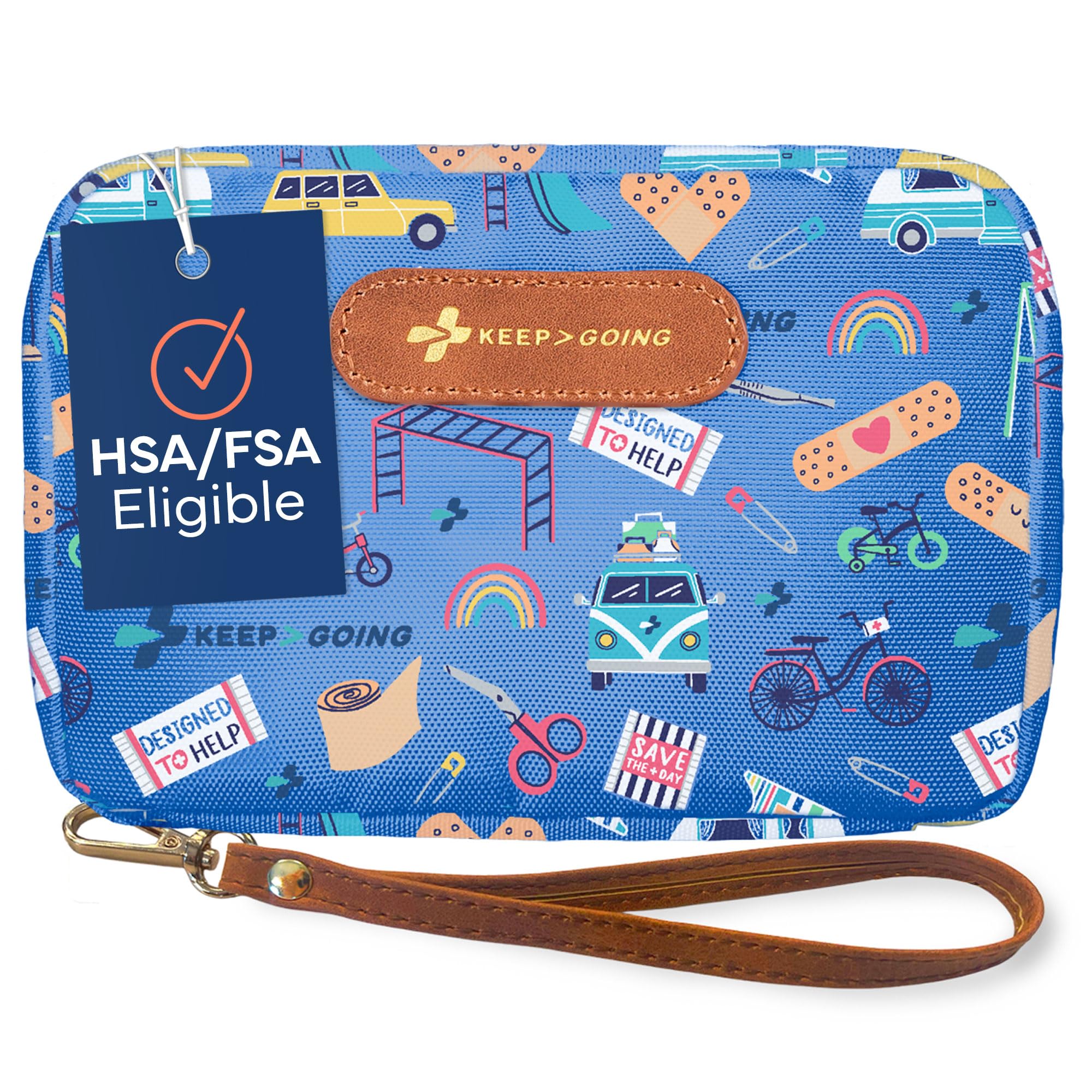
This is the kit you buy for a five-year-old with a scraped knee, not for a highway shoulder. The bandages are printed with cheerful designs, there are stickers and a lip balm in the pouch, and the contents are organized into sections so a babysitter can find the right plaster without tipping everything onto the counter. Anyone who has negotiated with a crying child over a beige bandage will recognize why that matters.

It measures 2 by 7 by 5 inches and weighs 9.6 ounces, so it drops into a diaper bag or a seat-back pocket, and the fabric case is stain- and water-resistant, the two things that count when it lives next to a juice box. It is also sold as TSA-approved travel size, which makes it the one here you can carry onto a plane without a second thought. We appreciate that the maker sells refills, because the fun bandages are the ones that vanish first.

The catch is the price: this is a premium kit with 130 pieces, so you are paying for the design and the child-specific contents rather than volume. If the kit is mostly for adults, the money buys more coverage elsewhere. If it is for a family, this is the one you can hand to a sitter without explaining it.

Pros

  • Kid-friendly bandages, stickers, and lip balm
  • Labeled sections a sitter can follow
  • Sized for a diaper bag or a carry-on
  • Refill kits sold separately

Cons

  • Premium price for 130 pieces
Our verdict

Our pick for parents of small children: cheerful bandages kids do not fight, labeled compartments, and refills when the good ones run out.

Check Latest Price
6

Best for Off-Road and Overlanding

EVERLIT 250-Piece Survival Kit

96 /100
Trail Score Outstanding

Key details

Extras
Flashlight, space blanket, paracord
Pieces
250
Material
1000D water-resistant nylon
Case Type
MOLLE EMT pouch
Check Price on Amazon

Where our top pick expects a glove box, this one expects a trailhead. The EVERLIT arrives in a MOLLE pouch, 1000D water-resistant nylon with straps on the outside and three large compartments inside, the kind of bag you lash to a roll bar or clip to a pack rather than tuck under a seat. If your drives end where the pavement does, start here.

The 250 pieces include the first aid basics, then gear a standard kit does not carry: a mylar space blanket, a three-mode flashlight, and a multi-function paracord bracelet. We were skeptical of the extras until we thought about where this kit gets used, an unlit trailhead at dusk or a cold wait for a tow. The flashlight earns its space in a way that a fifteenth bandage does not.

Construction is the sturdiest of the group. The stitching and the pouch itself feel like gear rather than packaging, and there is slack in the compartments to add your own supplies: a few doses of pain reliever, spare gloves, a proper trauma dressing if you drive far out.

The trade is bulk and specialization. It is a big, strapped bag that takes up cabin space, and it carries survival tools where a commuter just wants more gauze. The bandages inside are much like everyone else's; the bag and the extras are what you are buying.

Pros

  • MOLLE pouch straps to a rig or a pack
  • Flashlight, space blanket, and paracord included
  • Room left to add your own supplies

Cons

  • Big strapped bag takes up cabin space
  • Survival gear uses space medical supplies could take
Our verdict

We take this one off-road: a MOLLE pouch that straps to a rig, with a flashlight and space blanket for when help is far away.

Check Latest Price
7

Backup or Second Car

Vriexsd Mini 150-Piece Kit

96 /100
Trail Score Outstanding

Key details

Pieces
150+
Weight
10.9 oz
Case Type
Waterproof EVA hard shell
Dimensions
6.49 x 4.92 x 2.76 inches
Check Price on Amazon

A carabiner on a first aid kit sounds like a gimmick until a kit has slid out from under the seat every time you brake. This one clips to a headrest post, a cargo hook, or the outside of a daypack, and the EVA shell is rigid enough that it does not collapse when something gets piled on top. At 6.49 by 4.92 by 2.76 inches and just under 11 ounces, it is small enough to live in the car permanently.

Inside, the 150-plus pieces are split into separate sleeves, with povidone-iodine swabs among the supplies, an antiseptic that cheap kits often skip. The gap we found is antibiotic ointment: there is not any, so add a small tube before this goes in the glove box. Even with that addition it is the least expensive route here to a properly divided kit, and the hard shell means the contents will still be intact the third time you open it.

Pros

  • Carabiner clips to a headrest or pack
  • Waterproof EVA hard shell
  • Separate sleeves keep supplies sorted
  • Least expensive kit here

Cons

  • Small capacity compared with family kits
Our verdict

The least expensive way here to put a real kit in the car: clip it where it will not slide, and add a tube of antibiotic ointment.

Check Latest Price
8

Trunk and Cargo

Be Smart Get Prepared 330-Piece

95 /100
Trail Score Outstanding

Key details

Pieces
330
Weight
1 lb
Case Type
Soft-sided bag
Dimensions
4 x 8 x 10 inches
Check Price on Amazon

Three hundred and thirty pieces is the biggest count outside a workshop cabinet, and this bag gets there for less money than most of the 150-piece kits here. It is sold as meeting FDA standards for a medical device, it is FSA and HSA eligible, and at 4 by 8 by 10 inches and about a pound it disappears into a cargo bin.

What that number buys is mostly bandages. The mix leans hard on adhesive strips in every size and thinner on the supplies that solve problems a bandage cannot, so read the contents list against the injuries you actually deal with before ordering. If your household goes through plasters at a rate, this is the kit that keeps up.

The bag is the practical part: soft-sided, with a fully organized interior and multiple compartments, marked with a medical symbol so anyone can find it in a loaded trunk. It is the shape that slides under a seat and squashes into a wheel-well gap, which is what you want from something you touch twice a year.

Our reservation is how much the count flatters the contents, and the bag is smaller in person than 330 pieces suggests. If you need broad coverage rather than a lifetime of plasters, a kit with 40 distinct items gives you more ways out of trouble. If you want a well-stocked bag to throw in the trunk and forget, check the list and fill the gaps on day one.

Pros

  • Big piece count for the money
  • Organized interior with multiple compartments
  • Soft bag stows flat under a seat
  • FSA and HSA eligible

Cons

  • Bandage-heavy mix leaves gaps elsewhere
  • Smaller in person than the count suggests
Our verdict

We rate it the value pick for a trunk: a huge bandage supply in a soft bag that stows flat, once you check the contents against what you want.

Check Latest Price
9

Camping Cars

General Medi 2-in-1 258-Piece

96 /100
Trail Score Outstanding

Key details

Pieces
215 plus 43-piece mini
Weight
1.5 lb
Case Type
Soft bag with compartments
Dimensions
9.8 x 6.3 x 3.5 inches
Check Price on Amazon

Two bags for the price of one kit is the pitch, and it is a good one: a 215-piece main bag for the car and a 43-piece mini that lives in a backpack, a saddlebag, or a glove box of its own. If you have ever wanted a small kit upstairs and a big one in the garage, this splits the difference without buying twice.

The main bag is 9.8 by 6.3 by 3.5 inches and 1.5 pounds, organized into multiple compartments, with an ice pack, a moleskin pad for blisters, and an emergency blanket among the supplies. The moleskin is the detail we appreciated most. It is the item hikers actually use and the one most car kits leave out.

Three and a half inches deep is more than a glove box wants, and the two-bag arrangement means two things to keep track of and two inventories to check. Where it earns its place is the vehicle that doubles as a camping car: the big bag rides in the cargo area and the mini goes in whichever pack you grab on the way out.

Pros

  • Two kits: a 215-piece bag plus a 43-piece mini
  • Ice pack, moleskin, and emergency blanket included
  • Multiple compartments keep it organized

Cons

  • 3.5 inches deep will not suit a shallow glove box
  • Two kits mean two inventories to maintain
Our verdict

Our pick for the car that goes camping: a full kit plus a 43-piece mini to move between packs, with moleskin most kits forget.

Check Latest Price
10

Cargo Bins

VRIEXSD 400-Piece Kit

95 /100
Trail Score Outstanding

Key details

Pieces
400
Weight
2.5 lb
Compartments
Labeled divided sections
Case Material
1680D polyester
Check Price on Amazon

Four hundred pieces and 2.5 pounds makes this the biggest kit here, and that settles the question of where it goes. It is a cargo-bin kit, not a glove-box one. If your car has a dedicated emergency bin in the back, or you drive something with real storage, the coverage is hard to argue with; if you want the kit within arm's reach, look at something flat instead.

The organization is the best part. Labeled compartments split the bag into sections, so the gauze is not mixed in with the gloves, and the 1680D polyester shell is built to take a beating and shrug off a wet trunk floor. There is slack to add your own supplies too, which matters more at 400 pieces than at 100, because you will want to add the things this kit did not think of.

Two things to know. Filled this full, the bag does not close politely: contents can shift and spill when you open it after a few months in a trunk, so move the loose pieces into a zip bag. And at 2.5 pounds it is heavy enough that it needs securing rather than rolling around. Neither is a dealbreaker for the buyer this suits; it is simply not the kit for a glove box.

Pros

  • 400 pieces in labeled compartments
  • 1680D polyester shell handles a wet trunk
  • Room to add your own supplies

Cons

  • 2.5 pounds needs securing in the cabin
Our verdict

For a dedicated cargo bin: 400 pieces in a tough, well-labeled bag, so secure it and expect to repack the loose items.

Check Latest Price

What Four Months in a Glovebox Taught Us

We started with roughly 60 kits sold through auto-parts chains, big-box stores, and outdoor retailers, then cut anything that arrived with a broken zipper, no seal on the antiseptic wipes, or a case too big for a glovebox. That left 14, from budget drugstore pouches to soft-sided kits with room for a splint. For four months they lived where kits actually live — gloveboxes, cargo nets, under-seat bins — and handled the small stuff: a scraped knee in a parking lot, a dog paw opened on glass at a trailhead, a box-cutter slice while loading lumber.

Each kit got the same treatment on a kitchen table before it went into a car. I emptied it, counted what was genuinely usable against what the packaging claimed, and set aside the filler — the twelve alcohol swabs, the comb, the foil blanket that tears at the seam. Then I repacked it and tried to close the case with one hand, since that's how you'll do it with the other hand applying pressure. On the road, I timed how long it took to find gauze in the dark, checked whether bandages still stuck to a sweaty forearm, and noted whether the elastic loops put things back where they started after a week of hot-car jostling.

Portability and size were measured, not guessed: I weighed every kit loaded and compared its footprint to a paperback and a lunch bag. Value came down to cost per item you'd actually reach for, not cost per item in the box, and quality showed up in the boring places — zipper pulls that didn't separate, wrappers that stayed sealed in a hot car, a case that didn't crack at the hinge. Kits that failed on those details got cut no matter how thorough the contents list looked.

How to Choose a Car First Aid Kit

Measure the space before you compare contents

A glove box is a bad place to discover that compact meant backpack-sized. The kits here run from 1.5 inches thick to 3.5, and that single measurement decides whether the case disappears into the dash or rides loose in the trunk for the next three years. Measure the inside depth of your glove box before anything else.

Under 3 inches, and you want a slim hard case; the Protect Life at 1.5 inches is the obvious one. Three inches or more opens up the bigger soft bags, which hold far more and squash into gaps a box cannot follow. Also check width: a 9-inch case will not sit flat in a small hatchback's dash.

Read the item list, not the number on the box

Piece counts are inflated by adhesive bandages, and bandages are the cheapest thing in any kit. A 330-piece bag can be mostly strips in a few sizes, while a 250-piece kit that adds a cold pack, a space blanket, and a flashlight gives you more ways out of a bad evening. The number tells you how often you can bandage a finger; the item list tells you how many problems you can solve.

Count categories instead: wound care such as gauze, tape, and antiseptic; burn care; gloves; and the extras that handle sprains and shock. Families should look hard at the small-bandage supply, because that is the size that gets used. Our top pick's second number, not its first, is what earned it the recommendation.

Choose a hard shell or a soft bag by where it lives

A hard shell shrugs off a cooler sliding into it, wipes clean, and keeps contents dry in a damp trunk; the trade is that it only fits where its dimensions allow. A soft bag conforms to odd gaps, holds more per cubic inch, and is much easier to overstuff, which is why most of the biggest kits here use one.

Whichever you pick, the kit is only useful if it survives being buried. A waterproof case earns its keep near a door that gets wet or in a boat locker; a padded soft bag is the better choice for a cargo bin that gets loaded and unloaded weekly.

Plan for a kit that sits untouched for a year

Most car kits are bought, stowed, and forgotten, which is why the expiry date is the specification nobody checks. Go through the ointments, wipes, and sterile packets when the kit arrives, write the earliest date on the outside of the case with a marker, and set a phone reminder for that month.

Labeled compartments make restocking realistic; a single zippered pouch usually gets replaced instead of refilled. Where a maker sells refill packs, as KEEP>GOING does, that is the cheaper and tidier path, because the layout you already understand stays the same.

Frequently Asked Questions

Final Verdict

Buy the First Aid Only 313-piece kit if you want the decision made for you. It covers wounds, burns, and sprains, its clear pockets can be read at a glance in bad light, and the flat soft case fits under a seat or into a deep glove box. It is the best all-round answer in this set.

Two situations change that. If your glove box is shallow, the Protect Life 100 is the flattest case here and tough enough to survive being knocked around, as long as you top it up. If you drive where help is hours away, the EVERLIT 250's MOLLE pouch, flashlight, and space blanket cover the part a bandage cannot.