Best Home First Aid Kits of 2026

The last time I really needed a first aid kit, it was a paring knife, a wet cutting board, and a Saturday morning that got quiet fast. What I wanted wasn't a clinic — it was a box in the hall closet with gauze, tape, and a bandage big enough for a thumb. A good home kit is quiet household infrastructure: complete enough for small stuff, organized enough to open one-handed, and compact enough that you keep it within reach.

Over the past eight months, my team and I have lived with a dozen kits — in a kitchen drawer, a hall closet, a car trunk, and a backpack that came to weekend soccer games. We treated a sliced thumb, a scraped knee, a minor burn, a splinter, and a blister, and we noted whether each kit helped or made the moment worse. We also compared cost against replacing the supplies piecemeal, since a box of filler isn't a value. The picks below stayed stocked, stayed portable, and handled both household bumps and away-from-home mishaps.

1

Best Overall

First Aid Only 313-Piece Kit

96 /100
Trail Score Outstanding

Key details

Case
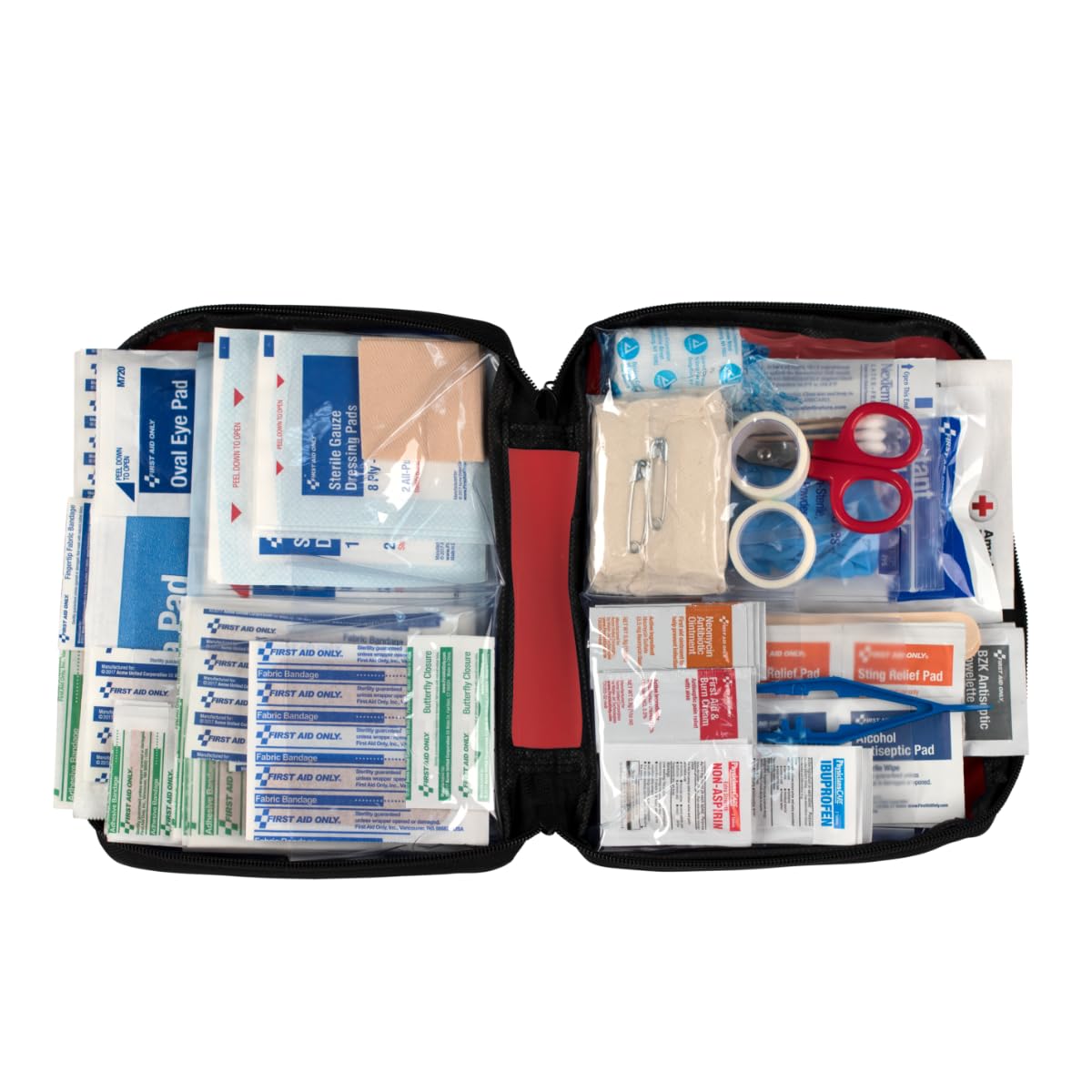
Soft-sided, two layers of clear pockets
Pieces
313
Dimensions
9.75 x 7.4 x 2.5 in
Wound Care
Gauze roll and pads, triangular bandage, burn cream
Check Price on Amazon

A home kit gets judged in the minute it takes to stop a cut bleeding through a paper towel, one-handed, while you dig for gauze. That's the test we kept coming back to, and it's why the First Aid Only 313-piece kit is the one we recommend first: two tiers of clear pockets and separate compartments mean the things you reach for in a hurry are visible instead of buried.

What earns it the top spot is the wound care beyond adhesive strips — gauze rolls and pads, a triangular bandage, antibiotic ointment, BZK wipes, burn cream packets, and fabric and plastic bandages in a spread of sizes. Plenty of kits here can cover a scraped knee. Fewer can dress a larger abrasion or a splash burn without sending you to the bathroom cabinet for extras. We also appreciated that the soft case is genuinely flat at 9.75 by 7.4 by 2.5 inches, so it slides into a drawer or onto the shelf over the washer instead of demanding wall space.

Nothing about it feels precious. The nylon case zips shut, the pockets are clear plastic, and a leaked tube of ointment wipes out. Our one reservation is the first evening: the smaller items arrive grouped in bags inside the pockets, so the kit isn't truly organized until someone decides where things belong. Do that once with a marker and a couple of spare zip bags and it holds.

Bandages dominate the count, as they do in every kit at this size, but the extras are the ones a household actually reaches for. If you want one box that covers a family, a car, and a rental week without a second purchase, this is the one we point to. Buy a spare box of small fabric bandages with it — those run out first.

Pros

  • Gauze, dressings, and burn care, not just bandages
  • Two layers of clear pockets keep supplies findable
  • Flat 2.5-inch case slides into a drawer
  • 313 pieces covers a whole household

Cons

  • No pain reliever or antihistamine in the box
Our verdict

The one we tell most households to buy: broad wound care, a case that fits a drawer, and enough supplies for a family without a pharmacy run.

Check Latest Price
2

Best with Medicines Included

Band-Aid All-Purpose 160-Piece

96 /100
Trail Score Outstanding

Key details

Case
Rigid plastic with molded compartments
Pieces
160
Weight
1.19 lb
Medications
Neosporin, Benadryl, Tylenol
Check Price on Amazon

Three things in this case don't turn up in most of the kits we compared: a tube of Neosporin, a packet of Benadryl, and Tylenol. That trio is the difference between dressing a cut and handling the rest of the evening — the bug bite that swells, the itch that won't let a child settle, the headache after a long day. It's the kit we hand to a household that wants one box to cover the whole small emergency.

The case backs it up. Rigid plastic, 9.5 by 7 by 3.25 inches, a little over a pound, with a latch that stays shut and molded compartments instead of a loose pile. We've used soft bags that do the job, but this is the one for a garage shelf or a boat locker where something heavy gets stacked on top. The bandages are the brand's own, in a spread of shapes and sizes, and they're not made with natural rubber latex.

Where it gives ground is depth: 160 pieces against the 300- and 400-piece kits here, with fewer gauze pads and no large dressings. For two or three people whose injuries run to kitchen knives and rose bushes, that's the right trade, and the medicines more than cover the difference. A household that wants to be ready for a larger wound should look at the bigger kits on this list.

Pros

  • Neosporin, Benadryl, and Tylenol included
  • Molded compartments instead of a loose bag
  • Latex-free bandages in assorted styles

Cons

  • Rigid case is deep enough to need a full shelf
Our verdict

Our pick when you want medicine in the box: Neosporin, Benadryl, and Tylenol alongside bandages, in a hard case that takes being stacked on.

Check Latest Price
3

Most Supplies

VRIEXSD 400-Piece Kit

95 /100
Trail Score Outstanding

Key details

Case
Water-resistant 1680D polyester
Pieces
400
Weight
2.5 lb
Organization
Labeled divided compartments
Check Price on Amazon

Four hundred pieces is the highest count here, and the bag carries them at about two and a half pounds — heavier than the compact kits, light enough to lift off a shelf with one hand. For a household of five with a camper in the driveway, the arithmetic is easy to like.

The labels are what make the number usable. Compartments are separated by category and marked, so someone who didn't pack the bag can find the burn dressing without pulling everything out — which matters most when you're the second person to open it, in a hurry, in a dim room. The outer fabric is a heavy 1680D polyester with a water-resistant finish, the right call for a bag that lives in a basement, a truck bed, or a damp garage.

Full bags have their own problem. Pack 400 pieces into compartments and the smaller items work loose when you open it wide. The fix is the one we give for any kit: spend ten minutes with it before you need it, open every compartment, and learn where the gauze lives. Do that and a full bag is an advantage; skip it and you're reading labels one-handed.

As a house kit for a big family, or for a workshop, a church hall, or a scout trailer, this is the strongest choice here on contents and on value — it's the most supplies for the money on this list. Someone living alone would be paying for bandages that pass their date before they're ever opened.

Pros

  • 400 pieces, the largest count in this guide
  • Labeled compartments anyone can navigate
  • Water-resistant 1680D polyester bag

Cons

  • Too bulky for a glove box or kitchen drawer
Our verdict

For a big household or a shared workspace: the most supplies here, in labeled compartments a stranger could navigate.

Check Latest Price
4

Best for Shared Spaces

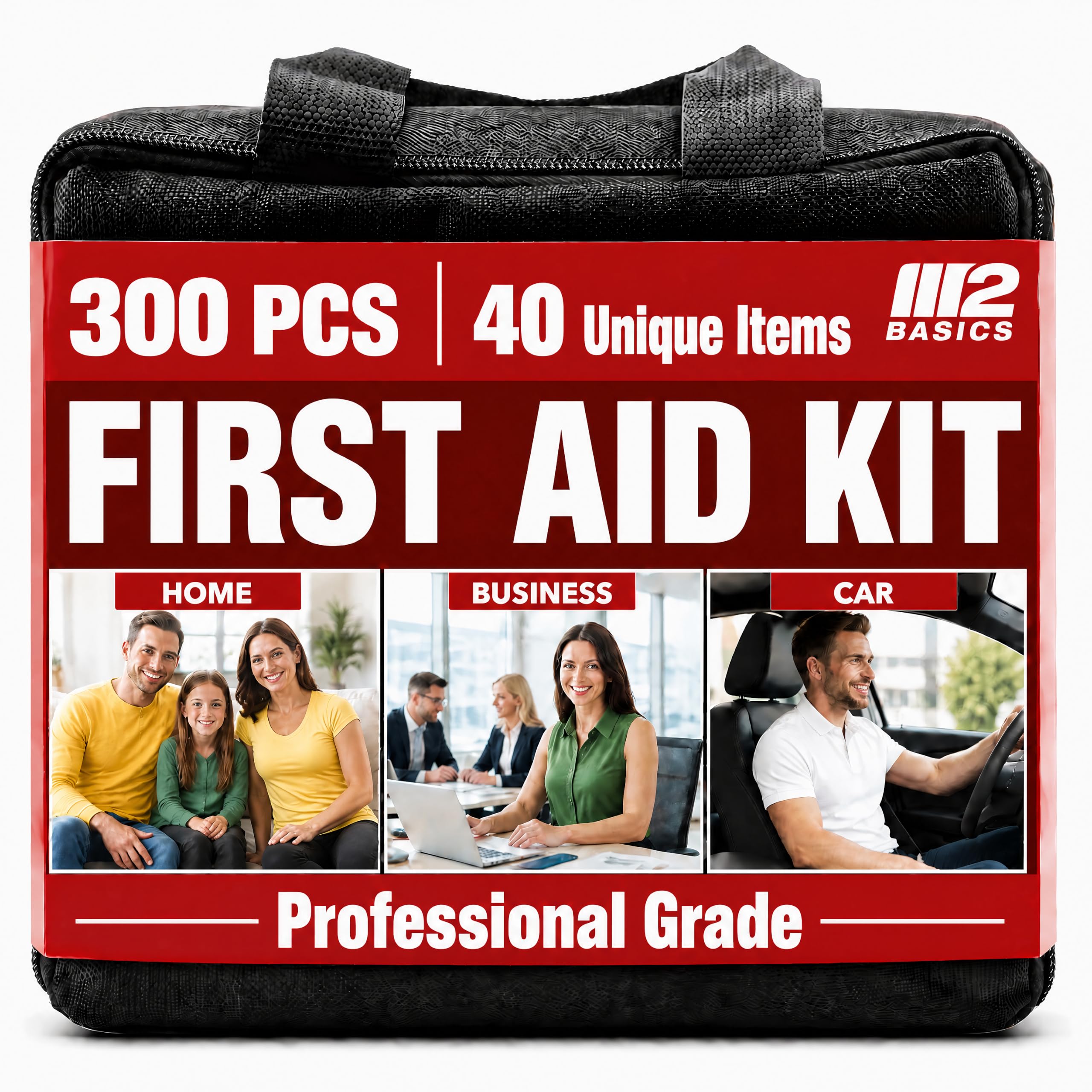
M2 Basics 300-Piece Kit

95 /100
Trail Score Outstanding

Key details

Case
Soft-sided with internal dividers
Extras
CPR face mask, cold pack, emergency blanket
Pieces
300, in 40 unique items
Dimensions
9 x 3.5 x 6.5 in
Check Price on Amazon

Forty different items is the number that matters here, not the three hundred. The M2 Basics kit covers the ordinary wound-care supplies and then adds the pieces most kits leave out: a CPR face mask, an instant cold pack, an emergency blanket, gloves, scissors, and tweezers.

The case is soft-sided, 9 by 3.5 by 6.5 inches, about a pound and a half, with internal dividers holding the compartments apart. It fits a desk drawer or a shelf without a dedicated cupboard, and the dividers do their job as long as things go back where they came from — a soft case rewards tidiness in a way a molded plastic one doesn't. The bandages come in enough sizes for a knuckle and a forearm, and there's tape and dressing for the cuts a strip won't cover.

For a household that ends up supplying other people — the school committee, the youth team, the bench in a workshop — this is the pick we point to, because the contents are built for a stranger's emergency as much as your own. A couple in an apartment will find it more kit than the cupboard needs.

Pros

  • 40 distinct items, not 300 bandages
  • CPR face mask, cold pack, and blanket included
  • Fits a desk drawer at 1.5 pounds

Cons

  • Soft sides give the contents no crush protection
Our verdict

The shared-space kit: a CPR mask, gloves, cold pack, and blanket turn it from a household box into something you can hand a stranger.

Check Latest Price
5

Best Budget

Be Smart Get Prepared 180

95 /100
Trail Score Outstanding

Key details

Case
Hard plastic with slide latches
Pieces
180
Weight
1.3 lb
Dimensions
10 x 8 x 3 in
Check Price on Amazon

This is the least expensive kit in the guide, and the case is the surprise: at this end of the range we expected a nylon pouch and got a molded plastic box with slide latches that stay shut. For a first kit in a new apartment, a guest bathroom, or the trunk of a car, that combination is hard to argue with.

The case measures 10 by 8 by 3 inches, smaller than 180 pieces sounds, and the contents are packed to fit — the lid closes on a full box, not a roomy one. It's a hard shell, so it keeps dust and damp out and stacks under a seat or on a shelf without sagging.

Where it lands is the everyday. It's the box you pull a bandage from without thinking, and the one cheap enough to put in three rooms. Expect to add to it as the years go by; that's the nature of a kit this size.

Pros

  • Hard plastic case with latches that stay shut
  • 10 by 8 by 3 inches fits under a seat
  • Lowest price tier in this guide

Cons

  • Sparse on gauze and dressings for bigger wounds
Our verdict

The cheapest kit here still gets you a hard plastic case that latches, which is why we point budget shoppers to it before anything in a pouch.

Check Latest Price
6

Best for the Car

AMORNING 276-Piece Kit

94 /100
Trail Score Outstanding

Key details

Case
Red zippered pouch
Extras
Ice pack and emergency blanket
Pieces
276
Weight
1 lb
Check Price on Amazon

A pound, in a red case you can spot from across a dim garage: this is the kit that lives in the car, the hall drawer, or the bottom of a stroller basket and never announces itself until it's needed. The color matters more than it sounds. A black pouch at the back of a shelf is a pouch you forget you own.

What 276 pieces buys at this size is breadth rather than depth — bandages in several shapes, tape, gauze, scissors, tweezers, safety pins, an ice pack, and an emergency blanket. The ice pack and the blanket are what make it a car kit rather than a bathroom kit that travels: a bump on the head and a cold night at the roadside are the two moments when a bag of bandages stops being enough. For the size, that's the right set of priorities.

It's also the kit most likely to be bought twice, because one can live in the car and one in the house without either feeling like a compromise. At the low end of what the kits here cost, that's a sensible way to spend.

Pros

  • One pound, easy to stash under a seat
  • Ice pack and emergency blanket included
  • Bright red case is easy to find

Cons

  • Soft pouch gives no protection when stacked
Our verdict

The car kit: one pound, a bright red case, and an ice pack — small enough to live under a seat and cheap enough to buy twice.

Check Latest Price
7

Home Plus Car

General Medi 2-in-1 258-Piece

96 /100
Trail Score Outstanding

Key details

Case
Soft bag with separate mini pouch
Extras
Moleskin pad, ice pack, emergency blanket
Pieces
258, in a 215-piece kit plus 43-piece mini
Dimensions
9.8 x 6.3 x 3.5 in
Check Price on Amazon

There's a second, smaller kit packed with this one — 43 pieces in its own pouch, sized for a backpack or a glove box. That's the idea worth paying for: a home kit and a take-with-you kit in one purchase, so a weekend away doesn't mean unpacking the shelf.

The main bag is soft-sided with multiple compartments, about a pound and a half, and it carries 215 pieces including an ice pack, a moleskin pad, and an emergency blanket. The moleskin is the detail we noticed. It's the one item here aimed at blisters rather than cuts, the mark of a kit put together for hiking and scouting rather than a kitchen drawer.

Both bags are the point and the catch. If the small pouch actually travels — a daypack, a glove box, a bike bag — you get two useful kits and the arrangement is excellent for the money. If both end up in the same closet, you've bought a second set of bandages you won't reach for before they date, and a single bigger kit serves better.

Pros

  • Two kits in one purchase
  • Moleskin, ice pack, and blanket included
  • Main bag weighs only 1.5 pounds

Cons

  • Stubborn bandage wrappers and only fair adhesion
Our verdict

A home kit and a go kit in one buy — worth it if a small pouch will genuinely live in your car or pack.

Check Latest Price
8

Everyday Scrapes

Welly First Aid Kit 130

95 /100
Trail Score Outstanding

Key details

Pieces
130
Bandages
48 standard, 30 small, 12 waterproof
Dimensions
6.5 x 6.5 x 2.7 in
Medications
Triple antibiotic, hydrocortisone, ibuprofen
Check Price on Amazon

Count what a household actually pulls out of a first aid kit over a year and it's mostly bandages: the strip on a kitchen cut, the fresh one after a shower, the small one on a blister. The Welly box is built around that. Forty-eight standard flexible fabric bandages, thirty small ones, a dozen waterproof, plus butterfly strips, non-stick pads, and tape.

The bandages themselves are the argument. Flexible fabric, sealed on all four sides, and stretchy enough to stay on a knuckle that bends — the sizes that matter for fingers and toes are actually in the box rather than implied by the count. The kit also carries triple antibiotic, hydrocortisone, and ibuprofen, which puts it beside the Band-Aid kit as one of only two here with oral medicine.

The box is compact — 6.5 inches square and under three inches deep — in a rigid outer case that holds up to life in a car. It's organized enough that anyone can find a bandage without unpacking the rest, which is not nothing on a Saturday morning with a crying child in front of you.

For scrapes, blisters, and the endless bandage changes of a household with children in it, this is the best box here — the one you'll use down to the cardboard instead of leaving it sealed until it expires.

Pros

  • 48 standard, 30 small, 12 waterproof bandages
  • Antibiotic, hydrocortisone, and ibuprofen included
  • Compact rigid case, 6.5 inches square

Cons

  • No gauze roll or cold pack for bigger injuries
Our verdict

If most of your first aid is bandage changes, this is the box to buy: better bandages than the big kits, plus ointments and ibuprofen in a case that fits a shelf.

Check Latest Price

How We Tested the Best Home First Aid Kits

We started by pulling together the kits that show up in pharmacy aisles, home-goods stores, and online best-seller lists, then filtered out the ones with vague contents lists, expired or near-expired supplies, and cases that looked impossible to reopen. We landed on a dozen kits and kept them for eight months in the places people actually store them: a kitchen drawer, a hall closet, a car trunk, and a backpack for weekend soccer games.

Every kit got opened, inventoried, and repacked before we used it — we counted how many useful sizes of bandages and gauze came in each one, checked whether the scissors cut cleanly through tape, and saw whether the tweezers could grip a splinter without bending. Then we put them to work on real household injuries: a sliced thumb from a paring knife, a scraped knee from a bike fall, a minor stovetop burn, a splinter, and a blister from new shoes. We noted whether the packaging stayed organized when opened one-handed, whether the case fit in a drawer or glove box without hogging space, and whether the contents were still usable after a few months in a hot car.

Value came down to more than the sticker price: we priced out replacing the useful supplies individually and compared that with what each kit cost, and we noted whether the case was sturdy enough to reuse or mostly filler. The kits that rose to the top had bandages that stuck, instructions we could follow without squinting, and enough variety to handle a kitchen cut and a soccer-field scrape without sending us to the store. A good home first aid kit should feel like a small, organized answer — not a drawer full of mystery packets.

How to Choose a Home First Aid Kit

Count Contents, Not Pieces

Piece counts are the easiest thing to shop by and the least informative. A 300-piece kit can be 200 adhesive bandages and a handful of wipes. What tells you whether a kit can handle a real wound is the presence of gauze pads, a gauze roll, tape, and at least one larger dressing — our top pick carries all four, which is much of why it's the default here.

Before you buy, read the contents list and count the items that aren't bandages. If that number is under a dozen, you're buying a bandage box, not a home kit, and the gap will show up the first time someone needs more than a strip.

Pick the Case for Where It Will Live

Decide where the kit goes before you decide which one: a hall drawer, a garage shelf, a car door pocket, a boat locker. A rigid plastic case with latches survives being stacked on and keeps dust out, which is why we favor one for a garage or workshop. A soft pouch or zip bag is flatter and easier to wedge into a car, but it offers the contents no protection from weight above it.

Measure first. A case three inches deep is a different purchase from one that slides under a seat, and the kits here range from a pound to two and a half.

Decide Whether You Want Medicines in the Box

Most kits stop at ointment and antiseptic wipes. A few, including the Band-Aid kit here, add oral medicine — a pain reliever and an antihistamine — and that's the difference between dressing a cut and handling the evening after it. If you buy a kit without them, you're not missing a feature so much as adding a step.

Check what's already in your medicine cabinet, then put a small pack of each into the kit and write the date on the outside. Anything you add, date it, so the kit doesn't quietly go stale around you.

One Kit or Two

A single large kit in the hall closet covers the house, but it doesn't travel, and the car is where a lot of small injuries happen. Two smaller kits — one for the shelf, one for the vehicle — usually work out better than carrying the big one back and forth and restocking it every time.

A 2-in-1 set with a separate mini pouch solves the same problem in one purchase, as long as the small bag genuinely leaves the house. If both kits end up in the same closet, you've paid for a second set of bandages you won't reach for before they date.

Frequently Asked Questions

Final Verdict

The First Aid Only 313-piece kit is the one we recommend to most households: real wound care, not just bandages, in a flat case that slides into a drawer and has the pockets to find things in a hurry.

Buy the Band-Aid kit instead if you want medicine in the box — Neosporin, Benadryl, and Tylenol in a hard case that takes being stacked on. And if you're supplying a big family, a workshop, or a scout trailer, the VRIEXSD bag carries the most here in labeled compartments a stranger could navigate.