Best Tennis Elbow Braces of 2026

Tennis elbow doesn't announce itself on the court. Mine started with a twinge while picking up a coffee mug, and by the end of that week I was typing one-handed. The annoying truth about braces is that the ones that quiet the pain fastest tend to be the most restrictive, which is exactly why so many get loosened, then abandoned, halfway through the day. The right one holds the forearm muscle in check just hard enough that you can keep playing, lifting, and typing without flinching.

Fit is where most people get it wrong: these aren't one-size garments, and the difference between a strap that stays put through a sweaty third set and one that slides toward your wrist can be half an inch of forearm circumference. Our team has spent the past three months wearing 14 braces through matches, workdays at a keyboard, and gym sessions, paying attention to where they press, whether they stay in place, and how the velcro holds up. The ones below earned their spot.

1

Best Overall

Bodyprox Elbow Brace 2 Pack

89 /100
Trail Score Excellent

Key details

Pad
Gel compression pad
Closure
Hook-and-loop
Material
EVA, nylon, SBR, spandex
Pack Size
2 braces
Check Price on Amazon

Two braces in one pack is the practical reason we make the Bodyprox our default pick. You can leave one in a gym bag and one at a desk, or keep a spare while the other air-dries. Each brace uses a gel pad and a double hook-and-loop closure, so the pressure is focused on the forearm rather than wrapped around the whole joint. For a first tennis elbow brace, that combination is easy to understand and easy to live with.

The double strap is the detail we appreciate most. It lets you set the pad where it feels right and then add tension from either side, which is more forgiving than a single narrow band. The brace is light enough to wear under a loose sleeve, and the hand-wash routine is simple. We like it for tennis, gardening, and repetitive desk work because it does not make the elbow feel locked in place.

Against the sleeves here, it trades full-joint coverage for pinpoint pressure. That is the right trade for tennis or lifting, where you want the pad on a specific spot. For all-day general soreness, a sleeve makes more sense. The pair also makes the first purchase less fussy: if one strap gets damp or disappears into a bag, you are not stuck.

Pros

  • Two braces for home and gym
  • Targeted gel pad you can position
  • Double strap is easy to reset

Cons

  • No stated arm-size range
  • Can shift during sweaty activity
Our verdict

We recommend the Bodyprox as the default tennis elbow brace because it gives you two adjustable, targeted straps without a big commitment.

Check Latest Price
2

Best for Hard-To-Fit Arms

Sleeve Stars Tennis Elbow Brace

88 /100
Trail Score Excellent

Key details

Closure
Hook-and-loop
Fit Range
9–23 in
Pack Size
Pair
Strap Sizes
3
Check Price on Amazon

The 9- to 23-inch fit range is the first thing we check on the Sleeve Stars, because most elbow straps make you guess between small, medium, and large. This set arrives with three strap lengths, and you thread the one that suits your forearm through the same pad. For an arm that sits between sizes, that is a more useful kind of adjustability than a longer Velcro tail alone.

We recommend this one when standard sizing has already failed you. The strap is easy to position with one hand, and the pad can be moved without swapping the whole brace. The pair format also means you can keep one at home and one in a bag. We like the broad color choice, though the fit range matters far more than the finish.

The trade-off is hardware: a long strap and a separate pad take a little more fussing than a simple elastic band. That is the trade for the fit range, and for an arm that normally falls between sizes, we think it is worth it. If your forearm lands squarely in the middle of a standard range, a simpler two-strap design is less fuss.

Pros

  • Three strap lengths cover 9–23 in
  • Easy to position with one hand
  • Pair lets you keep a spare

Cons

  • Pricier than the basic straps here
  • Can slide during sweaty play
Our verdict

This is the one we point to when standard arm sizes fail, thanks to three strap lengths that cover a wide fit range.

Check Latest Price
3

Best Compression Sleeve

Crucial Compression Elbow Sleeves

89 /100
Trail Score Excellent

Key details

Care
Hand wash
Sizing
Medium (12.0–14.0 in)
Material
Nylon/spandex
Pack Size
2 sleeves
Check Price on Amazon

The pair is what makes these Crucial sleeves worth a look: one can be on your arm while the other is drying, and both are finished with the kind of double stitching that holds up to repeated wear. We reach for this set when the goal is all-day compression rather than pinpoint pressure. The nylon-and-spandex knit feels more like a supportive sock than a rigid brace.

What we like most is how little there is to adjust. You pull the sleeve on, smooth it flat, and get on with the day. The medium size is listed for a 12- to 14-inch elbow circumference, so the size chart is the place to start; guessing from a T-shirt size is a mistake. The fabric is breathable enough for workouts and quiet enough under a loose shirt, and the pair makes the price easier to justify than a single sleeve.

This is not the pick for someone who wants a pad pressing on one spot. It is the pick for general tenderness, post-activity soreness, or an elbow that feels better with warmth and even pressure. Compared with the thinner budget sleeves here, the Crucial pair has a more substantial feel and a cleaner fit. We keep it in the bag for days when a strap feels like too much hardware.

Pros

  • Two sleeves for rotation
  • Breathable knit for long wear
  • Substantial fabric and stitching

Cons

  • Sizing can run large
Our verdict

For all-day compression, we choose this pair of sleeves: the fabric, fit, and two-sleeve value make it the most comfortable sleeve option here.

Check Latest Price
4

Best Low-Profile Strap

CAMBIVO Elbow Strap 2 Pack

89 /100
Trail Score Excellent

Key details

Pad
Contoured EVA
Closure
Hook-and-loop
Profile
Low-profile
Pack Size
2 straps
Check Price on Amazon

A low-profile strap solves a different problem from a sleeve: it puts pressure on a small area and then gets out of the way. CAMBIVO's two-pack does that with a contoured EVA pad and a slim hook-and-loop band that sits close to the arm. We like it for wearing under a button-down or a lightweight athletic layer, where a bulkier brace announces itself.

The pad is the part that earns the design. It is shaped to press on the forearm rather than spread flat across the whole joint, and the band is narrow enough to position precisely. We also appreciate that the pack gives you a spare for the office or the car. The closure is easy to reset, and the brace does not make the elbow feel locked.

A narrow band is a targeted tool for activity, not an all-day compression sleeve. Placement matters more than it does on a sleeve, so take a minute to center the pad before you tighten. If you want something you can pull on and forget, the Crucial sleeve is the easier choice; if you want discreet pressure under a shirt, this is the one we reach for.

Pros

  • Low-profile enough for a shirt
  • Contoured pad targets the tendon
  • Two straps in the pack

Cons

  • Hook-and-loop can wear out over time
  • Can be hard to tighten on thin arms
Our verdict

We like this low-profile strap when you need targeted pressure that disappears under a shirt or athletic sleeve.

Check Latest Price
5

Best Wide-Band Strap

SENTEQ Wide Elbow Strap

88 /100
Trail Score Excellent

Key details

Closure
Buckle
Material
Neoprene
Warranty
1 year
Band Size
15.5 x 3.5 x 0.3 in
Check Price on Amazon

The SENTEQ band is the widest strap in this group, and that changes how it feels: instead of a thin line of pressure, it spreads the load across a broader section of the forearm. The 15.5-inch length and 3.5-inch width are the numbers to picture, and the buckle closure gives it a more mechanical, set-and-hold feel than a simple Velcro tab.

We like that broad band for hard sessions and for anyone who finds narrow straps dig in. The neoprene has a substantial feel, and the one-year warranty is a useful vote of confidence for a part that sees a lot of pull and release. The SENTEQ is also easy to wipe clean and less likely to curl at the edges than a thin elastic band.

That broad coverage is why it earns a place for heavy use, especially for anyone who finds a narrow strap concentrates pressure too sharply. It is not the most discreet brace here, and the extra material makes it a better match for a workout bag than a pocket. The band also has enough surface area to stay settled once you get it positioned, which matters when you are gripping a racket or a weight. We reach for it when stability matters more than a barely-there feel.

Pros

  • Wide band spreads pressure
  • Buckle holds tension securely
  • One-year warranty

Cons

  • Requires two hands to fasten
  • Runs small for larger forearms
Our verdict

We recommend this wide-band strap for hard sessions and buyers who want a broad, buckle-secured pressure zone.

Check Latest Price
6

Single-Sleeve Simplicity

Kunto Fitness Elbow Sleeve

89 /100
Trail Score Excellent

Key details

Size
Medium
Closure
Pull on
Material
70% nylon, 15% spandex, 15% rubber
Pack Size
1 sleeve
Check Price on Amazon

The Kunto takes the hardware out of the equation. There is no strap to center, no pad to position, and no closure to reset with one hand. You pull it on, smooth the fabric, and go. The 70% nylon, 15% spandex, and 15% rubber blend gives it a stretchy, close fit that stays put, and the close fit means less bulk under a sleeve.

What we like is the simplicity for long days. The sleeve covers the whole elbow, so it is a good match for general tenderness and recovery days. It works under a loose shirt, through a workout, and when a strap feels like too much. The fabric is breathable, and the pull-on design is the fastest thing here to put on.

Compared with the Crucial pair, the Kunto is a single sleeve rather than a two-pack, and it has a more utilitarian look. We still keep it in the conversation because the fabric is comfortable for hours and the pull-on design is the fastest thing here to put on. If you want a brace you can forget about until lunch, this is the shape to consider.

Pros

  • Pull-on sleeve is simple and fast
  • Comfortable knit for long wear
  • Supports the whole elbow

Cons

  • Only one size listed
  • No targeted pad for pinpoint pressure
Our verdict

We keep this sleeve in the conversation for buyers who prefer pull-on simplicity and a strong record for comfort.

Check Latest Price
7

Adjustable Sleeve Support

APOYO Tennis Elbow Brace

89 /100
Trail Score Excellent

Key details

Size
Large
Fabric
Moisture-wicking knit
Closure
Adjustable strap
Pack Size
1 sleeve
Check Price on Amazon

APOYO's sleeve-plus-strap design is a middle ground: the knit sleeve wraps the whole elbow, and an adjustable strap adds extra tension on the forearm. That combination suits days when a plain sleeve feels too passive but a bare strap feels too focused. The large size and moisture-wicking knit make it a better match for a bigger arm or a workout than for a barely-there fit.

The sleeve is the comfortable part, and the strap is the dial. You can wear it as a straightforward compression sleeve or snug the strap when the tendon needs more support. The strap is easy to reset, and the fabric stays smooth enough under a loose shirt. Keep the hook side away from the knit when you take it off; it can catch if you let the strap fold onto the sleeve.

The strap can be cinched without moving the sleeve, and the closure makes it easy to loosen between sets. That is more control than a pull-on sleeve gives you, without the precision demand of a narrow strap. The large size is the one to check against your measurement, since the sleeve fit drives the rest of the brace.

We like the way the strap changes the feel without forcing you into a different brace. Against the Crucial pair, the APOYO gives you more adjustment but less simplicity. Against a basic strap, it gives you full-joint coverage. That makes it a good fit for changing support during the day, especially if you like a sleeve's coverage but want a strap's extra hold.

Pros

  • Sleeve plus strap adjusts support
  • Moisture-wicking knit for workouts
  • Strap is easy to reset

Cons

  • Knit fabric can fray with heavy use
Our verdict

We see this as a useful sleeve-plus-strap hybrid, as long as you accept that the fabric may show wear sooner than the support does.

Check Latest Price
8

Smaller-Arm Budget

Rakiie Tennis Elbow Brace 2 Pack

89 /100
Trail Score Excellent

Key details

Pad
EVA compression pad
Closure
Hook-and-loop
Fit Range
7.08–14.17 in
Pack Size
2 braces
Check Price on Amazon

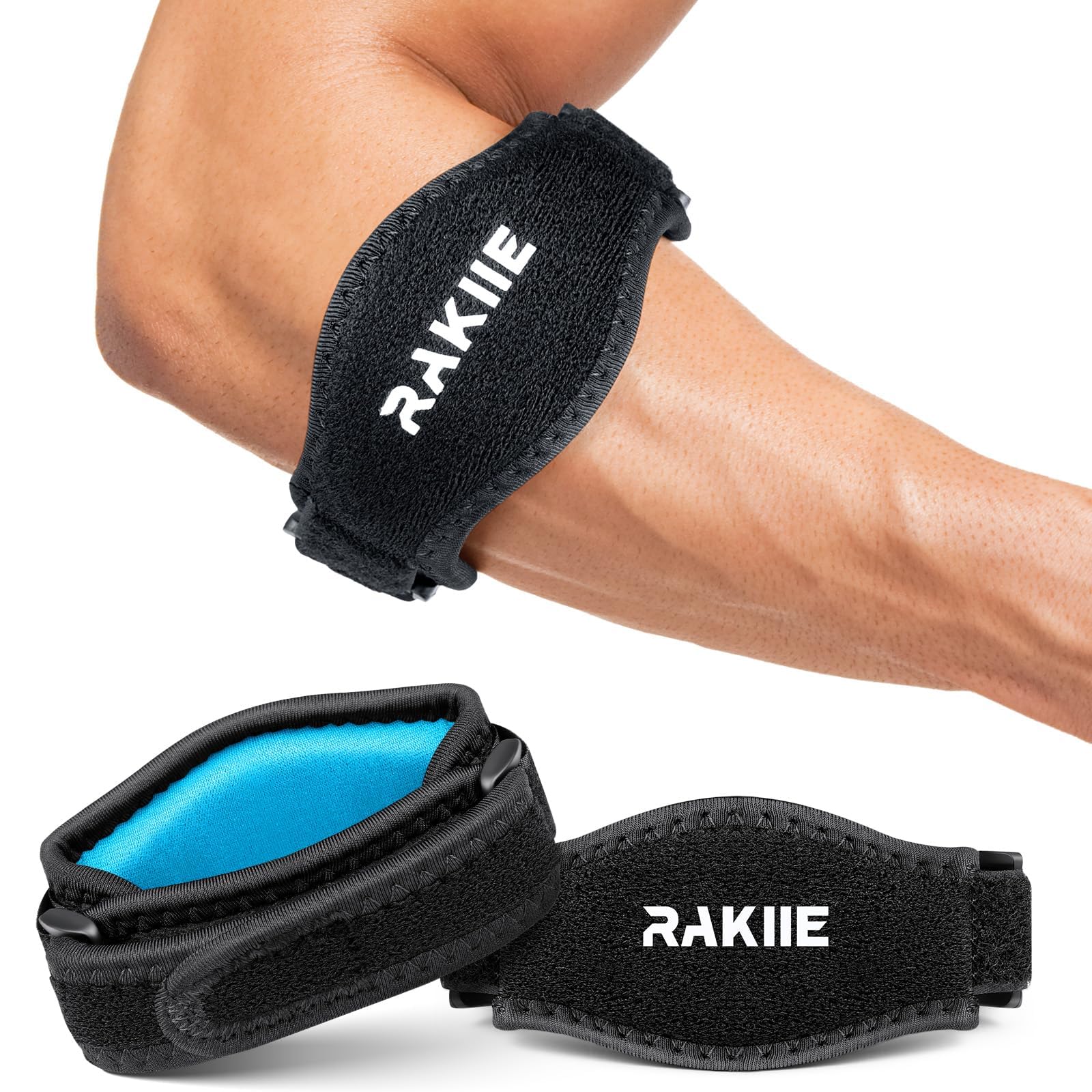
The 7.08- to 14.17-inch fit range is the detail that defines this Rakiie pair. It is aimed at smaller forearms, and the two straps let you set the EVA pad on the tendon and then snug the band from either side. For a budget two-pack, the layout is simple: a pad, two straps, and a hook-and-loop closure.

The pad is firm enough to feel purposeful, and the straps are easy to reset. We like the pair for the way it disappears into a routine: keep one in a tennis bag and one in a desk drawer, and you are less likely to leave the brace at home on the day your elbow complains. The blue color is a small bonus if you want to spot it in a dark bag.

The fit range is also the limit. If your forearm measures above 14.17 inches, this pair is not the one; look at the Sleeve Stars or a wider band instead. The straps are best for light-to-moderate use, where you can keep the closure clean and dry.

We reach for this pair on lighter days, not for a heavy training block. The EVA pad and two-strap layout do the real work, and the strap tension is easy to read by feel. The fit range is what decides whether it belongs in your bag.

Pros

  • Fits smaller forearms, 7.08–14.17 in
  • Two braces for bag and desk
  • EVA pad targets the tendon

Cons

  • Hook-and-loop can lose grip over time
Our verdict

We recommend this pair for smaller arms and tight budgets, with the caveat that the fit range is narrower than most.

Check Latest Price

How We Tested 14 Tennis Elbow Braces

We started by pulling every brace we could find that published a real forearm-circumference range and didn't require a custom fitting, then cut the list to adjustable strap styles rather than fixed compression sleeves. That left 14 braces, which we wore over three months — not on a lab bench, but during the things that set the pain off in the first place.

Each brace got at least one full workday at a keyboard, a hitting session of groundstrokes and serves, and a gym day of dumbbell rows and pull-ups, plus whatever the week threw at us: hauling grocery bags, picking up a toddler, an afternoon of gardening. We noted how far down the forearm a brace crept after 20 minutes of play, how many times we had to re-tighten a strap to keep pressure off the tendon, and whether we still wanted it on after four hours.

Sizing got its own round. We measured forearms at their widest point on three different testers, compared those numbers against each brand's chart, and flagged the braces whose charts ran small or vague. For durability and velcro strength, we undid and refastened every strap 40 times across the testing period, washed each brace every two weeks per its care label, then checked whether the hook tape had furred up, curled, or stopped gripping. Comfort we judged by pressure points — braces that left a red mark after an hour rarely made the final list.

How to Choose a Tennis Elbow Brace

Start With Strap or Sleeve

A counterforce strap is the more targeted tool: it puts a pad on the forearm just below the elbow and offloads the tendon without wrapping the whole joint. A compression sleeve spreads pressure and warmth across the elbow, which suits general soreness, all-day wear, or recovery days. We reach for a strap for tennis or lifting and a sleeve when the elbow feels tender through the workday. Neither is a cure; the right choice is the one you will keep positioned correctly.

Fit Is the Feature That Matters Most

Measure around your elbow with the arm relaxed, then compare that number with the product's stated range rather than guessing from S, M, or L. A strap needs enough tail to tighten without running out of closure; a sleeve needs to sit smooth without pinching. Too loose and it slides; too tight and you will not forget it is there. The Sleeve Stars' 9- to 23-inch range and the Rakiie's 7.08- to 14.17-inch range are useful because they tell you where each one stops.

Place the Pad Before You Tighten

For tennis elbow, the pressure point belongs on the outside of the forearm, roughly an inch below the elbow crease. Golfer's elbow switches to the inner side. Set the pad first, then tighten gradually until you feel support without a pinch. Recheck after a warm-up: sweat and swelling can change how the band sits. A brace that feels right while you are standing still can become uncomfortable after a few games, so give yourself a minute to reset it.

Plan for Sweat, Sliding, and Wear

Lotion, sunscreen, and sweat all give a strap something to slide on. Put the brace on dry skin, snug it after you start moving, and avoid tugging it tighter every few minutes. Hook-and-loop closures collect lint and lose grip when washed carelessly; press the strap closed before washing and let it air-dry. If the edges curl or the pad flattens, replace the brace rather than relying on a closure that no longer holds. A two-pack helps here because you always have a dry backup.

Decide How Many You Need

One brace is enough if you only wear it for tennis or one recurring task. A two-pack makes more sense if you split time between home, gym, and office, if both arms hurt, or if you want a spare while one is drying. Sleeves are often sold in pairs; straps vary. Buy for the way you will actually use it, not for the largest pack on the page. The extra brace is only useful if it is the one you can find when your elbow starts complaining.

Frequently Asked Questions

Final Verdict

The Bodyprox earns our default recommendation because it combines the two things a first tennis elbow brace needs: a pad you can place precisely and a closure you can reset as the session goes on. The two-pack is a practical bonus, not a gimmick; keep one in the gym bag and one where you work.

If you prefer full-joint compression, the Crucial pair is the sleeve we reach for, and the Sleeve Stars is the better answer for an arm that falls outside standard sizing. Start with the fit, then choose the style.