Best Hinged Knee Braces of 2026

A knee that gives way on a stair step or a trail downhill gets your attention fast. A hinged knee brace is meant to be the answer: rigid side supports that keep the joint from wobbling sideways while still letting you bend, walk, and sit down like a normal person. But the difference between a brace that helps and one that ends up in a drawer comes down to fit, comfort, and whether it stays put. I've worn them through post-injury rehab and long hikes, and I know how quickly a slippery strap or scratchy seam can ruin the whole thing.

We put 12 hinged knee braces through eight months of real use—stairs, dog walks, gym sessions, and a humbling attempt at pickleball—judging support, comfort, pain relief, and value. Price didn't predict quality: a modest brace can beat a bulky pricier one if the hinges sit right and the straps actually hold. The picks below are the ones that stayed in place, eased pain, and didn't shred their Velcro after a few weeks.

1

Best Overall

Vive Hinged Knee Brace

87 /100
Trail Score Excellent

Key details

Care
Hand wash, air dry
Hinge
Two removable aluminum
Closure
Four hook-and-loop straps
Material
Latex-free neoprene blend
Check Price on Amazon

The Vive is the brace we forget we are wearing. The neoprene blend is thin and moisture-wicking, the back is open, and the four straps wrap around the leg instead of pulling over the foot, so it goes on sitting down — which is the difference between wearing it and skipping it on a morning when the knee is stiff.

Lightness is the whole argument. The two aluminum hinges come out, so the same brace can be firm lateral support for a hike and a plain compression wrap on a rest day, and the open patella keeps pressure off the kneecap rather than pressing on it. Of everything here, it covers the widest stretch of a recovery: the careful weeks, the return to stairs and errands, and the long build back to activity.

Four separate hook-and-loop straps let you set the top and bottom tension independently — tighten the thigh without strangling the calf — and the brace sits flat enough to disappear under loose trousers. The 60-day guarantee is generous at this price, and it means you get a real recovery window to decide whether the shape suits your leg.

Where it gives ground to the Bodyprox is firmness. This is support for a knee that needs steadying, not for one that feels like it might fold on a turn.

Pros

  • Removable aluminum hinges adjust the support level
  • Thin, breathable, moisture-wicking fabric
  • Goes on seated with four independent straps
  • Sits flat under trousers

Cons

  • Hook-and-loop grip weakens after months of daily use
Our verdict

Our top pick for most knees: light enough to forget, firm enough to trust, and adjustable from full hinge support down to a plain wrap.

Check Latest Price
2

Best for Post-Injury Stability

Bodyprox Hinged Knee Brace

89 /100
Trail Score Excellent

Key details

Size
Medium
Hinge
Dual removable aluminum
Design
Open patella and open back
Material
Latex-free neoprene blend
Check Price on Amazon

Two aluminum hinges, a padded buttress around the kneecap, and an open back: the Bodyprox is built like the braces that turn up in a physical therapy clinic, without the clinic bill.

Firm is the right word. Leave the hinges in and the brace resists the sideways give that makes a healing knee feel unreliable; pull them out and it becomes a supportive wrap for the stiffness that lingers afterward. Its support is near the top of this set, and it is the one we hand over when the knee is being protected rather than merely accompanied.

Comfort holds up better than the bulk suggests. The open back removes the seam that usually digs in behind the knee when you bend, and the neoprene blend is latex-free, which matters if you have reacted to a brace before. The top and bottom straps tension independently and it stays flat enough for jeans.

At half a centimeter thick before the hinges go in, it is not the slimmest thing to tuck under tailored trousers. Anyone in looser trousers or shorts will not care, and the firmness is what you are buying.

Pros

  • Bilateral aluminum hinges with padded buttress
  • Open back stays clear of the knee crease
  • Latex-free neoprene blend
  • Independent strap tension above and below

Cons

  • Lower strap must be threaded behind the knee
Our verdict

The firmest support here for the money: real aluminum hinges, an open back, and straps you tension yourself.

Check Latest Price
3

Best for Sports

Shock Doctor 875 Hinged Knee Brace

88 /100
Trail Score Excellent

Key details

Size
Large
Hinge
Bilateral support hinges
Fabric
Vented N-Tex neoprene
Closure
Hook and loop
Check Price on Amazon

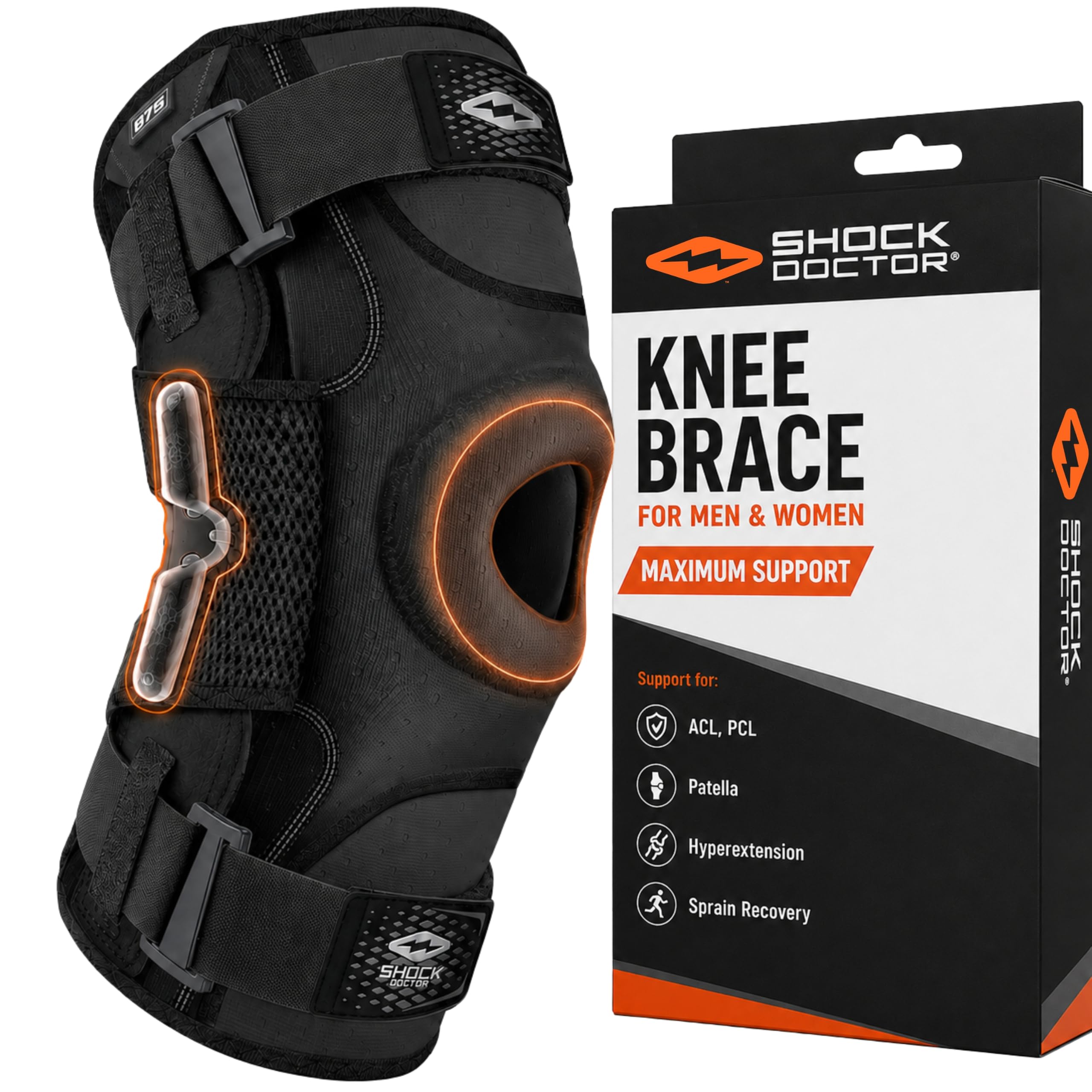
The Shock Doctor is the closest thing here to athletic equipment rather than a medical aid: vented neoprene, a hinge on each side, and compression that holds the whole joint instead of nudging it from two points.

The fabric does the work. N-Tex vented neoprene wicks moisture while it holds therapeutic warmth, and the compression wraps evenly around the knee — no strap-by-strap tuning, just a snug cylinder that keeps the joint warm through a cold practice or a long day on a ski hill.

For sport, that is exactly what we want. Support is the strongest single dimension of any brace here — this is the one that stopped us thinking about the knee mid-session — and the bilateral hinges are sturdy enough to trust on a cut or a landing. If the goal is a return to basketball, skiing, or a full practice rather than a walk around the block, this is our pick.

What the premium buys is compression and hinge quality rather than immortality. The seams are the part to watch if this becomes a daily brace instead of a twice-a-week one, and the construction is otherwise sturdier than most of the group.

Pros

  • Strongest support in this set
  • Vented neoprene wicks while holding warmth
  • Bilateral hinges steady the joint in sport
  • Even compression without re-tuning straps

Cons

  • Runs snug, so layering over clothing is difficult
  • Fabric presses behind the knee on long wears
Our verdict

Our pick for sport: even compression and sturdy bilateral hinges for a knee heading back to hard activity.

Check Latest Price
4

Best Premium

McDavid 429RX Hinged Knee Brace

87 /100
Trail Score Excellent

Key details

Size
XX-Large
Hinge
Bi-lateral polycentric geared
Straps
Cross straps
Material
4.8 mm neoprene
Check Price on Amazon

Geared polycentric hinges are why this brace costs what it does. Instead of a single pin, each hinge follows the knee's own roll-and-glide, so the brace moves with the joint while still resisting the sideways and backward motion an unstable ligament cannot stop on its own.

The cross straps are what we appreciate most. They run diagonally above and below the kneecap and pull the whole brace into the leg, which is where the confidence on a turn or a stair comes from. Add 4.8 mm neoprene dense enough that the compression survives wear after wear, and this is the most serious brace here short of a custom fit.

The details are thought through: reinforced pull tabs to haul it on, an open padded buttress so the kneecap is not squashed, and anti-migration mesh against the skin. It is also the brace we trust for hyperextension, where the hinge itself does the work of stopping the leg from snapping backward.

Seating a snug one takes a minute — tabs, cross straps, then a final tug — and that effort is the price of the hold it gives.

Pros

  • Geared polycentric hinges track the knee
  • Cross straps add real medial and lateral hold
  • Dense 4.8 mm neoprene keeps its compression
  • Listed for hyperextension as well as ligament strain

Cons

  • Runs small against its own size chart
Our verdict

Premium money, premium control: geared hinges and cross straps for a knee that is unstable rather than just sore.

Check Latest Price
5

Best Anti-Slip Grip

Fit Geno ReActive+ Hinged Knee Brace

87 /100
Trail Score Excellent

Key details

Grip
Two silicone anti-slip strips
Size
M/L/XL
Hinge
Aluminum side hinges
Straps
Four adjustable straps
Check Price on Amazon

Every brace on this page says it will not slide down. The Fit Geno is the one that made us believe it: two medical-grade silicone strips sit against the skin, and four straps pull in four directions rather than one continuous wrap.

That grip changes what the brace is for. On a sweaty pickleball court or a softball field, staying where you set it is most of the value, and the aluminum hinges and gel patella pad keep the support honest while it does. It is the pick for anyone who tried a brace, liked it, and gave up because they were hauling it back up every ten minutes.

There is a sequence to putting it on, and it is worth reading the instructions once — tighten in the wrong order and the top strap rides over the hinge instead of sitting above it.

Sizing runs from medium to extra large, and the profile is slim enough to sit under slacks for a workday rather than only under shorts.

Pros

  • Silicone strips hold it against sweat
  • Four straps adjust in separate directions
  • Gel pad cushions the kneecap
  • Aluminum hinges keep support firm

Cons

  • Can still creep down on long, sweaty walks
Our verdict

The brace that stays where you put it, which is most of what anyone wants on a sweaty court.

Check Latest Price
6

Best for Behind-The-Knee Comfort

Athledict Hinged Knee Brace

87 /100
Trail Score Excellent

Key details

Size
Large
Hinge
Removable hinges
Closure
Front-opening wrap
Patella
Reversed open design
Check Price on Amazon

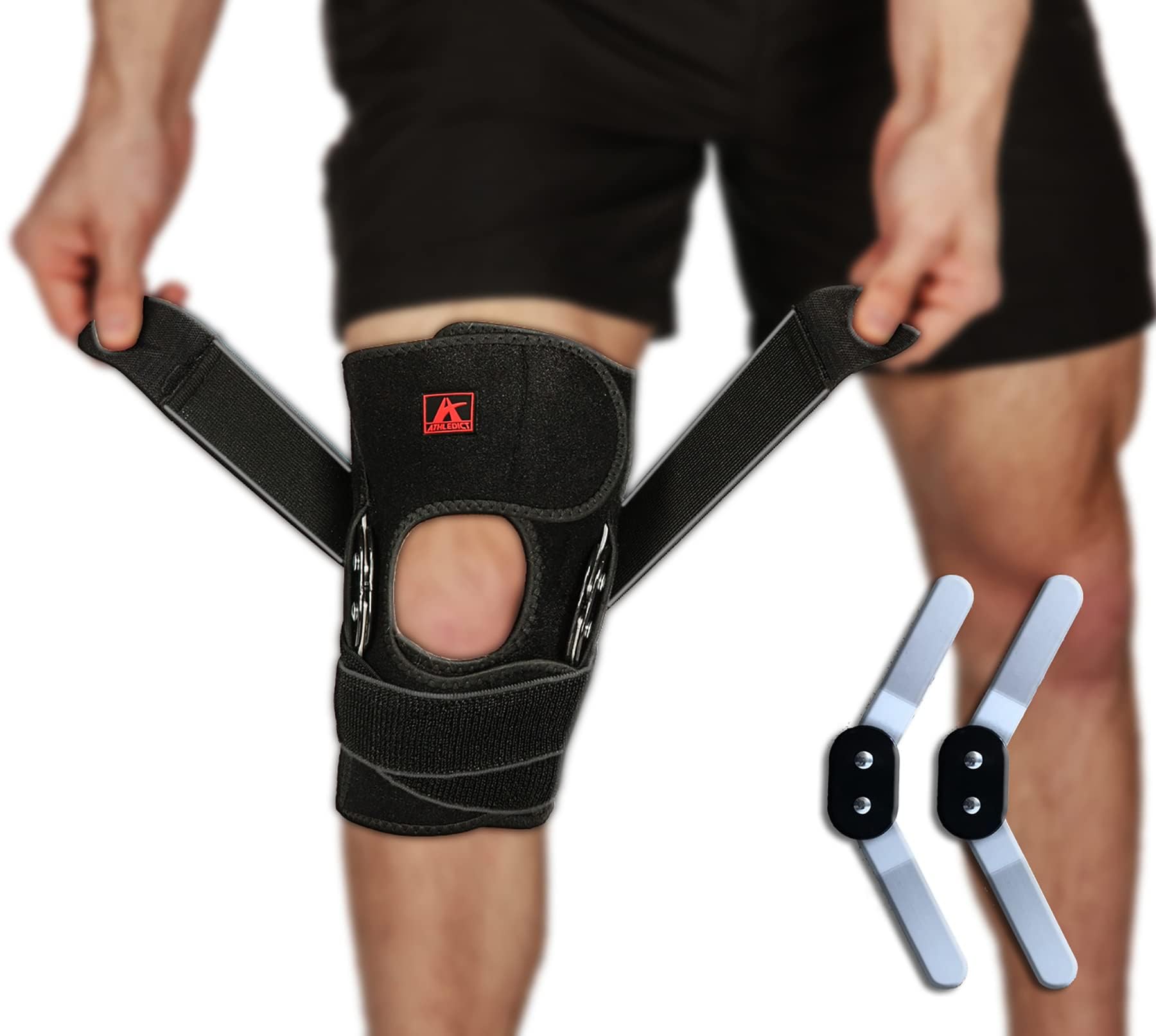
You fasten this one from the front. The closure runs along the shin side of the joint and the patella opening is reversed, so no strap crosses the crease behind your knee — the spot where nearly every other brace here starts to rub after an hour.

For anyone with arthritic hands, a sore shoulder, or a knee that will not bend far enough to step into a sleeve, that front closure is worth more than any specification. We also like that the hinges come out, so the support winds down as the knee gets stronger, and that the adjustment range covers everything from a light wrap to proper bracing.

It holds well enough for racket sports and golf, and it does not bunch behind the knee when you sit, which is the payoff of that reversed opening.

A single brace that can be set up several ways means one purchase rather than a drawer of half-used supports — the difference is where the straps land, so spend a few minutes finding your configuration before you judge it.

Pros

  • Front closure avoids reaching behind the leg
  • Reversed open patella keeps the knee crease clear
  • Removable hinges adjust the support level
  • Comfortable enough for all-day wear

Cons

  • Hinge pockets can wear where stitching meets the hinge
  • Sizing is unpredictable between L and XL
Our verdict

Buy it if reaching behind your knee is the part you dread — the front closure is the whole idea, and it works.

Check Latest Price
7

Best Budget

ACE Brand Hinged Knee Brace

87 /100
Trail Score Excellent

Key details

Care
Hand wash, air dry
Size
One size fits most
Hinge
Dual-pivoting hinges
Padding
Kneecap cushion
Check Price on Amazon

One size fits most is a promise most braces quietly break. The ACE comes closer than its price suggests — dual-pivoting hinges on each side, a kneecap cushion, and a wrap that closes around the leg rather than pulling over the foot.

This is the brace for the weeks when you are not sure yet. Keep it in the car or the gym bag, wear it while you wait for an appointment or a proper fitting, and do not expect it to outlast a brace costing several times as much. For occasional support and short days it does the job.

The hinges are simple pivots rather than the geared mechanism on the McDavid, which is fine for steadying a knee through errands and a flight of stairs and not enough for cutting on a court. That is the honest boundary of what this one is for.

Judged against the rest of this group, it asks the least of you: no size to choose, no sequence to learn, nothing to mourn if it ends up under the passenger seat. That is a real job, and it does it.

Pros

  • Dual-pivoting hinges on both sides
  • Wrap style goes on without removing shoes
  • Kneecap cushioning adds protection
  • The least expensive hinged brace here

Cons

  • One size runs small on larger thighs
  • Closure sits behind the leg, which is awkward to reach
Our verdict

A stopgap brace that beats its price: simple pivoting hinges, one size, and no tears if it lives in the car.

Check Latest Price
8

Kneecap Pressure Relief

NEENCA Professional Hinged Knee Brace

88 /100
Trail Score Excellent

Key details

Hinge
Removable copper side hinges
Design
Open patella and back
Patella
Gel pad ring
Material
SBR and nylon blend
Check Price on Amazon

A gel ring around the kneecap is the detail that sets the NEENCA apart. It cups the patella instead of laying a flat panel over it, which is the difference between a brace you notice all day and one you stop feeling.

The rest of the design is familiar and mostly well judged: removable copper-wrapped side hinges, an open patella and open back, and a firm shell that holds its shape through a long shift on your feet.

Support is where it earns its place: firm through the sides, cushioned at the kneecap, and open enough at the back to stay on past the hour mark. On pain relief and stability it holds its own against braces that cost more.

Order by your own tape measure rather than the chart, because this one runs tight through the thigh — sizing up is the difference between support and a bad afternoon. Do that and it is a sensible mid-priced choice; ignore it and you will blame the brace for a fit problem.

Pros

  • Gel ring cushions the kneecap
  • Removable copper-wrapped side hinges
  • Open patella and open back reduce pressure
  • Firm support through a long workday

Cons

  • Seam stitching can give out
Our verdict

A well-padded mid-priced brace with a gel patella ring; order by thigh measurement, not by the chart.

Check Latest Price

How We Tested the Best Hinged Knee Braces

To build the shortlist, I started with the hinged braces that keep showing up in physical therapy clinics, running stores, and customer reviews, then narrowed by hinge style, strap configuration, available sizes, and price. My team ordered 12 braces in sizes that matched our testers' thighs and calves, from low-profile sleeves with side hinges to full-wrap models with adjustable straps.

Testing ran for eight months and happened where knees actually give out: on stairs, during dog walks, in the gym, and through a weekly pickleball game that turned out to be the best stress test we had. Each tester wore every brace for at least a few full days, noting how easy it was to get on and off, whether the hinges lined up with the knee joint, and whether the straps stayed where we set them after 30 minutes of walking. We also asked testers to rate pain before and after use, and we checked for pressure points, bunching behind the knee, and heat build-up.

Then we got picky about the details that separate a keeper from a drawer-dweller. We tugged on every strap and re-fastened the Velcro dozens of times, looking for frayed edges or hooks that stopped grabbing. We washed removable sleeves as directed and checked whether the stitching held. Support was judged by how much side-to-side wobble the hinges stopped without making us feel like we were walking in a cast. Value came down to whether the price matched how well the brace fit, how long it lasted, and how much relief it actually delivered.

How to Choose a Hinged Knee Brace

Start with the hinge, not the padding

Hinges do two different jobs. A simple pivot resists side-to-side play and gives the knee something to stop against when it tries to hyperextend; a geared polycentric hinge, like the one on the McDavid 429RX, follows the knee's own roll-and-glide through a deeper bend. Removable hinges matter more than they sound, because braces like the Vive and Bodyprox convert to a plain compression wrap as healing progresses — one purchase covers the whole arc instead of two.

What none of them do is replace a custom functional brace or the rehab that makes a knee reliable again. If a surgeon or physical therapist has specified a brace, that specification wins over anything on this page.

Measure, then ignore the chart's optimism

Almost every fit complaint in this category starts with a number. Measure your thigh circumference about three inches above the kneecap, and the calf at the matching distance below if the sizing guide asks for it. Use a tape, not a guess, because charts in this group lean small and the same size label means different measurements from brand to brand.

The trap is that a too-small brace feels impressively supportive for ten minutes and then starts marking skin. If the tape puts you at the top of a range or between two sizes, go up — and if you are choosing between a one-size wrap and a sized brace, take the sized one.

Wrap-around or compression: how it goes on matters

A wrap design — the Vive, Bodyprox, Fit Geno, ACE, and Athledict all use one — opens flat, closes with straps, and can be re-tensioned while you are sitting down. That matters as swelling shifts through the day, and it matters a lot when bending to reach your foot is the thing your knee will not do. A compression-style brace like the Shock Doctor delivers more even pressure around the joint but offers less adjustment on the fly.

There is a third option worth knowing about: the Athledict fastens from the front, which suits anyone whose hands, shoulders, or knee bend make reaching behind the leg painful. Think through the moment of putting it on before anything else.

Slip, heat, and the back of the knee

Two things decide whether a brace survives a full day: whether it migrates, and whether it presses where the knee bends. Silicone grip strips and anti-migration mesh help the first; an open back or a reversed patella opening helps the second.

Neoprene runs warm, which some knees like and some hate by mid-afternoon. If you will be sweating, put grip and breathability first; if you will be at a desk, put the open back first.

Plan for the hook-and-loop to wear

Straps are the first thing to go on every brace here. Hook-and-loop loses its bite when it collects lint and heat, so hand wash in mild soap, air dry flat, and store the brace with its straps pressed closed rather than flapping open in a gym bag.

That is also the argument for spending more if you will wear one daily for months: better fabric and stitching buy time before the straps give out. No brace here is a lifetime purchase, so treat a replacement pair of straps as part of the cost.

Frequently Asked Questions

Final Verdict

For the ordinary case, the Vive is the brace we point people to: lightest of the group, easy to put on seated, and cheaper than most while still covering everything from a careful first walk to a longer hike. Step up to the McDavid 429RX if the knee is genuinely unstable and you want geared hinges doing the work, or to the Shock Doctor if the goal is a return to hard sport.

And if you simply need something in the car for the bad days, the ACE is the least expensive way here to put a real hinge on your knee.