Best Home Gym Machines of 2026

A home gym machine promises a whole weight room in the corner of a basement. The catch: a machine built to do everything — leg press, lat pulldown, chest press, rows — can end up doing none of it well, and the ones that fold up small often feel shaky under load. What a good one really buys you is the end of excuses — no bag to pack, no cable stack to wait for, no 25-minute drive between you and a workout.

I've had a multi-gym in my garage for three years, and the difference between the machine you use and the one that becomes a drying rack is rarely the price. It's whether the build eats an afternoon or a weekend, whether the seat and cable height adjust without a fight, and whether the resistance feels honest at the top of a rep. We put six of them through eight months of real training, and the one thing I'd tell a first-time buyer is this: the pulley ratio matters more than the number printed on the stack. The picks below earned their floor space.

1

Best Overall

Total Gym APEX G3

92 /100
Trail Score Outstanding

Key details

Exercises
70+
Dimensions
15.5"D x 93"W x 43.25"H
Resistance
8 incline levels
Max User Weight
300 lb
Check Price on Amazon

Resistance here is your own body weight working against an incline. Eight notches tilt the rail, and the steeper it sits, the more of you the glideboard has to lift, so a beginner and a reasonably fit adult share the same machine and simply work different notches. It is the simplest resistance system of anything we recommend, and for a household with mixed abilities that simplicity is the point.

Where it earns the top spot for us is breadth without a second machine: 70-plus exercises covering pressing, pulling, squats off the included squat stand, dips, Pilates and stretching, plus a flip chart clipped to the tower so you can follow a routine without balancing a phone on the floor. The ceiling is load. Because resistance scales with your weight, someone who already benches or squats seriously runs out of challenge well before running out of exercises. For general strength, toning and joint-friendly work, there is plenty in it.

Storage is where it beats the stack machines. The frame folds and stands narrow, so a spare room goes back to being a spare room; open, it wants floor length rather than a corner. Assembly is genuinely easy, with labeled hardware and a machine that arrives close to built.

The glideboard is the one component we minded. At gentle inclines it travels smoothly, but wind the rail up and the motion can turn jerky, and the rollers get noisy with use. It does not stop you training; it just means this feels like a home machine rather than a gym one.

Pros

  • Eight incline levels cover beginners and fit adults
  • Folds to a narrow footprint between sessions
  • 70+ exercises with squat stand and dip bars
  • Rated for users up to 300 pounds

Cons

  • Needs 93 inches of floor length when open
  • Resistance is capped by your body weight
Our verdict

We recommend it as the default pick here: strength, stretching and low-impact cardio from one frame that folds away, provided you have the floor length for it.
Check Latest Price
2

Best Weight Stack for Small Spaces

Mikolo HGS Pro

87 /100
Trail Score Excellent

Key details

Stations
10-in-1
Warranty
Lifetime frame, 1 year components
Dimensions
75"D x 36.3"W x 80"H
Weight Stack
154 lbs, 12 levels
Check Price on Amazon

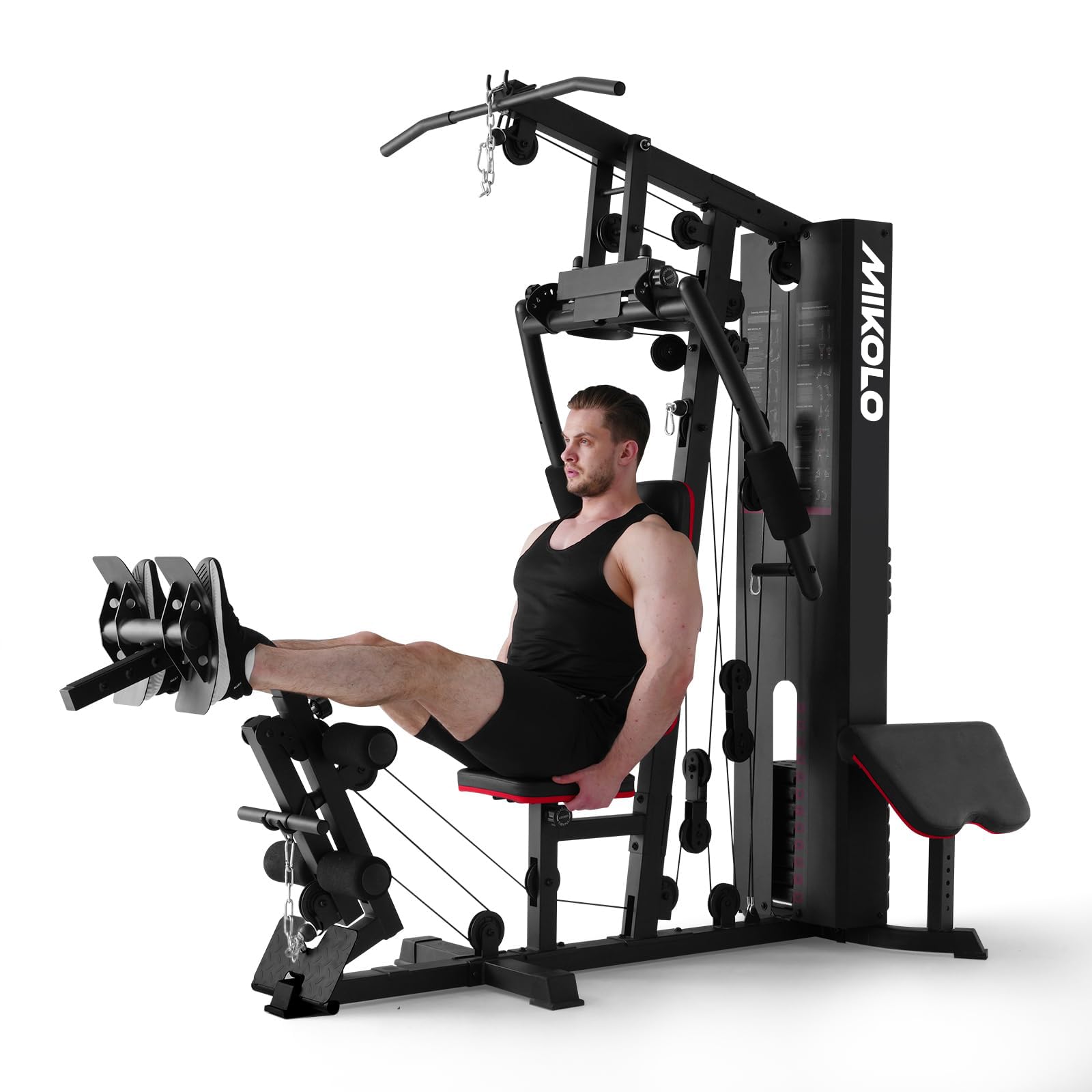
36.3 inches wide and 75 inches deep, with the stack tucked behind the frame rather than hung off one side: that is the number which gets the HGS Pro into rooms the other machines here cannot use. Ten stations run off the same 154-pound stack, covering pec fly, lat pulldown, chest press, low row, leg extension, leg press, preacher curl, calf work, core work and seated or mid rowing, with the curl pad and leg press fittings lifting off when you do not want them.

A selectorized stack is why we point small-space lifters here instead of at a rod or incline machine. You pull a pin, the load changes in fixed increments, and progress becomes a number you can watch instead of a rail position you have to remember. The pull feels smooth and quiet, and the included D-handles, short bar, lat bar and rope cover most of a home routine without a separate shopping list.

The build is the part to plan around. It arrives in pieces, the written instructions are the weakest thing about the purchase, and the supplied tools make for a slow evening; find the assembly video before you open the boxes. With the machine assembled at 300 pounds, the spot you build it in is the spot it stays in, so choose that first. Coverage is the best in this group: a lifetime frame warranty with a year on components.

Pros

  • 154-pound stack with 12 selectable levels
  • Ten stations including pec fly and leg press
  • 36.3-inch width suits small rooms
  • Lifetime frame warranty

Cons

  • Written instructions are hard to follow
  • 300 pounds assembled, so it stays put
Our verdict

For a small room and a real weight stack, this is the machine we point people to; nothing else here packs ten stations into a three-foot width.

Check Latest Price
3

Best for Rowing

BowFlex PR1000

92 /100
Trail Score Outstanding

Key details

Exercises
25+
Dimensions
84"D x 38"W x 82"H
Resistance
200 lb Power Rods
Item Weight
144 lb
Check Price on Amazon

The rowing conversion is what earns the PR1000 its place in our list. The bench slides out into a rolling seat, and the machine you were pressing on becomes something you can row on for ten minutes. Nothing else in this guide does cardio, which makes it the pick for anyone whose workout has to include a sweat as well as sets.

The rest is straightforward strength work: over 200 pounds of Power Rod resistance across 25-plus exercises, pulley positions at the top and bottom of the frame so you can change the angle of a press or a row, and a bench that sets flat or inclined. Rods load progressively, lightest at the start of the rep and heaviest at the end, so they feel nothing like a plate stack, and people used to plates often find the first inch of a press easier than expected.

It folds upright and stands against a wall between sessions, which is how it survives in a spare room. Open, it is 84 inches long: shorter than the Total Gym, but still a committed piece of floor. For a household where one person lifts and another just wants to row, that is a fair trade.

Pros

  • Rowing seat converts it to a cardio machine
  • Over 200 pounds of Power Rod resistance
  • Multiple pulley heights change the angle
  • Folds upright for storage

Cons

  • 60-day parts warranty is short
  • Cables and pad covers wear first
Our verdict

Buy it when cardio has to come from the same footprint as your strength work; it's the only machine here that rows, and the rod resistance suits light-to-medium lifting.

Check Latest Price
4

Leg Press Work

SincMill 148 lb Home Gym

88 /100
Trail Score Excellent

Key details

Warranty
10 years
Dimensions
69"D x 40.7"W x 80"H
Leg Station
Pedal attachment
Weight Stack
148 lb
Check Price on Amazon

A leg press pedal on a stack machine is unusual, and it is why the SincMill holds a place in our list: 148 pounds of selectorized resistance, a preacher curl pad, ankle straps, a chain and four quick-release latches, with a lower-body station the rest of this set does not offer. Assembly is the usual evening's work; the manual occasionally points at the wrong hardware and the video is clearer.

The machine is drawn around an average frame. Average-height lifters settle into it well, broader shoulders feel the squeeze immediately, and tall users lose leg press travel and end up bent at odd angles to finish a rep. Standing curl work rocks the frame unless you plant a foot on the front base, a small habit you pick up the first time. Set against the rest of the group, the steel is sturdy, the stack moves cleanly through those latches, and the ten-year warranty is the longest here bar the Mikolo's frame coverage. It is a machine you fit yourself to rather than one that adjusts to you.

Pros

  • 148-pound stack with quick-release latches
  • Leg press pedal adds lower-body work
  • Ten-year warranty

Cons

  • Sized for average builds, not tall users
  • Written instructions trail the video
Our verdict

A sturdy, well-equipped stack machine at a fair price; just know it's built around an average frame, so taller and broader lifters should check the fit first.

Check Latest Price

How We Tested Six Home Gym Machines Over Eight Months

We started with a list of roughly 40 machines and narrowed it using the things that decide whether one actually fits in your life: footprint, ceiling clearance, resistance type, and the real cost once you add the attachments sold separately. Six made the final cut, and each lived in a working home gym — a garage, a basement, a spare bedroom — for eight months, not a week in a showroom.

Assembly came first, because it's the part most buyers dread. I built each machine alone using only the included instructions and tools, timed the build, and noted every step where the diagram and the hardware disagreed. Two of the six genuinely needed a second person, and I wrote that down rather than pretending otherwise.

Then we trained on them. Two of us — one 5-foot-3, one 6-foot-1 — used each machine on weekday mornings and in longer weekend sessions, switching mid-workout to see how quickly the seat, press arm, and cable height moved, whether the settings held under load, and whether the range of motion suited both frames. We noted if a cable ran smooth through the whole pull or hitched at the top, whether a press arc pushed the shoulders into an awkward path, whether the frame rocked during lat pulldowns, and whether we came away feeling worked the way a session at the gym leaves you.

Once a month I went back over each machine: checking bolt tightness, looking for fray in the cables, pressing a thumb into the pads to see how much they'd softened, and confirming the stack still felt true to its label. At the end we weighed what each one delivered for the money — how many exercises it did well, which attachments came included, and how much floor it claimed to get there.

How to Choose a Home Gym Machine

Start With How the Resistance Is Made

Three systems cover almost everything here. A selectorized stack, as on the Mikolo and the SincMill, pins load in fixed increments, so progress is a number you can watch. Power Rods on the BowFlex load progressively, easiest at the start of a rep and heaviest at the end, which suits light-to-medium training and feels nothing like plates. A bodyweight incline like the Total Gym's changes resistance by tilting the rail, which is the gentlest on joints and the hardest to outgrow.

If progress means adding weight, buy a stack. If you want one machine the whole household can use for strength, stretching and low-impact work, the incline does more with less.

Measure the Working Footprint, Not the Folded One

In a listing, compact usually describes the machine folded and standing against a wall, not the floor it occupies while you are on it. These machines run 69 to 84 inches deep and about 80 inches tall when open, and the Total Gym needs 93 inches of length. Mark the space on the floor with tape, including room to get on and off and to swing a lat bar, and check the ceiling above the machine if anyone will press overhead.

Check the Machine Against Your Body

Range of motion is where these machines succeed or fail, and it rarely appears in the headline specs. Look at three distances: how far the seat travels forward and back, how long the leg press stroke is, and where the press arms sit relative to your shoulders at the start of a rep. Average-height lifters fit most of these comfortably; broad shoulders and long legs are where the snug machines, the SincMill especially, start to feel like a compromise. Where a machine does offer adjustment, the seat and press arms are the two that matter most.

Plan Delivery, Assembly and the Spot It Stays In

These arrive crated and heavy, often across several boxes, so measure the narrowest doorway and any stair turn before the truck shows up. Plan on an evening with two people, and choose the final position before you start, because once a stack machine is built nobody wants to move it. Assembly quality varies as much as the instructions do: the Total Gym arrives close to assembled, while the stack machines take the longer route.

Frequently Asked Questions

Final Verdict

Four machines, four different jobs, and the Total Gym APEX G3 is the one we send most people to. It carries a 300-pound user, folds out of the way, and covers strength, stretching and low-impact cardio without claiming a spare bedroom.

The exception is load. If you want a number to chase, pin more weight, add a rep, buy the Mikolo HGS Pro instead. You give up the folding frame and the long exercise menu, and you get a real 154-pound stack in a footprint that still fits a small room.