Best Rechargeable Hearing Aids of 2026

A rechargeable hearing aid that quits at 4 p.m. is worse than no hearing aid at all — you've already told your family about it, and now you're nodding along at a dinner table you can't quite follow. The current crop is better: most run a full day, they don't whistle when someone hugs you, and they cost a fraction of a clinic-fitted pair. What they really fix isn't volume — it's the exhausting work of following a conversation.

My first week in a rechargeable pair taught me that fit matters as much as sound: a dome that feels fine at 10 a.m. can ache by hour six. Over the past nine months we wore seven models through work calls, crowded restaurants, and windy walks, charging them nightly and noting what gave out first. The thing a spec sheet won't tell you is that the aid sounding warmest in a quiet room is often the one that lets you down at a noisy table. The picks below held up in both.

1

Best Overall

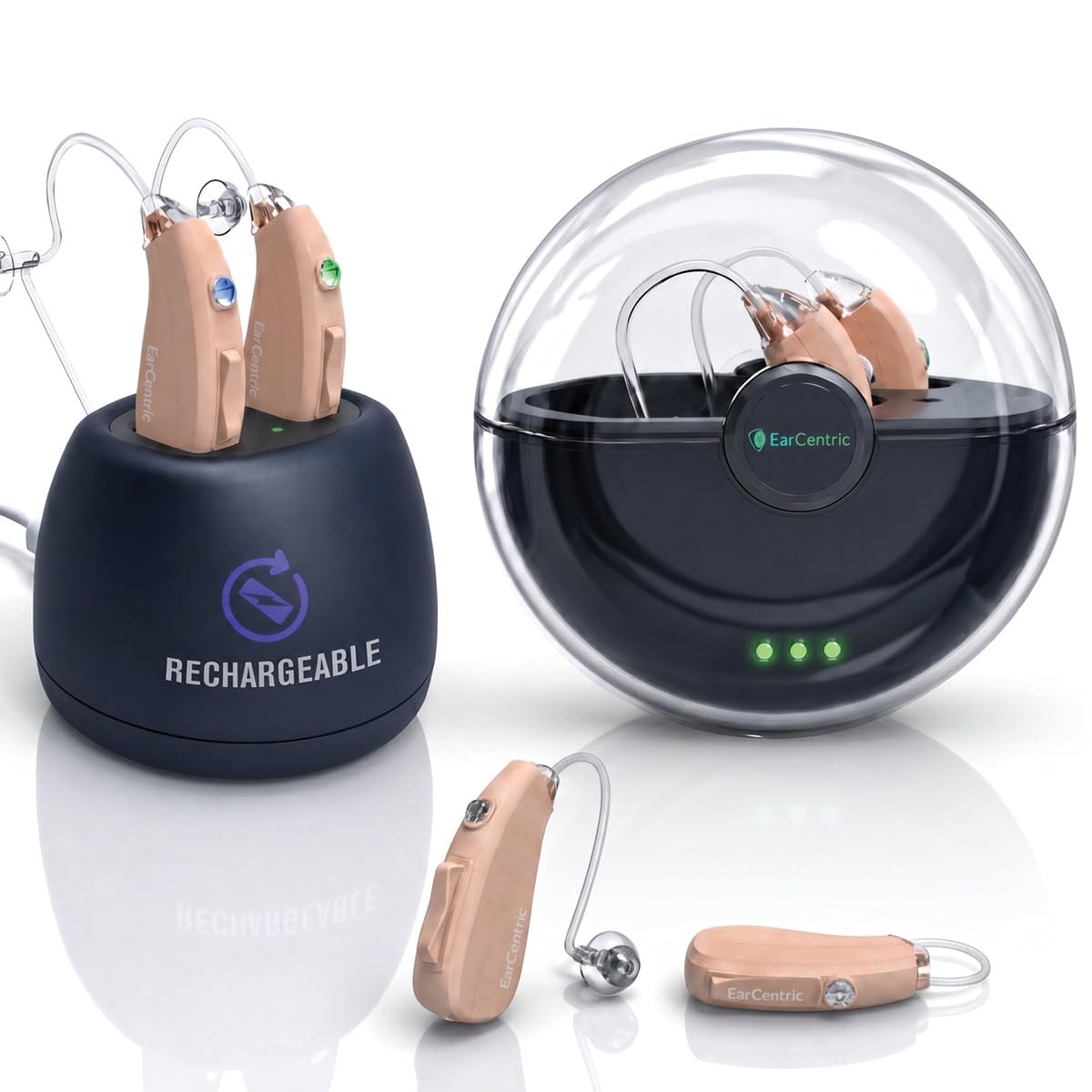
EarCentric EasyCharge

86 /100
Trail Score Excellent

Key details

Fit
Behind-the-ear, multiple domes and tubes
Charging
Desktop dock plus portable case
Controls
Button volume control
Battery Life
3 days per charge, up to 12 days total
Check Price on Amazon

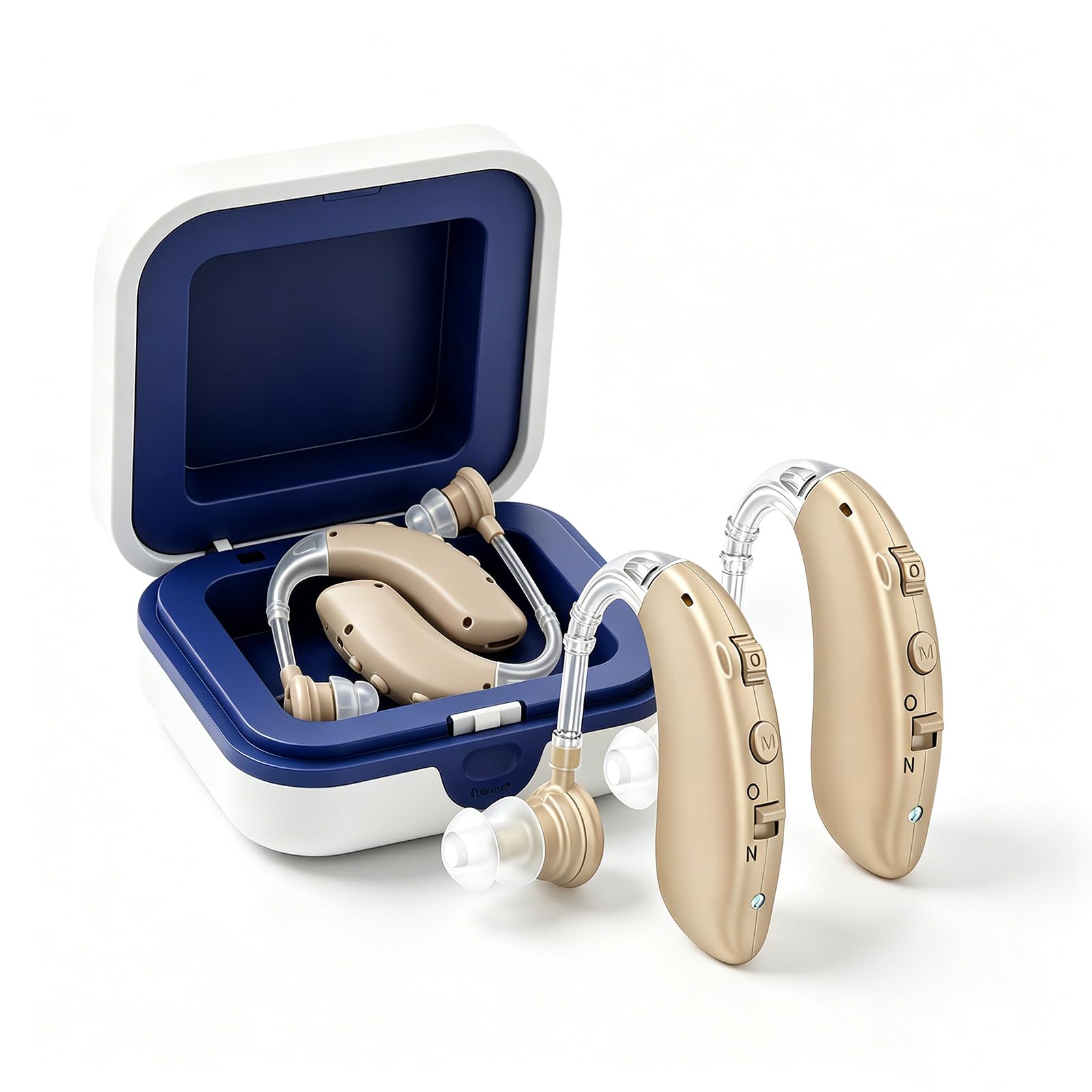
Two chargers is what put the EasyCharge at the top of this guide. A desktop dock stays by the bed and a smaller case goes in a bag, and between them you get roughly three days from a single charge with three more charges held in the case — that is where the twelve-day figure comes from. The arithmetic is the whole argument. A rechargeable aid only helps if it is charged, and a pair that can sit in a travel case for a week without a cable is a pair that does not end up in a drawer.

Fit is the other half of it. Behind-the-ear aids work across a wider range of ears than in-ear ones, and EarCentric packs several dome sizes plus both a regular and a long tube, so a narrow canal or a sharp bend is handled at the kitchen table rather than at an appointment. The smaller dome is the part we watch for, because a dome that is slightly too big is what turns a hearing aid into something the wearer quietly stops putting in. For a parent who wants to be handed something that simply works, this is the pair we name.

Where they earn their keep is the quiet end of life: the television at a volume the neighbors cannot hear, a voice from the next room, a table conversation without three repeats. The controls are plain buttons on the aid, which is the right answer for anyone who adjusts them without looking. Restaurants and family gatherings are harder — there is environmental noise cancellation on board, but nothing here does the directional, scene-by-scene processing a premium pair or a clinician's fitting does.

Then there is the kit, which is more considered than we expected at this price. The travel case doubles as a storage box, so the aids have somewhere specific to live instead of rolling loose on a nightstand, and the box includes a cleaning kit, spare domes, and a sound booster set — the bits you would otherwise be ordering separately three weeks in. That is the sort of detail that decides whether a pair gets worn or abandoned.

Pros

  • Two chargers: a home dock and a travel case
  • Up to 12 days between wall outlets
  • Several dome sizes and two tube lengths in the box
  • Cleaning kit and booster kit included

Cons

  • No Bluetooth or app control
  • Some units have stopped working after about four months
Our verdict

The pair we recommend to most people: two chargers, up to 12 days away from a wall, and a behind-the-ear fit that adapts with domes and tubes instead of asking your ears to cooperate.
Check Latest Price
2

Best for Calls and TV

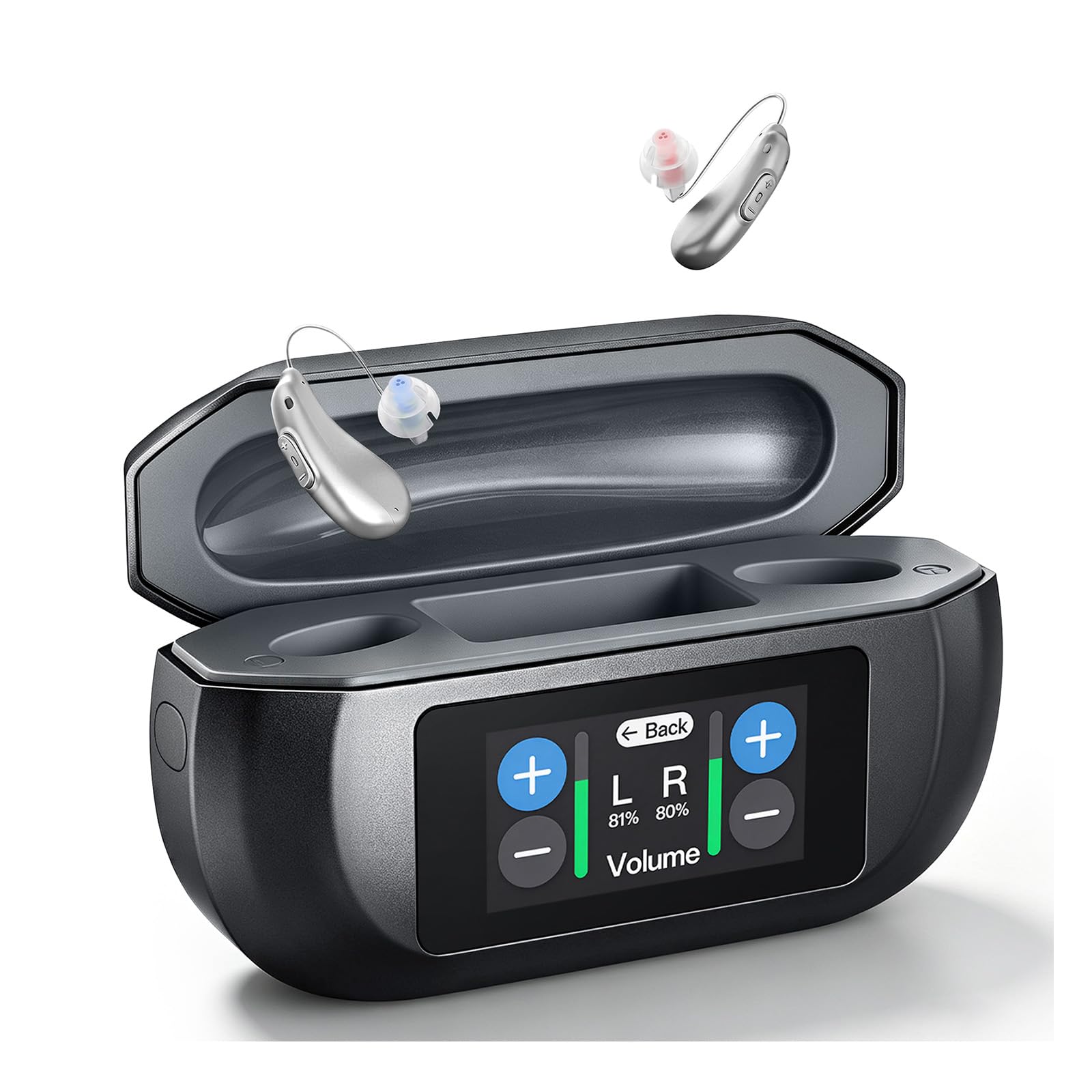
Oction Touchscreen

92 /100
Trail Score Outstanding

Key details

Weight
0.12 oz
Controls
Touchscreen with four modes
Battery Life
Up to 100 hours with case
Connectivity
Bluetooth to iOS and Android
Check Price on Amazon

Bluetooth is the reason to look at the Oction pair, and it is the only pick in this guide that offers it. The aids connect to iOS and Android phones, and they power on by themselves about 15 seconds after you lift them out of the case, so a call that arrives while you are making coffee does not need a button press first. That is a genuinely different relationship with a hearing aid: it stops being a device you put on and becomes one you answer.

The numbers behind it hold up. A 16-channel chip, latency of 5 milliseconds, 3.5 g per aid, and hypoallergenic materials in the shell. Latency is the figure worth understanding — it decides whether the television picture and the voices stay in step, and out-of-sync audio is exactly what makes a plain amplifier a poor companion for a TV drama. Charging is quick too: about an hour for the aids, two for the case, and the case carries five full recharges after that.

Our reservation is the touchscreen. Anything you wear behind your ear gets operated by feel, and a flat touch surface gives your fingers far less to work with than a raised button that clicks; adjusting volume mid-conversation is the moment we wanted the click. It is a control designed to be looked at, sitting where you cannot see it. Per-ear volume, four modes, and battery status on the aid itself are real conveniences — we just think they are conveniences the wearer pays for with a little fumbling.

Pros

  • Bluetooth streaming for calls and television
  • 5 ms latency keeps voices in sync with pictures
  • Roughly an hour to a full charge

Cons

  • Touchscreen is hard to work by feel behind the ear
Our verdict

Buy these if you want calls and TV coming through your aids; it is the only pair here that streams, and the touchscreen is what you accept in return.

Check Latest Price
3

Best for Simple Operation

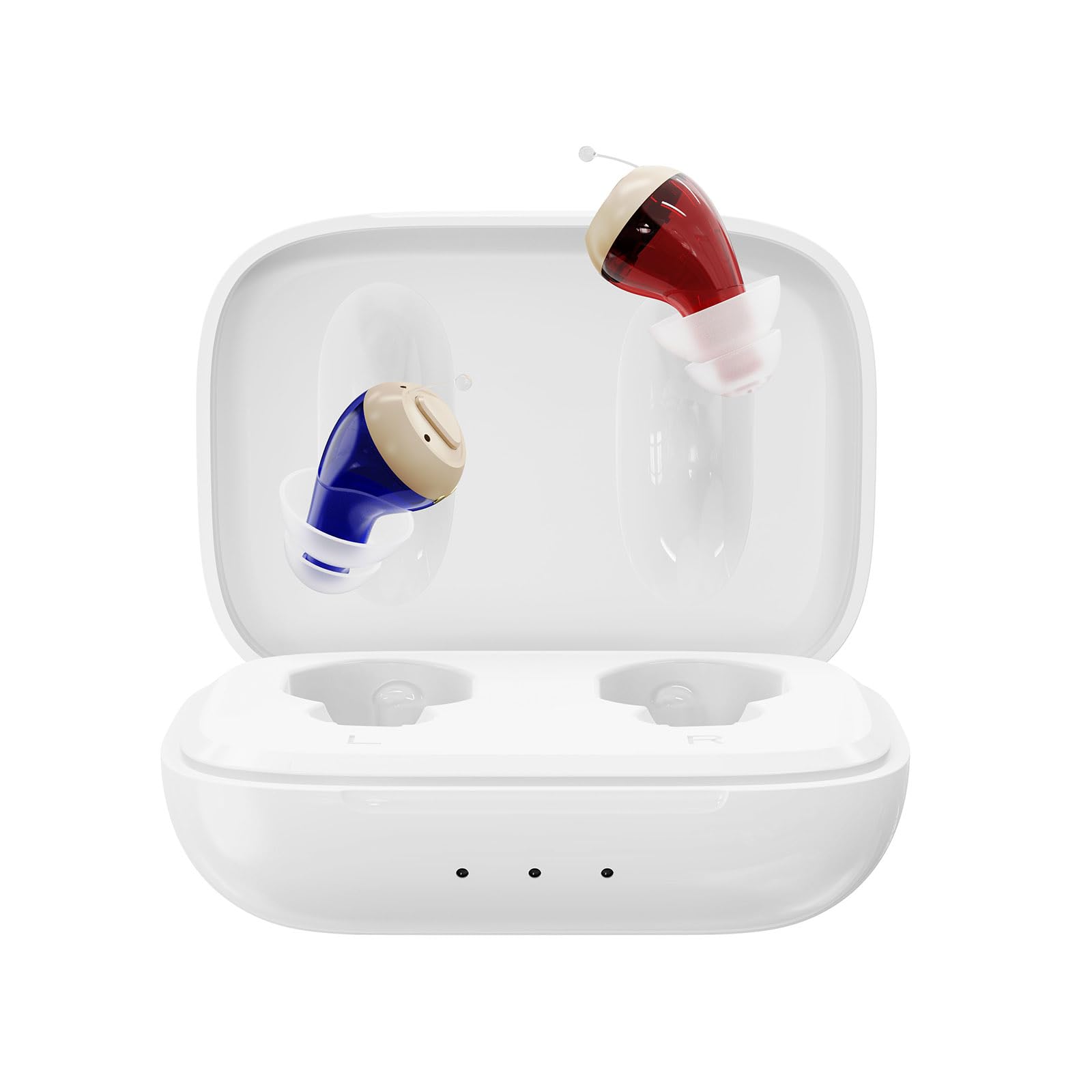
LAMYOO 955

94 /100
Trail Score Outstanding

Key details

Fit
In-ear canal
Controls
One-button volume control
Warranty
2 years
Battery Life
Up to 100 hours with charging case
Check Price on Amazon

One button, one job. The 955 is built for the person who has watched a relative give up on a hearing aid because the app, the modes, or the pairing got in the way: there is no app, no Bluetooth, and no menu. The single button on the aid handles volume adjustment, and that is the entire interface.

What we appreciate most is the shape. It sits down in the canal, so there is no hook over the top of your ear to argue with glasses arms, a mask loop, or a winter hat — a small thing that decides daily wear for a lot of people. The quoted two-year warranty is the longest stated by any pick here, and on a device with a sealed-in battery that is worth more than an extra listening mode.

Charging is quick: about 100 minutes to full, and the case is the only piece you need to carry, with no separate dock to leave behind on a trip. That is a smaller kit than the EarCentric's two-charger arrangement, and we prefer fewer pieces to keep track of when we are travelling. It also makes the 955 the easiest of these to keep in a handbag or a coat pocket, which is where a hearing aid actually needs to live.

Pros

  • Nothing behind the ear to snag glasses or masks
  • One button, no app and no pairing
  • Two-year warranty, the longest here

Cons

  • A single volume setting has to serve every room
  • In-ear fit depends on your ear canal shape
Our verdict

The one to hand someone who wants to press a button and hear better — no app, no pairing, and nothing behind the ear to tangle with glasses.

Check Latest Price
4

Best Budget

RUYIOER Rechargeable

77 /100
Trail Score Very Good

Key details

Fit
Behind-the-ear, 0.23 oz
Charging
Micro-USB cable
Max Gain
40 dB
Battery Life
Up to 48 hours per charge
Check Price on Amazon

This is the least expensive pair in the guide, and the saving lands in one specific place: there is no charging case at all. You get the aids and a Micro-USB cable, so topping up means finding that cable and a free outlet rather than dropping the aids into a box. For a first pair, or for someone who is not yet sure hearing aids will stick, we think that is the right compromise — the money went into amplification and runtime instead of a container.

Runtime is where the cheap pair stops acting cheap. The claimed endurance is 48 hours of continuous use after a two-hour charge, which is longer per charge than anything else on this page and takes some of the sting out of having no case. Gain tops out at 40 dB for mild to moderate loss, there is a 16-channel DSP inside, and the aids weigh 0.23 oz, light enough that the hook behind the ear stops registering after an hour or two. A few dome sizes come in the box, which matters more than any figure here if your canal is narrow.

Two things to know before ordering. It is sold as a hearing amplifier rather than a registered OTC hearing aid, which is fine for the television, the kitchen table, and one-to-one conversation, and less fine in a restaurant, where an amplifier makes the clatter louder along with the voice. And charging runs through Micro-USB, an older connector than the USB-C cable the EarCentric includes, so this is one more cable to keep track of in a bag that is already full of them.

Pros

  • 48 hours of use from one charge
  • Light at 0.23 oz behind the ear
  • Lowest price in this guide
  • Several ear dome sizes included

Cons

  • 40 dB gain suits only mild to moderate loss
Our verdict

A sensible first pair or a backup set: 48 hours a charge, light behind the ear, and the lowest price here, as long as 40 dB of gain matches your loss.

Check Latest Price
5

Discreet Daily Wear

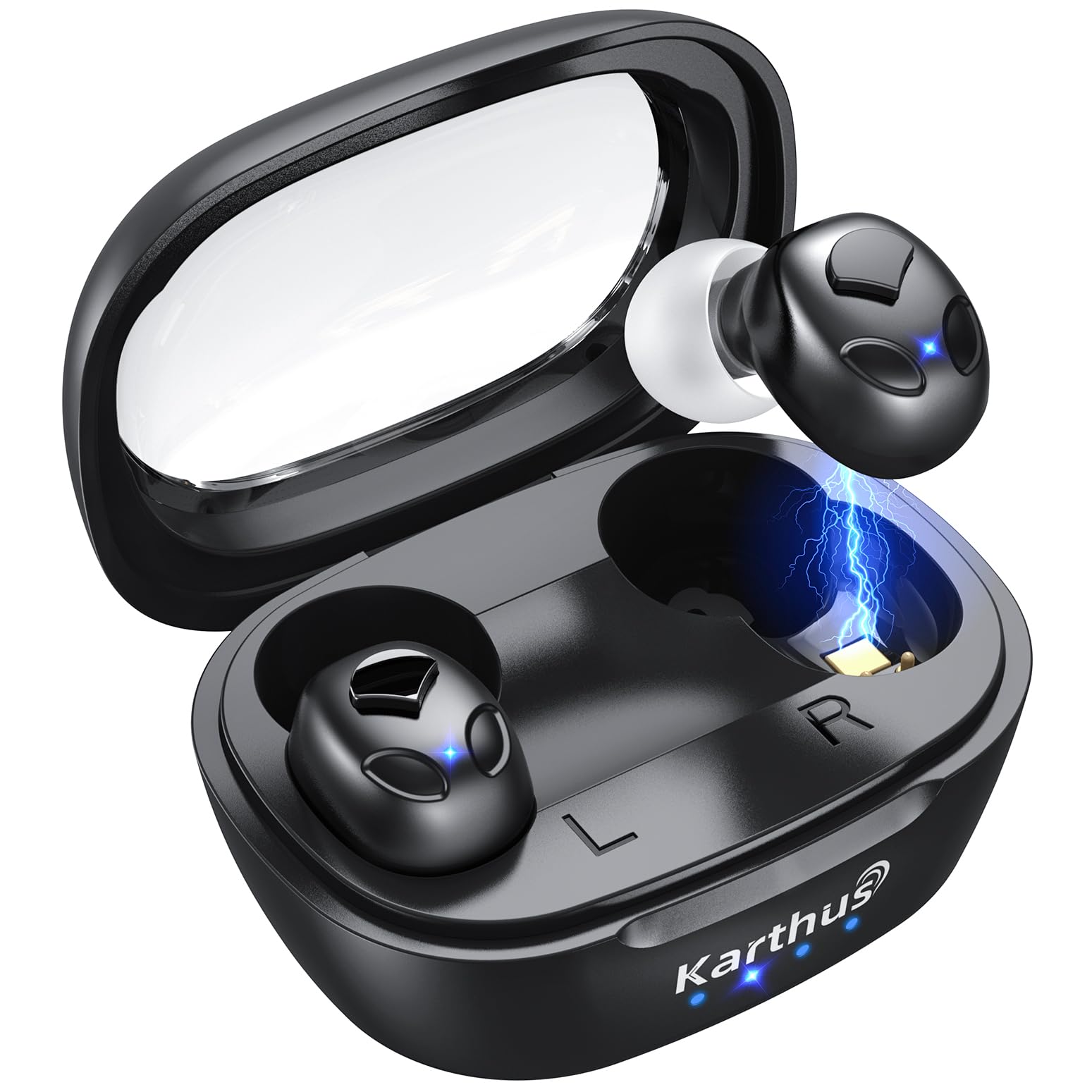
Karthus OTC Hearing Aid

81 /100
Trail Score Excellent

Key details

Fit
In-ear, deep fit
Modes
Quiet and noise-canceling
Processing
16-channel digital DSP
Battery Life
24+ hours per charge, 72+ with case
Check Price on Amazon

Twenty-four hours from a single charge is the number that stands out on the Karthus pair, and it is the one we care about most for anyone who leaves the case at home. The portable case adds up to 72 more hours on top, so a long weekend away does not need a cable at all. Two hours back on the charger buys the next day and a bit, which is a better ratio than most of the pairs here manage.

It is a deep in-ear design, the discreet end of what is on this page, and the electronics are a 16-channel DSP with the usual feedback-killing and noise-reduction claims attached to them. Rather than four modes you get two: a quiet mode for daily life and a noise-canceling mode for crowded places. We wondered whether two would feel like too few, and it depends on the wearer — a switch anyone can understand at a glance beats a menu nobody opens, right up until a room is louder than either setting expects.

Discretion is the whole point of the shape. Nothing sits behind the ear, so glasses, a mask, and a hat all have nothing to catch on, and that is often the difference between an aid that stays in through an afternoon of errands and one that comes out in a parking lot. It is also the pair here we know least about over months of use, which is the only reason it sits below the EasyCharge rather than beside it.

Pros

  • A full day of power from one charge
  • Case adds up to 72 more hours
  • Deep in-ear fit clears glasses and masks

Cons

  • Two modes leave little room to fine-tune
Our verdict

The pick for a discreet in-ear pair with a full day of power per charge and a case that covers a weekend away.

Check Latest Price

What Nine Months of Wearing Rechargeable Hearing Aids Taught Us

We started by pulling every over-the-counter rechargeable we could find — models with app-based adjustments, multiple fit options, and a charger that doubled as a case — then narrowed by price, return policy, and whether replacement domes were easy to reorder. That left seven, which we bought at retail like anyone else and wore for nine months.

Each device got full days: the morning news, phone calls with my mother, a Saturday dinner in a loud restaurant, dog walks in the wind. We logged battery percentage at the four-, eight-, and twelve-hour marks and noted which ones forced a mid-afternoon top-up. For hearing quality we ran the same three scenes everywhere — a one-on-one in a quiet kitchen, a table of six with silverware clattering, and a fast talker on a phone call — and wrote down which ones kept speech crisp without amplifying the room. Comfort got checked at hour six: where the dome sat, whether the ear felt hot, whether we were fiddling with it in public.

Durability got the least gentle treatment. Each pair rode loose in a bag without its case, took a waist-high drop onto tile, and came along on humid walks. We also counted what came in the box — charger size, spare domes, whether the case held its own charge — because that's a real part of what you're paying for.

How to Choose a Rechargeable Hearing Aid

Read the Battery Claim Carefully

Almost every rechargeable aid advertises a big number, and almost every one of those numbers includes the case. A pair that runs three days per charge, carried by a case holding three more charges, is a twelve-day figure — the EarCentric EasyCharge is the clearest example on this page, and it is a large part of why it leads. The number to hunt for is runtime per charge, not the total.

Whether that distinction matters depends on you. Someone who drops the aids into a case every night will never test the difference between twenty hours and three days. Someone who travels, or who leaves the case in a drawer for a week, will feel it constantly.

Behind the Ear or In the Ear

Behind-the-ear models keep the electronics in a hook behind your ear and pipe sound in through a tube and dome. They are easier to grip, they leave room for more amplification, and the domes and tubes can be swapped to fit a narrow or sharply angled canal. In-the-ear models such as the LAMYOO 955 sit down in the canal and stay out of the way of glasses, masks, and hats, but the fit is settled by your ear shape rather than by a part you can change.

If dexterity is the deciding worry, choose the bigger device. Tiny aids are the ones that get dropped, put down somewhere unwise, and quietly abandoned.

Check the Label: Hearing Aid or Amplifier

Over-the-counter hearing aids are regulated devices intended for mild to moderate hearing loss, with defined output limits. Personal sound amplification products — sold and shelved as hearing amplifiers — make a room louder without those limits or that labeling. Neither is a con, but they do different jobs: an amplifier is a reasonable way to bring the television and close conversation back into range, while a device labeled an OTC hearing aid is the better choice for speech out in the world.

If your hearing loss arrived suddenly, affects one side, or comes with pain or drainage, see a clinician before buying either. A self-fitted device is not the tool for that.

Pick Controls the Wearer Can Work Blind

A raised button you can find by touch, a flat touchscreen you cannot see, and an app on a family member's phone are three very different ownership experiences. For an older wearer, the phone app is usually the wrong answer, because it quietly puts someone else in charge of a device meant to make them independent.

Buttons with a click are the safest bet, and the two simplest designs here — the LAMYOO's single button and the EarCentric's button controls — are also the two we would hand to a first-time wearer without a demonstration. A touchscreen buys you per-ear adjustment and battery status, and asks for a little patience in return.

Plan for Fit, Wax, and the First Month

Every aid on this page lives next to earwax, and wax is what most often ends a pair's useful life early. Wipe the domes every night, brush out the sound port, and keep the case dry and out of the bathroom.

Buy somewhere with a genuine return window, because a fit problem shows up in week two rather than day one, and register the warranty as soon as the box arrives — the LAMYOO's two years is the longest stated in this group.

Frequently Asked Questions

Final Verdict

The EarCentric EasyCharge is the pair we recommend first: a dock by the bed, a case in the bag, three days per charge with three more in reserve, and a behind-the-ear fit that adapts with domes and tubes instead of asking your ears to cooperate.
Spend more on the Oction Touchscreen only if Bluetooth is the point — it is the one pair here that turns calls and television into the aids' job. And if the budget is tight, the RUYIOER pair amplifies for a fraction of the money, provided 40 dB of gain is enough for your loss and you can live with a cable instead of a case.