Best Hearing Aid Dryer of 2026

Hearing aids are tiny, expensive, and constantly exposed to the two things that kill electronics: sweat and humidity. A dedicated dryer pulls that moisture out overnight, so you're not greeted by a crackling, dead-sounding aid in the morning. I learned this the hard way after a sweaty summer commute left one of my aids cutting in and out—and a night in a cheap desiccant jar fixed it. The right dryer keeps your aids dry, your battery consistent, and your investment protected.

Over the past eight months, my team and I have tested 12 different hearing aid dryers, from simple bead-filled cups to electric units with fans and UV lights. We kept them on nightstands, in bathroom cabinets, and in gym bags, paying attention to how easy they were to use after a long day, whether they actually pulled moisture out, how quickly the desiccant beads changed color, and which ones held up after months of daily use. Along the way, we learned that the most expensive model isn't always the best—and that a dryer you'll actually use every night beats a fancy one that's too bulky or fussy to bother with.

1

Best Overall

PerfectDry LUX Hearing Aid Dryer

92 /100
Trail Score Outstanding

Key details

Cycle Time
45 minutes
Consumables
None
Drying Method
Heated air + 360° UV-C
Max Temperature
113 °F
Check Price on Amazon

Forty-five minutes is the whole argument. Load the aids, close the lid, and the LUX is finished with them before you have finished breakfast — where the overnight machines in this guide want a full eight hours and a desiccant block that has to be replaced.

That is why this is our top pick. Drying only happens if it is easy enough to do on a bad morning, and a cycle this short is one you will run without thinking about it. The chamber holds a regulated 113 °F, warm enough to drive moisture out of receivers and tubing without being hot enough to worry about the shells, and the 360° UV-C lamp wraps the compartment rather than shining from one corner.

No desiccant is the other half of the appeal. There is no block to buy, no disc to swap, and no pellets to microwave, so you are not maintaining the dryer, just using it. The kit is complete out of the box as well: a carrying case is included, and the unit itself is about 3.6 by 3 by 1.9 inches.

The one habit it does not fit is overnight storage. If your aids go in at bedtime and come out in the morning, a jar or one of the eight-hour machines will serve you better. The LUX is a morning appliance, and it is a very good one.

Pros

  • 45-minute cycle fits a morning routine
  • No desiccant to buy or recharge
  • 360° UV-C lamp and regulated 113 °F heat
  • Carrying case included

Cons

  • No desiccant, so nothing dries between cycles
Our verdict

For most people this is the hearing aid dryer to buy: a 45-minute heated, UV-C cycle and no desiccant to keep replacing.

Check Latest Price
2

Best Value Electric

PerfectDry Q.R. Hearing Aid Dryer

87 /100
Trail Score Excellent

Key details

Warranty
2 years
Cycle Time
45 minutes
Drying Method
Heated air, no desiccant
Stated Capacity
2 BTE + 2 ITE aids
Check Price on Amazon

Same maker, same 45-minute cycle, more room inside, less money. The Q.R. is the practical version of our top pick, and it is the one we point to when someone likes the sound of a fast heated dryer but does not want to pay flagship money for one.

The interior is the difference worth knowing about. The listing says it takes two behind-the-ear aids and two in-the-ear aids at once, which is more than most people need and genuinely useful if you and a partner both wear aids, or if you like to give a spare pair a cycle now and then.

It is a heater rather than a desiccant box, so nothing needs buying afterwards: regulated 113 °F, no blocks, and a two-year warranty. The whole thing is close to one-button, which is what you want when you are half awake and holding two very expensive pieces of electronics.

Settle one thing before you order: the compartment. The interior dimensions in the listing do not line up with the claim that it holds four aids, so if you are drying a cochlear implant processor with the coil still attached, get the measurement confirmed first. Everyone else gets the LUX's speed, a bigger stated capacity, and nothing extra to maintain.

Pros

  • Same 45-minute heated cycle as our top pick
  • Stated room for two BTE and two ITE aids
  • No desiccant to replace
  • Two-year warranty

Cons

  • No carrying case in the box
Our verdict

If you want the speed of our top pick for less money, the Q.R. runs the same 45-minute heated cycle with more room inside.

Check Latest Price
3

Best for Custom Cycles

Serene Innovations Hearing Aid Dryer

91 /100
Trail Score Outstanding

Key details

Extras
Battery tester and storage strip
Cycle Options
2, 4, or 8 hours
Drying Method
Heated air + UV light
Max Temperature
113 °F
Check Price on Amazon

A magnetic strip for spare batteries and a built-in tester are two features no other dryer here has, and they say what Serene thinks the job is: not just drying a pair of aids, but getting them ready for tomorrow.

The drying is adjustable in a way the rest of this group is not. You choose two, four, or eight hours depending on how much moisture your aids are carrying, and the chamber warms to 113 °F while the UV light runs on its own timer, separate from the heat.

We rate that flexibility highly. Hearing aids do not get equally wet in February and August, and dialing the cycle to the day beats defaulting to eight hours every night out of habit. The unit is 5.8 by 3.5 by 2 inches, so it wants a shelf rather than a drawer, and it runs quietly enough to sit in a room you are using.

The caveat is how long the unit itself lasts. Alongside long-serving examples there are ones that stop working at around the two-year mark, so buy it expecting a few good years rather than a decade. That is a fair trade for the flexibility, but it is the reason this sits behind the top pick rather than beside it.

Pros

  • Drying cycles of 2, 4, or 8 hours
  • UV light with its own timer
  • Battery tester and magnetic storage strip
  • Holds at 113 °F with no desiccant to buy

Cons

  • Requires two AA batteries
Our verdict

Pick the DB-100 if you want to choose how long each cycle runs and keep a spare battery where you can find it.

Check Latest Price
4

Best Premium Overnight Dryer

Dry & Store Global II

92 /100
Trail Score Outstanding

Key details

Power
USB
Cycle Time
8 hours, auto shutoff
Consumables
Dry-Brik II blocks
Drying Method
Warm air + Dry-Brik II + UV-C
Check Price on Amazon

This is the most expensive dryer in the group, so the question is whether the premium buys anything you will notice. In our experience it does, but only if you are drying overnight.

The Global II works two ways at once: gentle warmth moves moisture off the aids, and a Dry-Brik II desiccant block keeps pulling at it through a full eight-hour cycle, with the UV-C lamp running alongside. Press power at bedtime and it shuts itself off in the morning. For anyone whose aids are damp every single day, whether from a humid climate, a physical job, or heavy sweating, that combination is the most thorough routine here.

The hardware is a step up as well. The lid is hinged, the drying compartment is rounded so you can get a fingertip under the aids, and it runs from USB, which means a power bank or a laptop will do when you are away from home. It is quiet enough that we have left it running in a bedroom without a second thought.

The Dry-Brik blocks are consumables sold separately, and that is the running cost you accept in exchange for the deeper dry. Worth it if you are drying every night in a wet climate; harder to justify if your aids are only occasionally damp.

Pros

  • Eight-hour cycle shuts off on its own
  • Warm air, desiccant, and UV-C together
  • USB powered for travel
  • Hinged lid and rounded drying compartment

Cons

  • Some units quit inside the first year
Our verdict

The one to buy if you want to set it running at bedtime: eight unattended hours of warm air, desiccant, and UV-C for aids that are damp daily.

Check Latest Price
5

Best No-Power Travel Dryer

Dry & Store DryCaddy

92 /100
Trail Score Outstanding

Key details

Size
3 x 3 x 4.5 in
Power
None required
Kit Contents
Jar, six discs, storage cylinder
Drying Method
Molecular sieve desiccant
Check Price on Amazon

A hotel room with one outlet behind the nightstand, a tent, a cabin: there is no plug, no cycle to start, and no indicator light to hunt for in the dark. You drop the aids into the small jar, screw the lid down, and that is the whole procedure — which is exactly why this is the one in the guide we take on trips.

The desiccant is a molecular sieve rather than the silica beads in the cheapest jars, and the kit is thought through: a small jar for the aids, six discs, and a larger cylinder that keeps everything together so the discs do not end up loose in a suitcase. Nothing needs charging, reactivating, or plugging in.

It is compact, about 3 by 3 by 4.5 inches for the main container, and there is no motor, lamp, or fan to go wrong. That is the appeal of a passive dryer: it looks after itself as long as there is life left in the desiccant, and it never asks for a socket.

What it is not is a machine. There is no fan, no cycle, and no timer, so it works on whatever moisture reaches the desiccant and it takes its time doing it. For everyday home use with heavy sweating, one of the heated dryers earns its shelf space. For travel, a spare pair in a bag, or anyone who does not want another thing to plug in, nothing here is easier.

Pros

  • No power, cord, or charging needed
  • Molecular sieve desiccant in a complete kit
  • Six discs and a storage cylinder included
  • Small enough for a suitcase

Cons

  • No heat or UV, so it dries but does not sanitize
Our verdict

A jar, six desiccant discs, and no cord: this is the dryer we pack for travel and the simplest way to keep aids dry without electricity.

Check Latest Price
6

Budget Electric

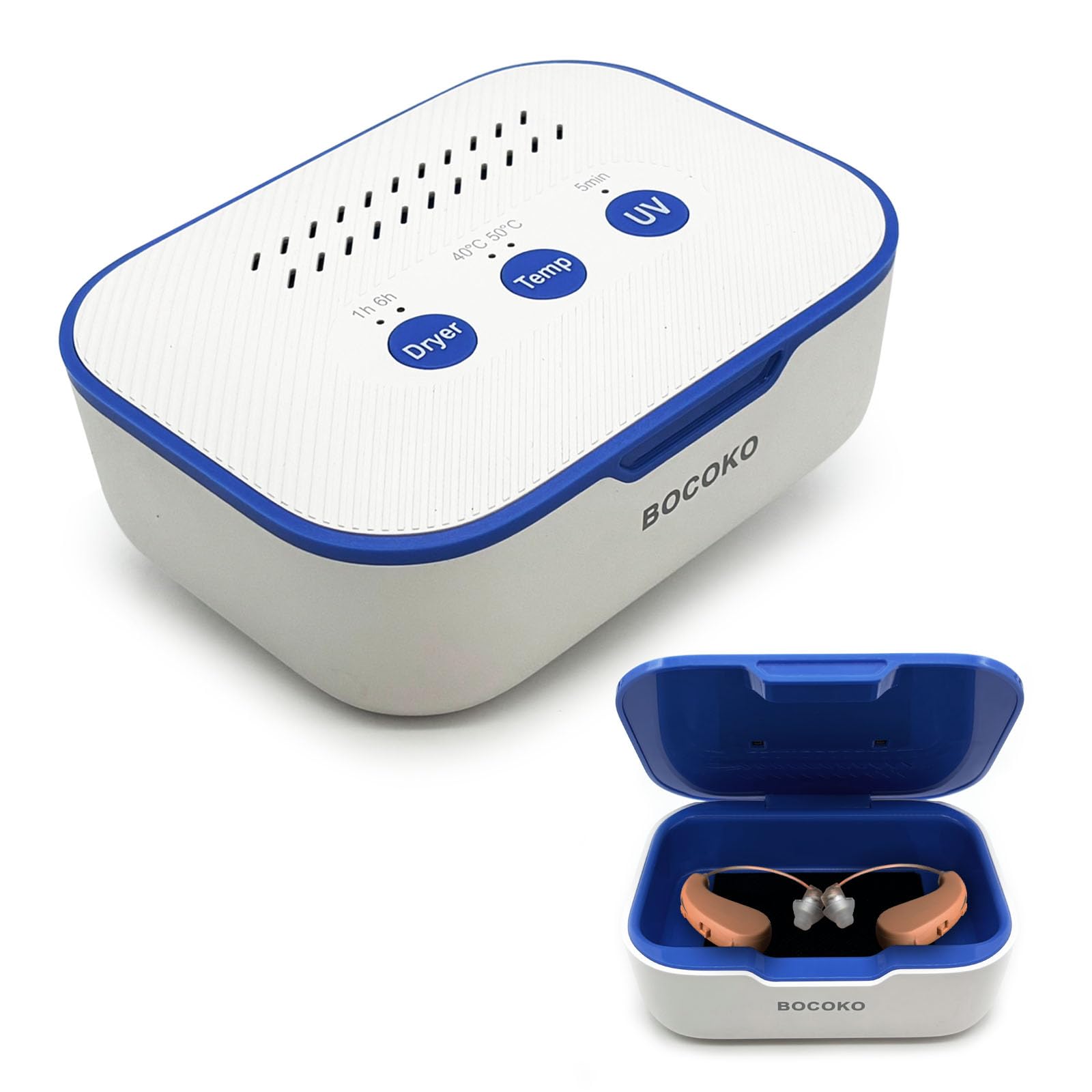
BOCOKO UV-C Hearing Aid Dryer

88 /100
Trail Score Excellent

Key details

Warranty
3 years
Cycle Options
1 hour basic, 6 hours deep
Drying Method
Heated air + UV lamp
Check Price on Amazon

An unfamiliar name at a modest price is usually where we start hunting for the catch. Very little turned up: the BOCOKO is a heated UV dryer with automatic shutoff, and it carries a three-year warranty, the longest stated in this guide.

The two modes are the practical part. One hour is a routine dry, short enough to run in the morning before you leave, and six hours is the deep clean for the week you have been sweating through a heat wave or the stretch you spent somewhere humid. Either one ends on its own, so you are not watching a clock.

What we cannot tell you is how one behaves in year three. The PerfectDry models have a long record behind them and this one does not, and that is the difference that matters more than the spec sheet does. It is a gap in time, not a fault we found.

Where that leaves it: if you want a heated, UV, automatic dryer and you want to spend as little as possible on one, this is the pick, and the warranty takes most of the risk out of trying a smaller name. If you would rather buy the model with years of use already behind it, the LUX is the step up.

Pros

  • One-hour and six-hour drying modes
  • Heated drying with a UV lamp
  • Three-year warranty
  • Automatic shutoff at the end of either cycle

Cons

No notable drawbacks to flag.

Our verdict

The budget electric pick: a one-hour heated UV cycle, a six-hour deep clean, and a three-year warranty from a smaller brand.

Check Latest Price
7

Lowest Cost

Hal-Hen Super Dri Aid

89 /100
Trail Score Excellent

Key details

Power
None required
Reactivation
Microwave
Drying Method
Reusable desiccant pellets
Check Price on Amazon

Maintenance is a short spell in the microwave. Tip the loose pellets out, heat them to drive the moisture off, let them cool, and the jar is back in service — no cord, no batteries, no blocks to reorder, and nothing thrown away.

The jar is a workable size for a pair of behind-the-ear aids, and the pellets pull damp out of tubes and domes overnight. The payoff is the one you are after: aids that come out dry rather than damp enough to crackle through the morning.

For a lot of people this is the whole answer. It is the cheapest way into a real drying routine, it does not need an outlet, and there is nothing electronic to fail. We keep coming back to it as the option for someone who is not sure they will stick with drying and does not want to find that out with a machine.

What it is not is automatic. There is no fan, no warm air, and no cycle to switch on, so results depend on your own timing and on the pellets being fresh. If you want a machine to take the job over, this is not it. If you want the job done for very little, it is.

Pros

  • Reusable pellets, no recurring purchases
  • No power, batteries, or electronics
  • Works on tubes and domes overnight

Cons

  • Pellets must be reheated by hand
Our verdict

A jar of reusable desiccant pellets you recharge in the microwave: cheap, effective, and never needing a cord or a battery.

Check Latest Price

How We Tested Hearing Aid Dryers

We built our shortlist by scanning specs for desiccant capacity, cycle time, and footprint, then filtering out models with vague instructions or no clear moisture indicator. That left us with 12 dryers, which we rotated through eight months of real use. Each one spent at least two weeks on a nightstand, a week in a steamy bathroom, and a few days in a gym bag.

To test moisture removal, we wore our hearing aids through sweaty workouts and humid commutes, then placed them in each dryer overnight. In the morning, we touched the aids and the inside of the case, looking for condensation or damp spots. We also tracked the desiccant beads: how many days before the color shifted, and whether the beads could be regenerated evenly. For ease of use, we timed how long it took to load the aids and start a cycle, and we tried each unit in dim light to see if the buttons were readable.

Size mattered more than we expected—we measured each unit's footprint and tried to fit it on a crowded nightstand and into a standard dopp kit. Durability got checked by daily wear and tear: hinges, latches, and cords. We also dropped each unit once from counter height onto a tile floor. Value came down to whether the features matched the price, and we noted which models felt solid from day one versus which started rattling after a month.

How to Choose a Hearing Aid Dryer

Start With the Drying Method

Three approaches show up here and they behave differently. Heated dryers move moisture off with warm air and add UV light for hygiene; they finish inside an hour and need no supplies. Warm-air-plus-desiccant machines run eight hours, with a block inside pulling moisture out of the air so the cycle keeps working all night. Passive jars hold nothing but desiccant and ask for no power at all.

Choose by routine rather than by price. A morning dryer suits someone who wants the job done and forgotten; an overnight machine suits heavy sweat or a humid climate where the aids are damp every single day; a jar is for travel, a spare pair, or a drawer. One trap worth naming: a heat-only dryer stops working when the timer does, so if you want the aids to sit somewhere overnight, that is a jar or a desiccant machine, not a heat box.

Match the Cycle to How Wet Your Aids Get

Cycle length is not a quality ranking. Forty-five minutes handles everyday perspiration. An eight-hour cycle with a desiccant keeps extracting moisture long after warm air alone has stopped mattering, which is why it holds up in a humid climate, on a physical job, or through a summer of heavy sweating.

Whichever length you pick, the safe ceiling is the same. The heated models here stop at 113 °F on purpose, and a hotter box is not drying anything faster that matters — it is just working on plastic and electronics with more enthusiasm.

Add Up What It Costs to Keep Drying

Two numbers matter: what the dryer costs and what it costs to keep it working. Desiccant blocks for the Dry & Store machines are sold separately and get used up; the DryCaddy discs cannot be reactivated, so the six in the kit are eventually spent. Heat-only dryers and the microwaveable pellet jars have no such cost at all.

That gap adds up. A cheaper dryer with expensive consumables can cost more across a couple of years than a heat box that needs nothing, so work out the yearly figure before you decide — and check what comes in the box, because a starter block or disc set is not always included.

Check the Compartment, the Noise, and the Plug

Compact describes the unit, not the inside of it. Measure what you are drying: a cochlear implant processor with the coil still attached, or a pair of behind-the-ear aids with earmolds, needs more room than two small in-the-ear aids, and a jar that swallows a pair may not close on a processor. Where a listing's interior figures and its capacity claim disagree, trust the measurement you take yourself.

Then think about where it lives. A dryer beside the bed needs to be quiet; one that travels wants USB power or no power at all; one that sits in a bathroom wants a lid that shuts properly and a compartment you can wipe out. Matching those three details to your home is worth more than an extra feature you will never press.

Frequently Asked Questions

Final Verdict

Buy the PerfectDry LUX. It is the dryer most people will keep using, because 45 minutes fits into a morning and there is no desiccant to remember, buy, or recharge. No other pick here makes drying as easy to keep up with.

If your aids are soaked every single day and you would rather set something running at bedtime, the Global II's eight-hour warm-air, desiccant, and UV-C cycle does more work overnight. And if the dryer only ever travels with you, the DryCaddy needs no outlet at all.