Best Power Racks for a Garage Gym of 2026

A power rack should be the most boring thing in your garage: you step inside, set the safeties, and forget it while you squat. Plenty of racks look sturdy in photos, then walk, flex, or crowd your ceiling once there's real weight on the bar. I care less about attachment counts than whether the uprights stay put, the pull-up bar feels solid, and one person can assemble the thing without a second set of hands. For a garage gym, sturdiness, mounting, and a usable footprint make a rack worth the floor space.

Over eight months, we tested six power racks in a working garage gym. The differences showed up in details you notice after a few weeks: whether the rack shifts when you rack a heavy squat, how much the pull-up bar flexes, and how much of the assembly you can manage solo. Some racks are easier to move and re-anchor than others, which matters if the garage doubles as parking space. The picks below reflect that mix of quality, value, and versatility; they're the racks we'd trust for daily training.

1

Best Overall

ULTRA FUEGO Power Cage

91 /100
Trail Score Outstanding

Key details

Capacity
1000 lb
Included
Pulley, lat bar, landmine, dip handles
Uprights
50 x 50 mm, 1.5 mm steel
Footprint
63"D x 47"W x 82.7"H
Check Price on Amazon

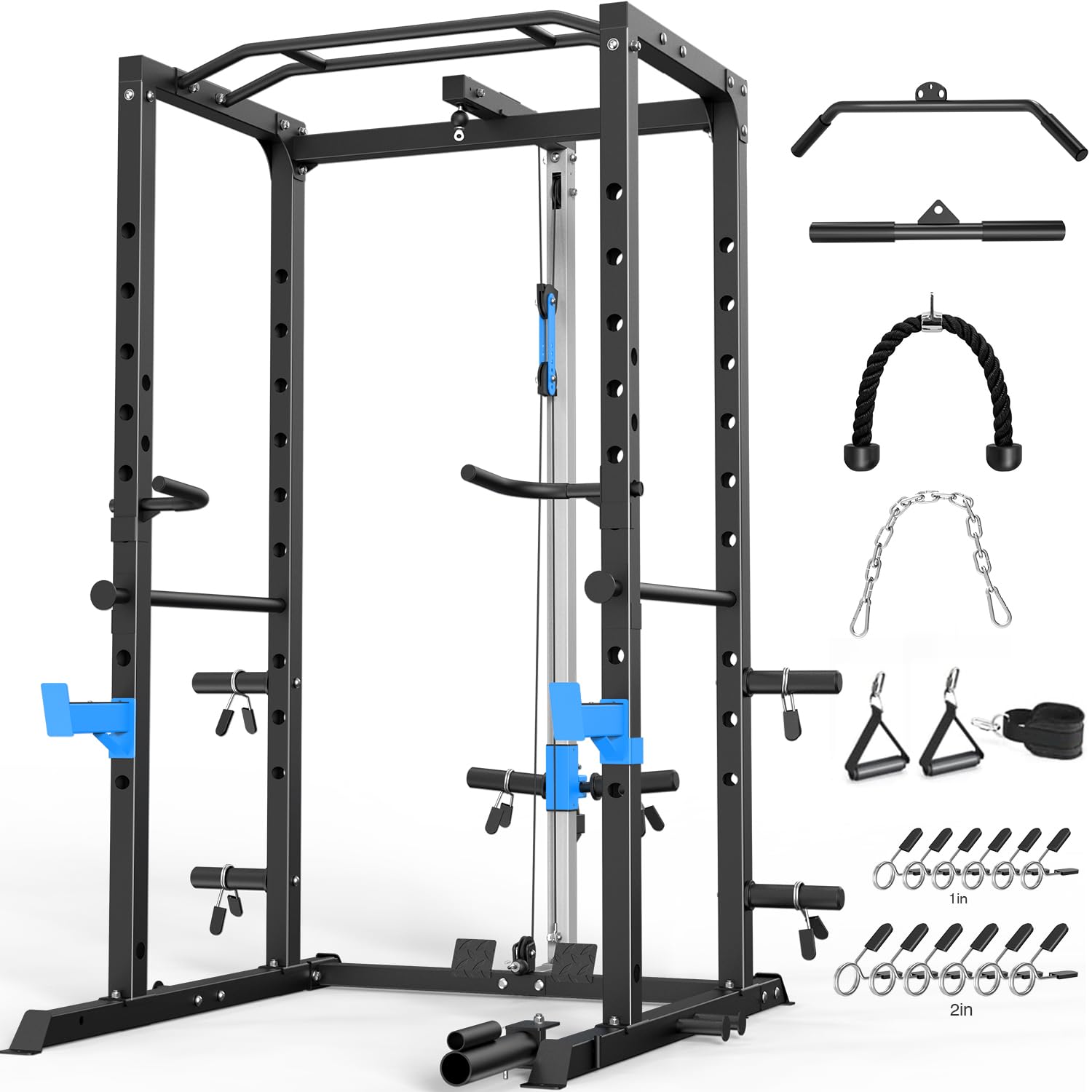
A lat pulldown, a landmine, dip handles, a tricep rope and two cable handles come with this cage, and that bundle is why it's our top pick. A garage only holds so much, and one frame that covers squats and bench inside the uprights plus lat work, rows and curls on the pulley outside does the job of two machines on one slab of concrete. The hardware underneath is the right kind of boring: 50mm uprights, 1.5mm steel, a 1,000-pound rating and 10 height settings for the J-hooks and safety bars.

We paid attention to how the pulley feels, because a rough cable makes a rack seem cheap in a way no spec sheet shows. It runs smoothly through the full range in both the high and low positions, so lat pulldowns, face pulls and seated rows work without re-rigging anything between sets. The landmine at the base is the second thing we keep coming back to; it turns a corner of the cage into a rowing station without bolting on another machine.

The plate pegs on the sides are the practical detail we'd miss on a cheaper frame. They hold your plates within reach of the uprights and let the weight you already own do some work while the bar is racked. Set aside an evening and a second person for the build — the top crossmember and the pulley housing are much easier with four hands, and the cable routing is fussier than the frame.

If you squat, press and do nothing else, one of the simpler racks here handles that for less. The moment you want to train your back without driving to a gym, the extra spend stops looking like a luxury. This is the version of a home gym that doesn't feel like a compromise.

Pros

  • Pulley, landmine and dip handles included
  • 1,000-pound rating on 50mm uprights
  • Covers barbell and cable work in one footprint
  • Two-year manufacturer warranty

Cons

  • Frame rocks on hard pull-ups until ballasted
Our verdict

Buy this if you want squats, bench, pull-ups and cable work from one frame; it's the most complete garage gym here for the money.

Check Latest Price
2

Best for Heavy Lifting

Sunny Power Zone SF-XF9925

93 /100
Trail Score Outstanding

Key details

Capacity
2130 pounds combined
Included
Plate storage, 6 band pegs, reversible pull-up bar
Footprint
50.4"D x 65.1"W x 82.9"H
Frame Weight
133 lb
Check Price on Amazon

The 2,130-pound figure is a combined total across the rack's zones rather than one rating for the J-hooks and safety arms, and that distinction is worth more than the number itself. What it tells you is that Sunny engineered this frame for load: 14-gauge steel, 133 pounds of rack, plate storage and band pegs all counted in. What it doesn't tell you is the working limit on the spotter arms, so match those to the weights you actually handle.

For a garage where the bar gets heavy, this is the rack we point to. It's also the widest frame in this group at just over five feet across, which buys interior room for a wide squat stance and means you should tape the footprint on the slab before you fall for the capacity. Fifty inches of depth plus a loaded bar is more space than it sounds like.

Small choices make it easier to live with. The uprights are numbered, so you can match the left and right J-hook heights exactly instead of counting holes, and the pull-up bar sits centered in the frame rather than hanging off the front, which is why it stays steady overhead. The plate posts sit low, though; loading the bottom pair means a real bend, and we'd have moved them up a foot.

Add plates to the storage posts and the frame settles — the side-to-side sway you notice when it's empty goes away once it's weighted. Between the band pegs, the storage and the 2,130-pound build, it's a lot of rack for the middle of the price range.

Pros

  • Highest combined capacity in this group
  • Numbered uprights for matching heights
  • Plate storage and six band pegs included
  • Centered pull-up bar stays steady

Cons

  • Plate posts sit low, so loading is a bend
Our verdict

Our pick for a heavy bar: more capacity than anything else here, with plate storage and band pegs built into the frame.

Check Latest Price
3

Best for a Shared Garage

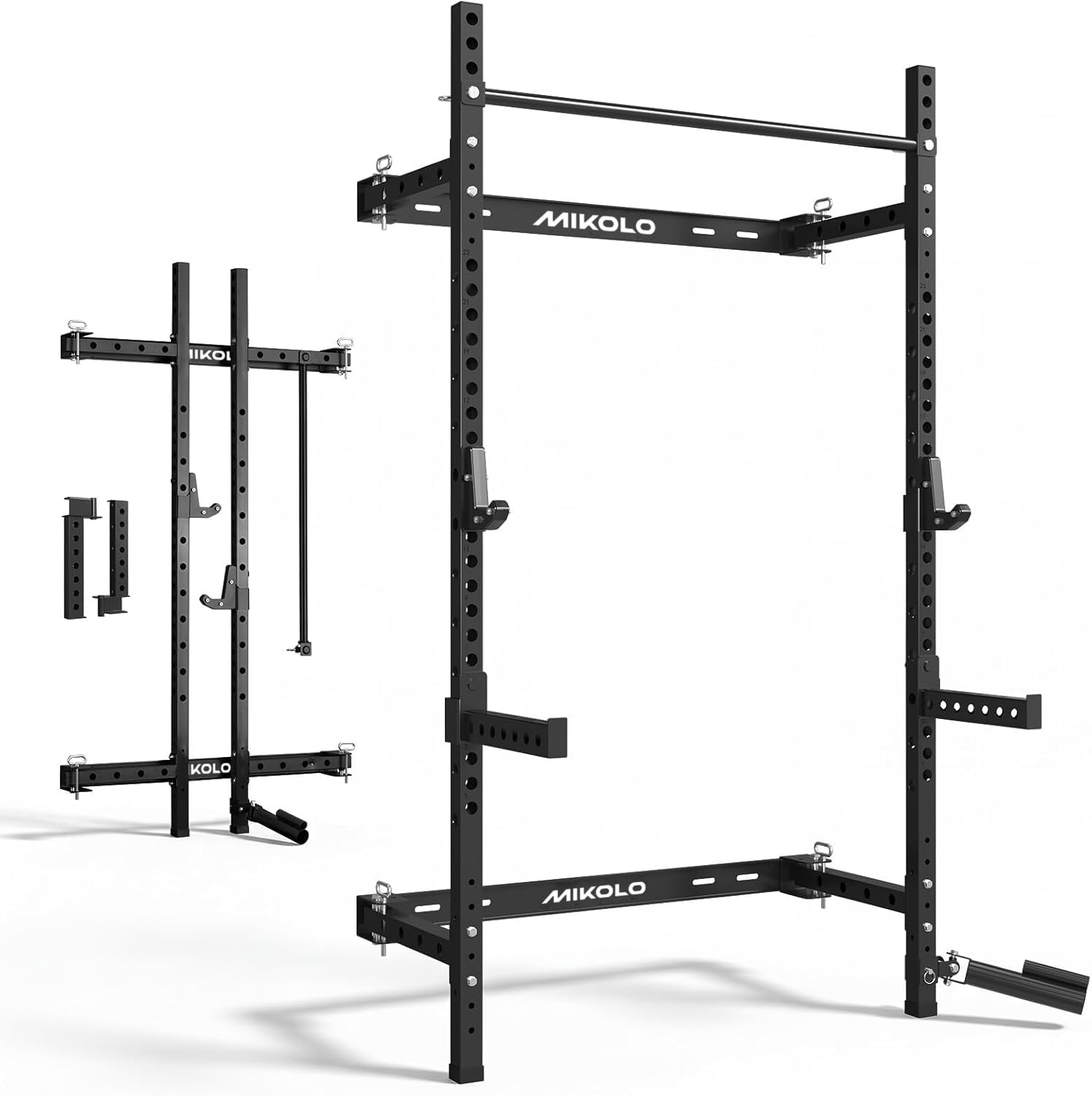
Mikolo Folding Squat Rack

89 /100
Trail Score Excellent

Key details

Capacity
1000 lb
Mounting
Wall mount with stringer
Uprights
2 x 2 inch, 13 gauge
Dimensions
86 x 22 x 47 inches
Check Price on Amazon

The reason to buy this one has less to do with the rack than with the other half of the garage. It bolts to the wall, swings out for a session and folds back to a few inches of depth in about fifteen seconds, which is the difference between a garage gym and a garage.

For a one-car garage, that's the pick. The frame is 2-by-2-inch, 13-gauge steel rated to 1,000 pounds, with a pull-up bar, J-cups and safety catches, and it does what a freestanding cage does except take up the floor. You just have to accept that the wall becomes part of the structure.

Which is the part to get right. It has to go into studs, and the included stringer only helps if the framing behind it is where the instructions expect it. If your studs are spaced oddly or the wall isn't straight, sort that out before the drill comes out — a wall rack that isn't square will bind every time you fold it, and no amount of tightening fixes a bad mounting point.

Everything else is a straight trade. You get a rack that disappears when you're done, a pull-up bar that reaches higher than most of the freestanding frames here, and a floor you can sweep in one pass. For a garage that has to hold a car, that's the trade worth making.

Pros

  • Folds to a few inches off the wall
  • 1,000-pound rating on 13-gauge uprights
  • Stringer and mounting hardware included

Cons

  • Ceiling must clear an 89-inch pull-up bar
Our verdict

The pick for a shared garage: a 1,000-pound wall-mounted rack that folds flat in seconds so the car still fits.

Check Latest Price
4

Best for Tight Spaces

FLYBIRD SR1 Squat Rack

89 /100
Trail Score Excellent

Key details

Capacity
950 lb
Dimensions
42 x 51 x 83 inches
Barbell Fit
6 ft and 7 ft barbells
Height Settings
22
Check Price on Amazon

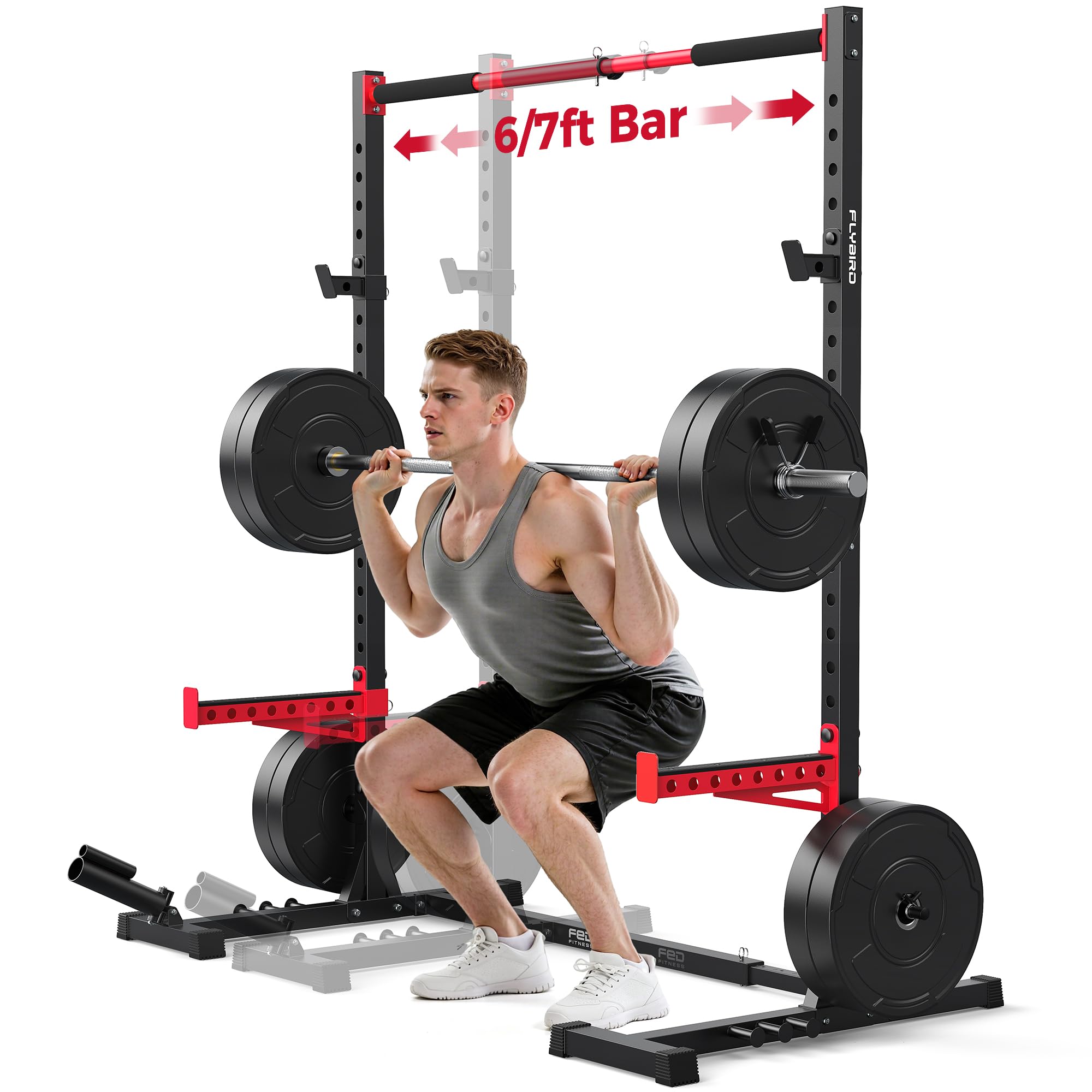
Adjustable width is the detail most shoppers skip, and it's the one that got this rack onto the list. The uprights slide to fit both six-foot and seven-foot barbells, so a short bar you already own still sits where you expect it to, and a narrow frame squeezes into a bay that would refuse most cages.

Twenty-two height settings on one-inch holes is more adjustment than most racks here offer, and that one-inch pattern is the standard one, so aftermarket J-cups and attachments drop straight in — which is not true of every rack in this guide. The safety arms extend 16.7 inches and come with liners, and that length is what actually catches a missed rep instead of letting the bar roll off the end.

At 68 pounds it's the lightest full-height rack here, and the 950-pound rating is honest for that steel rather than generous. For squats, bench and pull-ups in a home gym, that's plenty; nobody doing three sets of five needs more rack than this. What you're buying is fit and adjustment range, not mass.

The extras are sensible for the money: a landmine for T-bar rows, six band pegs, and a foam-padded pull-up bar. It's a starter rack that doesn't feel like a starter rack, which is the highest compliment we can pay something in this price tier.

Pros

  • Adjustable width fits 6- and 7-foot bars
  • 22 height settings on standard 1-inch holes
  • 16.7-inch safety arms with liners
  • Landmine and six band pegs included

Cons

  • Light frame for very heavy rack pulls
  • Padded pull-up bar is less grippy than knurling
Our verdict

A compact, adjustable rack that fits a short bar and a small garage; 950 pounds is enough for solo squat and bench work.

Check Latest Price
5

Best Compact Cage With a Cable

JELENS S11 Power Cage

88 /100
Trail Score Excellent

Key details

Capacity
2000 lb
Included
Lat pulldown, landmine, dip handles
Footprint
57.5"D x 44.5"W x 82.6"H
Floor Space
12.5 square feet
Check Price on Amazon

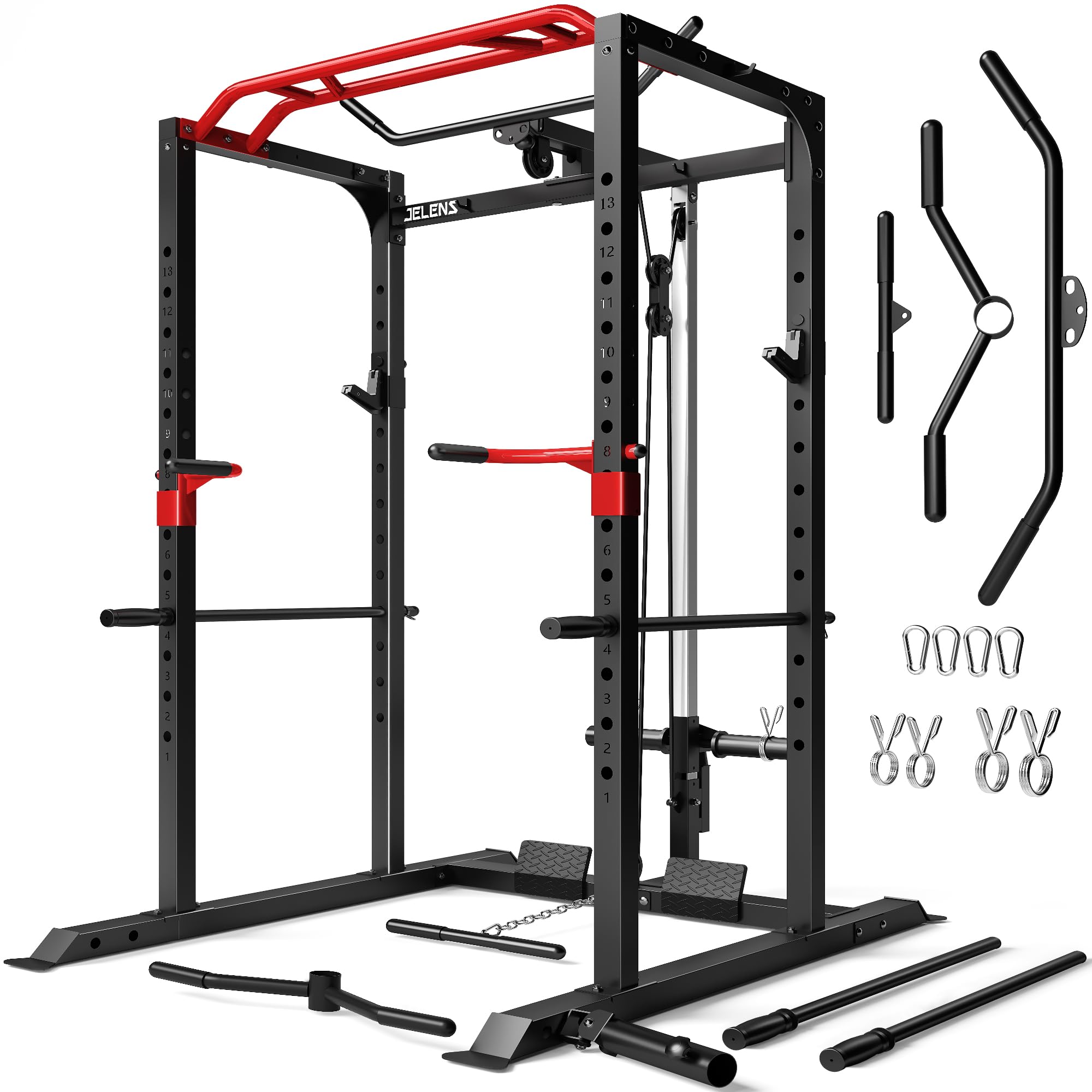
Twelve and a half square feet is the figure that separates this cage from everything else here. That's a four-post rack with a pull-down pulley, a landmine, dip handles and a multi-grip pull-up bar in a footprint you can tape out between two shelving units, and at 44.5 inches wide it's one of the two narrowest cages in this group.

The steel is 50mm square with a 2,000-pound rating, and the up-and-down pulley runs on bearing pulleys with a coated cable rather than the bare rope you find on cheaper attachments. We were pleased by how much of the range the cable covers — lat pulldowns from the top, seated rows from the low position — without the drag that makes a cheap pulley feel like a chore by the third set.

The landmine sits at the front of the cage and the dip handles hang inside, so the same footprint handles T-bar rows and dips without unbolting anything. Nothing on the frame feels improvised, which is more than we can say for some of the cages at this price.

Narrow is the whole point, and it's also the thing to check first. At 44.5 inches across, measure your bench and your grip before you order — a cage too narrow to bench inside is a squat stand with extra steel. If you press outside the uprights, that stops mattering, and this becomes the best space-to-function trade in the group.

Pros

  • Full cage, pulley, landmine and dips
  • 2,000-pound rating on 50mm steel
  • Smallest floor space of the cages here
  • Cable runs smoothly through the range

Cons

  • Directions are hard to follow
Our verdict

A full cage with a cable in one of the smallest footprints here; the pick when the garage bay is narrow.

Check Latest Price
6

Best Premium Pick

pooboo P43 Power Cage

92 /100
Trail Score Outstanding

Key details

Capacity
2000 lb
Footprint
62.9"D x 43.3"W x 82.6"H
Attachments
20+ included
Frame Weight
417 lb
Check Price on Amazon

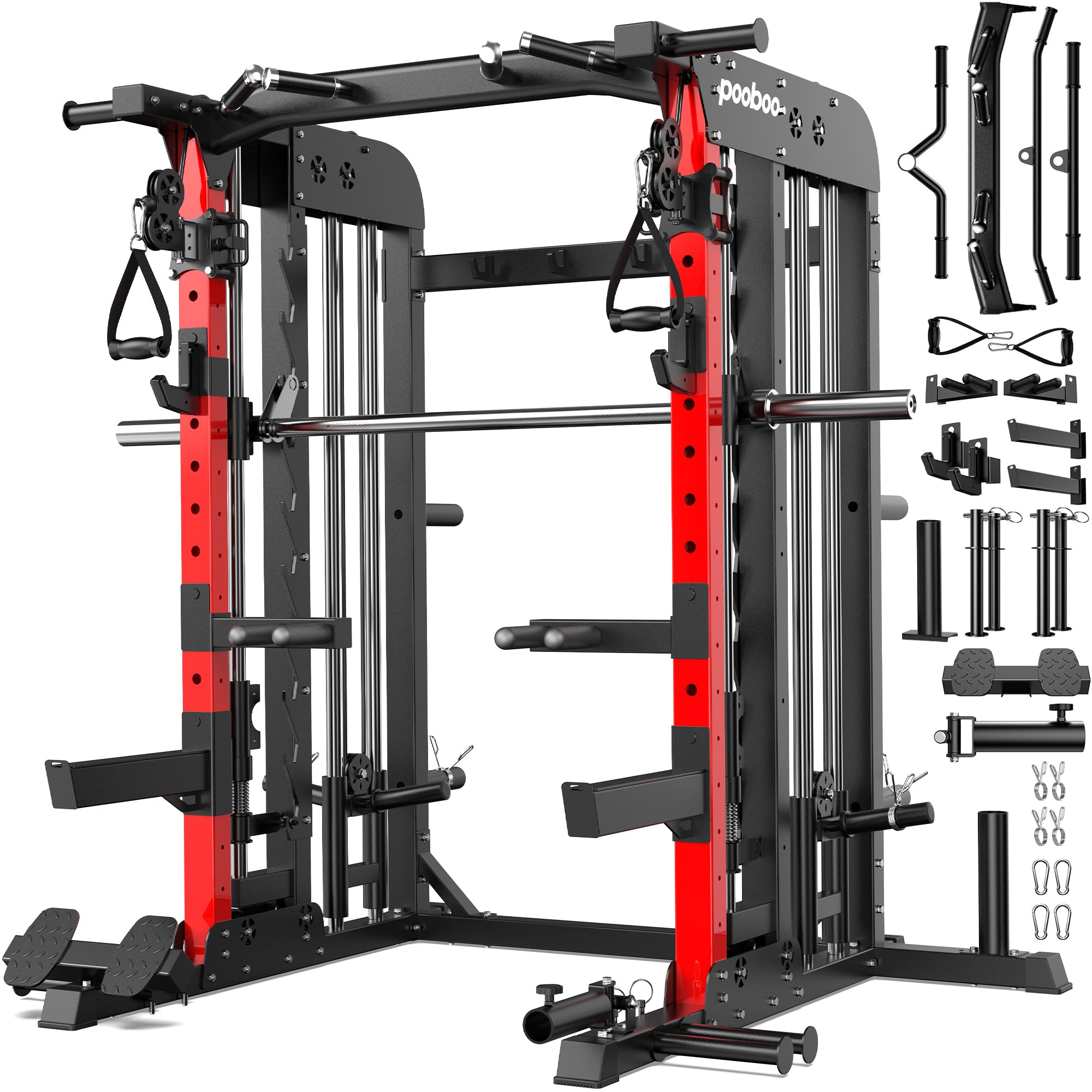
This is the one that doesn't feel like home equipment. A 417-pound frame, a 2,000-pound rating and a cable crossover with two pulleys at independent heights add up to something closer to a commercial machine than to a rack with a lat pulldown bolted on.

The weight is the point. At 417 pounds it sits still on a slab without a single anchor bolt, which is a claim most cages here can't make, and the cable runs on bearing pulleys with a PU rope rather than the thin coated cable you find on cheaper attachments. That's the difference between a pulley you use for one exercise and one you build a back day around.

What it asks in return is time. Assembly is a half-day with two people, and there are more than twenty attachments in the boxes, each with its own home. Read the manual before you open the hardware bags; sorting by step is the difference between an afternoon and a weekend.

Then there's the crossover, which is the real argument. Two independent pulleys let you do chest flyes, face pulls and single-arm work the way you would at a gym, and no other rack in this guide offers it. If you're buying one machine and never want another, this is that machine.

Pros

  • Cable crossover with independent pulleys
  • 417-pound frame stays put unbolted
  • Over 20 attachments included
  • Two-year warranty

Cons

  • Premium price
  • Deep footprint takes garage floor
Our verdict

The premium call: a 2,000-pound cage with a true cable crossover for a garage gym that's staying put.

Check Latest Price
7

Budget Barbell Work

Sunny SF-XF9931 Power Rack

94 /100
Trail Score Outstanding

Key details

Dimensions
38"D x 53"W x 87"H
Adjustments
18-point J-hooks
Pull-up Bar
8-position angled
Frame Weight
83 lb
Check Price on Amazon

The holes in the uprights aren't the standard one-inch pattern, so the aftermarket J-cups, spotter arms and landmines sold for most racks won't drop in. If you like the idea of adding attachments over time, that's a real ceiling — you're buying into Sunny's parts or nothing.

Set that aside and it's a usefully compact rack: 38 inches deep, the shallowest frame here, which matters when the nose of a car sits a few feet away. The 18-point J-hook adjustment and safety-lock spotter arms cover squats and bench, and the angled eight-position pull-up bar gives you wide, neutral and close grips without changing a thing.

As a first rack for a garage gym, it earns its place. It does the three things most people buy a rack for — squat, bench, pull up — with hardware that arrives in the box, and it does them without dominating the floor. We'd happily set a beginner up on it and spend the savings on plates.

The pull-up bar is the part to watch. It can shift when a loaded bar gets racked hard against the uprights, so check it's tight before you hang from it and keep your re-racks deliberate rather than sloppy. Do that and it's a lot of rack for a small garage and a small budget.

Pros

  • Shallow 38-inch footprint
  • 18-point J-hook adjustment
  • Includes safety spotter arms
  • Angled eight-position pull-up bar

Cons

  • Non-standard holes lock out aftermarket parts
  • Tall 87-inch frame needs ceiling clearance
Our verdict

A budget rack that covers squats, bench and pull-ups; buy it only if you're content with Sunny's own attachments.

Check Latest Price
8

Accessory-Heavy Setups

SunHome Power Cage

87 /100
Trail Score Excellent

Key details

Capacity
2160 lb
Dimensions
46.9"D x 42.4"W x 84.9"H
Adjustments
28 positions
Frame Weight
115 lb
Check Price on Amazon

Dip handles, a multi-position pull-up bar, four plate posts and a pair of barbell hooks all come on this frame, and that accessory list is the reason it's here. Very few racks at any level hand you a dip station out of the box, and the multi-grip bar covers wide, neutral and close positions overhead.

Twenty-eight adjustment positions is the most in this group, which matters more than it sounds: fine steps mean the safety arms land just under your squat depth instead of two inches too low. The frame carries a listed 2,160-pound capacity at 115 pounds of steel, which puts it well ahead of the budget racks on paper.

Stability is where it earns trust rather than admiration. A 115-pound frame on this footprint doesn't sway, and the dip bars are spread wide enough to actually use rather than perch on. The four plate posts hold plates off the floor and give the frame ballast at the same time, which is the cheapest stability upgrade there is.

Where it lands depends on what you want next. If dips, plate storage and a multi-grip bar are the goal, it's a strong buy. If a cable is on your list, put the money toward the ULTRA FUEGO instead — the pulley is worth more than the extra adjustment positions.

Pros

  • 28 adjustment positions, the most here
  • Dip handles and multi-grip pull-up bar
  • Four plate posts and two bar hooks

Cons

  • Narrow 42.4-inch frame limits a wide bench grip
Our verdict

A narrow, accessory-rich cage with dip handles and plate storage; the pick if you want stations rather than a cable.

Check Latest Price

How We Chose and Tested Garage Gym Power Racks

To build the shortlist, we started with racks that fit common garage ceilings and footprints, then narrowed by steel gauge, weld quality, upright size, hole spacing, anchoring hardware, and price relative to included attachments. We ruled out models with vague weight ratings or mounting instructions that assumed a professional installer. The final six racks spent eight months in a working garage gym, sharing the same concrete slab and the same lifting schedule.

Assembly came first: one person unpacked each rack, laid out the hardware, and timed the build using only the included instructions and tools. We noted missing or mislabeled parts, whether the uprights lined up without forcing, and how easy it was to tighten the frame once it was standing. Then we put each rack through daily training: squats, bench, overhead press, and pull-ups, including slow strict reps and a few controlled kip swings to see how much the pull-up bar moved. We racked and re-racked loaded bars off the J-cups, dropped empty bars from shoulder height, and checked whether the feet lifted or the frame walked across the floor.

We also tested mounting and mobility in the same space: anchoring each rack per its instructions where possible, then noting whether it could be shifted, rolled, or repositioned without a full disassembly for parking a car or sweeping. Versatility got judged by how well the rack accepted attachments and whether the safeties adjusted through a useful range, while value came down to what was included versus what we had to buy separately.

How to Choose a Power Rack for a Garage Gym

Measure the Room, Not the Rack

Start with a tape measure and a ladder. Most garage ceilings sit near eight feet, and the cages here run 82 to 87 inches tall before you count a pull-up bar that may reach 89 inches — anything you plan to hang from has to clear your head with room to spare. Then tape the footprint on the slab and add about four feet in front for a bench and three behind for walking a bar out. A seven-foot Olympic bar is 86 inches long and doesn't care where your walls are.

Stability Is Ballast and Anchoring, Not Just Steel

A cage is a frame, not a foundation. Every freestanding rack here shifts a little when you rack a heavy bar or pull hard from the top until it's weighted or bolted, and the ones with plate storage settle fastest because the plates you already own become the ballast. On a garage slab you can drill and anchor with wedge bolts; if you rent, keep the storage pegs loaded and keep heavy sets inside the uprights. Buy the rack whose storage you'll actually fill.

Read What the Capacity Number Covers

Capacity claims are not all the same measurement. Some are a single rating for the frame; others, like the 2,130-pound figure on the Sunny Power Zone, add several zones together into one combined total. Neither is dishonest, but you can't compare them side by side. What matters is the load your J-hooks and safety arms carry, since that's where the bar actually sits — so assume the lower number and size your lifting to that.

Width, Safety Arms and Hole Spacing

Two measurements decide whether you can train alone. Interior width has to clear your bench and your grip; a 42- or 44-inch cage is a gift in a narrow bay and a nuisance if you bench wide. Safety arm length is the other: a 16-inch arm catches a missed squat, a short stub lets the bar roll off the end. Then check the holes — one-inch spacing is the accessory standard, and the smaller pattern on some racks means aftermarket J-cups and landmines simply won't go in.

Decide Whether You Want a Cable

A pulley turns one frame into a whole gym, and it's the feature garage owners tend to value most because back work is what a barbell-only setup does badly. It also adds cost, assembly time and a wear point, and a rough cable is worse than none at all. If you squat, press and pull up and nothing else, put the money into steel and safety arms. If you'd otherwise drive to a gym for lat pulldowns, buy the cable.

Frequently Asked Questions

Final Verdict

Start with the ULTRA FUEGO. It's the rack that turns a garage into a gym you don't have to leave: a full cage for squats and bench, a pulley for lat work, a landmine for rows and dips, all in one footprint.

If the bar gets genuinely heavy and you want the most capacity here, the Sunny Power Zone is the stronger frame and its plate storage earns its keep. And if the car has to park on the same slab, nothing else in this guide folds out of the way like the Mikolo.