Best Squat Racks for a Home Gym of 2026

A squat rack is what turns a corner of the garage into a real home gym—or into a very expensive place to store a barbell. The right one gives you a steady place to squat and press without a commute; the wrong one rattles, eats floor space, or makes you second-guess the pull-up bar. I care about the unglamorous details: bolts that stay tight, uprights that adjust without a fight, and a footprint that suits your ceiling height and training style.

Over eight months, my team and I assembled and trained in seven squat racks, from compact folding designs to full cages. We racked barbells, did pull-ups, checked how easily each one moved when the car needed the garage back, and noted where assembly tripped us up. The racks that earned a spot balanced sturdiness and weight capacity with value, and they fit a home gym rather than pretending to be commercial equipment. Below are the ones that held up—and what to weigh before you give up the floor space.

1

Best Overall

Sunny Health & Fitness SF-XF9931

94 /100
Trail Score Outstanding

Key details

Pull-up Bar
8-position angled
Rack Weight
83 lb
J-hook Adjustment
18 positions
Assembled Dimensions
38 x 53 x 87 inches
Check Price on Amazon

Two things make a home rack worth its floor space: safety arms that sit where a failed rep actually lands, and a frame that doesn't walk when you slam the bar home. The Sunny SF-XF9931 does both, and it does them for less than the two big cages we cover. You get a full-size rack with locking spotter arms, 18 J-hook positions and an eight-position angled pull-up bar — the same working layout as racks that cost a good deal more.

At 83 pounds it isn't the heaviest frame here, but it's heavy enough that we left it standing unbolted and never felt it shift under a squat. Floor space is 38 by 53 inches, narrow enough for a spare bedroom and wide enough to load plates without stepping out of the rack. It's also the tallest rack in this guide at 87 inches, so measure to the joists rather than the ceiling, and leave room for a chin-up, which wants more than eight feet over this frame.

Assembly is where cheap racks usually fall apart, and this one comes with the tools and hardware bagged in numbered steps that match the manual, so one person can get it standing. The compatibility catch is the upright holes: they're smaller than the one-inch standard, so check the pin size on any J-cups, landmine or dip bar you plan to add — most off-the-shelf accessories won't drop in.

Pros

  • Locking spotter arms for lifting alone
  • 18 J-hook height positions
  • Stays put without bolting at 83 pounds
  • Tools and step-numbered hardware included

Cons

  • Pull-up bar has some give when re-racking
Our verdict

It's the rack we recommend first: safety arms that catch a missed rep, a frame that stays put unbolted, and 18 height positions.
Check Latest Price
2

Best for Small Spaces

FLYBIRD SR1 Squat Rack

89 /100
Trail Score Excellent

Key details

Safety Arms
16.7 inches
Height Settings
22
Weight Capacity
950 lb
Assembled Dimensions
42 x 51 x 83 inches
Check Price on Amazon

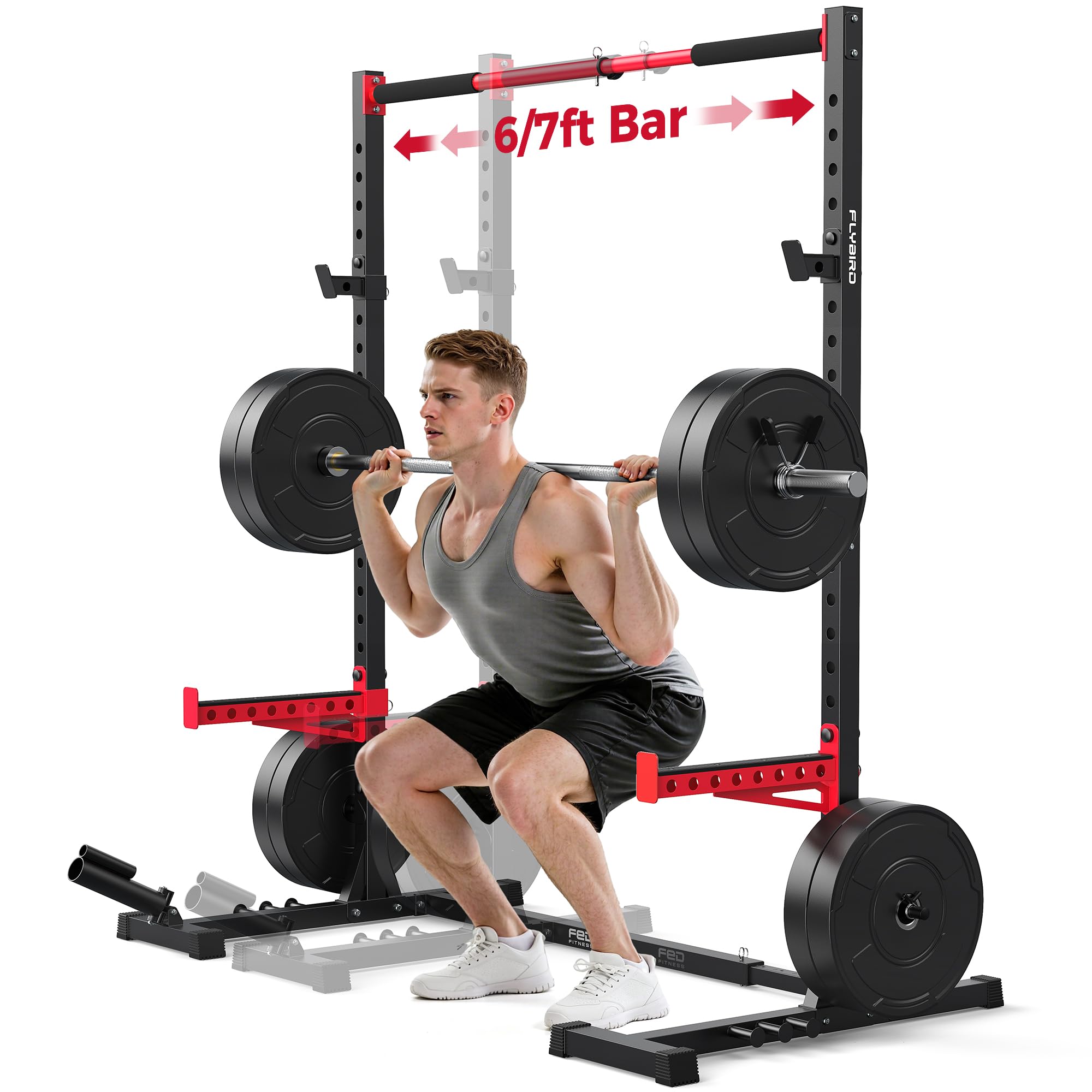
Floor space is where a home rack gets vetoed, and this is the answer to that: 42 by 51 inches on the ground and 83 inches tall, so it slips into a spare room a full cage would swallow. It's a half rack, which means you step in from the side rather than standing inside a box — fine for squats and presses, and it leaves you an open side to bail toward.

What we ended up valuing most is the adjustable width. The uprights slide to fit a 6- or 7-foot barbell, which matters if you're on a short bar now and a full-length one later. Twenty-two one-inch holes give finer height steps than most racks here, and the arms run 16.7 inches, which is enough to bench inside without feeling like you're aiming at a shelf.

The trade-off is mass. At 68 pounds, with a 950-pound rating, this is a rack you keep inside moderate loads — treat the rating as a ceiling rather than a target. A hard re-rack moves it, and the fix is plates on the frame or a bolt kit through the feet. What the light frame buys you is a rack you can carry up a staircase and stand up in a room where nothing heavier would fit.

Pros

  • Adjustable width fits 6- and 7-foot bars
  • 22 one-inch height settings
  • 83-inch height clears more ceilings
  • Landmine and band pegs included

Cons

  • Pull-up bar hangs on four small screws
Our verdict

A half rack for tight rooms: 22 height settings, safety arms long enough to bench with, and a width that slides to fit your bar.

Check Latest Price
3

Best All-In-One

Sportsroyals RK2 Power Cage

88 /100
Trail Score Excellent

Key details

Frame Weight
150 lb
Height Levels
14
Weight Capacity
1,200 pounds
Assembled Dimensions
59.6"D x 59.6"W x 82.6"H
Check Price on Amazon

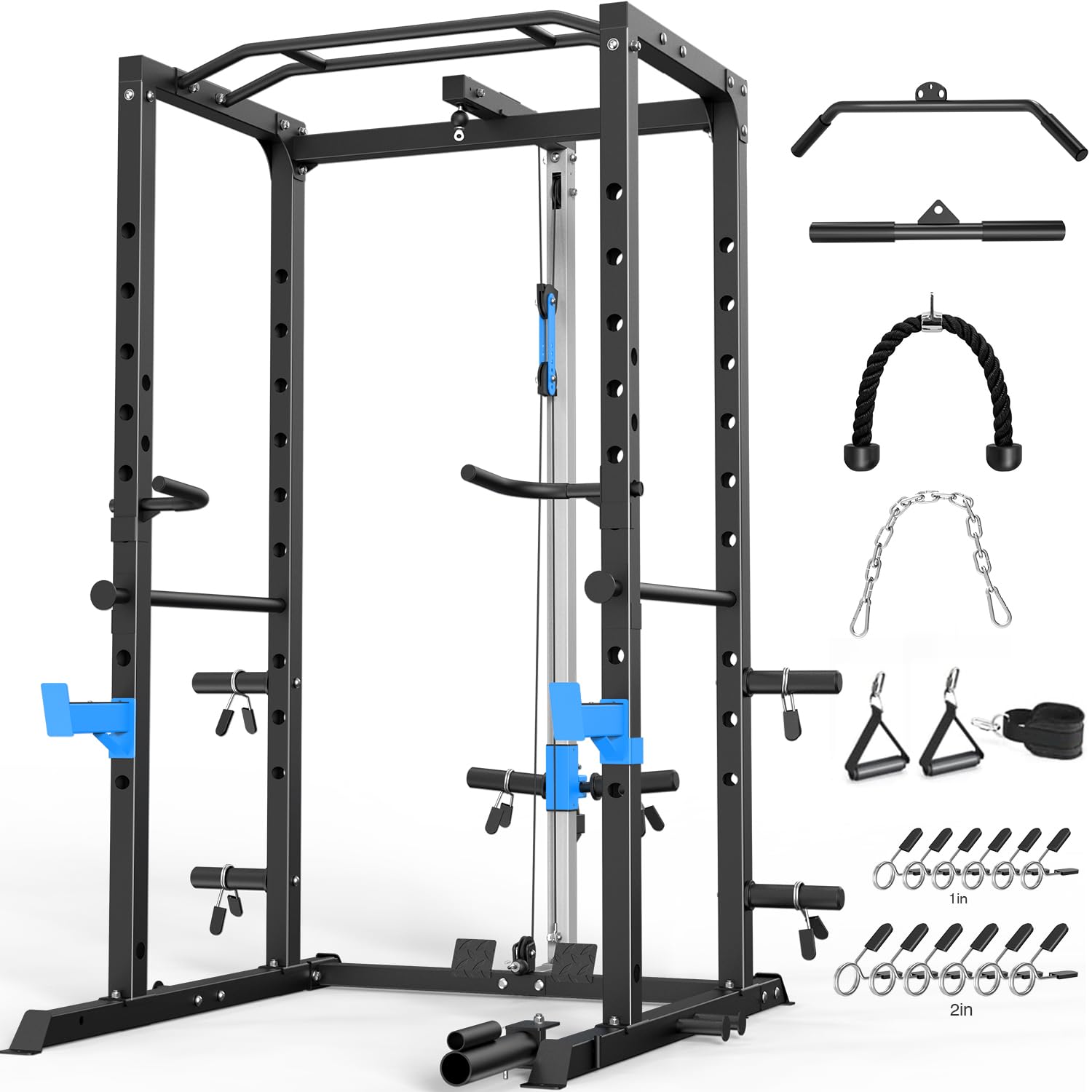
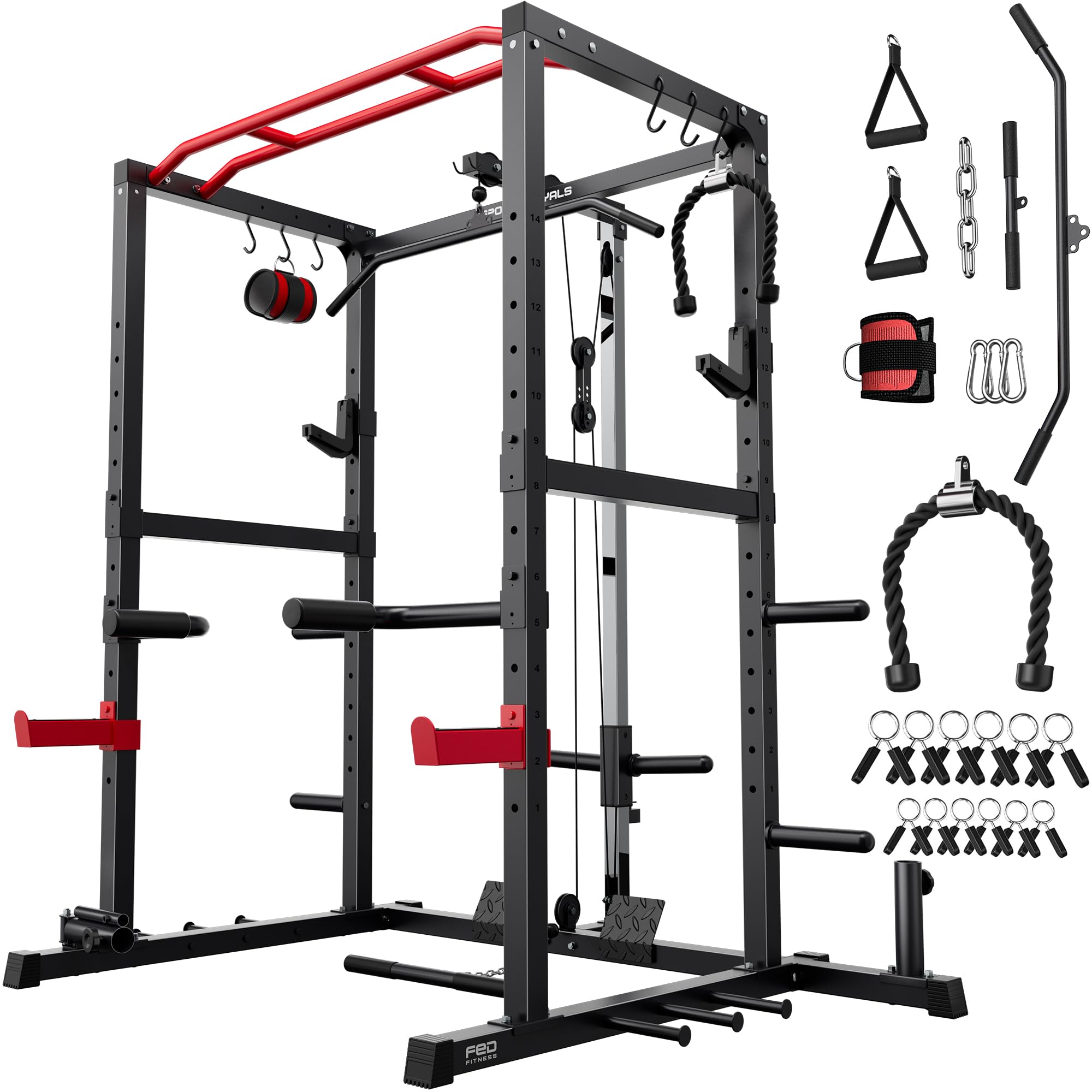
The cable is the reason to pay for this cage. A high and a low pulley run off the back of the frame, so lat pulldowns, rows, face pulls and tricep work happen in the same footprint as your squats — the thing that otherwise pushes people into a second machine or a gym membership.

The kit is unusually complete: lat bar, rowing bar, tricep rope, ankle strap, cable handles, dip stands, a landmine, six band pegs, plate storage, J-hooks and safeties. The frame is 50mm square steel at 150 pounds, rated to 1,200 pounds, with 14 height levels on the uprights and 59.6 inches of floor in each direction. That's more room than anything here except the 65-inch Sunny cage, so give it a real corner rather than a wall.

Where it earns its keep is the second workout — back and arms without dragging a bench into the rack, which is the difference between a cage you use four times a week and one you walk past. Load the plate storage before pull-ups, or bolt the feet: at 150 pounds the frame is heavy but not immovable, and the cable pulls want ballast under them.

Pros

  • High and low cable pulley built in
  • Landmine, dip bars and plate storage included
  • 1,200-pound rating on a 150-pound frame
  • 14 J-hook height levels

Cons

  • Cable guide bars rattle during pulls
  • Takes nearly 60 inches of floor each way
Our verdict

The one to buy if a cable station matters as much as the bar: a 1,200-pound cage, a working pulley and a full attachment kit.

Check Latest Price
4

Best High-Capacity Cage

Sunny Health & Fitness SF-XF9925

93 /100
Trail Score Outstanding

Key details

Frame
14-gauge steel
Band Pegs
6
Combined Capacity
2,130 pounds
Assembled Dimensions
50.4"D x 65.1"W x 82.9"H
Check Price on Amazon

That 2,130-pound figure needs translating before you hang a bar on it. It's a combined rating across the rack's zones — J-hooks, safety arms, plate storage, pull-up bar — not a single load you can drop from the top. Read it as a measure of how much steel is in the frame rather than permission to put 2,130 pounds on the bar.

The steel is 14-gauge, the frame measures 50.4 inches deep by 65.1 wide by 82.9 tall, and the box includes a reversible pull-up bar, six band pegs and plate storage across the back. Width is the headline: 65 inches of overall span is the most here, which is what you want if you squat wide or like room to step around the bar between sets.

The band pegs sit where you want them for accommodating resistance, and the reversible pull-up bar switches grip width without moving the frame. Plate storage on the back doubles as ballast in a room where you can't drill the floor, which is most of the reason this one stays put once it's loaded.

For a lifter planning to add bands, chains and volume, this is the cage we point to after the top pick — the extra width and capacity buy room to grow. In a spare bedroom, that 65-inch span and 82.9-inch height are a lot of rack for the space, and the narrower Sunny above will serve you better.

Pros

  • 2,130-pound combined rating across zones
  • 65-inch span, the widest here
  • Band pegs and plate storage included
  • Reversible multi-grip pull-up bar

Cons

  • Working width between uprights is tight for the footprint
  • Plate storage sits low, so loading is a bend
Our verdict

The cage to grow into: the widest span here, a 2,130-pound combined rating and band pegs for lifters adding resistance.

Check Latest Price
5

Best Budget

Yaheetech Adjustable Squat Rack

87 /100
Trail Score Excellent

Key details

Frame
50mm steel tube
Pair Weight
40.8 lb
Safety Pins
14 per post
Height Range
44 to 70 inches
Check Price on Amazon

Two stands, 44 to 70 inches of adjustment, 14 safety pins on each post: that's the entire idea, and for a first home setup it's enough. You set the hooks at the height you squat from, set the pins a notch below your sticking point, and get on with it. The pair weighs 40.8 pounds and nothing needs bolting, so it goes to the wall when the car needs the garage.

What you give up is mass. A light stand with a light base sways when you set the bar down hard, and the answer isn't technique — it's plates on the feet. We keep a pair of 25s on the base whenever the bar is loaded. The hardware is the other quirk: the bolts want a real wrench, not fingers, or the joints stay loose enough to wobble before your first rep.

Buy this if you're training in the low hundreds and want to stop paying for a gym. It's the wrong choice if you're chasing a bench max, and there's no pull-up bar, no band pegs and no frame behind you — a stand puts a bar at the right height and does nothing else.

Pros

  • Adjusts from 44 to 70 inches
  • 14 safety-pin positions per post
  • 40.8-pound pair moves easily
  • The cheapest pick in this guide

Cons

  • No frame behind you to catch a missed rep
  • No pull-up bar or band anchors
Our verdict

The least you can spend on a setup that squats and benches, provided you keep the loads moderate and weight the base.

Check Latest Price
6

Cable Variety

Ultra Fuego UF-896 Power Cage

91 /100
Trail Score Outstanding

Key details

Warranty
2 years
J-hook Levels
10
Weight Capacity
1,000 pounds
Assembled Dimensions
63"D x 47"W x 82.7"H
Check Price on Amazon

Compared with the Sportsroyals above, this cage trades a little rated capacity for longer coverage and more depth: 63 inches front to back, 47 wide, 82.7 tall, built from 50mm uprights with a pulley running high and low. The box adds a landmine, dip handles, J-hooks, safety bars, a lat bar and a tricep rope.

What we liked is the walk-in room. A deep cage lets you step forward out of the bar path instead of sideways, and the landmine at the base opens up rows and rotations without another machine. Ten levels of J-hook and safety adjustment is coarser than the 14 on the Sportsroyals, which shows up when you're hunting a precise bench height.

The caveat is stability: a frame this size still walks when you pull from the high pulley unless the plate storage is loaded or the feet are bolted down. The two-year warranty is the reason it stays on this list — it's the longest coverage on this page, and coverage is worth something on a frame you plan to load.

Pros

  • 1,000-pound rating with high and low pulley
  • Landmine, dip handles and cable kit included
  • Two-year warranty, the longest here
  • 63-inch depth gives walk-in room

Cons

  • Safety bars let a resting bar sit loose
Our verdict

A cable cage with the longest warranty here: a 1,000-pound frame, a full pulley kit and a deep footprint for lifters who want variety.

Check Latest Price
7

Budget Cages

papababe 800LB Squat Rack

89 /100
Trail Score Excellent

Key details

Rack Weight
61 lb
Weight Capacity
800 lb
J-hook Positions
26
Assembled Dimensions
47 x 48 x 82 inches
Check Price on Amazon

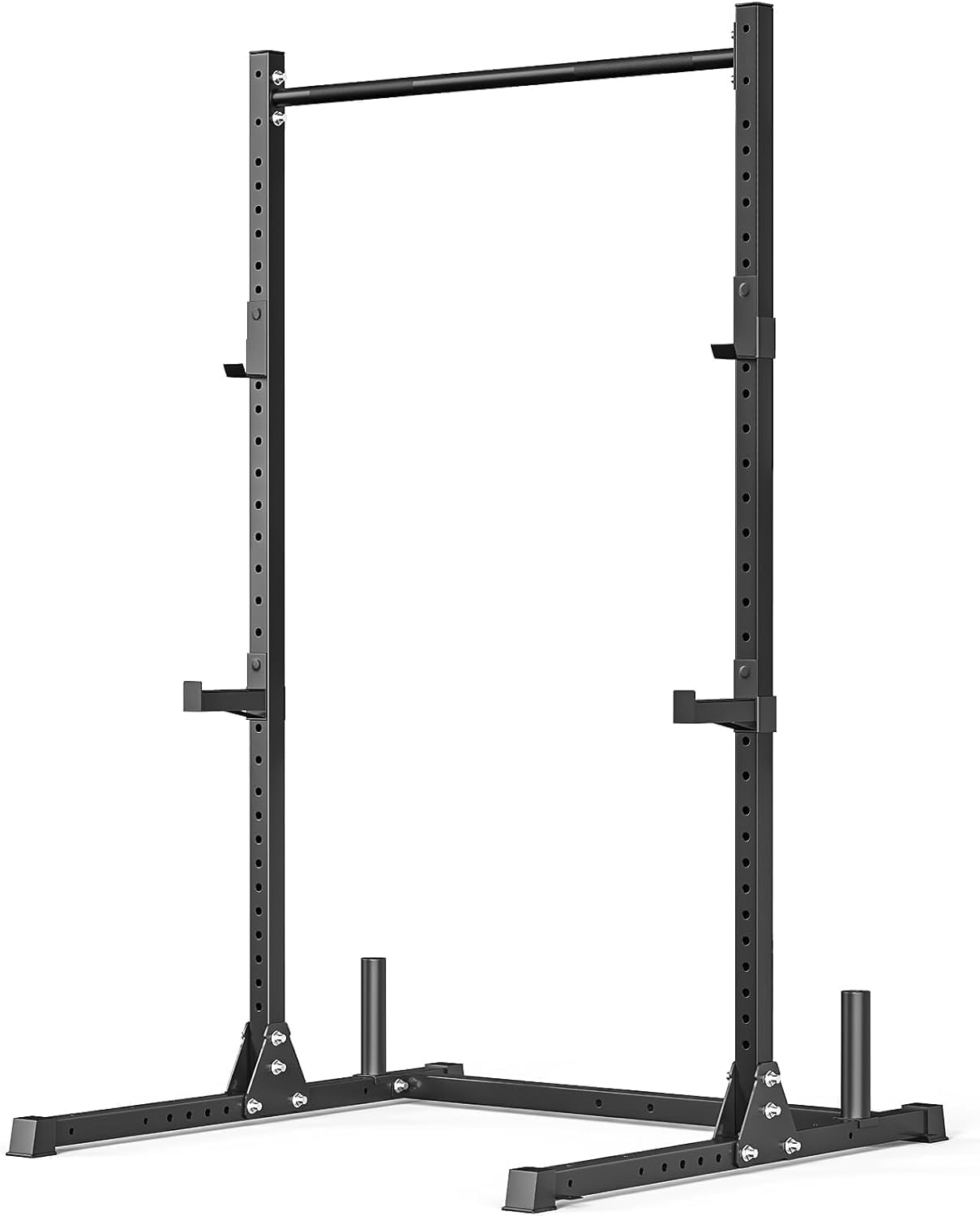
Nothing here comes with a bar, plates or a bench, and that's the honest way to read this cage: it's the frame, the safeties and a pull-up bar for less than any other cage we cover. What you get for it is 26 J-hook positions, more than most racks here, which means you can set the hooks within an inch of where you want them instead of picking between two holes.

The frame is 2x2 13-gauge steel, 47 by 48 inches on the floor and 82 inches tall, with a multi-grip pull-up bar across the top that sits above the bar path so squats and presses clear it. Wide, neutral and underhand grips come standard, which saves buying a separate pull-up bar for the garage wall.

Sixty-one pounds is the trade. This cage is light, and light means plates on the base or a bolt kit before you push heavy — the same advice that applies to every budget frame here. What we didn't expect at this price is how much of the layout matches the expensive cages: 26 holes, a real pair of safeties, and a pull-up bar that isn't an afterthought.

Pros

  • 26 J-hook height positions
  • Multi-grip pull-up bar across the top
  • 2x2 13-gauge steel frame
  • Cheapest cage in this guide

Cons

  • Short spotter arms limit catch room
  • Uprights join from two sections
Our verdict

The cheapest real cage here: safety bars, a multi-grip pull-up bar and 26 J-hook positions in a 61-pound frame.

Check Latest Price
8

Narrow Spaces

CANPA Multifunction Power Rack

89 /100
Trail Score Excellent

Key details

Weight Capacity
800 lb
Support Arm Holes
17 per side
Assembled Dimensions
43.03"D x 40.75"W x 85.71"H
Frame Height Settings
6
Check Price on Amazon

At 40.75 inches wide and 43 inches deep, this is the smallest full cage here — narrow enough for a basement corner that won't take the Sunny or the Sportsroyals. You still get a multi-grip pull-up bar, plate storage on the back, 17 hole positions per support arm and six height settings on the main frame, rated to 800 pounds.

What the width costs you is bench room. The space between the uprights is tight, and a wide grip puts your hands close to the J-hooks; pressing with the bar outside the frame, or with a narrower grip, works around it, but that's a workaround rather than a design.

Squats, overhead press, rows and pull-ups are where it's at home, and the plate storage doubles as ballast in a room where you can't drill the floor. The main frame's six settings are coarse, so set your working height with the 17-hole support arms and leave the frame alone once it's where you want it.

For a lifter in a small room working barbell basics, this is a good use of a corner, and the 800-pound rating is generous for the size. If bench press is your main lift, spend the extra on a wider cage — the narrow interior is the one thing that won't fix itself.

Pros

  • 40-inch width fits a small room
  • 17-hole support arms
  • Plate storage doubles as ballast
  • Multi-grip pull-up bar

Cons

  • Shakes when the bar is dropped on the safeties
Our verdict

A small-room cage for squats, presses and pull-ups; check your bench width before you plan to press inside it.

Check Latest Price

How We Tested Seven Squat Racks at Home

We started with a shortlist of more than 30 squat racks and narrowed it by footprint, ceiling-height requirements, weight capacity, price, and whether attachments and replacement parts were easy to source. That left seven racks we could realistically fit in a home gym, from folding wall-mounted styles to full power cages. I assembled each one mostly solo, timing the process and noting where the instructions stalled or a second person would have helped.

Then we trained in them for eight months. That meant squats, bench presses, overhead presses, and rack pulls with a loaded barbell, plus pull-ups from every bar. We watched for side-to-side sway, listened for rattles, and checked whether the rack shifted when we racked a heavy bar. We adjusted J-cups and safety arms at several heights, noting whether pins slid cleanly and stayed put under load.

We also moved each rack across concrete and rubber flooring when the garage needed to be a garage again, and we folded or broke down the ones that allowed it. Bolts were rechecked after the first week and again after a month; we looked at paint chips, weld quality, and hardware that stripped or loosened. Finally, we compared what came in the box against what had to be bought separately, because a lower sticker price can stop looking like value once you add safeties and a pull-up bar.

How to Choose a Squat Rack for a Home Gym

Cage, Half Rack, or Stands

Training alone is the whole reason safety arms matter. A power cage surrounds the bar, so a missed rep lands on the spotter arms at whatever height you set them; a half rack gives you the same arms with one open side; a pair of stands gives you nothing behind the bar at all. That difference decides how hard you can safely train without a spotter.

If you squat and bench solo, pay for a cage or a half rack. Our top pick is a full cage for exactly that reason, and the cheapest stands here are for lifters who already know they stop short of failure.

Measure the Ceiling Before the Floor

The racks here run from 82 to 87 inches tall, and the tallest needs close to seven and a half feet of clearance before you think about the bar path. Then add room for a chin-up: over an 87-inch frame you want more than eight feet.

Measure to the joists rather than the drywall between them, and look for a garage door track or a light fitting in the same space. Overhead pressing usually happens outside the cage, so leave standing room beside it.

Read the Weight Rating for What It Counts

One cage here quotes a combined figure that adds up its J-hooks, safeties, plate storage and pull-up bar; others quote a single bar load. Neither number is a test — it's a claim. Weigh it against the frame instead: steel gauge, upright size and the weight of the rack itself tell you more than the headline.

A 60-pound cage rated at 800 pounds and a 150-pound cage rated at 1,200 pounds are making different promises. If you drop the bar onto the safeties, stay well inside the lower rating.

Width, Bar, and Bench

Two fit questions decide whether a rack works with your equipment: the space between the uprights and the width your bar needs. A 7-foot Olympic bar takes up most of the interior; a 6-foot bar leaves room to spare, which is why adjustable-width racks earn a place here.

Then check the bench. Pressing inside the cage needs enough room for your hands outside the J-hooks, and the narrowest cage here is fine for squats and frustrating for wide-grip benching.

Bolting, Ballast, and the Floor Underneath

Almost every rack here can be bolted, and almost none has to be. Plate storage on the back plus a couple of bumpers on the pegs will settle a light cage, and that's usually the cheaper answer.

Where it sits matters as much as how it's fixed. A garage slab takes a bolted rack without complaint, while a second-floor wood frame is better served by rubber mats and spreading the load. If the rack walks when you re-rack, add ballast before you blame your technique.

Frequently Asked Questions

Final Verdict

The Sunny SF-XF9931 is the rack we point most home lifters to: spotter arms for solo training, a frame that stays put without drilling, and enough adjustment to fit a beginner and a lifter five years in. If the ceiling is low or the room is shared, the FLYBIRD SR1 does the same job with 4 fewer inches of height and 15 fewer pounds.

And if cable work is the reason you're building a gym at all, the Sportsroyals RK2 buys you a lat pulldown in the same footprint — no second machine, no bench shoved into the corner.