Best Pedometers for Walking of 2026

A pedometer is a tiny motion sensor with an opinion about your day. It feels a jolt, decides whether that jolt was a step, and adds it to a number you'll either trust or quietly argue with by lunchtime. That's the entire machine, which is why two devices that look nearly identical can land a thousand steps apart after the same walk. What a good one actually buys you is simpler than the feature list suggests: a number you stop second-guessing, so a trip around the block becomes two.

I've worn a clip-on pedometer on and off for years, mostly because I don't want another screen asking me to make an account. Over the past four months, my team and I walked, shopped, climbed stairs, and pushed strollers with 14 pedometers clipped to our waistbands, and the spread was wider than I expected. Size turned out to matter more than any spec sheet — the ones the size of a cracker got left in drawers. Here's what held up, from bare-bones clip-ons to app-connected trackers, and which ones earn their spot on your belt.

1

Best Overall

StepLify CR-837

84 /100
Trail Score Excellent

Key details

Carry
Detachable clip and lanyard
Power
USB rechargeable
Sensor
Tri-axis accelerometer
Display
1.3 inches
Check Price on Amazon

The plug is the detail that won us over. This counter charges from any USB port — a laptop, a wall adapter, the brick already sitting in the kitchen — so a walking routine never stalls because a button cell died on a Tuesday morning. That is the difference between a pedometer that gets worn every day and one that waits in a drawer for the next trip to the store.

Everything else is deliberately plain, and that is the part we like most. No app, no Bluetooth, no pairing, and nothing to configure: press the single button, hold it for five seconds when you want the count back at zero, and you have learned the whole interface. The 1.3-inch display uses big numerals that we read at a glance at waist height, and a backlight covers the after-dinner walk that starts at dusk in October. A detachable clip and a lanyard both come in the box, so the same unit rides a waistband on weekdays and hangs from a collar at the weekend.

We wore it three ways — clipped to a waistband, loose in a trouser pocket, and on the lanyard — and the count followed our walking rather than our typing. A tri-axis sensor with a movement filter is standard equipment in this group; what impressed us is that the simplicity costs you nothing in normal use. Plan for the cable, though: a button-cell unit can be left alone for a year, and this one has to go on the charger eventually. If you already plug in a phone every night, that is a habit you have rather than a chore you are taking on.

Pros

  • Recharges over USB, so no button cells to buy
  • Ready to use with no setup, app, or pairing
  • Backlit digits readable at waist height
  • Clip and lanyard cover waist, pocket, or neck

Cons

  • Steps only: no distance or calorie readout
Our verdict

Our default for everyday walking: one button, no app, no battery shopping, and a backlight for the evenings when you finally get out.

Check Latest Price
2

Best for Extra Metrics

Realalt 3DTriSport

82 /100
Trail Score Excellent

Key details

Carry
Waist clip and lanyard
Display
1.7 inches
Warranty
18 months
Battery Life
12 months
Check Price on Amazon

Where our top pick counts steps and stops there, the 3DTriSport keeps distance, calories, and elapsed time as well. That is the difference between knowing you walked and knowing how far, and for anyone building a routine the distance figure is the one that makes a target mean something. You enter your stride length and weight once so the conversions are not guesswork; after that the numbers are there when you want them.

The hardware is built for a long stay. Battery life is listed at 12 months on a CR2032, and there is a mini screwdriver in the box for the battery door — a small touch we appreciated, because it turns a swap into a two-minute job instead of a hunt through the junk drawer. The 18-month warranty is longer than most of the picks here carry.

For a walker who likes to see the numbers stack up, this is the one we point to: the extra metrics and the long coverage justify the step up in price from the plain counters. Setup is the tax. You enter stride, weight, and time, the unit wants each entry made within a few seconds of the last, and the menu text is small work on a 1.7-inch screen — do it once at the kitchen table with the manual open and you never touch it again.

A waist clip and a lanyard are both in the box. On jeans the clip is fine; on a light shirt or a waistband with no body to it we use the lanyard, which is the more secure of the two over a long walk.

Pros

  • Adds distance, calories, and elapsed time
  • 12-month battery with a screwdriver included
  • 18-month manufacturer warranty
  • Waist clip and lanyard both included

Cons

  • Step totals can drift from a hand count
Our verdict

We point walkers who want distance and calories alongside the step count here — the one-time setup is the trade for the extra numbers.

Check Latest Price
3

Best for Aerobic Data

Omron HJ-720ITC

85 /100
Trail Score Excellent

Key details

Tracks
Steps, aerobic steps and minutes, calories, distance
Battery
1 CR2 (included)
History
7 days
Aerobic Threshold
10 continuous minutes
Check Price on Amazon

Most counters treat a shuffle to the kitchen and a brisk twenty-minute loop as identical. The HJ-720ITC splits them: it counts aerobic steps and minutes separately — the ones taken in stretches of 10 continuous minutes or more — and holds seven days of history so a week's pattern is visible on the device itself.

That split is the reason to spend more here. A daily total tells you that you moved; the aerobic figure tells you whether any of it was the kind of walking that raises your heart rate, and over a month those two numbers tell very different stories. We also like that the history lives on the unit, so a bad week is visible without opening a computer.

The bundled desktop software is the weak link. It is a program that can be choppy to use, and we treated it as optional: the charts are pleasant if you want a month in one view, but the daily count does not need it. It does show the unit's age, which is not surprising for a design this established. What you are paying for is the aerobic split and the stored week, and nothing else in this guide does either.

Pros

  • Separates aerobic steps taken in 10-minute blocks
  • Seven days of history kept on the device
  • Accuracy and step tracking read strongly
  • Motivates a daily walking target

Cons

  • Belt clip can come loose from a waistband
  • Priciest pick in this guide
Our verdict

We think the extra outlay is worth it if you want to know how much of your walking was brisk: it splits aerobic minutes from everyday steps and keeps a week of both.

Check Latest Price
4

Best Budget Pick

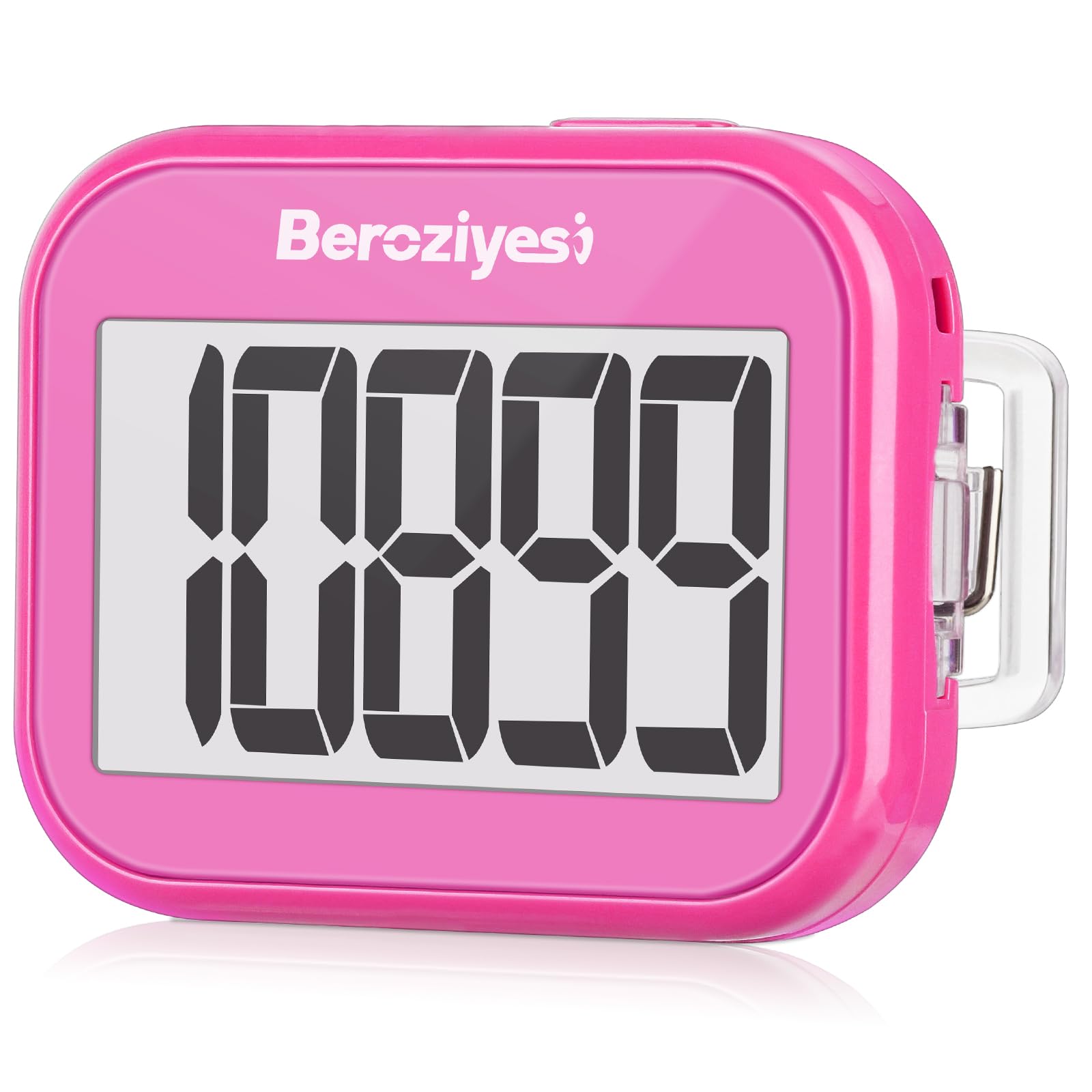
Beroziyesi Bero-P03

83 /100
Trail Score Excellent

Key details

Carry
Removable clip and lanyard
Weight
0.95 oz
Battery
CR2032, 6-12 months
Display
1.73 inches
Check Price on Amazon

The screen is what makes this one worth handing to someone. At 1.73 inches it is the largest display in this guide, and the digits fill it. That matters more than it sounds, because a step count gets read at waist height, at arm's length, while you are moving — on this unit you glance down and the number is simply there, with no squinting and no lifting it up to your face.

Everything else is basic in the way a budget counter should be. No app, no setup, no pairing; it counts to 99,999, so a long week of walking will not roll it over; and it sleeps after two minutes of stillness and wakes when you move again. At 27 grams, with a removable clip and a lanyard, it disappears on a waistband or a collar, and the CR2032 is listed at six to twelve months, so battery changes are rare enough to forget.

The clip holds better than the plastic body suggests, which is the thing we noticed first — a counter that falls off is a counter you stop trusting, and this one stayed put through a morning of errands. It is also the one we can hand to a grandparent or a kid with no explanation at all, and on a device whose whole job is being glanced at, that counts for more than any extra feature.

Pros

  • Largest display here at 1.73 inches
  • Strong clip that stays on clothing
  • Counts to 99,999 without rolling over
  • Light 27-gram body with clip and lanyard

Cons

  • Totals can read high or low depending on the walk
Our verdict

Our budget pick: the biggest digits in this group, a clip that holds, and a plain step count for the least money here.

Check Latest Price
5

Evening Walks

AVTREK 3D Step Counter

82 /100
Trail Score Excellent

Key details

Weight
1.06 oz
Battery
CR2032, about 1 year
Display
1.57 inches
Backlight
Automatic, 6 p.m. to 6 a.m.
Check Price on Amazon

Walk after dark and this is the counter that behaves. Press the side button between 6 p.m. and 6 a.m. and the display lights up on its own: no hunting for a backlight control with gloves on, no tilting it toward a streetlamp. The digits are oversized on a 1.57-inch screen, and a single press gives you the time of day as well as the step count.

It weighs 30 grams and runs on a Maxell CR2032 listed at roughly a year of use at eight hours a day, which is the sort of battery life that means you will lose the manual before you need it. The 10-step error correction is the same approach used across this group: short bursts of hand movement get filtered rather than banked as steps.

The lighting window is the catch, and it is a small one. The light runs from 6 p.m. to 6 a.m., so a 5:30 start on a January morning is the one walk where you will be squinting at your own waistband. For the after-work and after-dinner walks that most winter walking actually consists of, this is the one we pick up.

Pros

  • Backlight switches on automatically after 6 p.m.
  • About a year on one CR2032
  • Shows time as well as steps
  • Light 30-gram body with big numerals

Cons

  • Small, awkwardly placed buttons
  • Clip is the weakest part of the build
Our verdict

We reach for this one on evening walks — the backlight comes on by itself after 6 p.m., the digits are big, and one battery covers about a year.

Check Latest Price
6

Belt-Loop Carry

U-Trak 701W

80 /100
Trail Score Excellent

Key details

Carry
Clip and spring carabiner
Weight
1.06 oz
Warranty
2 years
Auto-sleep
After 1 minute
Check Price on Amazon

Clips get lost; carabiners don't. That is the case for the U-Trak in one line — a spring gate hooks over a belt loop, a tote strap, or a lanyard ring and hangs outside your clothes, where the count is visible without digging. We found the mount changes how often you look at the thing, and looking is most of what a pedometer is for.

It is 30 grams, it sleeps after a minute of stillness, and it screens out short bursts of motion with a 10-step error-prevention rule, the same tri-axis approach as everything else here. The clip comes off, so the same unit can hang carabiner-first on a walk and sit in a pocket on a workday. Two years of manufacturer coverage is the longest in this guide, which is unusual on a device at this end of the price range.

The plain clip is the weak mount: on smooth fabric it can slide, and that is how these end up lost, so leave the carabiner attached and hook it to something that will not give. Read the number as a rough guide rather than a ledger and this remains the easiest of the budget counters to keep with you, because it hangs where you can see it.

Pros

  • Spring carabiner hangs outside your clothes
  • Two-year manufacturer warranty
  • One-minute auto-sleep saves the cell
  • 10-step error prevention filters stray movement

Cons

  • Step totals can run high or low
Our verdict

We like the carabiner best: hook it on a belt loop or a bag strap and the count hangs where you can see it, with a two-year warranty behind it.

Check Latest Price

How We Tested 14 Pedometers on Real Walks

We started with a shortlist of about 40 pedometers — bare-bones clip-ons, wrist-worn trackers, and a few app-connected models — and cut it down by reading specs and customer reviews for what actually ends a pedometer's life: a belt clip that pops off, a setup that needs a manual before your first walk, software that loses a day of data. That left 14, which we wore for four months, usually two at a time.

Setup came first. I unboxed each one and timed how long it took to get a first step count, noting whether it needed an app, a stride-length measurement, or a manual reset every morning. For accuracy, we counted 500 steps by hand on a measured loop and compared, then watched what happened during non-walking jolts — a bus ride, a stroller push, folding laundry.

Everyday scenes did most of the judging. We clipped them to waistbands and belts for dog walks, grocery runs, and stairwells, and deliberately wore a couple loose to see whether they stayed put and kept counting. Size and clip strength came down to whether we forgot we had them on and whether they survived getting in and out of a car. App-connected models got a separate check: did the software sync without prompting, keep a month of history, and not quietly reset at midnight?

Reliability and value got the last word — which ones needed a battery change, which held their count after a drop in the parking lot, and which we still reached for in month four. A steady number and a clip that holds beat a longer feature list every time.

How to Choose a Pedometer for Walking

Start With How You'll Carry It

Clip, lanyard, carabiner, or pocket: pick one and stay with it. These units use tri-axis sensors that count in any orientation, so no position is wrong, but a counter that migrates between a waistband, a handbag, and a coat pocket gives you numbers you can't compare from week to week.

Mounts that hang outside your clothes get checked more often than one buried in a pocket, which is the quiet argument for the U-Trak's carabiner. Check the clip against the fabric you actually wear, too. A plastic clip grips denim far better than it grips smooth activewear, and that is how these get lost.

Steps Alone, or Steps Plus Distance and Calories

A steps-only counter has nothing to configure and nothing to get wrong; the StepLify CR-837 is that idea done properly. The moment a unit adds distance and calories, it needs your stride length and weight, and that is where the fiddly half of setup lives.

Take the extra metrics only if you'll use them. Distance is genuinely useful for planning a route or pacing a daily loop. A calorie figure derived from step count is a rough estimate at best, so don't pay extra for that number alone.

Battery: A Cable or a Coin Cell

Two designs, two habits. USB charging means no battery shopping and no tiny screwdriver, but it puts one more thing on the charger, which is the trade the CR-837 makes. A coin cell is listed at anywhere from six months to a year across this group, so a long-life cell is something you can genuinely forget about.

Match the power source to your patience rather than to the bigger number. If a cable already lives by your bed, rechargeable is no burden at all; if the pedometer lives in a coat pocket for months at a time, buy the cell.

Readability, and Walking After Dark

Screens here run from 1 inch to 1.73 inches, but the measurement that decides your experience is the height of the digits, because you read this at arm's length from your waist while moving. The Beroziyesi's 1.73-inch display is the most legible in this set for exactly that reason.

If your walks fall at either end of the day, look for a backlight and check when it operates. The AVTREK lights automatically from 6 p.m. to 6 a.m., which covers a winter evening but leaves a pre-dawn start in the dark.

Check the Count Against Your Own Stride

Every unit here pairs a tri-axis accelerometer with a filter that ignores short bursts of movement, and none of them will match a hand count exactly; gait, carry position, and pace all push the number around. That is a property of the category, not a fault in any one pick.

Run your own check before you trust a daily total: count 100 steps at your normal pace, then read the display. A gap of a few steps compounds across a day of walking, and if the number is far out, change where you carry the unit before you blame the device.

Frequently Asked Questions

Final Verdict

For a daily walking habit and one number to chase, the StepLify CR-837 is the pick we hand over: no app, no setup, no battery shopping, and a backlight for the evenings when the walk finally happens. It asks nothing of you, which is why it gets worn.

Spend more only for a specific job. Choose the Realalt 3DTriSport if you want distance and calories, or the Omron HJ-720ITC if you want to know how much of your walking was brisk enough to count as aerobic. For everyone else, the plain version is the right one.