Best Pedometers for Seniors of 2026

A pedometer should be the least demanding gadget in the house: clip it on in the morning, walk, glance down, done. Yet the category finds endless ways to complicate itself, with setup menus, companion apps, and a sync routine you have to repeat every time you want a number. For anyone with stiff fingers or a pair of reading glasses parked by the door, the small details become the whole experience, which means a display you can read without squinting, a clip that stays on a waistband through a full day, and a reset you can work with one thumb. The right one hands you a single number you can trust, then stays out of your way.

I've become the unofficial tech support for my parents and an uncle, which is how 14 pedometers ended up spread across my kitchen counter this spring. Over four months of walking with them, one piece of wisdom held up: no pedometer counts every step perfectly, and a counter that stays consistent from Tuesday to Saturday is worth more than one that nails a single mile. The ones that made the cut all got the basics right.

1

Best Overall

Beroziyesi 3D Pedometer

83 /100
Trail Score Excellent

Key details

Display
1.7 inches
Battery Life
6 months
Step Capacity
99,999 steps
Carrying Options
Clip and lanyard
Check Price on Amazon

A lot of senior-friendly pedometers claim to be simple; this one behaves that way from the moment the battery tab comes out. There is no app, no pairing, no account, and no menu to learn. You can clip it to a waistband or hang it from the lanyard, then use a single button when you want to clear the count. That is the whole routine.

That stripped-back approach is why it earns our top spot for most buyers. The 1.7-inch display is big enough to read at a glance, and the count goes up to 99,999 steps, so it will not roll over during a long day. We clipped it on and forgot it was there; at 27 grams, it does not tug at a waistband or swing heavily from a lanyard. We also appreciate the deliberate press-and-hold reset, which is harder to trigger by accident than a quick tap.

The restraint is the point. This is a step counter, not a dashboard: no distance, no calories, and no extra metrics to cycle through. If you want to compare Tuesday with last Tuesday, the Realalt is the better fit, and its 30-day memory is the reason we keep it in the group. For the reader who just wants today's number, fewer screens mean fewer things to explain, forget, or accidentally change. That is the version of simplicity we keep coming back to.

Pros

  • No app, pairing, or setup
  • Large 1.7-inch display
  • Clip and lanyard included
  • Counts up to 99,999 steps

Cons

  • Step totals can drift from a hand count
Our verdict

For the senior who wants a readable daily step count without a phone or app, this is the one we recommend first.

Check Latest Price
2

Best for Tracking Progress

Realalt 3DTriSport Pedometer

82 /100
Trail Score Excellent

Key details

Display
1.7 inches
Step Memory
30 days
Battery Life
12 months
Carrying Options
Waist clip and lanyard
Check Price on Amazon

The feature that separates this from our top pick is memory. The Realalt keeps 30 days of steps, distance, calories and activity time, and it puts a clock on the same little screen. If you like to look back at a good week or notice that a bad stretch is becoming a habit, that record is the reason to choose it.

The first five minutes are the least pleasant part. You have to enter stride length and set the time, and the setup prompts are more cramped than the main step display. We took it slowly with the manual and the video link, and after that the day-to-day operation settles into a button press. The 1.7-inch main display is clear, and the waist clip and lanyard give you two ways to carry it.

We rate it the best of this group for the walker who wants a month of context, not just a number at the end of the day. The 12-month battery is a genuine convenience, and the 30-day history is unusual among the simple clip-ons here. It is also the pick we point to when someone wants distance and calorie estimates alongside steps. The trade-off is that it asks more of you up front; if setup is the part that makes a device feel like work, the Beroziyesi is the easier start.

Pros

  • Keeps 30 days of step history
  • Tracks distance, calories and activity time
  • One-year battery
  • Waist clip and lanyard included

Cons

  • Setup requires stride and clock entries
  • Clip grip can feel less secure
Our verdict

Choose this if you want to review a month of walks, not just today's count; the extra memory is worth the more involved setup.

Check Latest Price
3

Best Ultralight Clip-On

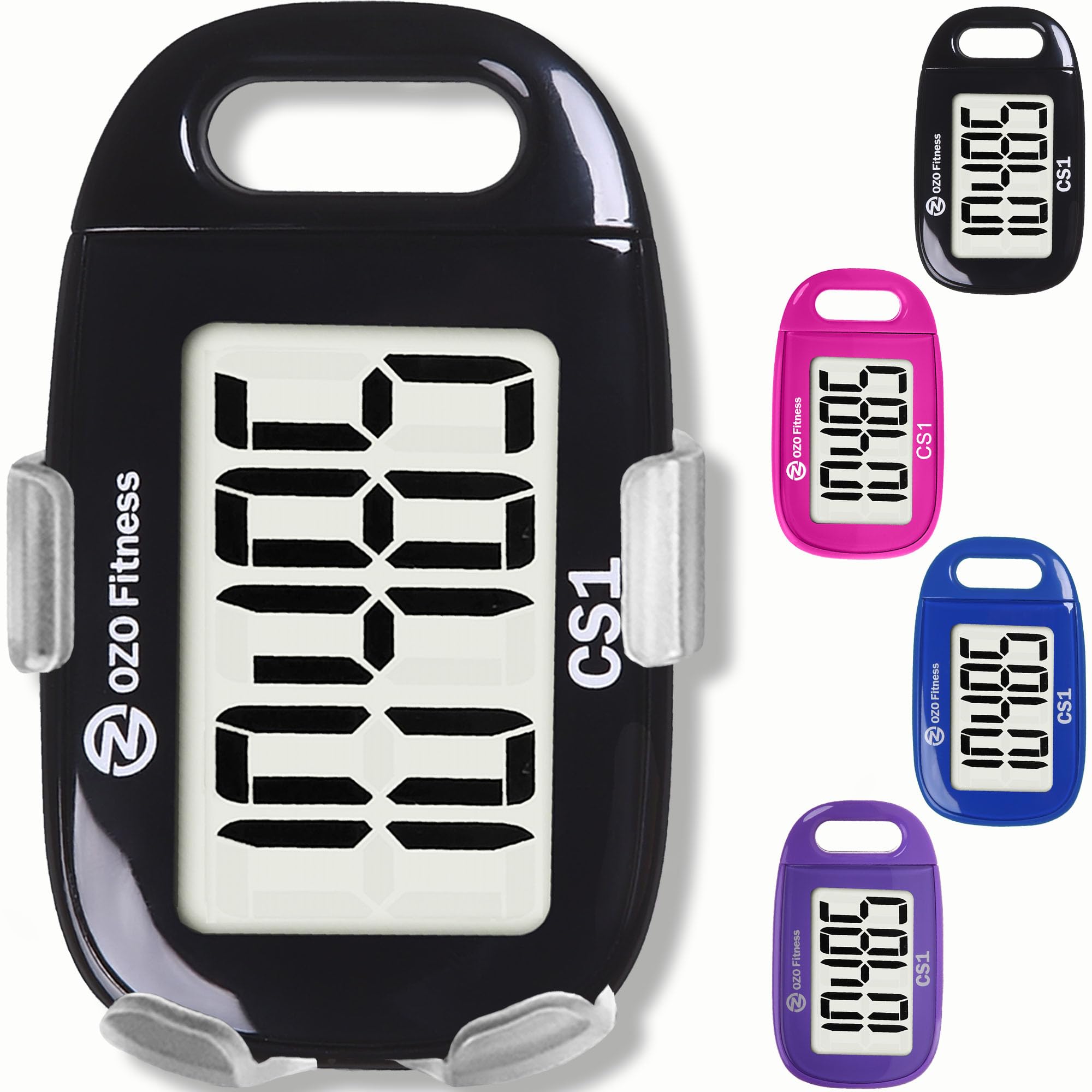
OZO Fitness Clip-On Pedometer

85 /100
Trail Score Excellent

Key details

Weight
0.78 oz
Display
1.5 inches
Battery Life
365 days
Carrying Options
Clip and lanyard
Check Price on Amazon

At 22 grams, this is the one that disappears. We clipped it to a waistband and also tried the lanyard, and it was easy to forget either way. Setup takes seconds, and there is no phone or app in the loop. For all-day wear, that lightness is the feature we appreciated most.

The 1.5-inch display uses high-contrast numerals, and the shell is built to handle pocket life and the occasional knock. The battery is rated for 365 days, so it is a once-a-year errand rather than a weekly charge. We also like that the clip and lanyard both come in the box; it means the same pedometer can move from a waistband on a walk to a bag on a shopping trip.

The caveat is the count itself. Step totals can drift from a hand count, especially when the device is worn loosely or shifted around, so we use it as a consistent daily target rather than a perfect tally. That is a fair trade for a pedometer this light and this easy to keep on. If you want the most detailed record, look at the Realalt instead; if you want the least noticeable thing on your waist, this is the one.

Pros

  • 22-gram body disappears on a waistband
  • One-year battery
  • Clip and lanyard included
  • High-contrast display

Cons

  • Daily reset is manual
Our verdict

For an all-day clip you will forget you are wearing, this is our pick; just expect a useful trend, not a perfectly exact step tally.

Check Latest Price
4

Best Rechargeable

StepLify CR-837 Pedometer

84 /100
Trail Score Excellent

Key details

Display
1.3 inches
Charging
USB
Backlight
Yes
Carrying Options
Clip and lanyard
Check Price on Amazon

The USB plug is the first thing that makes this one different. Instead of hunting for a coin battery, you charge it like a small gadget. It also has a backlight, which matters more than it sounds if you walk before sunrise or after dinner. The rest of the routine is deliberately plain: no setup, no Bluetooth, and one button to reset.

We think it is the best fit here for low-light walking. The 1.3-inch display keeps the body compact, and the numbers are large within it; the backlight makes the count readable when the light drops. We also appreciate the choice of clip or lanyard, so it can ride on a waistband, a pocket, or around the neck. For someone who already keeps a phone cable by the kitchen counter, the charging routine is easy to absorb.

What you give up is context. This one counts steps and nothing else, so there is no distance, calorie, or extra metric to flip through. That makes it a poor fit for a data-minded walker and a very good fit for someone who wants one number and no decisions.

Pros

  • USB rechargeable, no coin battery
  • Backlit display for low light
  • No setup or Bluetooth
  • Clip and lanyard included

Cons

  • 1.3-inch screen is small at a distance
  • Needs a USB charge instead of a battery
Our verdict

If you walk in low light and prefer plugging in to changing batteries, this simple, backlit counter is the one we point to.

Check Latest Price
5

Best Watch-Style

Stiive Pedometer Watch

80 /100
Trail Score Excellent

Key details

Display
1.85 inches
Battery Life
14 days
Standalone Use
No app or phone
Water Resistance
IP68
Check Price on Amazon

If clipping something to a waistband feels like one more thing to remember, this is the watch-shaped answer. The Stiive puts the step count on your wrist, where you can check it without reaching for a pocket. The 1.85-inch screen is the largest display in this group, and the larger type makes the daily number easy to find.

The basic tracking works without an app or phone, which is the part that matters for a senior who does not want to sync anything. It also tracks heart rate, stress and blood oxygen, and it adds sleep data and multiple workout modes. The 14-day battery and IP68 water resistance make it a low-maintenance watch; we did not have to think about charging it every night.

We included it for the reader who will actually wear a watch, and it earns that place because it combines a readable screen with a battery that lasts long enough to forget. The extra screens are the trade-off. There is more to cycle through than on a one-button clip, and the app unlocks features that the watch does not show on its own. If you only want steps, the Beroziyesi is simpler; if you will actually wear a watch, this one is easier to keep on.

Pros

  • Large 1.85-inch display
  • Works without an app or phone
  • Up to 14 days per charge
  • IP68 water resistance

Cons

  • More screens to learn than a clip-on
  • App-only features add complexity
Our verdict

For someone who will wear a watch every day, this is our pick: a big screen, no phone required, and a two-week battery.

Check Latest Price

How We Tested 14 Pedometers Over Four Months

We built the shortlist by filtering for what this category actually needs: models that work with no app, no phone, and no account, then narrowed by display height, button count, battery type (replaceable coin cell versus USB charging), and whether they clip, hang from a lanyard, or slip in a pocket. Fourteen units came home with us, spanning simple one-button counters to backlit models with strap mounts.

Testing happened where walking happens. Each unit rode a waistband through morning laps of the neighborhood, grocery runs, physical therapy appointments, gardening, and a week-long trip to visit grandchildren. To check accuracy, we wore two at a time on the same waistband over a hand-counted 1,000-step loop at a rec center track, then repeated the loop on grass, up stairs, and while pushing a shopping cart, noting which units drifted high and which came up short. We also logged false steps during car rides and while seated, and compared week-one readings against week-twelve readings on the same route to see whether the count held steady or wandered.

For setup, we handed each pedometer to my dad, 74, cold, with no instructions, and timed how long it took him to reach a step count, counting every button press along the way and noting whether he accidentally landed in a mode he couldn't leave. Readability got checked in a dim hallway, in direct afternoon sun, and through progressive lenses. Clips were hooked to waistbands, robe pockets, and belt loops, then subjected to sitting, standing, getting in and out of a car, and an afternoon of yard work, and we flagged any that slid off or flipped over. Reset was tested with a thumb alone. Finally, we weighed price against whether the thing genuinely replaced a phone app, since a cheap pedometer you abandon is no bargain.

How to Choose a Pedometer for Seniors

Decide whether you want a watch or a clip

A clip or lanyard keeps the wrist free and puts the sensor near the hip. A watch is easier to glance at and harder to leave in a pocket. The question that matters is which one the person will actually put on every morning.

We lean toward a simple clip for a first pedometer because there is no strap, charger, or app to manage. A watch makes sense for someone already used to wearing one. The Beroziyesi and OZO cover the low-fuss clip role here, while the Stiive is the watch-shaped option.

Read the display from where you will stand

A large step number is not the same as a readable whole screen. On multi-stat models, the step count may be big while the setup labels are tiny. Check the number at the distance you will use it: waist height for a clip, wrist length for a watch.

We put more weight on the main step count than on the smallest menu text. A high-contrast 1.5- to 1.7-inch screen works well for a clip; a watch needs a bigger face, like the 1.85-inch Stiive, because you read it at a glance.

Choose an attachment you trust

A clip is only useful if it stays on. Waistband clips are easy to knock off when you sit or get into a car; a lanyard keeps the pedometer inside a shirt but can swing. We prefer a model with both options so you can change with the day.

For someone who walks with a walker, clip the device to a waistband or pocket rather than the walker frame, so it moves with the body. A watch solves the attachment question entirely, as long as the strap is comfortable enough to forget.

Check accuracy with a simple test

A three-axis sensor counts steps from body movement, so a loose clip, a shuffling gait, or a device that swings can change the total. Before you trust a new pedometer, count 100 steps yourself and compare. If the gap is large, move it to a waistband or pocket and try again.

Some models wait for 10 continuous steps before counting. That helps filter out fidgeting, but it does not make the total exact. Use one device consistently and watch the daily trend rather than expecting a perfect tally.

Match the battery and memory to your routine

A coin-cell pedometer that runs six to twelve months is the least demanding choice: no cable, no charging routine. A USB-rechargeable model adds a cable but can bring a backlight. We prefer the coin cell for someone who will not keep track of a charger, and the rechargeable StepLify for a walker who wants a lit display.

Memory is the other fork. A simple counter gives you today's number and nothing else; a model with 30-day memory, like the Realalt, lets you review a month. Decide whether you want a number or a record before you pay for extra screens.

Frequently Asked Questions

Final Verdict

Start with the Beroziyesi if the goal is a readable daily step count without a phone, app, or menu. It is the simplest of these to live with, and the large screen and one-button routine suit the person who wants fewer decisions, not more data.

If you want a month of history, the Realalt earns the upgrade; if a wristwatch is the only thing you will keep on, the Stiive is the better shape for the habit.