Best OTC Hearing Aids of 2026

Over-the-counter hearing aids have made mild-to-moderate hearing loss easier to address without a prescription or an audiologist. But the category is young, and listing claims often overstate real-world performance, especially around silencing background noise. A spec sheet tells you little about how an aid performs at a family dinner or on a busy street.

This guide sorts the aids that genuinely hold up in daily conversation from those leaning on inflated ratings. Because the OTC category is still new, a handful of listings carry stars earned by unrelated products. Match a device to where you actually listen — a quiet den or a crowded restaurant — and the sound you get back is the proof that matters.

Fit and charging convenience matter as much as amplification. The aid you will actually wear daily is the one that keeps conversations effortless, so ear-tip selection and battery reliability deserve your attention.

1

Best Overall

EarCentric EasyCharge

86 /100
Trail Score Excellent

Key details

Battery Life
12 days total
Fit & Comfort
Multiple domes, tubes
Clarity In Noise
Environmental noise cancel
Check Price on Amazon

The EarCentric EasyCharge has one dominant strength: it makes everyday conversation plainly easier to follow. Its owner community is the largest in this comparison, and the praise centers on exactly what an adult with mild-to-moderate loss wants — grandchildren's chatter, a partner's low voice, and live TV dialogue no longer blur together. The default tuning brings human speech forward without flattening the whole soundscape, which is what separates a genuine hearing device from a simple volume booster.

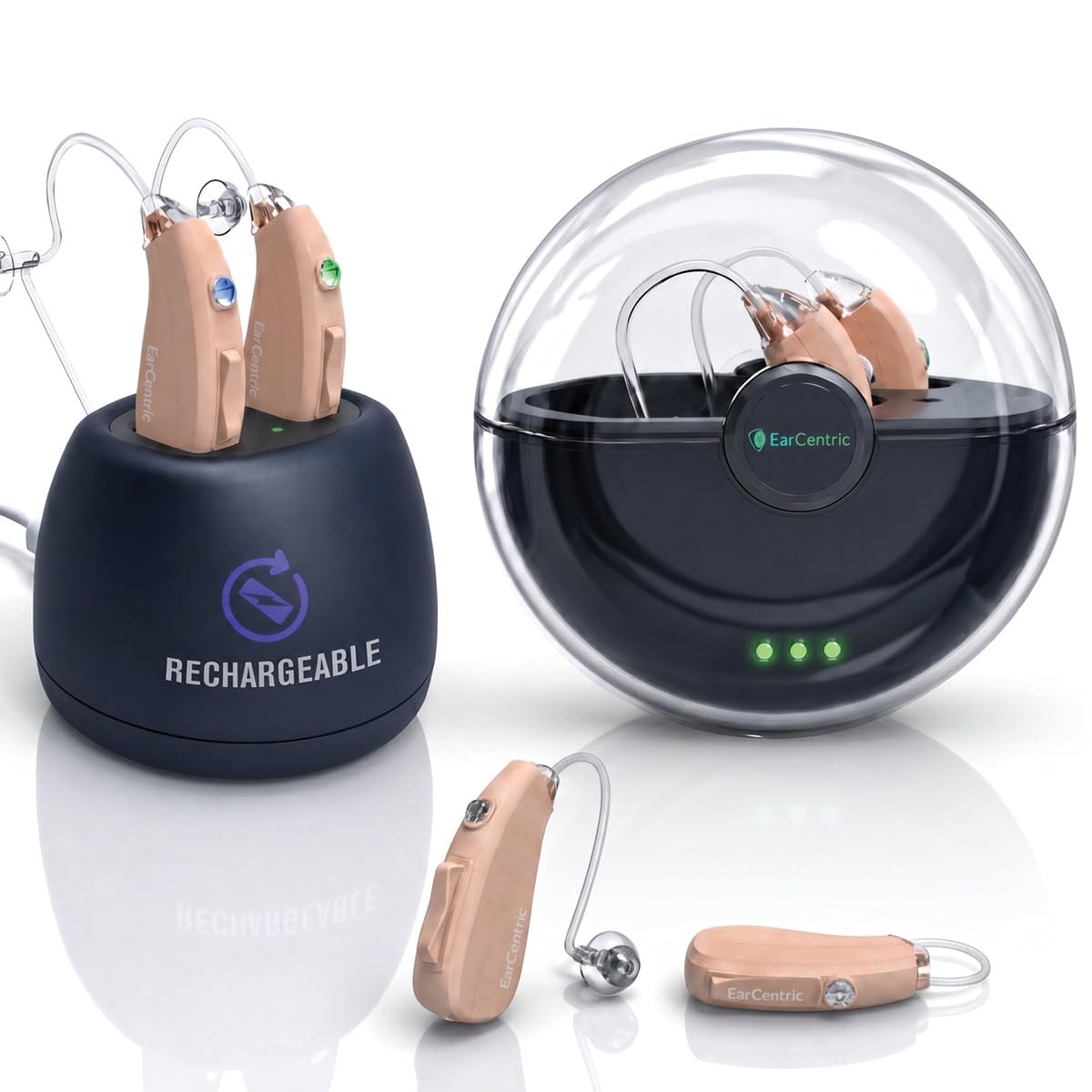
The behind-the-ear form factor is a practical match for this audience. A selection of soft domes and tube lengths lets each wearer settle into a comfortable seal, and because the module rests behind the ear rather than inside the canal, it stays put through a full day of talking, turning your head, and wearing glasses. The charging arrangement is unusually forgiving: a desktop dock tops up the aids, and a pocket-sized case carries enough stored power to keep the pair working for roughly twelve days between wall-outlet sessions.

This is best aimed at the older adult with mild-to-moderate hearing loss who wants proven output, a secure fit, and no app tinkering. The straightforward controls and long battery reserve suit someone who wants to lift the aids out of the charger in the morning and not revisit them until bedtime. Those who want a discreet in-canal look will not find it here; the visible behind-the-ear body is a boundary to accept before buying.

Background noise is not this device's strength, and it is worth stating plainly. In a crowded reception or a busy street, ambient sound still travels through the microphones alongside the voice you are listening to; active separation of speech from noise belongs instead to the higher-priced premium selections in this comparison. For the person who listens mainly at home, in quiet restaurants, at doctor visits, and on neighborhood walks, that limitation rarely intrudes — and the residual benefit in returning to live conversation outweighs it.

💡 null

Pros

  • Brings voices forward clearly, making family dinners, TV dialogue, and daily talk easier to follow.
  • Charging case plus desktop dock extends runtime to roughly 12 days without a wall outlet.
  • Comfortable behind-the-ear fit holds steady through a full day, even under glasses.
  • Owners notice a real improvement in everyday situations like gatherings and outdoor walks.

Cons

  • In a crowded room or windy street, ambient sound can stay audible alongside the speaker.
Our verdict

For a straightforward OTC that restores everyday conversation without app fuss, this is the safest default in the set — the noise limitation is predictable rather than a flaw, and it appears only where you are already competing with a room full of voices.

Check Latest Price
2

Best Budget Choice

Flaygo Hearing Aids

80 /100
Trail Score Excellent

Key details

Battery Life
12h, 80h case
Fit & Comfort
Behind-the-ear
Clarity In Noise
Digital noise reduction
Check Price on Amazon

A one-button design that leaves the phone out entirely: Flaygo's 16-channel processing keeps everyday conversation crisp enough that speakers do not need to repeat themselves. The behind-the-ear shell is slim enough to forget during all-day wear, and one charge covers a day of listening, with the case adding roughly a week of casual use before an outlet is needed.

Best for budget-conscious first-time wearers managing mild hearing loss who value a no-app routine: volume is limited to four broad steps, so precise loudness matching is impossible, but a listener who locks one comfortable level into daily wear rarely hits that wall. It is not for those expecting Bluetooth streaming or app-based audio tailoring, which belong to higher-priced models.

The noise-reduction label oversells street reality: inside a busy café or busy restaurant, ambient chatter still competes with conversation despite the modest signal processing. Around the house and in one-on-one chats that limitation rarely surfaces, which makes Flaygo a living-room companion rather than a restaurant regular — its limits stay predictable, and its value holds.

Pros

  • Lifts everyday conversation to a clear, natural level so family members do not have to strain.
  • Slim behind-the-ear shell stays light enough for long stretches of daily wear.
  • One charge covers a day of use, with the case adding roughly a week between charges.
  • Budget pricing delivers practical amplification without an app or ongoing costs.

Cons

  • Inside a busy café, background chatter can still compete with conversation despite the noise-reduction label.
  • The four volume steps are broad, so a preferred loudness may sit between settings.
Our verdict

As a low-commitment first hearing aid, Flaygo covers clear conversation, comfort, and easy recharge with nothing extra to learn.

Check Latest Price
3

Best for App Control & Bluetooth

ELEHEAR-Beyond Hearing

81 /100
Trail Score Excellent

Key details

Battery Life
20h, 100h case
Fit & Comfort
Nine dome sizes
Clarity In Noise
AI noise cancellation
Check Price on Amazon

The only model here that directs its microphones: pivot pickup toward a partner across the table or open to a full 360-degree room, with real-time frequency and mode adjustment through one clean phone app. Conversation boost approaches what devices costing twice as much produce, and control over the soundstage makes that gain deliberate rather than accidental.

This pick rewards the app-fluent senior who would otherwise graduate to custom-fit hearing aids — one happy to invest an evening mapping presets to living room, dining, and car. A buyer requesting set-and-forget will instead find default tone on the thin side with possible echoes in some rooms, and instances of charging quitting after weeks have occurred on the listing, so testing within the return window is worth planning for.

All-day stamina follows through: each charge powers nearly 20 hours of listening, the pocket case extends that to roughly 100 hours for trips, and nine dome sizes help lock a comfortable seal. Bluetooth coverage reaches about 40 feet, so podcasts and calls keep streaming as the wearer moves from the sofa to the kitchen.

💡 When voices sound hollow, nudge the app's presence slider and step through environment presets across the first listening sessions before deciding.

Pros

  • Conversation boost approaches what custom-fitted aids costing twice the price deliver.
  • Directional pickup and frequency sliders in one app tailor sound to each room.
  • Bluetooth streams calls and audio steadily out to roughly 40 feet.

Cons

  • Speech can emerge hollow or echoey straight out of the default tuning.
  • Charging may stop holding a full day's power after several weeks on select packs.
Our verdict

The ELEHEAR-Beyond turns amplification into something the wearer aims and refines — a tailored fit for seniors who enjoy an evening of curation. Simpler listeners will get more from the EarCentric's hands-off operation.

Check Latest Price
4

Best for Premium Features

Audien Ion Pro 2

76 /100
Trail Score Very Good

Key details

Battery Life
16h, 48h case
Fit & Comfort
Behind-the-ear
Clarity In Noise
—
Check Price on Amazon

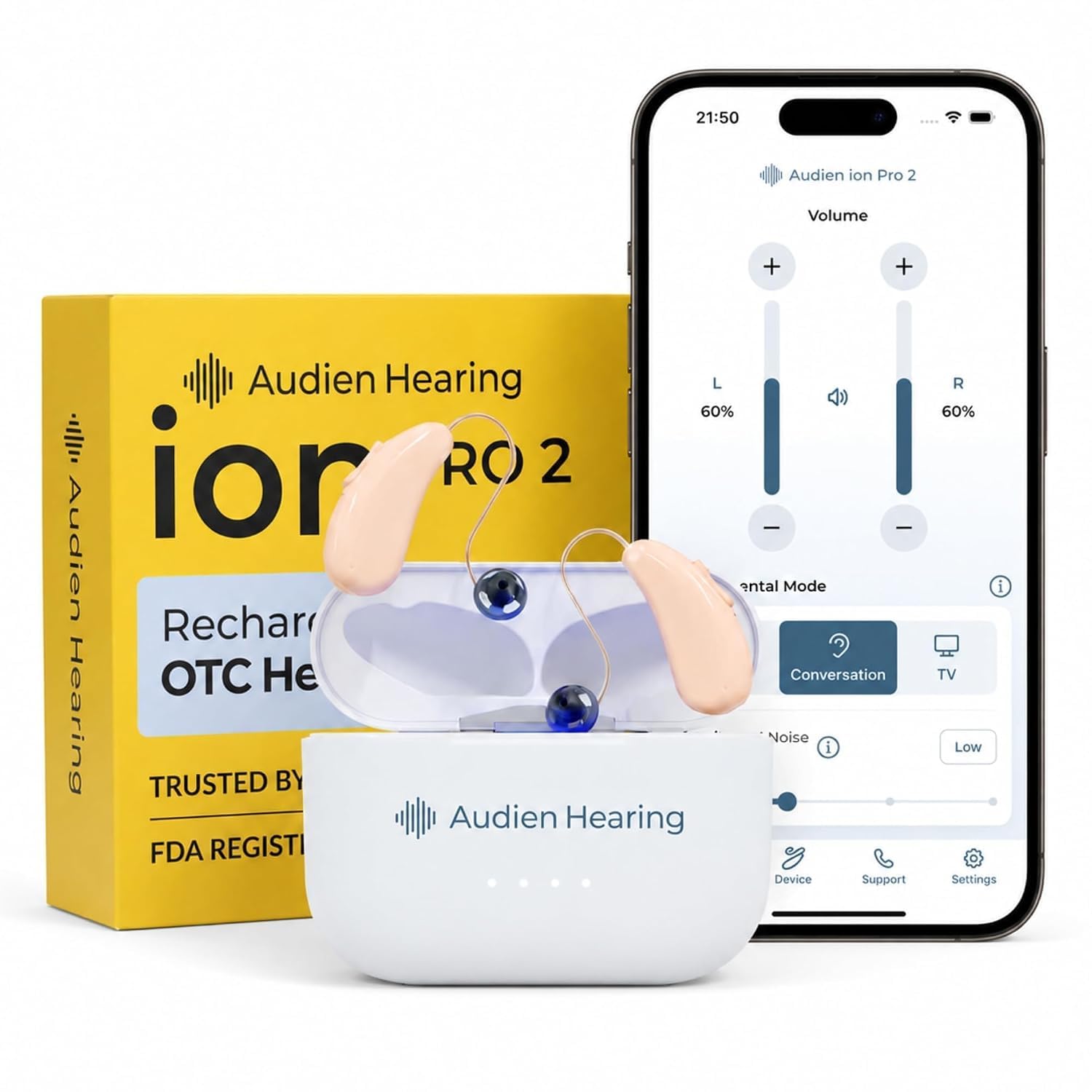
The Ion Pro 2 goes beyond the stronger mainstream pick on features: a UV case cleans both aids while they charge, Bluetooth streams calls and podcasts directly into each ear, and an app adjusts volume across four listening presets. Owners who pair a phone also skip needing a separate streamer or hunting for tiny physical buttons mid-conversation.

Sound delivery is the strong suit. Early adopters describe noticeably clearer group conversation, crediting the amplification itself for making speech easier to follow in social settings; fully working pairs prompted the most enthusiastic comments in this comparison.

The right owner is a tech-comfortable senior with mild-to-moderate loss who expects phone pairing and app-based adjustments and is willing to manage a gadget along the way. The premium cost only makes sense if that Bluetooth reliability holds up, though: in some handsets a stream drops mid-call and returns only after the aid is set back into its charger, so buyers without patience for an occasional reset are better served by the simpler pick with fewer moving parts.

Pros

  • Self-cleaning UV case sanitizes both aids each time they dock for charging.
  • Bluetooth pairing carries phone calls and podcasts straight into the ear without extra hardware.
  • App controls and four listening presets adjust volume and scene from a phone.
  • Fully working pairs deliver clearer conversation in group settings for early adopters.

Cons

  • Premium pricing sits well above simpler OTC aids that deliver comparable everyday amplification.
  • Bluetooth stream can drop mid-conversation and generally requires reseating the aid in the charger to re-pair.
Our verdict

Right for tech-fluent seniors who treat streaming and self-cleaning as must-haves and can overlook an occasional sync reset. Everyone else gets comparable conversation clarity from the simpler mainstream pick without the extra cost.

Check Latest Price
5

Discreet in-Ear Use

SOUNDFIT Hearing Aids

93 /100
Trail Score Outstanding

Key details

Battery Life
38h, plus case
Fit & Comfort
In-ear design
Clarity In Noise
16-channel noise reduction
Check Price on Amazon

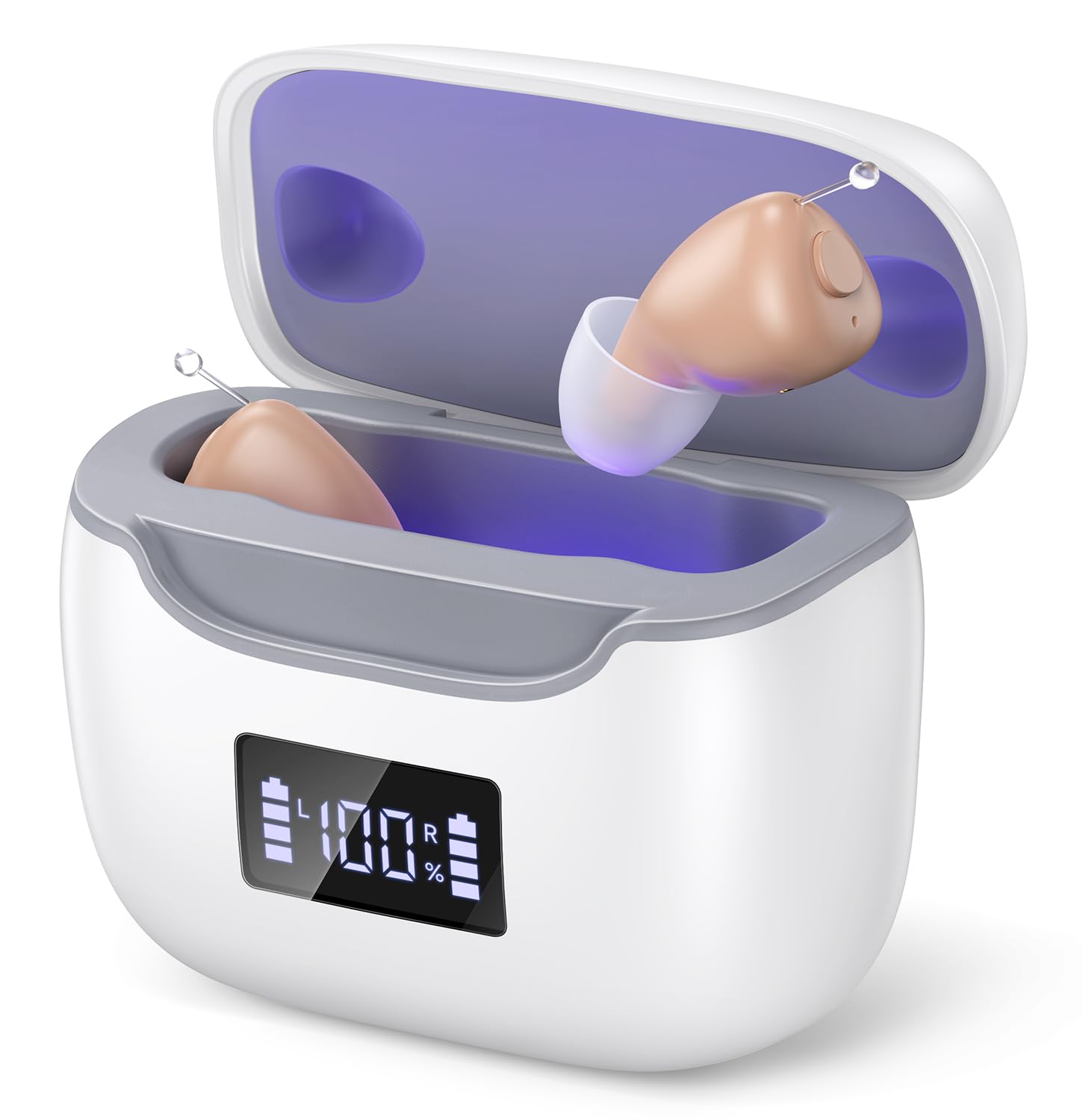
SOUNDFIT takes the quiet-discretion path in this set: a completely-in-canal shell that sits nearly flush with the ear opening, backed by a 38-hour listening battery and three more charges stored in the charging case. Four scene-based modes — Normal, Restaurant, Outdoor, and Music — route a 16-channel processor toward the environment, and IP56 water resistance tolerates sweat and light rain. That spec package is the whole story for now. This is a fresh listing whose written owner experience is thin, so articulation in loud restaurants and long-term comfort remain unverified against claims. Nothing here disputes the brand's numbers, but nothing confirms them either.

Pros

  • Nearly invisible completely-in-canal fit keeps the aid out of sight during conversation.
  • Runs roughly 38 hours per charge, with three more charges stored in the case.
  • Scene-based modes plus IP56 resistance adapt to restaurant chatter and light rain.

Cons

  • The shell leaves little to grip, so insertion and removal are fiddly for fingers used to bulkier hearing aids.
  • First fittings carry real uncertainty about articulation in noisy spaces until the wearer tests each mode by ear.
Our verdict

Pick SOUNDFIT when an invisible profile outranks everything else — and you are comfortable judging sound for yourself rather than leaning on a base of owner feedback that hasn't accumulated yet.

Check Latest Price
6

Hygiene-Focused Seniors

Aimsumy Hearing Aids

94 /100
Trail Score Outstanding

Key details

Battery Life
20h, 120h case
Fit & Comfort
In-ear design
Clarity In Noise
—
Check Price on Amazon

Lifting an Aimsumy aid out of its case powers it on, and dropping it back in runs a UV sanitation cycle while the battery tops up. For someone who wants no switches to learn and no delicate cleaning routine, that single motion covers the whole daily operation — a genuinely simpler loop than anything else here.

Sound handles everyday one-on-one conversation well enough, yet there is no app-based fine-tuning and no meaningful background-noise suppression, so in a busy restaurant ambient chatter still reaches the microphone. That suits a senior who mostly talks face-to-face and would rather forget the device exists than shape its listening profile. Comfort and sound quality currently rest on a narrow set of first impressions covering easy conversation, so approach this as an inexpensive way to test hearing assistance rather than a definitive long-term commitment.

Pros

  • Aid powers on automatically when lifted out, so there are no switches to fumble.
  • Charging case runs a UV sanitation cycle, keeping earpieces cleaner with zero effort.
  • Budget price makes it a low-risk first trial for someone unsure about hearing aids.

Cons

  • In a lively restaurant, background noise still reaches the microphone since no suppression circuit is included.
  • No app exists to fine-tune volume or shape the listening profile beyond the factory setting.
Our verdict

Pick it for seniors who want a do-nothing daily aid and value automatic cleaning, and are comfortable that long-term wear behavior is not yet broadly documented — otherwise choose the EarCentric for its deeper owner track record.

Check Latest Price

How to Choose OTC Hearing Aids

Hearing Speech in Noise

Single-microphone OTC aids raise everything around you evenly, so a voice two tables away arrives at nearly the same level as the person in front of you. That is why a chip's noise-reduction spec rarely translates into a calm conversation at a crowded cafe.

Models that let you shrink pickup to front-only, or that switch to a restaurant preset, preserve speech with direction. Budget and mid-range units manage this task modestly, so set expectations there rather than expecting silence.

Battery Life and Charging

Hours-per-charge figures describe listening time, while case figures describe how many times the aid can refill. A big standby number is not usable talk time, and rechargeable lithium cells lose capacity after roughly two years of daily cycling.

Match the advertised time to your habits: a 12-hour listening battery suits an all-day user who charges nightly, while a larger case saves you from hunting for an outlet during travel. Buyers who forget to charge do best with a dock that tops up automatically.

Comfort and Fit

Behind-the-ear models sit with a tube into the canal, which makes them easier to insert for stiff fingers and keeps them compatible with glasses. In-ear designs hide almost completely but demand more dexterity and leave less room for handling error.

The ear dome's seal controls how much low-frequency sound you receive and whether the aid whistles with feedback. Most of the clarity difference comes from trying multiple dome sizes, so treat the included tips as adjustable rather than a fixed fit.

Listening Programs

Presets remap gain and compression for a specific environment, but each is only useful if you can switch to it while it matters. A four-mode aid you cannot cycle without fumbling is effectively a one-mode device in real life.

Check whether changing modes is a single click or a deep menu dive. Restaurant and outdoor presets matter most to people who eat out and walk busy streets, so prioritize a device whose mode switch sits where your finger naturally lands.

Adjusting Your Aid

Physical buttons give simple, tactile control but often coarse steps, so a four-level volume can jump from too soft to too loud. App-based aids add finer volume and equalizer detail at the cost of pairing a smartphone and draining extra battery.

Choose by dexterity and tech comfort. Automatic units that power on when lifted from their case suit people who want to forget the device exists, while app-heavy models reward those willing to open an app daily.

Frequently Asked Questions