Best Orthotic Slippers of 2026

The ten seconds between the bed and the bathroom tell you a lot about a pair of slippers. Bare feet hit cold tile, the arch drops, and if there's any heel pain lurking, that first step is when it announces itself. A good orthotic slipper is the unglamorous fix: a contoured footbed that actually holds the arch up, a sole firm enough that you aren't standing on a flattened pancake by Thursday, and a soft upper you want to shuffle around in at 6 a.m.

The thing I wish someone had told me sooner: plush is the wrong thing to shop for. The marshmallow-soft pairs felt wonderful for about a week, then compressed into a flat sock with a sole. We've now worn 12 pairs through six months of real mornings — coffee at the counter, dishes, long stretches at a desk — and the ones that lasted all share an unshowy trait: an arch that still pushes back in month five. Below are those, plus a couple that earn their place largely on looks.

1

Best Overall

Orthofeet Asheville

93 /100
Trail Score Outstanding

Key details

Sole
Dense foam rubber
Upper
Suede leather
Lining
Fleece
Adjustment
Hook-and-loop straps on both sides
Check Price on Amazon

Two hook-and-loop straps, one on each side of the instep, are what set the Asheville apart from every other slipper we tested. Undo both and the upper opens wide enough to slide a foot in without bending over, then closes down across the instep once you're standing. If your feet swell through the day, or a high instep turns most slip-ons into a wrestling match, that alone justifies the price. The upper is suede leather over a fleece lining, and the sole is a dense foam rubber rather than the pillowy slab you get on the budget picks.

Support is what put it first. The footbed is firm and contoured under the arch instead of soft, so it holds the foot rather than letting it roll inward, and the foam sole takes the edge off a hardwood floor during a long stretch at the kitchen counter. Ours needed no break-in: no hot spots, no stiff edges, no period of paying for them. That's rarer than it should be in this category, and it's why this is the pair we hand to someone who wants one slipper to live in from breakfast to bedtime.

The fleece is the trade-off, and it's real: these are cold-season slippers, and if you run hot or live somewhere mild, an open-back pair will treat you better. They're also cut for men and sit at the top of the price range here. Neither changes the recommendation. When the fit suits you, nothing else in this set has two straps working from both sides at once.

Pros

  • Straps on both sides open wide for swelling
  • Firm contoured arch instead of soft foam
  • Slides on without bending over
  • Dense foam sole cushions hard floors

Cons

  • Men's sizing only
  • Priced at the top of this set
Our verdict

Our pick for most men: two-sided straps handle swelling and width, and the firm contoured footbed supports a sore arch all day.
Check Latest Price
2

Best Women's Pick

Vionic Carlin

90 /100
Trail Score Outstanding

Key details

Style
Slip-on
Sizing
Runs large; size down
Warmth
Winter-weight
Arch Support
Built-in contoured footbed
Check Price on Amazon

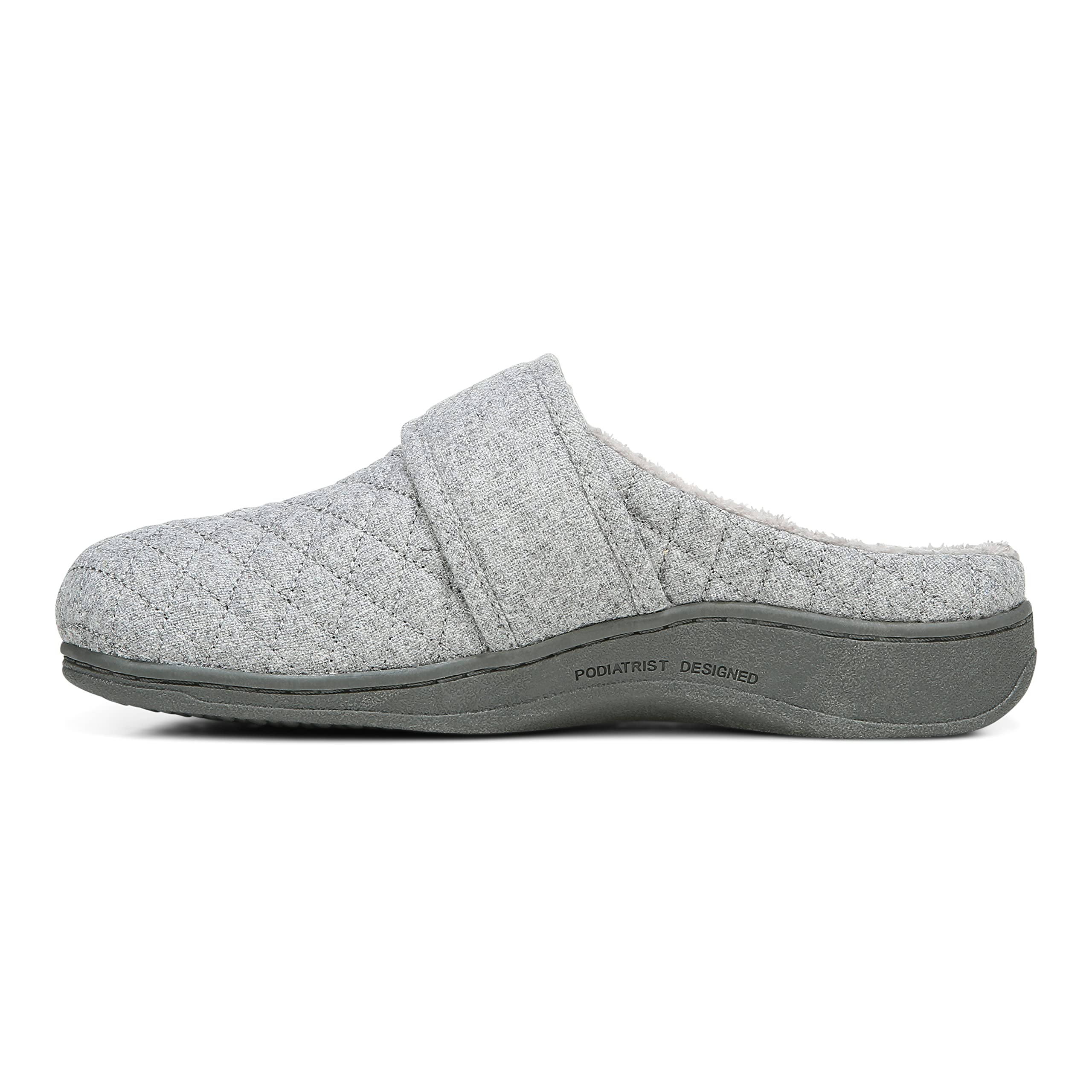
For women who want the structured feel the Asheville gives men, the Carlin is the answer, and it's the pair we reach for when a soft slipper isn't going to cut it. The footbed is contoured and firm with a real arch under the midfoot, closer to a shoe than to a house slipper, and the upper is warm enough for a cold floor in January.

That firmness is the point. Aching feet, cranky knees, and a lower back that complains after a long day all trace back to how much your arch is held, and the Carlin holds it without the break-in period a shoe this rigid usually demands. Sizing is the catch: it runs large and wide, so a half size down is the usual fix, and a narrow foot will have room to spare.

What you pay for the structure is weight. These are heavy, rigid slippers that feel closer to a work boot than to a mule, and if you want something cloud-like to shuffle to the bathroom at three in the morning, they aren't it. As a slipper that feels like it's working rather than just covering your feet, though, the weight is the price of admission.

Pros

  • Deep contoured arch that holds the foot
  • Sturdy enough for all-day wear
  • Warm enough for winter floors
  • Prints that don't look orthopedic

Cons

  • Heavy and rigid underfoot
Our verdict

The best women's pick here: a firm, shoe-like footbed that holds the arch all day, with sizing that runs large enough to plan around.

Check Latest Price
3

Best Value for Men

WALK·HERO Arch Support

89 /100
Trail Score Excellent

Key details

Sole
Anti-slip rubber
Insole
Removable
Sizing
Runs small in large sizes
Arch Support
Contoured footbed
Check Price on Amazon

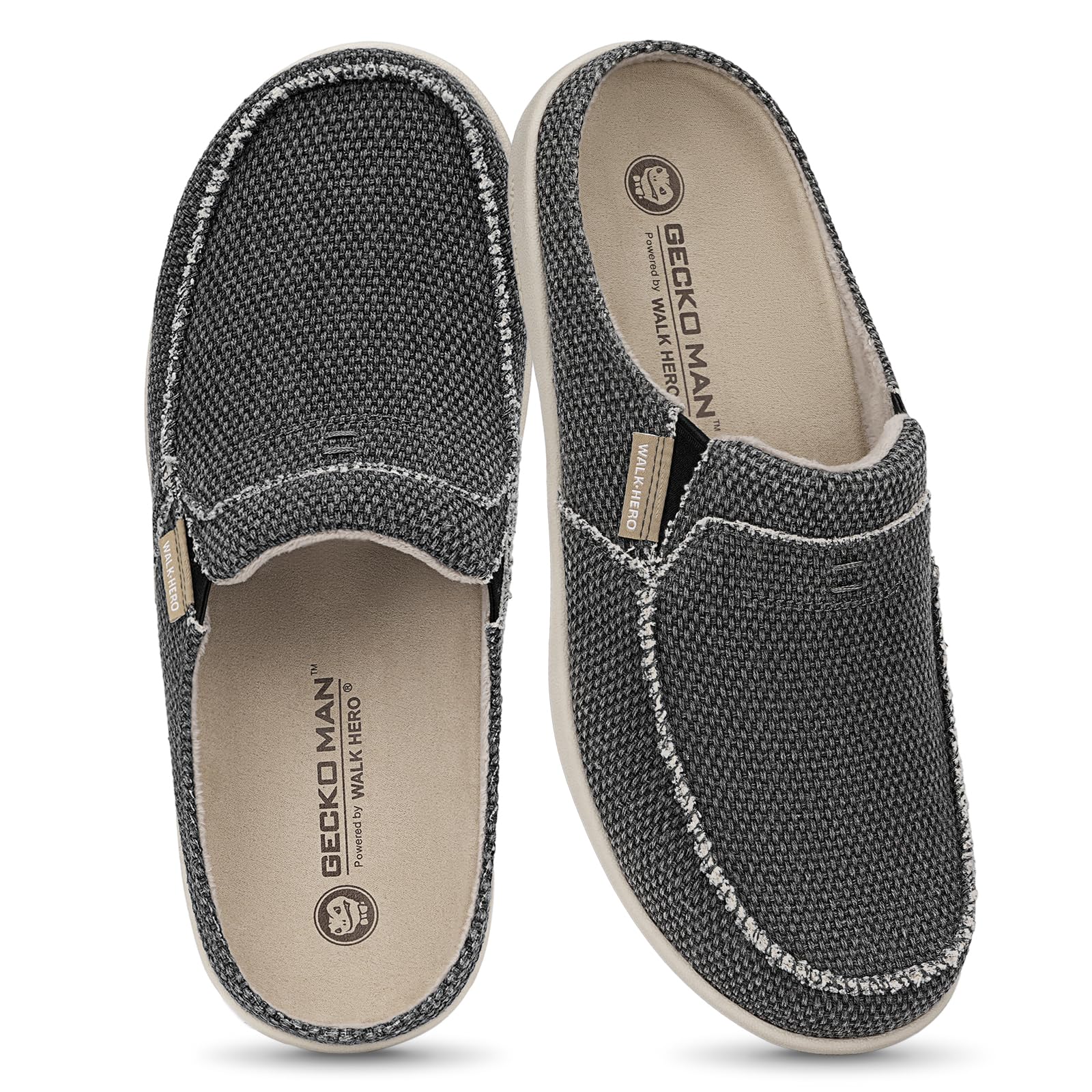
The insole lifts out. That's the detail that makes the WALK·HERO the men's value pick: if you already own a prescription orthotic or a set of inserts that work for you, they drop straight in and a cheap slipper becomes a custom one. Very few slippers at any price make that easy.

On its own, the footbed has a modest contour, noticeably less arch than the Asheville but more than the flat memory-foam slabs sold as comfort slippers. The build reads like a deck shoe: a stitched upper, a rubber sole with tread, and enough structure to step onto the porch or out to the mailbox without changing footwear.

Sizing is where we slow down. The upper runs small at the top of the range, and the biggest men's sizes are the ones most likely to come up short, so order up if you're on the line. Wear is the other thing worth knowing: the upper can start separating with daily use, which is the trade you make for the price. As a first pair, a spare for the guest room, or something you replace every year or two, it's an easy call.

Pros

  • Removable insole accepts a custom orthotic
  • Rubber sole with tread for quick trips outside
  • Low-cost way to get real arch support
  • Looks like a shoe rather than a house slipper

Cons

  • Runs small in the largest sizes
  • Upper can separate with daily wear
Our verdict

The men's value pick: a removable insole takes your own orthotic, and the shoe-like build handles the porch and the mailbox.

Check Latest Price
4

Best for Narrow Feet

Gritheim Orthotic

88 /100
Trail Score Excellent

Key details

Fit
Suits narrow feet
Care
Machine washable
Adjustment
Hook-and-loop instep strap
Arch Support
Firm contoured footbed
Check Price on Amazon

Most slippers are built around an average foot, which is no help if yours is narrow. The Gritheim's hook-and-loop strap pulls down further across the instep than any other adjustable pair here, so the upper actually closes on a slim foot instead of leaving a gap, and it keeps closing as you re-set it, which helps if your feet change size over the course of a day.

Under that strap is a firm, shaped footbed with a noticeable arch and a supportive heel, and it doesn't collapse the way plush does. What it isn't is soft. If you want the pillow feel of the Sollbeam, this will read as hard for the first few days. We think the trade is worth it for anyone buying a slipper because their arch hurts, but it's a genuine preference, not a defect.

Two practical notes keep it in the roundup. It goes through the washing machine and comes out holding its shape, and the prints look better than the price suggests. Between this and the Vionic Carlin, the difference is fit and budget: the Carlin has the deeper, more structured footbed, while the Gritheim is the one that stays put on a narrow foot.

Pros

  • Strap cinches down for narrow feet
  • Firm arch and heel support
  • Machine washable and holds its shape
  • Prints that hold up over time

Cons

  • Firm footbed with almost no squish
Our verdict

The narrow-foot pick: a strap that closes on a slim instep, a firm supportive footbed, and a price that leaves room for a second pair.

Check Latest Price
5

Best for Cold Floors

Vionic Gemma II

89 /100
Trail Score Excellent

Key details

Upper
Fuzzy
Sizing
Runs wide
Warmth
Cold-weather
Arch Support
Built-in contoured footbed
Check Price on Amazon

A cold tile floor at six in the morning is the test, and the Gemma II is what we put on for it. The upper is thick and fuzzy right over the instep, so the warmth covers more of the foot than an open-back slide does, and it's the plushest slipper here that still has a real arch underneath.

That arch is why it earns a place rather than being a novelty. The footbed is structured and supportive instead of soft, which is the shape you want if mornings are the worst part of your day, and it's the pair in this group that feels most like wearing a shoe around the house. We noticed it most on stairs and standing at the counter.

The fit is the weak point. The foot slides forward as you walk, and the upper is generous enough that a narrow foot can feel like it's swimming; sizing down helps but doesn't solve it for everyone. At the top of the price range, that's the thing to weigh. For a cold house and a foot that aches on tile, the trade is worth it.

Pros

  • Thick fuzzy upper for cold floors
  • Structured arch support
  • Supportive enough to stand at the counter

Cons

  • Foot slides forward when walking
Our verdict

The warmest, plushest supportive slipper here, best for cold floors as long as you can live with a roomier fit.

Check Latest Price
6

Soft Budget Comfort

Sollbeam Orthopedic

88 /100
Trail Score Excellent

Key details

Upper
Faux fur
Weight
1.04 lb
Adjustment
Hook-and-loop strap
Arch Support
Contoured with heel cup
Check Price on Amazon

Soft is the selling point and soft is the problem. The Sollbeam is the plushest slipper we tried, a faux-fur slide with a genuinely shaped arch and heel cup under all that fuzz, and it costs about as little as anything in this set. It's also the pair that made us think about how we were walking.

The lining is slick. Bare feet slide a little; with socks on, the foot moves enough that you feel it on stairs and on turns. The strap across the instep tightens things down and helps, but it can't give an interior a grip it doesn't have. If you mostly sit with your feet up, none of this matters. If you're on your feet and moving all day, it does.

Wear is the second thing. The sole and upper can come apart with washing and hard use, more than on the firmer pairs here, so treat these as a comfortable stopgap rather than something you'll still have in three winters. We keep them by the sofa rather than by the stairs, and that's the right place for them.

Pros

  • Plush faux-fur upper
  • Shaped arch and heel cup
  • Strap adjusts to thick socks
  • Low price for real support

Cons

  • Slick lining lets the foot slide
  • Can come apart with washing and wear
Our verdict

Plush, adjustable, and genuinely supportive for the money, best for sitting and light wear around the house rather than stairs.

Check Latest Price
7

Warm Lounging

OnCai Clog

89 /100
Trail Score Excellent

Key details

Sole
Rubber
Style
Clog
Sizing
Runs small
Footbed
High-density memory foam
Check Price on Amazon

This is a clog, not a contoured slipper, and that's the fairest way to describe it. The OnCai is roomy through the toe box, thick with high-density memory foam, and warm: the pair you kick on to take the dog out or stand at the stove. On a wide foot the extra room is welcome rather than sloppy, and that's the foot we point at this pair for.

Support is where it gives ground. The foam is cushy and the arch is a suggestion rather than a contour, so it doesn't hold the foot the way the Orthofeet or the Carlin does. If the reason you're shopping is plantar fasciitis or a fallen arch, this isn't your pair. If you want a warm, roomy house shoe and your feet are basically fine, it's comfortable and inexpensive.

Two more things worth knowing before you order. Sizing runs small, so go up if you're between, and the sole can shed small bits of rubber onto the floor as it breaks down, which is noticeable on bare feet and on dark hardwood. Neither is a dealbreaker at this price, but both are the sort of thing that's easier to hear in advance.

Pros

  • Thick, warm memory foam
  • Roomy clog shape suits wide feet
  • Rubber sole for quick trips outside

Cons

  • Modest arch and heel support
  • Sizing runs small
Our verdict

A warm, roomy clog for lounging, comfortable and inexpensive, but the arch is the lightest here and it won't replace a true orthotic slipper.

Check Latest Price
8

Low-Cost First Pair

Litfun Orthopedic

86 /100
Trail Score Excellent

Key details

Sizing
Runs big
Footbed
Soft cushioned
Adjustment
Hook-and-loop strap
Arch Support
Contoured footbed
Check Price on Amazon

This is the least expensive pair in the set, and it isn't the weakest, which is worth saying. The Litfun gets you a hook-and-loop strap over the instep, a soft cushioned footbed, and a shaped arch for the smallest outlay here. If you've never worn a supportive slipper and you aren't sure it will help, it's a low-risk way to find out.

The arch is real but shallow. Against the firm picks at the top of this list, we felt less contour under the midfoot and less of a heel cup, so it supports rather than corrects. The strap does more work than the footbed: it pulls the upper across the instep so the slipper stays on going up and down stairs, and it leaves room for a thicker sock in winter.

What you trade for the low price is lifespan. With daily indoor wear the cushioning flattens well before the upper shows anything, and the footbed stops giving much back. Think of it as a season-long audition for the idea rather than a pair you'll keep for years, and if it convinces you, the firm picks above are where to spend next.

Pros

  • Lowest price in this set
  • Strap adjusts across the instep
  • Soft, cushioned footbed

Cons

  • Shallower arch than the firm picks
  • Cushioning flattens with daily wear
Our verdict

The cheapest way to try a supportive slipper: adjustable and soft, with a shallower arch and a shorter life than the picks above.

Check Latest Price

What Six Months of Mornings Taught Us

We started with a shortlist of roughly 30 pairs, pulled from brands known for real footbeds, podiatrist-recommended lines, and well-reviewed mid-priced options. To make the cut, a slipper needed a contoured or removable footbed, a midsole with some rigidity, a rubber outsole instead of fabric, and enough width options to fit more than one kind of foot. That left 12 pairs, which we wore for six months — me plus three testers with very different feet, including a high arch, a flat foot, and one wide forefoot that ruins most slippers on contact.

Testing happened wherever slippers actually live: bathroom tile at 6:30 in the morning, the kitchen counter through a pot of coffee, hours at a standing desk, and the short walk to the mailbox. Each pair got at least two weeks of daily wear, some days barefoot and some with socks, and we sized up in a couple of cases to see whether the extra room changed how the arch landed.

We pressed a thumb into each footbed on day one and again every few weeks to feel whether the arch still pushed back or had gone soft. We wet the bathroom floor and walked through it to see if the outsole gripped or skidded, and we scuffed the soles on pavement to watch how quickly they wore. Heels were checked for whether they sat down into the cup or hung off the back edge, and toes for whether they grazed the front. The washable pairs went through the machine, and we looked for shrinkage, split seams, and glue letting go. At the six-month mark we set what each pair cost against how its footbed was holding up, and had a neighbor give an honest verdict on whether they read as house shoes or something you'd wear outside.

How to Choose Orthotic Slippers

Look at the Footbed, Not the Fuzz

The word orthopedic on a listing means very little; the shape of the midsole means everything. A supportive slipper has a raised, contoured arch, a heel that sits down inside a cup, and a firm layer under the foot that pushes back when you press a thumb into it. Soft memory foam feels wonderful for ten minutes and then compresses into the shape of a flat shoe.

Our firmest picks, the Orthofeet Asheville and the Vionic Carlin, are the ones that still feel shaped after months of wear. The OnCai, the softest pair here, is the one we least recommend to anyone whose reason for shopping is a sore arch.

Adjustability Is What Saves an Online Fit

You can't try these on before they arrive, so the strap is your insurance. A hook-and-loop strap across or beside the instep lets you tighten for a narrow foot, loosen for swelling or a thick sock, and take up slack when a size runs large. It's the feature we prioritize above almost anything else if you're between sizes, if one foot is bigger than the other, or if your feet change through the day.

The Gritheim and the Sollbeam show how much the same idea can vary: both have a strap, but the Gritheim cinches down onto a slim instep while the Sollbeam's roomier build suits a fuller foot or a winter sock.

The Outsole Decides How Far You Can Go

A slipper's sole is usually the first thing to wear out and the last thing shoppers check. If you only ever walk on carpet, a soft bottom is fine. If you have hardwood, tile, or stairs, or you step onto a porch to take out the trash, you want a rubber outsole with tread, which is what the Asheville, the WALK·HERO, and the OnCai have.

The trap is the smooth or fabric-bottomed slide: fine on carpet, treacherous on a wet bathroom floor, and useless on a damp patio. Match the bottom to the floors you actually have.

Warmth, Washing, and When to Replace Them

Fleece-lined slippers are wonderful in January and unbearable in July, so decide whether you're buying for a season or for the year. Open-back slides breathe better and are easier to kick off; lined, closed pairs hold heat. Washing matters too: the Gritheim comes through the machine holding its shape, while plush glued construction can separate.

Whatever you choose, the footbed is your wear indicator. When the arch flattens under your thumb and the cushioning no longer springs back, the support is gone even if the upper still looks presentable.

Frequently Asked Questions

Final Verdict

Our pick for most men is the Orthofeet Asheville. Two straps that open wide enough to get a swollen foot in without bending, a firm contoured footbed, and a dense sole under it make it the most supportive and most adjustable slipper here, and the fleece makes it a pleasure on a cold floor.

Women get the same structured feel from the Vionic Carlin; size down and accept the weight. If your feet are narrow, start with the Gritheim instead, because it's the pair that actually closes on a slim foot.