Best Instant Cold Packs of 2026

The last time I actually needed a cold pack, I was 40 minutes from the nearest freezer, standing on a sideline while a kid held a swelling ankle. That's the gap these things fill: squeeze the pouch, give it a knead, and you have something genuinely cold in about 30 seconds — no ice machine, no freezer, no bag of frozen peas. They're the purchase you make right after a moment like that and then quietly keep in the car, the gym bag, and the back of a kitchen drawer for the next one.

The catch is that this cold is a sprint, not a marathon. What separates a good pack from a frustrating one isn't the first 30 seconds; it's minute 15, when the chill starts falling off, and whether the seams are still holding when you peel it off your skin. We've squeezed, timed, and hauled 16 instant cold packs through four months of real scrapes, headaches, and post-workout knees, and the ones worth restocking all behave the same way under pressure. Below are the picks we'd keep on hand, plus notes on which size suits which kind of bad afternoon.

1

Best Overall

General Medi Instant Cold Pack

89 /100
Trail Score Excellent

Key details

Use
Single-use disposable
Pack Size
4 x 5.5 in
Activation
Squeeze center to activate
Pack Count
50
Check Price on Amazon

Fifty packs is a lot of cold therapy, but the 4 x 5.5 inch size is what makes the General Medi box our top pick: it fits a wrist, an ankle, or a child's bump without swallowing a whole shelf. We like that you can keep several in a first-aid kit and not treat each one like a precious resource. The flexible pouch is easy to squeeze around a joint, and the pack activates without a freezer.

The activation is the usual squeeze-and-shake, and the outer pouch stays flexible enough to wrap around a wrist. We appreciate that the packs are compact enough to live in a glovebox or a sports bag, which is where an instant pack actually earns its keep. The small format makes them easy to hand to a kid or tuck into a pocket of a team bag.

Against the other picks here, the General Medi box is the best balance of count, size, and everyday usefulness for a household. The AllSett box gives you more packs in a slightly larger size; the McKesson pack is the large-area choice. But for the kit you keep in the hall closet, the small packs are the ones we reach for first. That's the real test of an emergency supply: you use it instead of saving it.

Pros

  • Compact 4 x 5.5-inch packs fit first-aid kits
  • 50-count supply at a budget price
  • Squeeze activation with no freezer
  • Flexible pouch wraps small joints

Cons

  • Small 4 x 5.5-inch coverage
  • Short useful cold period
Our verdict

Buy the General Medi 50-pack if you want a compact, budget-friendly supply for a household first-aid kit; it's our default for everyday bumps and sprains.
Check Latest Price
2

Best Bulk Value

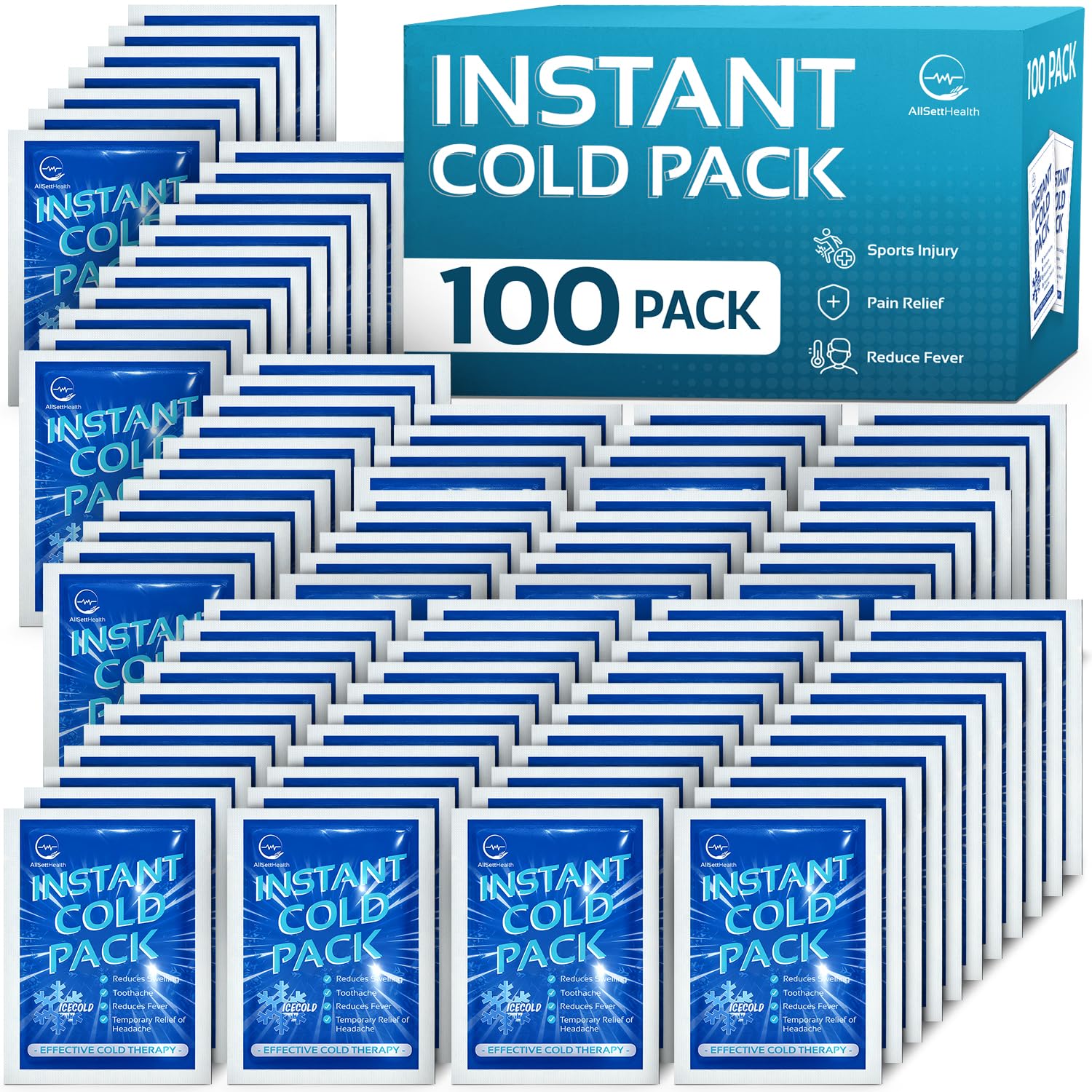
AllSett Health 100-Pack

87 /100
Trail Score Excellent

Key details

Pack Size
4.5 x 6 in
Activation
Squeeze center to activate
Pack Count
100
Outer Pouch
Tear-resistant exterior
Check Price on Amazon

A hundred packs sounds excessive until you're the person restocking a team bag every week. The AllSett box puts 100 individually wrapped 4.5 x 6 inch packs in one place, and that size is the useful middle: big enough for an ankle, knee, or elbow, small enough to store without a dedicated cabinet. The tear-resistant exterior is a small detail that matters in a gym bag full of cleats and water bottles.

For a coach or a busy family, this is the bulk box we reach for. The pack activates with a squeeze, and the cold comes on quickly enough for the first response. The quality feels a step above the flimsiest packs here, with an outer pouch that doesn't feel like it will split the moment you cram it into a kit. The 100-count box is the reason to choose it over a six-pack, not the pack design itself.

For a household that ices often, or a team that goes through packs in a season, the AllSett box is the practical middle ground between a tiny kit and an industrial case. The 4.5 x 6 inch size is also easier to wrap around a knee than the smallest packs here. We like it less as a single household kit and more as the box you restock from.

Pros

  • 100-count bulk supply for teams
  • 4.5 x 6 inch mid-size coverage
  • Tear-resistant outer pouch

Cons

  • Large box needs dedicated storage
  • Inner pouch can need a firm press
Our verdict

We recommend the AllSett 100-pack for coaches and busy families who want a useful mid-size pack in bulk.

Check Latest Price
3

Best for Large Areas

McKesson Instant Cold Pack 6 x 9

87 /100
Trail Score Excellent

Key details

Material
Latex-free
Pack Size
6 x 9 in
Activation
Squeeze to activate
Check Price on Amazon

A 6 x 9 inch cold pack covers the parts smaller packs miss: a thigh, a shoulder, a broad back. That extra surface area is why the McKesson pack is our choice for large areas. It's also latex-free, which is a quiet advantage in a household with sensitive skin or a latex allergy. The pack activates with a squeeze and is large enough to cover a back or thigh without constant repositioning.

The larger size does more of the work than a compact pack: you're cooling a broader area, not just a pinpoint. That makes it feel more useful for a back spasm or a hamstring strain, where a 4 x 5 inch pack would need constant repositioning. A towel wrap helps with grip and skin protection.

Against the Dynarex 5 x 9, the McKesson is the wider of the two; against the General Medi, it's the large-area specialist. If you're icing a knee, either size works. For a back or a thigh, the 6 x 9 is easier to keep in place. The latex-free film is the detail that tips it for us over a generic large pack.

Pros

  • 6 x 9 inch broad coverage
  • Latex-free materials
  • Squeeze activation, no freezer

Cons

  • Bulkier than compact packs for small joints
Our verdict

Our pick for broad coverage is the McKesson 6 x 9 pack, which is latex-free and sized for a back, thigh, or shoulder.

Check Latest Price
4

Best for First-Aid Kits

Clever Instant Cold Pack 6-Pack

89 /100
Trail Score Excellent

Key details

Pack Size
5 x 7 in
Activation
Squeeze until inner bag pops
Pack Count
6
Check Price on Amazon

Six 5 x 7 inch packs are enough to make a first-aid kit feel prepared without turning it into a storage project. The Clever box is the tidy middle ground: larger than a wrist pack, small enough to slide into a glove compartment or a shelf bin. The 5 x 7 size is a versatile everyday shape here for a bumped knee, a sprained wrist, or a child's shin.

The pack activates by squeezing until the inner bag pops, and there's no cover or wrap in the box. That's not a dealbreaker—a clean dish towel does the job—but it's one more thing to remember in the moment. The six-count format is the real appeal: you can keep one in the car, one in the kitchen, and still have spares without committing to a 50-pack.

For a single household or a car kit, this is the box we choose. The trade is deliberate: a small, tidy count that fits where you actually store first-aid supplies. The 5 x 7 inch pack is the reason it works; it's big enough to feel useful without becoming a commitment.

Pros

  • Six-pack fits small kits
  • 5 x 7 inch versatile size
  • Simple squeeze activation

Cons

  • Higher cost per pack than bulk boxes
Our verdict

We like the Clever six-pack for a home or car first-aid kit, with 5 x 7 inch packs that are big enough for most everyday injuries.

Check Latest Price
5

Best with Covers

Primacare PCP-45 Cold Packs

85 /100
Trail Score Excellent

Key details

Cover
Non-woven cover included
Pack Size
4 x 5 in
Activation
Squeeze until inner pouch bursts
Pack Count
24
Check Price on Amazon

The non-woven cover is the first thing we noticed about the Primacare box, and it's the reason to choose these 4 x 5 inch packs over a cheaper bulk bag. Each pack comes with its own cover, which gives you a layer between the cold surface and skin. That matters when you're icing a child, a sensitive area, or a spot where you can't easily hold a towel in place.

The covers are what make this set worth choosing. The 24-count box is a sensible middle ground for a household: enough to get through a season of bumps without taking over a shelf. The pack activates by squeezing until the inner pouch bursts and shaking gently. The cover doesn't change the cold, but it removes one excuse to skip icing when you're in a hurry.

For smaller spots, the cover makes it easier to hand the pack to someone else and say 'hold this.' If you're stocking a kitchen drawer or a school kit, the Primacare covers are the detail that earns the space. The 24-count box is also small enough to keep one in the car and one at home.

Pros

  • Non-woven cover included
  • 24-count household supply
  • Cover helps protect skin

Cons

  • Small 4 x 5 inch coverage
Our verdict

Primacare's 24-pack earns its place with a non-woven cover for each 4 x 5 inch pack, making it our pick for kid-friendly, skin-conscious icing.

Check Latest Price
6

Best for Curved Areas

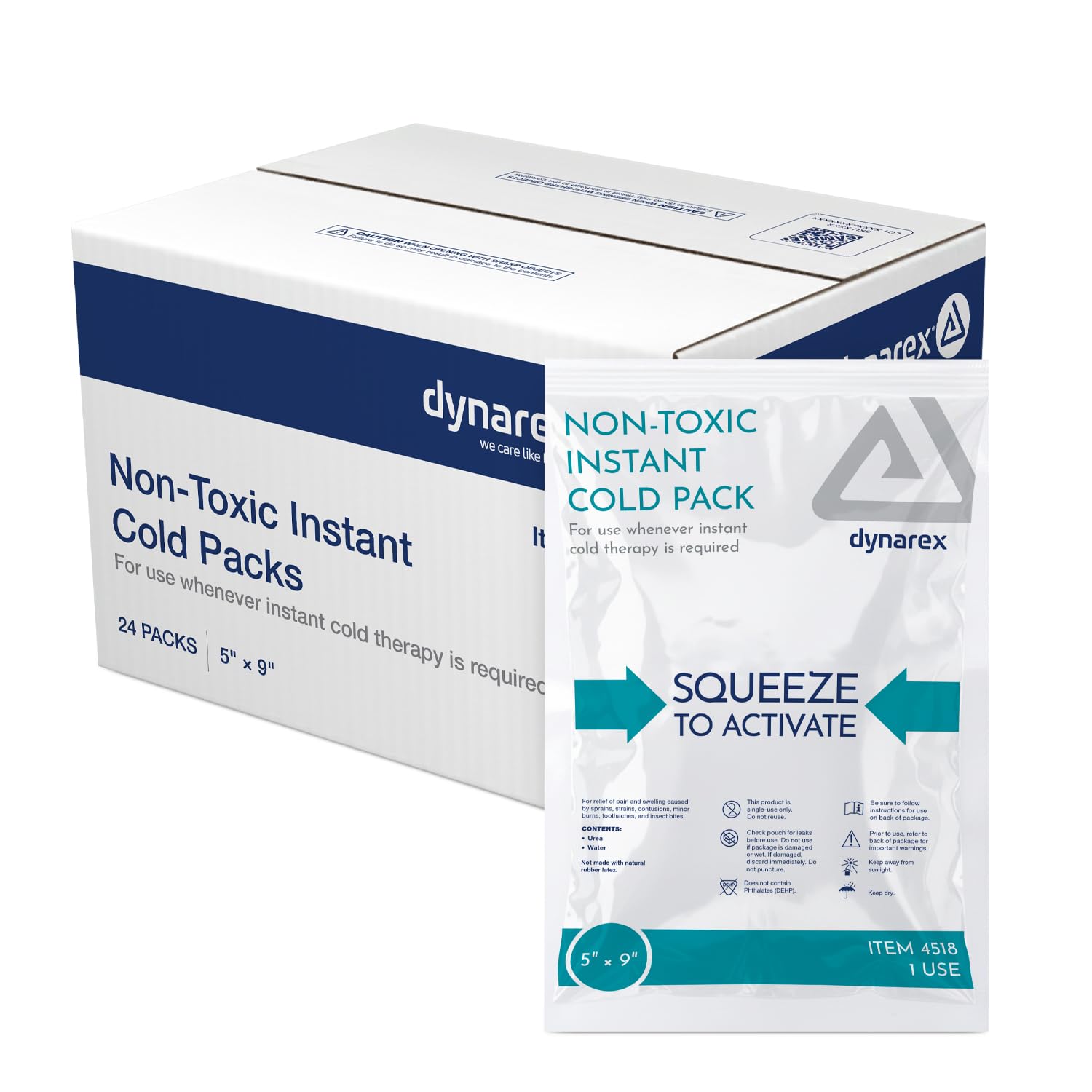
Dynarex Instant Cold Packs

87 /100
Trail Score Excellent

Key details

Material
Urea
Pack Size
5 x 9 in
Activation
Squeeze or fold, then shake 30 seconds
Pack Count
24
Check Price on Amazon

The 5 x 9 inch Dynarex pack is the one that bends. The flexible packaging molds around a shoulder, knee, or hip instead of sitting on top like a stiff rectangle. That's the reason to choose it over a larger flat pack: the cold stays in contact with the curve of the joint, which is where an instant pack often slides off.

The box holds 24 packs, so it's a serious supply without going industrial. The pack uses urea, and the instructions are more specific than most: squeeze or fold until you hear a pop, then shake well for 30 seconds. That extra step is worth following. The shake is what mixes the contents and gets the pack down to temperature.

The 5 x 9 size gives good coverage for a knee or shoulder. The flexible film is the detail that makes it feel less like a chemical bag and more like a cold pack you can actually hold in place. It's the pack we reach for when the injury is on a curve.

We like this as the joint-specific pick in a kit. It's not the smallest pack here, and it's not the cheapest per use, but it fills a role the compact boxes don't: a pack that conforms instead of perching. The 24-count box is small enough to store and big enough to get through a season of practices. That's the balance we look for in a pack that isn't just for emergencies.

Pros

  • Flexible 5 x 9 inch pouch
  • Conforms to shoulders and knees
  • 24-count box

Cons

  • Narrower than a 6 x 9 pack for broad backs
Our verdict

We reach for the Dynarex 5 x 9 pack when the injury is on a curved joint; its flexible pouch molds to a shoulder or knee better than a flat rectangle.

Check Latest Price
7

Best High-Volume Box

Ever Ready First Aid 125-Pack

85 /100
Trail Score Excellent

Key details

Pack Size
4.5 x 7 in
Activation
Shake, squeeze, and mix
Pack Count
125
Check Price on Amazon

A 125-pack is not a household first-aid purchase; it's a supply decision. The Ever Ready box is built for the person who restocks a team bag, a clinic cabinet, or a workplace kit and doesn't want to think about it again for a while. Each pack is 4.5 x 7 inches, a size that covers most limb injuries without needing a second pack.

The activation is straightforward: shake the contents, squeeze to mix, and apply. There's no cover in the box, so keep a towel or cloth with the kit. The 4.5 x 7 inch shape is large enough for a shin or forearm and flat enough to stack in a supply bin.

Against the other bulk boxes, the Ever Ready pack is the no-frills option. The 4.5 x 7 inch shape is a good compromise for a coach who needs one pack per player. The 125-count box is the reason to choose it, not the pack design itself.

We see this as the box for a coach, a clinic, or a workplace first-aid station. It's a volume purchase, and that's the whole appeal: you stop rationing because there's another box in the closet. The 125-count box belongs in a supply closet, not a glovebox.

Pros

  • 125-count high-volume box
  • 4.5 x 7 inch limb coverage
  • Simple shake-and-squeeze activation

Cons

  • Too large a supply for a household kit
Our verdict

We recommend the Ever Ready 125-pack for the coach, clinic, or workplace that goes through cold packs steadily and wants one box to cover the season.

Check Latest Price
8

Air Travel

ICEWRAPS Instant Cold Pack 50-Pack

86 /100
Trail Score Excellent

Key details

Travel
Airplane-safe before activation
Pack Size
4 x 7 in
Activation
Squeeze inner pouch and shake
Pack Count
50
Check Price on Amazon

The phrase 'airplane-safe before activation' is the detail that makes this 50-pack stand out for travel. Each pack is individually sealed, so you can toss a few in a carry-on without committing to the whole box. The 4 x 7 inch size is a good travel shape: long enough for an ankle or wrist, flat enough to slide into a bag pocket.

The pack activates by squeezing the inner pouch and shaking. That's the same basic move as the other picks, but the individual seal and flat shape make it easier to carry. The 50-count box is enough for several trips, and you can leave the rest at home without opening a giant bulk case.

We like this as the travel pack because the activation is contained and the pack is flat. For a hotel room, a hike, or a long drive, that's the useful part: it fits where a bigger pack won't. The 4 x 7 inch pack is the reason it works in a carry-on.

Pros

  • Airplane-safe before activation
  • Individually sealed 4 x 7 packs
  • 50-count travel supply

Cons

  • Short useful cold window
  • Narrower than 6 x 9 packs for broad areas
Our verdict

For travel, we choose the ICEWRAPS 50-pack: the 4 x 7 inch packs are airplane-safe before activation and flat enough for a carry-on.

Check Latest Price

How We Chose and Tested Instant Cold Packs

We started with about 30 options from drugstore shelves and online listings, then narrowed by format — single-use chemical packs versus reusable gel, squeeze-activated versus immersion-activated, and pouch material, since thin film packs feel like a sandwich bag while seam-welded nylon feels like actual gear. We ended up testing 16 of them over four months. We also noted which ones came with a sleeve, wrap, or strap, because a bare pack pressed against skin is its own problem.

Every pack got the same drill: I squeezed it one-handed as though I were the one who was hurt, timed how long it took to hit its coldest point with a thermometer against the surface, then read the temperature every two minutes until it climbed back above 50 degrees. That gave us a real duration number instead of a label claim, and showed which packs turn painfully cold and fade fast versus which stay moderately cold long enough to matter. Each one ran through the full cycle twice.

Then we lived with them. Packs rode in gloveboxes through July heat, got thrown around in gym bags, sat in a purse for a week at a time, and went onto real bruises after real falls, with notes on whether the swelling looked any better 20 minutes in. We weighed each one before and after activation, left used packs on paper towels overnight to catch weeping seams, and flagged any that went off accidentally in a bag or stayed squishy after a hard squeeze.

Size and fit surprised me — a large pack covers a whole lower back but won't wrap a wrist, while a small one goes warm before you've finished icing a knee. We tracked how each felt against skin after 10 minutes, whether the included sleeve or strap stayed where we put it, and roughly how many usable minutes of cold you get per pack, since that's the value question that actually matters here.

How to Choose Instant Cold Packs

Match the pack to the body part

A 4 x 5 inch pack is a wrist, ankle, or child's bump; a 5 x 7 or 4.5 x 7 inch pack covers most adult limbs; a 6 x 9 inch pack is for a back, thigh, or shoulder. We keep two sizes in a household kit because one pack can't do both jobs well. If you're buying for a team, the mid-size pack is the safer default; if you're buying for one person with a recurring back issue, go larger.

Make activation part of the decision

Activation is a squeeze, a fold, or a snap, depending on the pack, followed by a shake. The difference shows up when your hands are cold, shaky, or helping someone else. We look for an inner pouch that bursts with a firm press rather than a fight. A pack that needs a determined squeeze isn't a dealbreaker, but it's not the one to hand a child. Practice with one pack before an emergency so you know how much pressure it takes.

Expect a short cooling window

Instant packs are a first-response tool, not a long icing session. The chemical reaction is one-way; once the pack warms, it's done. We plan on swapping packs or moving to a reusable gel pack if we need longer cold. That's why two packs per injury is more useful than one pack and a hope. If you're stocking a kit, buy enough to cover the first response and a change-out.

Covers and materials matter

Cold packs should not go directly on skin for long. A cloth or towel works, but a pack with its own non-woven cover is easier to hand to someone else. Latex-free materials matter for households with a latex allergy. We prioritize a cover when the pack is likely to be used on a child or a sensitive area; otherwise, a clean towel is fine. Check the instructions for how long to apply and test the temperature first.

Buy the count that matches your use

A six-pack suits a car kit or a single household; 24 to 50 packs suit a busy family; 100 to 125 packs suit a team, clinic, or workplace. We don't recommend buying the biggest box unless you have somewhere to store it and a reason to go through it. Cost per pack matters, but so does the cost of a box that sits unused because it's too big to store. For most homes, a 24- to 50-pack is the sweet spot.

Frequently Asked Questions

Final Verdict

We recommend the General Medi 50-pack as the default for most households. The 4 x 5.5 inch packs are compact enough to keep several in a kit, the squeeze activation is simple, and the count makes it easy to use one without feeling wasteful.

If your main need is a large area—a back, thigh, or shoulder—the McKesson 6 x 9 is the better buy; its extra width covers more than the compact picks here. For a team or clinic, the AllSett 100-pack or Ever Ready 125-pack makes more sense than restocking small boxes.