Best Insoles for High Arches of 2026

High arches look like a good problem to have until you spend a full day on your feet. All that height sends your weight to the heel and ball with almost nothing in between, and most off-the-shelf insoles are built for the opposite foot — flat, soft, and quick to collapse under any real weight. A good pair fills the space under the arch with something firm enough to actually hold, then cushions the two spots doing the work. Get it wrong and you have added a lump to your shoe; get it right and a long walk stops being a calculation.

I have stubbornly high arches myself, so over the past six months my team and I put 14 pairs through the ordinary stuff — dog walks, long mornings standing at the kitchen counter, weekend hikes, one ill-advised 12-mile day. The keepers shared a pattern: firm under the arch, generous at the heel and forefoot, and thinner than you would expect, which matters because a bulky insole turns a roomy sneaker into a cramped one. The ones below earned a permanent spot in the rotation.

1

Best Overall

PowerStep Pinnacle High Arch

89 /100
Trail Score Excellent

Key details

Model
5021-01
Made In
USA
Arch Profile
High arch
Package Dimensions
14 x 4.5 x 2 inches
Check Price on Amazon

Most people with a high arch know the disappointment already: you drop a new insole into your shoe, press a thumb into the midfoot, and feel it sitting a good centimeter below where your arch actually is. PowerStep's Pinnacle High Arch is built to close that gap. The shell carries a genuinely tall contour under the instep, and rather than a bare plastic top it puts a cushioned layer over the firm base — the combination that makes a high-arch insole wearable past the first hour.

We ran this pair against the rest of the group, and it's the one where the shape landed most convincingly under a real high arch: the peak meets the foot instead of stalling short of it. The cushioning matters just as much. A high, stiff foot takes its punishment at the heel and the ball, so an insole that only props up the middle solves half the problem. Here the top layer takes the edge off hard flooring while the base underneath still resists, which is why it's our default across the widest range of shoes.

One thing we didn't expect: there's almost no break-in. The shape you feel on day one is the shape you have in month three, which suits anyone who wants support to be settled and predictable and frustrates anyone hoping the arch will soften toward their foot. It's full-length, so pull the factory insole out before you fit it.

Pros

  • Arch contour reaches a genuinely tall instep
  • Cushioned top layer over a firm base
  • Shape holds from the first day

Cons

  • Premium price
  • Firm underneath, not a soft insert
Our verdict

Our pick for a genuinely tall instep: the arch contour lands where a high arch actually sits, with just enough cushioning to make firm support livable all day.
Check Latest Price
2

Best Firm Support

Superfeet All-Purpose High Arch

89 /100
Trail Score Excellent

Key details

Sizing
7.5–9 M / 8.5–10 W
Weight
4 oz
Material
100% synthetic
Arch Profile
High arch
Check Price on Amazon

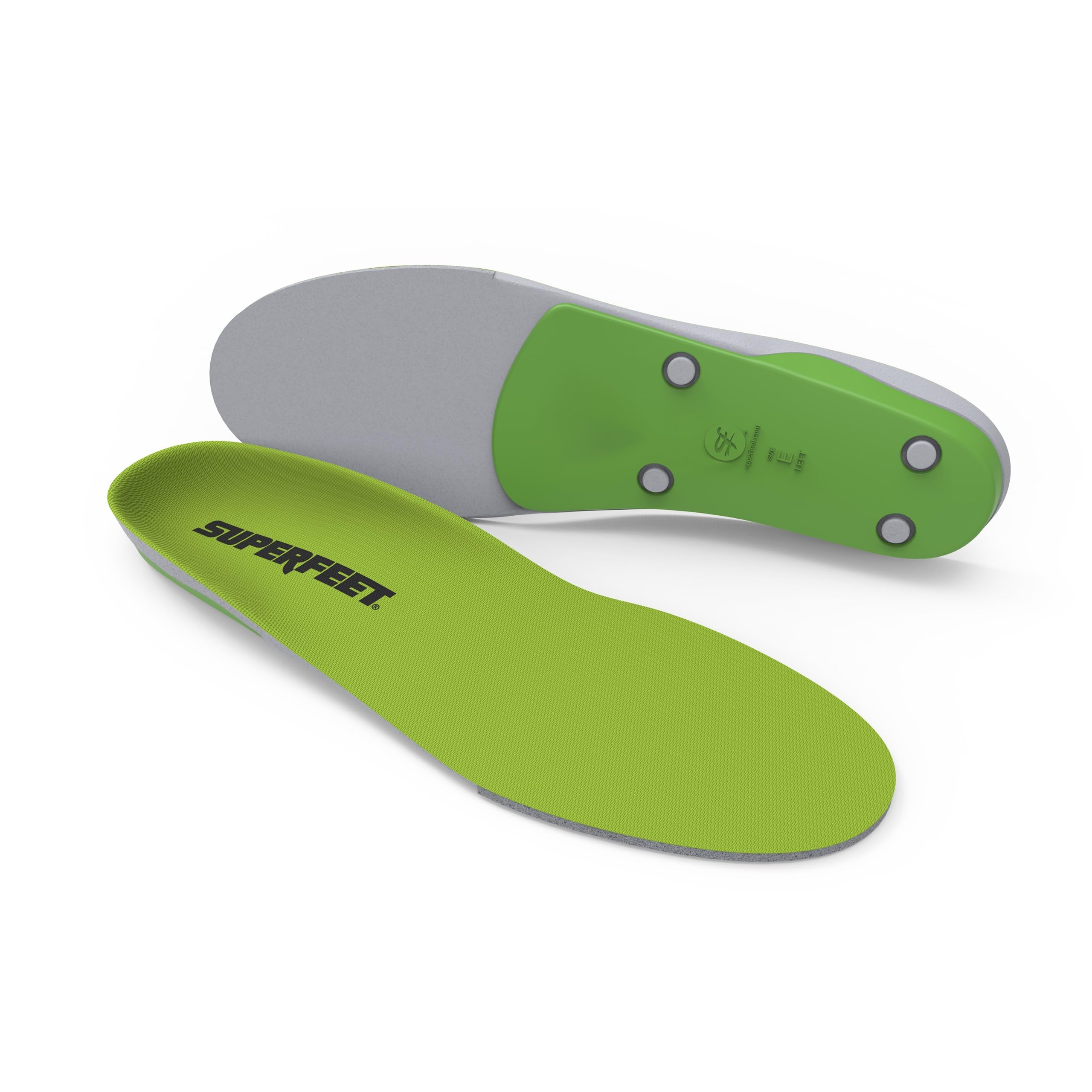
Where our top pick puts a cushion between you and the shell, the green Superfeet is the shell. It's a firm, fully synthetic platform with a deep heel cup and a hard-edged arch, and the first step onto it feels like standing on a shaped ridge. That's the point. If your high arches have flattened every soft insole you've tried, or you spend your days in stiff hiking boots that already supply the padding, this is the pair that keeps its shape while everything softer gives up.

Fit deserves a warning rather than a complaint. This variant is cut for men's 7.5 to 9 and women's 8.5 to 10, and the arch peak sits further back than a lot of feet expect. At the small end of that range it can land behind your own arch, which turns support into a bruise, so put the insole on the floor, stand on it, and feel where the ridge hits before you commit.

What you're paying for is longevity as much as shape. The build is dense and unpadded, so it doesn't pack down the way foam does — the pair we keep in a hiking boot has outlasted every softer insole we've put through the same shoe. It's the least immediately comfortable pick here and the one most likely to still be doing its job next year.

Pros

  • Firm platform that resists flattening
  • Deep heel cup keeps the foot planted
  • Long service life for the money

Cons

  • Hard, uncushioned underfoot
Our verdict

Buy it for a firm, unmoving platform under a high arch rather than a cushioned ride, and check that the arch ridge lands on your foot instead of behind it.

Check Latest Price
3

Best for Running

CURREX RunPro

92 /100
Trail Score Outstanding

Key details

Size
Large
Model
PRO-201
Weight
4.66 oz
Arch Profile
High arch
Check Price on Amazon

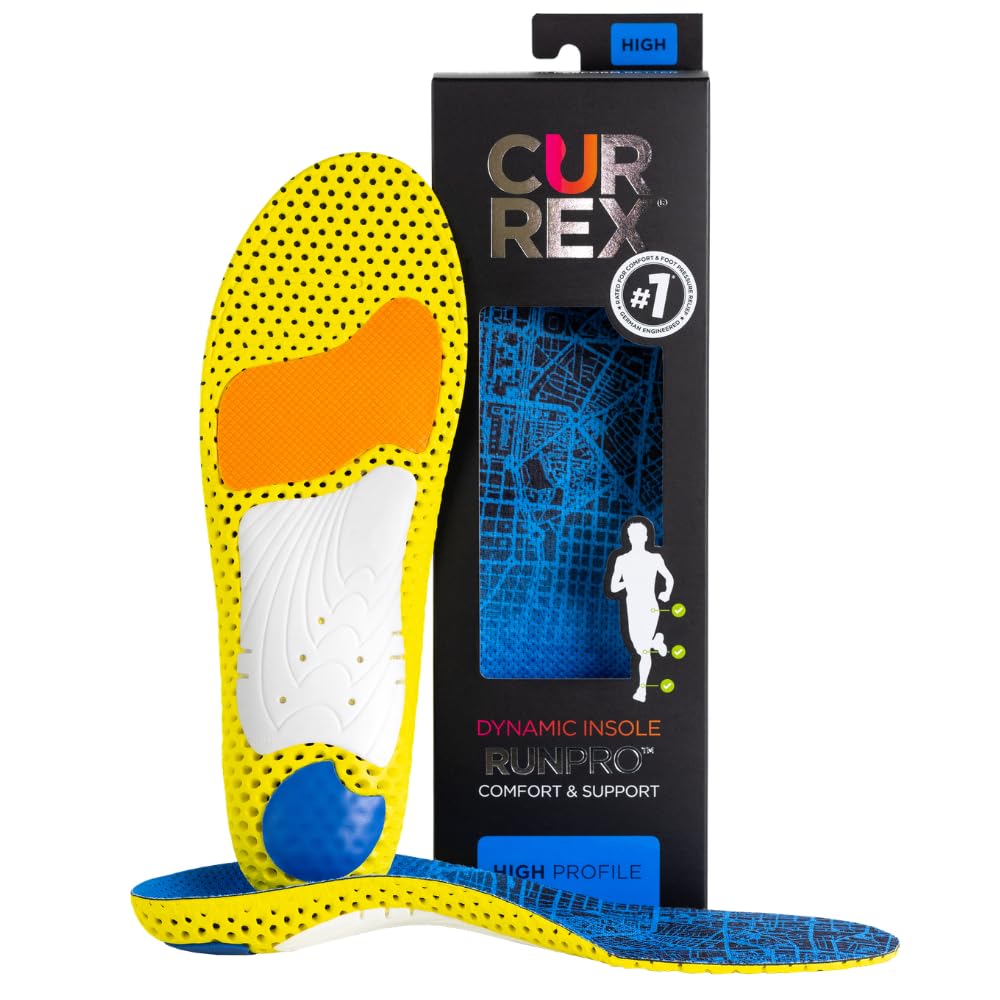
Running asks more of an arch than walking does: the foot rolls through a longer range, the heel lands harder, and a rigid plate that feels supportive at a desk turns punishing at mile three. CURREX built the RunPro around exactly that, with a flexible arch that gives as you load it and a decoupled heel cup that lets the two sides of the heel move independently. It's the only insole in this group designed around a stride rather than a shift.

The profile system is the part we appreciate most. CURREX sells this in low, medium and high arch versions, so a high-arch runner gets a shape cut for their foot rather than a compromise, and this variant is the high-arch in size Large. Underfoot it's springy rather than board-stiff, closer to a firm running-shoe midsole than to the hard orthotics elsewhere on this list, which is precisely why it disappears inside a light trainer.

It's also a low-volume insert, so there's no need to size up or haul the laces tight; it sits under the sockliner of most trainers without lifting your heel. What it isn't is a standing-all-day insole. The whole build is tuned for forward motion, so if your day is ten hours on concrete rather than five miles of pavement, one of the heavier-duty picks will serve you better.

Pros

  • Flexible arch that works with a stride
  • A dedicated high-arch profile option
  • Springy cushioning instead of a rigid plate

Cons

  • Premium price
  • Wears through with heavy mileage
Our verdict

The running pick: a flexible high-arch insole that moves with a stride rather than bracing against it, sold in a proper high-arch profile.

Check Latest Price
4

Best for Heavy Wearers

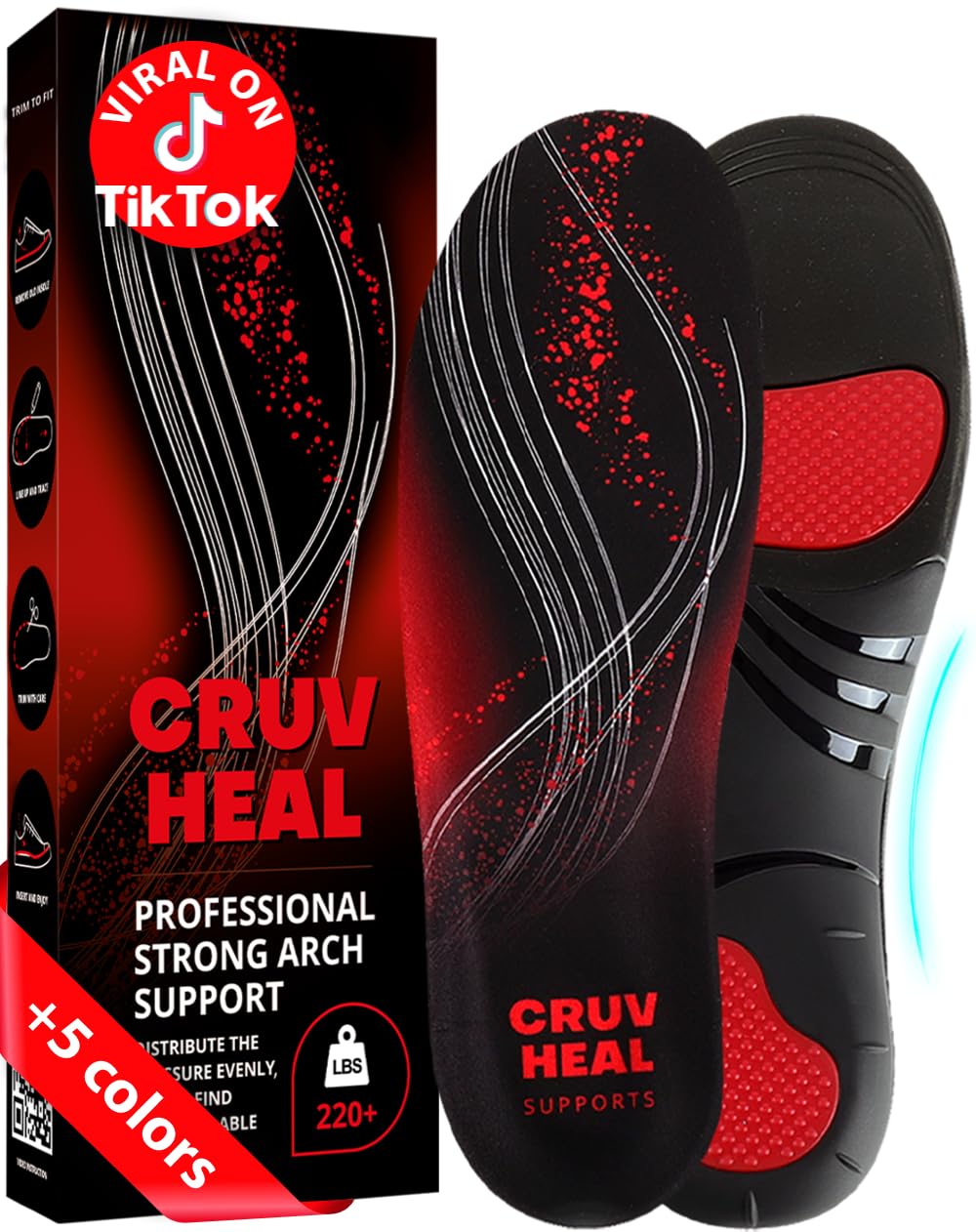
CRUVHEAL Heavy Duty 220+

88 /100
Trail Score Excellent

Key details

Length
11.02 inches
Arch Height
1.4 inches
Insole Weight
9.17 oz
Weight Rating
220+ lbs
Check Price on Amazon

The number worth noticing in the CRUVHEAL listing is 1.4 inches of arch height. That's a tall, deliberate contour, and on a genuinely high instep it means contact along the whole midfoot instead of one hot spot. Pair that with the gel pads under the heel and you have a design aimed at the two things a high arch complains about most: a midfoot nobody touches and a heel taking the entire landing.

This is the most complete package in the group for someone who stands all day. Nothing about it feels like a corner was cut: the arch holds, the cushioning doesn't collapse by mid-afternoon, and it stays put in everything from work sneakers to hiking boots. It's rated for 220-plus pounds as well, and that shows in the base — it resists the inward roll that softer insoles develop under a heavier body by the end of a shift.

Sizing takes a minute of work. CRUVHEAL asks you to pick by shoe size and then confirm the insole length against the inside of the shoe, which sounds fussy and isn't: that extra check is what keeps the heel cup under your heel instead of shoving your foot forward into the toe. In a shoe with a removable factory insole, swapping it out gives you the room the insert wants.

Pros

  • Tall 1.4-inch arch contour
  • Gel heel pads soften hard floors
  • Rated and built for 220+ lbs
  • One-year support from the brand

Cons

  • Thick build needs a roomy shoe
Our verdict

The heavy-duty default: a tall 1.4-inch arch and gel heel cushioning that hold up through long shifts and heavier wearers.

Check Latest Price
5

Best Budget

WalkHero Heavy Duty

89 /100
Trail Score Excellent

Key details

Cushioning
2 mm EVA, 3 mm OrthoLite foam
Arch Support
Nylon arch sheet
Insole Weight
5.61 oz
Weight Rating
220+ lbs
Check Price on Amazon

The WalkHero is the least expensive pair here by a clear margin, and it doesn't behave like one out of the box. Under the midfoot there's a rigid nylon arch sheet; over it, a thin high-density EVA layer, a springier OrthoLite layer and a soft top sheet. That stack is why it feels like far more insole than the price suggests for the first few weeks — properly supportive in a way the cheapest drugstore inserts simply aren't.

It's rated for 220-plus pounds too, which puts it in the same conversation as the CRUVHEAL. In sneakers and casual shoes it does the job: the arch is high and firm and the foam takes the edge off heel strikes. In a hard-soled work boot we missed the deeper heel cup and gel heel of the CRUVHEAL, because the WalkHero lets the foot slide a little more inside the shoe.

The top layer is genuinely soft, which is unusual this far down the price range, but the arch beneath it is rigid, so the first few days feel like a wedge under your midfoot. WalkHero's own directions recommend building up wear gradually, and that matches what we felt: by the end of a week the pressure settles into support.

What it's best at is rotation — a pair for the shoes you don't wear daily, a spare set for the gym bag, or a low-risk way to find out whether firm arch support suits your feet before you spend on one of the premium picks. Judged as a first foray into high-arch insoles rather than a lifetime buy, it's the value story of this group.

Pros

  • Lowest-priced pair in this group
  • Nylon arch sheet under three foam layers
  • Fits work shoes and sneakers

Cons

  • Foam packs down; layers can separate
Our verdict

The value pick: a firm nylon arch and a three-layer foam stack for the least money here, best treated as a rotation pair rather than a long-term one.

Check Latest Price
6

Work Boot Comfort

VALSOLE Heavy Duty 220+

88 /100
Trail Score Excellent

Key details

Arch Profile
High arch
Weight Rating
220+ lbs
Intended Shoes
Work boots and shoes
Check Price on Amazon

VALSOLE aims this one at a specific person: someone over 220 pounds who spends the day in work boots on hard floors. The shape follows the brief, with a deep, high arch and a firm base, and the build is a step heavier than the budget picks. That last part matters, because the classic failure of a cheap insole under a heavy wearer is that it flattens by lunchtime.

It's a full-volume insert. It works best in a boot or a roomy work shoe where you can lift out the factory insole and still have room over the toes; in a snug sneaker we had to loosen the laces to stop the heel lifting, and the whole thing felt like it was taking up space the shoe didn't have. Where it shines is in a boot, where the firm arch sits against the foot instead of shifting around.

Where it earns its place is the middle of the market: it delivers the deep, firm support of the premium picks for noticeably less, and it's built for standing rather than for running. What it lacks is polish. The top layer is utilitarian, the edges are squared off, and the whole thing looks like the tool it is. If your priority is a stiff arch inside a work boot and nothing else, that's an easy trade to accept.

Pros

  • Deep, firm arch for heavy wearers
  • Built for standing, not sport
  • Premium-style support at midrange money

Cons

  • Thin top layer over a firm base
  • Bulky in slim shoes
Our verdict

A work-boot insole for heavier wearers: deep, firm support at midrange money, with a plain finish and a bulky fit that suit boots better than sneakers.

Check Latest Price
7

Plantar Fasciitis Pain

PCSsole Plantar Fasciitis

88 /100
Trail Score Excellent

Key details

Build
Heavy duty
Arch Profile
High arch
Intended Use
Plantar fasciitis
Check Price on Amazon

The first thing to check with PCSsole's heavy-duty insert is width. It runs narrow, and on a wide foot the edges can end up under the middle of your arch instead of supporting its outer edge, which turns a decent insole into a pressure point. On a standard-width foot in a standard-width shoe it's a different story, and that's the buyer this pair is really for.

The support itself is real: a high, dense arch that holds its shape through a full shift, and a firmness that takes pressure off the ball of the foot rather than just propping up the middle. Construction feels solid for the money too, with a thickness that's clearly meant to last rather than squish away. It's pitched at plantar fasciitis as much as at the arch itself, and the combination of dense midfoot and firm heel makes sense for that.

Judged as a low-cost way into firm high-arch support, it's a sensible buy. It does reward a little patience: the surface is not gel-soft, so the first week is about your foot learning the shape rather than the insole softening to you. Give it that week before you decide, and don't force it into a shoe that was already snug.

Pros

  • Dense, high arch that holds shape
  • Low-cost entry into firm support
  • Solid construction for the price

Cons

  • Runs narrow for wide feet
  • Thick profile crowds snug shoes
Our verdict

A firm, low-cost high-arch insert for standard-width feet in a roomy shoe — narrow feet and snug shoes are where it goes wrong.

Check Latest Price

How We Tested the Best Insoles for High Arches

We started with a shortlist built from manufacturer specs, published arch-height ratings, and the review patterns that show up again and again on high-volume footbeds — then filtered hard. Full-length versus heel-cup only, trim-to-fit versus sized, foam and gel versus cork and composite, stated thickness, and price per pair all had to line up before a pair made the cut. We landed on 14 insoles ranging from budget drugstore picks to pricier molded options, and logged the return window on each one before the first wear.

Each pair went into three shoe types: a daily running shoe, a work boot, and a slim casual sneaker, because an insole that only works in one silhouette is a partial solution. We measured thickness at the heel and arch with calipers before and after trimming, timed how long a scissor trim took, and noted whether the insole shifted, curled at the edges, or pushed the heel out of the shoe. Testers wore them through full workdays, a fixed five-mile walking loop, and standing stretches at a counter, then reported where they felt pressure and whether their feet were less tired at 6 p.m. than they were without the pair.

Durability got checked at week one, week six, and the six-month mark — we looked for flattened arch beds, compressed heel pads, pilled top fabric, and edges that had started to curl. A pair that felt great on day three but bottomed out by week six was not a value, no matter what it cost, so we weighed price against how long each insole actually held its shape. The picks below are the ones still doing their job at the end of testing.

How to Choose Insoles for High Arches

Start With the Contour, Not the Label

Every insole in this group is sold as high-arch support and they don't feel remotely alike. A high, stiff foot carries its weight on the heel and the ball with very little contact in between, so what you're buying is contact: an insert whose peak meets your arch supports it, while one whose peak sits even slightly forward or back becomes a pressure point you notice within an hour. Before an insole goes anywhere near a shoe, lay it on the floor, stand on it barefoot, and feel where the ridge lands. If it sits under your arch and the heel cup cradles rather than digs, the shape is right. Settle the contour first; most everything else can be worked around.

Decide How Much Firmness You Actually Want

Firm and cushioned are not quality levels — they're different jobs. A rigid shell, like the Superfeet green, spreads load and keeps its shape, which suits stiff boots and feet that flatten soft insoles within weeks. A cushioned build, like the CRUVHEAL's gel heel pads or the WalkHero's foam stack, absorbs the impact a high, stiff foot sends up through the heel and ball. Runners and anyone standing on concrete usually want the second; hikers and heavier wearers usually want the first. The common mistake is buying the firmest insole as an upgrade — a rigid plate inside a soft running shoe fights the shoe instead of helping it.

Check the Volume It Takes Up

Thickness is where good insoles go wrong in practice. A full-length, deep-cupped insert can lift your heel out of the shoe's own heel pocket, and that is what causes the slipping and cramped toes people blame on sizing. Two numbers help: arch height, which tells you how much room the midfoot needs, and insert length, which should match the insole you're replacing rather than your foot. An insert exactly as long as your foot pushes you forward into the toe box. Most shoes with a removable factory insole will take a full-length orthotic; most dress shoes and slim sneakers won't.

Match the Build to Your Weight and Your Day

The 220-plus-pound ratings on several picks here aren't decoration: a heavier body compresses foam faster, and a base that folds under load stops supporting the arch it was bought for. If you're near or above that mark, or you're on your feet for ten-hour shifts, pay for the rigid base and accept the extra weight. If you're lighter and mostly walking, a midrange build does the same job for less. Either way, treat insoles as a consumable. Foam recovers for months, not years, and a pair that has visibly flattened is no longer giving you the arch it gave you in spring.

Give It a Week Before You Judge It

Firm arch support feels wrong before it feels right. A tall contour presses on a midfoot that's used to being untouched, and the first few days can feel like standing on a wedge — several makers here build a gradual wear-in into their own directions for exactly that reason. Wear them an hour, then a morning, then a full day. If the pressure is still sharp after a week, the profile is wrong for your foot and persistence won't fix it; if it has faded into support, you've found your shape.

Frequently Asked Questions

Final Verdict

Start with the PowerStep Pinnacle High Arch. It's the pair whose contour meets a genuinely tall instep, and the cushioned layer over the firm base means you can wear it through a full day rather than only in stiff boots. If you want a rigid platform that refuses to pack down, the green Superfeet is the firmer answer — confirm the arch ridge lands where yours does first. And if you're not yet sure insoles are for you, the WalkHero costs little enough to find out.