Best Insoles for Heel Pain of 2026

The pain shows up before your foot even reaches the floor — that first step out of bed, a sharp jab under the heel that makes you sit right back down. Heel pain is stubborn that way: it eases once you're moving, then comes back after a long day standing on tile or a walk around the block in thin-soled shoes. A good insole won't undo years of hard floors, but it can take pressure off the spot that's complaining and give your arch something solid to rest on, which is often the difference between limping to the coffee maker and walking normally.

I've spent the past four months rotating 16 pairs of insoles through my sneakers, my work boots, and the slip-on flats I wear around the kitchen, and my team has been doing the same in their own shoes — noting how each pair felt at that first morning step and again at 6 p.m. The surprise was that the thickest, squishiest options weren't the ones that helped most. Firmness matters more than plushness for heel pain, and a pair that genuinely supports the arch can feel worse for the first few days before it feels better. Here's what earned a permanent spot in my shoes.

1

Best Overall

PowerStep Pinnacle

91 /100
Trail Score Outstanding

Key details

Length
Full length
Weight
6.4 oz
Cushioning
Dual-layer
Arch Support
Moderate, contoured
Check Price on Amazon

Stand up after an hour in a chair and the first step tells you what an insole is worth. The Pinnacle is the one we point people to at that moment, because it works on both halves of the problem: a dual-layer cushion sits under the heel, and a firm contoured shell runs under the arch so the plantar fascia is not left to flatten and stretch with every step. Soft gel pads feel better for a week and then pack down; this one holds its shape, which is why it is the default recommendation here.

It is firm, and it is meant to be. The arch shell feels like something underfoot for the first few days, and a foot that has been collapsing inward for years will notice the correction more than a neutral one will. Most feet settle within a week of daily wear. If what you want is a pillow under the heel rather than a shaped arch, the PROFOOT gel insert is the better match — it simply corrects far less.

The shape assumes a shoe with a removable factory footbed and a little spare volume: running and walking shoes, work boots, some casual pairs. Drop it into a shoe with a glued-in footbed and a shallow toe box and you will feel the arch pressing where the shoe cannot give. Our suggestion is one pair in the shoe you wear most rather than shuttling it around every morning. The listed 6.4 ounces is heavier than the foam slab that came out of the shoe, and that weight is the shell you are carrying.

Pros

  • Firm arch shell that keeps its shape
  • Dual-layer heel cushioning for hard floors
  • Fits athletic, walking, and work shoes
  • Made in the USA with a 30-day guarantee

Cons

  • Needs a shoe with a removable factory footbed
Our verdict

We recommend the Pinnacle first because it does both jobs at once — a firm arch that holds its shape and a heel that stays cushioned on hard floors.

Check Latest Price
2

Best for Flat Feet and Overpronation

PowerStep Pinnacle Maxx

91 /100
Trail Score Outstanding

Key details

Heel
Angled and firm
Length
Full length
Weight
5.29 oz
Arch Support
Maximum, for overpronation
Check Price on Amazon

The Maxx is the Pinnacle's more opinionated sibling. Same full-length shape and cushioned top, but the arch is firmer and the heel sits in a firm, flexible cradle built to stop a foot rolling inward. PowerStep aims it at flat feet and overpronation, and the difference is obvious the moment you stand up in it.

For anyone whose shoes wear unevenly along the inner edge, or whose arch flattens when they stand, we take the Maxx over the standard Pinnacle. For a neutral or high-arched foot it is too much correction: the standard Pinnacle gives the same cushioning without pushing so hard under the midfoot, and that is the version we suggest first for those feet.

The scale was the surprise. It is listed at 5.29 ounces against the Pinnacle's 6.4, lighter despite being the stability model — the extra structure does not show up as weight. Give it a week before you decide; the first two days feel like a lot of insole under the midfoot.

Pros

  • Maximum stability for flat feet and overpronation
  • Angled heel cradle checks inward roll
  • Lighter than the standard Pinnacle

Cons

  • Too much correction for neutral or high arches
Our verdict

If your arch collapses when you stand, the Maxx gives you the firmer, angled correction the standard Pinnacle does not — our pick for flat feet and overpronation.

Check Latest Price
3

Best for Heavy Users and Work Boots

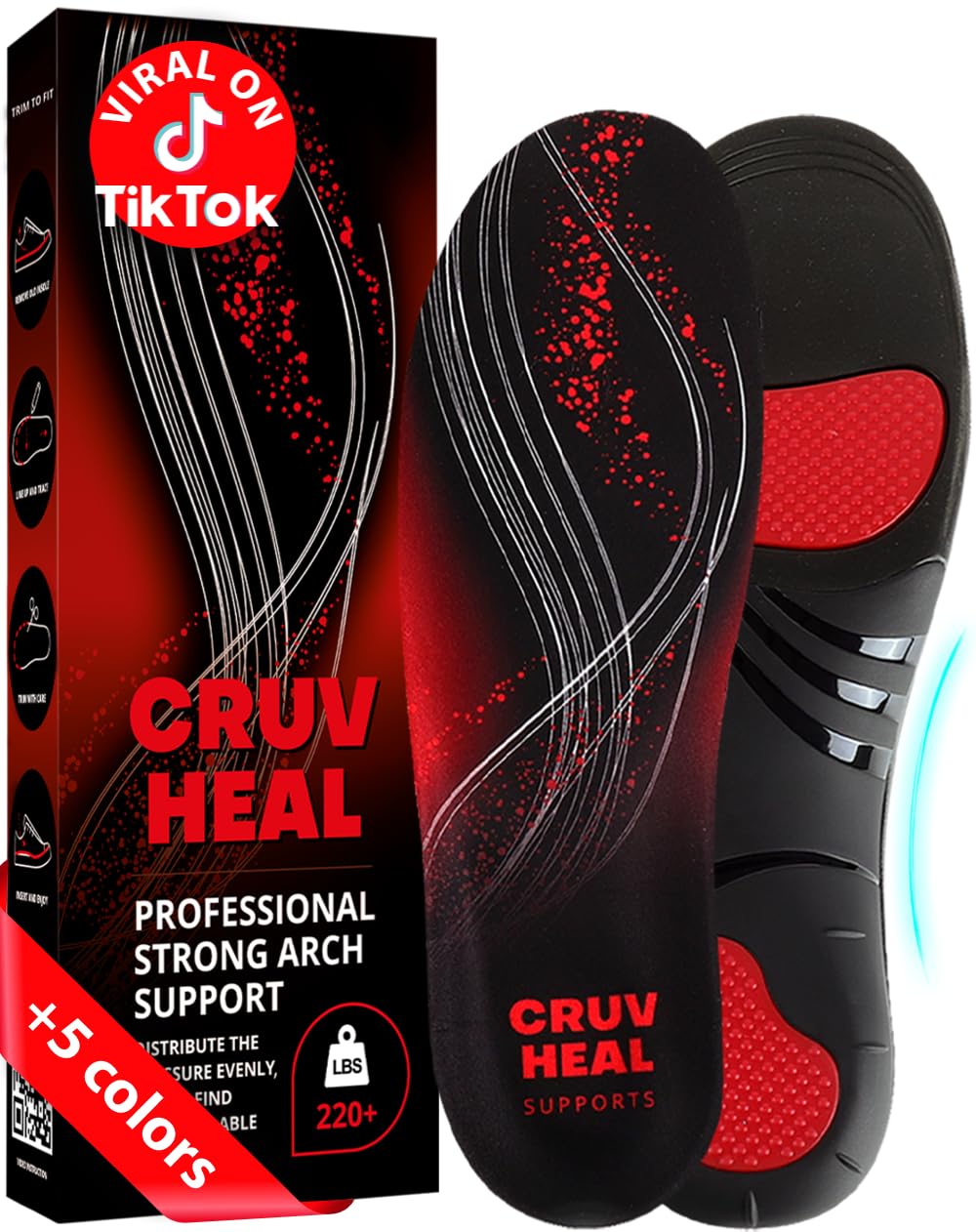
CRUVHEAL 220+ lbs

88 /100
Trail Score Excellent

Key details

Weight
9.17 oz
Arch Height
1.4 in
Weight Rating
220+ lbs
Heel Cushioning
Gel pads
Check Price on Amazon

Most insoles are designed around an average body and quietly give up their shape under a heavier one. The CRUVHEAL is built the other way round: a stated 1.4-inch arch, a base stiff enough to hold that height, and a design rated for people over 220 pounds. We appreciate that the number is on the listing instead of buried in an adjective.

Shock-absorbing gel pads sit under the heel and the forefoot, which matters more on a concrete floor than on carpet, and the full-length body wants a work boot or a roomy sneaker rather than a dress shoe. A one-year customer support line comes with it, which is more backup than most insoles here offer.

Firm is the right word. The company warns that the arch may feel unusual for the first few days while feet adapt, and that is the honest picture: this is a support insole, not a cushion. Feet that need softness under the heel should start with the PROFOOT gel instead.

Measure before ordering if you are between sizes. A full-length insert that runs into the toe box is the usual reason a good insole gets abandoned, and this one is long.

Pros

  • Holds a 1.4-inch arch under heavier loads
  • Gel pads under heel and forefoot
  • One-year customer support included

Cons

  • Heaviest insole here at 9.17 ounces
  • Needs a shoe with room for a full-length insert
Our verdict

Built around a heavier body, the CRUVHEAL keeps a tall 1.4-inch arch from flattening under load — our pick for anyone over 220 pounds on their feet all day.

Check Latest Price
4

Best Budget

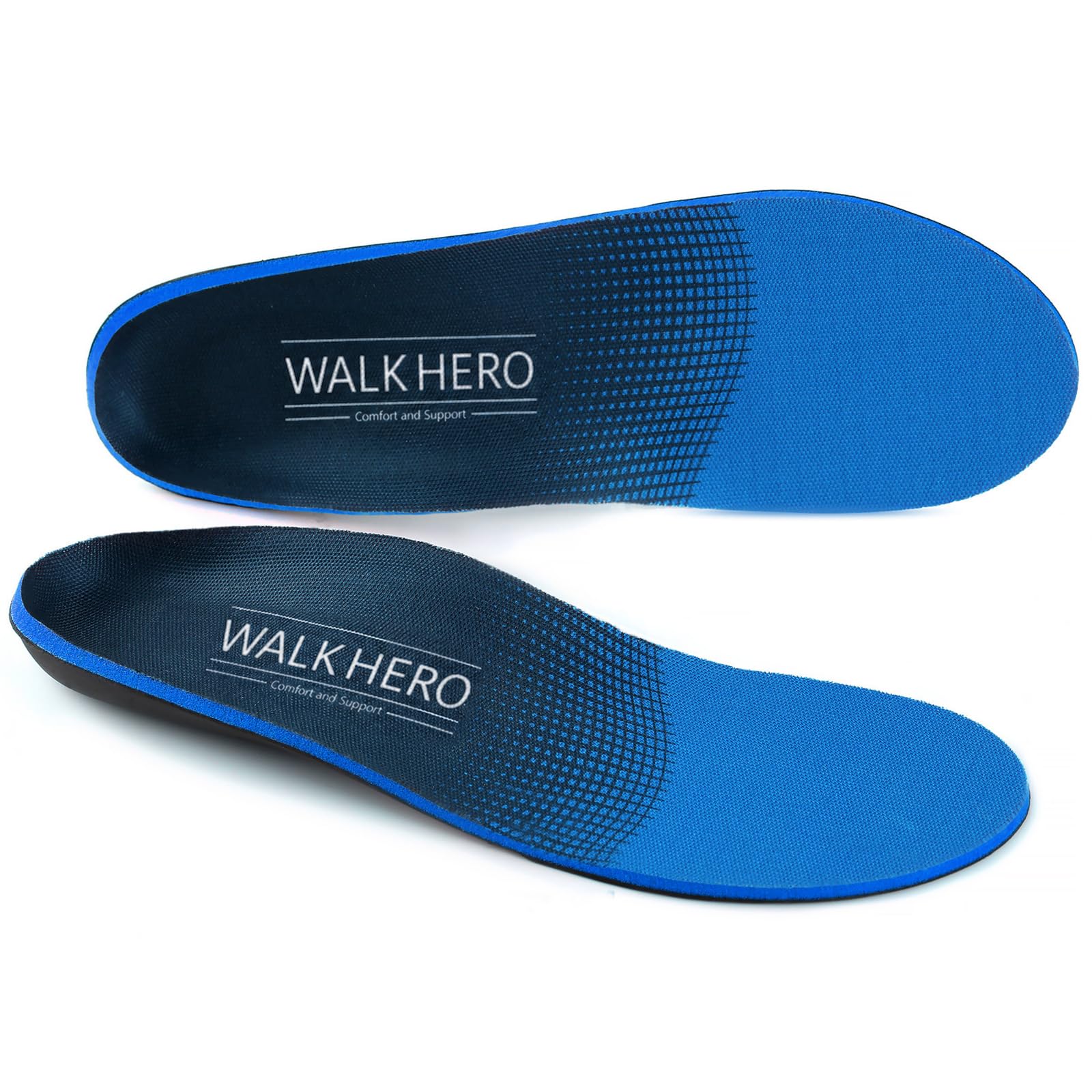
WalkHero Plantar Fasciitis

88 /100
Trail Score Excellent

Key details

Heel Cup
Deep
Material
EVA foam
Shoe Type
Wider, high-volume shoes
Arch Support
Contoured
Check Price on Amazon

WalkHero's insole is what we point to when the budget is the deciding factor and the shoe is roomy: an EVA foam body, a contoured arch, a deep heel cup, and nothing decorative. It sits at the bottom of the price range here and it does the basic job — it holds the arch up and stops the heel sliding.

The catch is firmness. This is one of the stiffest insoles in the group, and the stiffness is the support: the arch does not give when you stand on it, which is exactly what a collapsing foot needs. It also means very little cushioning under the heel or the ball, so a heel that wants softening should look at the PROFOOT gel instead.

WalkHero designs it for wider, high-volume shoes — work boots, basketball shoes, running shoes — and in a slim sneaker it takes up more room than you expect. The heel cup is the best part: deep enough to hold the heel instead of letting it wander.

Sizing is the one thing to get right. It runs about half a size small against the stated shoe size, so order up if you are between, and test the fit in the shoe before you trim anything.

Pros

  • Deep heel cup that holds the heel in place
  • Arch holds firm under weight
  • Designed for wider, high-volume shoes

Cons

  • Runs about half a size small
  • Almost no cushioning under heel or ball
Our verdict

A budget insole that genuinely supports the arch — firm, a little crude, and a sensible first pair if you are not ready to spend much.

Check Latest Price
5

Best 3/4-Length for Dress Shoes

Airplus Plantar Fascia 3/4

88 /100
Trail Score Excellent

Key details

Length
3/4 length
Arch Support
Full arch plate
Certification
APMA certified
Heel Cushioning
Gel drop
Check Price on Amazon

The Airplus stops before the toes, and that is the point. A plastic arch plate runs under the midfoot, a gel drop sits under the heel, and the front of a close-fitting shoe stays exactly as roomy as it was. In a loafer or a dress shoe with a glued-in footbed, it is the only kind of insole that will go in at all.

That is why we keep recommending it to people whose heel pain shows up in shoes they cannot change — the ones they wear to work, or to a wedding. The APMA certification is a real endorsement rather than a sticker, and the deep heel cup does more for a sore heel than the flat foam most dress shoes ship with.

The compromise of a short insole is movement. In a roomy shoe a three-quarter insert can creep forward through the day; keeping the footbed clean and dry helps, and a shoe that is snug across the midfoot holds it best. Check the length against your shoe before you commit, because a plate that ends in the wrong place under your arch is worse than nothing.

Pros

  • Fits dress shoes without crowding the toes
  • Gel heel cushion with a full arch plate
  • APMA certified for foot health

Cons

  • Soft top layer wears through faster than a molded shell
  • Can creep forward in a loose shoe
Our verdict

When a shoe has no spare volume, this is the insole that goes in anyway — a gel heel and an arch plate with nothing under the toes.

Check Latest Price
6

Best Gel Option for Women's Shoes

PROFOOT Plantar Fasciitis

88 /100
Trail Score Excellent

Key details

Heel
Gel insert
Sizing
Women's 6-10
Weight
1.12 oz
Includes
Stretching guide
Check Price on Amazon

The gel drop under the heel is the whole idea. A soft, slightly domed pad takes the impact of each heel strike and cradles the tender spot, and it is shaped for women's sizes 6 to 10. The whole insert weighs 1.12 ounces, so it adds almost nothing to the shoe.

It is the pair we keep for shoes that will not take anything thicker — ballet flats, loafers, a favorite pair of boots — where the goal is softening the landing rather than correcting the foot.

The arch support here is gentle, and a genuinely flat foot will want more. With no stiff plate running the length of it, the insert can also shift inside a roomy shoe; shoes you can lace or buckle snugly hold it best, and that is the trade-off for the low profile.

The included stretching guide is a more useful extra than it sounds. An insole manages load; it does not stretch a tight calf or a tight fascia, and the guide is a reminder that those are two separate jobs.

Pros

  • Soft gel heel pad for impact pain
  • Low profile fits slim women's shoes
  • Includes a stretching guide

Cons

  • Gentle arch support will not correct a flat foot
  • Slides in a roomy shoe
Our verdict

A soft gel heel in women's sizes for shoes that cannot take bulk — the pick when the heel needs cushioning more than the arch needs correcting.

Check Latest Price
7

Best Full-Length Cushioned Orthotic

Pure Stride Professional

92 /100
Trail Score Outstanding

Key details

Cover
Breathable mesh
Length
Full length
Sizing
Men's 9-9.5 / Women's 11-11.5
Construction
Four layers
Check Price on Amazon

The first thing to know about the Pure Stride is the color of it. The top layer is red, and it transfers: light socks pick up a pink tint where the heel and arch sit. That is an annoyance in an otherwise well-built insole, and it is the kind of thing you notice on the second wear rather than the first.

Under the mesh cover there are four layers — breathable mesh, soft EVA, a firmer support layer, and a base that keeps the shape — and the result is a full-length orthotic that cushions before it corrects. It is closer to the pair a podiatrist hands you than to the gel pads further down this list.

It is also wide. In a narrow shoe it will bunch at the edges, and the fit runs generous enough that a slightly roomy shoe suits it better than a perfect one. Cleaning is the easiest here: warm water, mild soap, air dry.

We reach for it when the shoe has room and the foot wants comfort as much as correction. The arch is real but it is not punishing, and that combination is rare in this group — most of the firm picks make you notice them for a week, and this one you stop thinking about.

Pros

  • Four cushioned layers under a breathable mesh
  • Supportive arch without a harsh break-in
  • Washes with soap and water

Cons

  • Red top layer can tint light socks
  • Wide shape bunches in narrow shoes
Our verdict

The plushest full-length orthotic here: four cushioned layers, a real arch, and no punishing break-in — just wear dark socks for the first week.

Check Latest Price
8

A Low-Cost First Try

Dr. Scholl's Plantar Fasciitis Relief

89 /100
Trail Score Excellent

Key details

Length
Full length, trimmable
Sizing
Men's
Weight
5.12 oz
Heel Cup
Deep, shock-absorbing
Check Price on Amazon

This is the plantar fasciitis insole you can pick up on a drugstore run: full length, trim to fit, with a deep heel cup and a softer feel than the molded orthotics here. It sits at the bottom of the price range alongside the WalkHero.

Trimming is where this one goes wrong. Cut a little, test it against the shoe's original footbed, then cut again — a template trimmed in one pass can end up short in a shoe with a long toe box.

The arch is the real difference. Where the Pinnacle puts a firm shell under the midfoot, this one is softer and lower, which suits a heel that hurts on hard floors and disappoints a foot that needs holding up.

So we suggest it as the first experiment rather than the long-term answer: it is inexpensive enough to settle the question of whether an insole helps at all, and if it does, the molded picks here are the ones still working in a month.

Pros

  • Deep heel cup with a soft step
  • Full length and easy to trim
  • Widely available in stores

Cons

  • Lower, softer arch than the molded picks
  • Needs careful trimming to fit
Our verdict

A low-cost, easy-to-find full-length insole with a deep heel cup and a gentle arch — a sensible first experiment before you commit to a molded orthotic.

Check Latest Price

How We Tested 16 Pairs of Insoles for Heel Pain

We started by pulling every insole we could find marketed for heel pain, plantar fasciitis, and heel spurs, then narrowed the field by reading spec sheets — arch height, heel-cup depth, top-layer material, and whether a pair came in actual shoe sizes or one universal size you trim to fit. We dropped anything sold in a single size with no trim guide, and we passed on thin gel-only inserts that flatten the moment body weight lands on them. That left 16 pairs, ranging from drugstore basics to rigid orthotic-style inserts.

Each pair went into real shoes for four months: sneakers for dog walks and weekend errands, work boots for full days on concrete, and those kitchen flats that get worn standing at the counter. I rated heel pain on a simple 1-to-10 scale at that first step out of bed and again at the end of the day, so we could tell whether a pair actually changed something over a week or just felt nice for the first ten minutes.

In the hand, we pressed a thumbnail into each heel pad and noted whether it sprang back or stayed dented, then stood on a hard tile floor in each pair to feel where the pressure landed. Arch support was judged by whether the arch felt held without digging in, and fit by whether the insole crept forward inside the shoe or needed trimming — we measured each one against the original footbed and cut along the guide where the manufacturer allowed it, watching for sizing that ran long, short, or true. Comfort got checked at the two-hour mark, not the two-minute mark, and functionality meant the thing stayed put when we pulled our foot out of the shoe.

At the end of four months we looked at what was left: foam flattened under the heel, edges that had curled up, fabric that had pilled or worn through, and top layers that had gone dark or stained our socks. The pairs that held their shape were almost always the ones that kept the morning pain down, which told us quality and relief are really the same conversation.

How to Choose Insoles for Heel Pain

Match the Insole to Where It Hurts

Heel pain that is worst on the first steps out of bed usually involves the plantar fascia, the band that runs from the heel to the ball of the foot. That is why a pad under the heel alone often disappoints: it cushions the impact but leaves the band stretching with every step. A deep heel cup adds stability, and a shaped arch reduces how far the fascia has to give.

If the pain sits under the ball of the foot instead, this is the wrong category — look for metatarsal padding. For heel and arch pain together, start with a full-length insole that has both a cushion and an arch you can actually feel.

Decide How Firm You Want the Arch

Soft and firm are not quality levels, they are different jobs. Gel and foam absorb impact and feel good on day one, but they do not hold an arch up for long. A molded shell or a plastic plate does, at the cost of a week where you feel it under your midfoot. That trade-off runs through this whole list: the PowerStep pair, the CRUVHEAL and the WalkHero are firm because support is the point, while the PROFOOT gel and the Dr. Scholl's insole are softer because cushioning is the point.

Our advice: if your arch flattens when you stand, take the break-in week. If your heel hurts on hard floors but your arch holds itself up fine, softer is comfortable and enough.

Full-Length or Three-Quarter Length

This is a shoe decision, not a support decision. A full-length insole replaces the shoe's own footbed, so it needs a shoe where that footbed lifts out and where there is a little spare volume. Drop one on top of a glued-in factory footbed and you raise your heel, crowd the toes, and make the fit worse — the most common way a good insole gets abandoned.

A three-quarter insole like the Airplus leaves the toe box untouched and suits dress shoes, loafers and anything with no spare room. The trade-off is that a short insert can creep forward, so it works best in a shoe that is snug across the midfoot.

Sizing, Trimming, and the First Week

Sizes are approximate. Measure a new insole against the shoe's existing footbed before you cut, and if you are between sizes, size up and trim down — you cannot add material back. Cut a little at a time and test the fit in the shoe, not on the table.

Then give it a week. A firm arch feels like too much for the first few days and most feet adapt; if the arch bruises rather than aches, the insole is wrong for your foot and worth returning.

What the Extra Money Buys

Across this list the premium buys shape retention rather than more cushion. A molded shell holds its arch long after foam and gel have compressed, which changes how you buy: if you plan to wear an insole every day, one firm pair that moves between shoes makes more sense than replacing flattened foam twice a year.

If you are still unsure whether insoles help at all, a budget pair is a fair test. Once you know they do, spend on the shell.

Frequently Asked Questions

Final Verdict

The PowerStep Pinnacle is the insole we recommend first for heel pain: a firm arch that keeps its shape, a heel that stays cushioned on hard floors, and the most consistent relief in this group. If your arch collapses when you stand, the Pinnacle Maxx adds the correction the standard model leaves out.

And if your shoes are slim or your budget is tight, the Airplus and the WalkHero each solve one half of the problem well — the first when there is no room for a full-length insert, the second when the price is the deciding factor.