Best Home Reverse Osmosis Systems of 2026

A reverse osmosis system should make your tap water taste cleaner—not turn the cabinet under your sink into a slow drip you check with a flashlight every morning. The appeal is simple: better-tasting water, fewer bottles hauled home, and a filter that takes on sediment, chlorine, and dissolved contaminants you would rather not think about. What separates a good one from a headache is less glamorous: a clear installation, steady flow when you fill a pot, and the kind of build that doesn’t announce itself with a puddle or a groan.

I’ve lived with undersink filters long enough to know that taste and water quality are only half the story; capacity, noise, and long-term value decide whether you actually keep using one. Over the past nine months, my team and I tested seven home reverse osmosis systems in daily kitchens, paying attention to installation, filtration performance, leakage, water flow, and durability. The picks below are for anyone who wants cleaner-tasting water without turning every glass into a maintenance project.

1

Best Overall

iSpring RCC7AK-BN

93 /100
Trail Score Outstanding

Key details

Dimensions
15.5"L x 16"W x 18"H
Production
75 GPD
Certification
NSF/ANSI 58, whole system
Filtration Stages
6, with alkaline remineralization
Check Price on Amazon

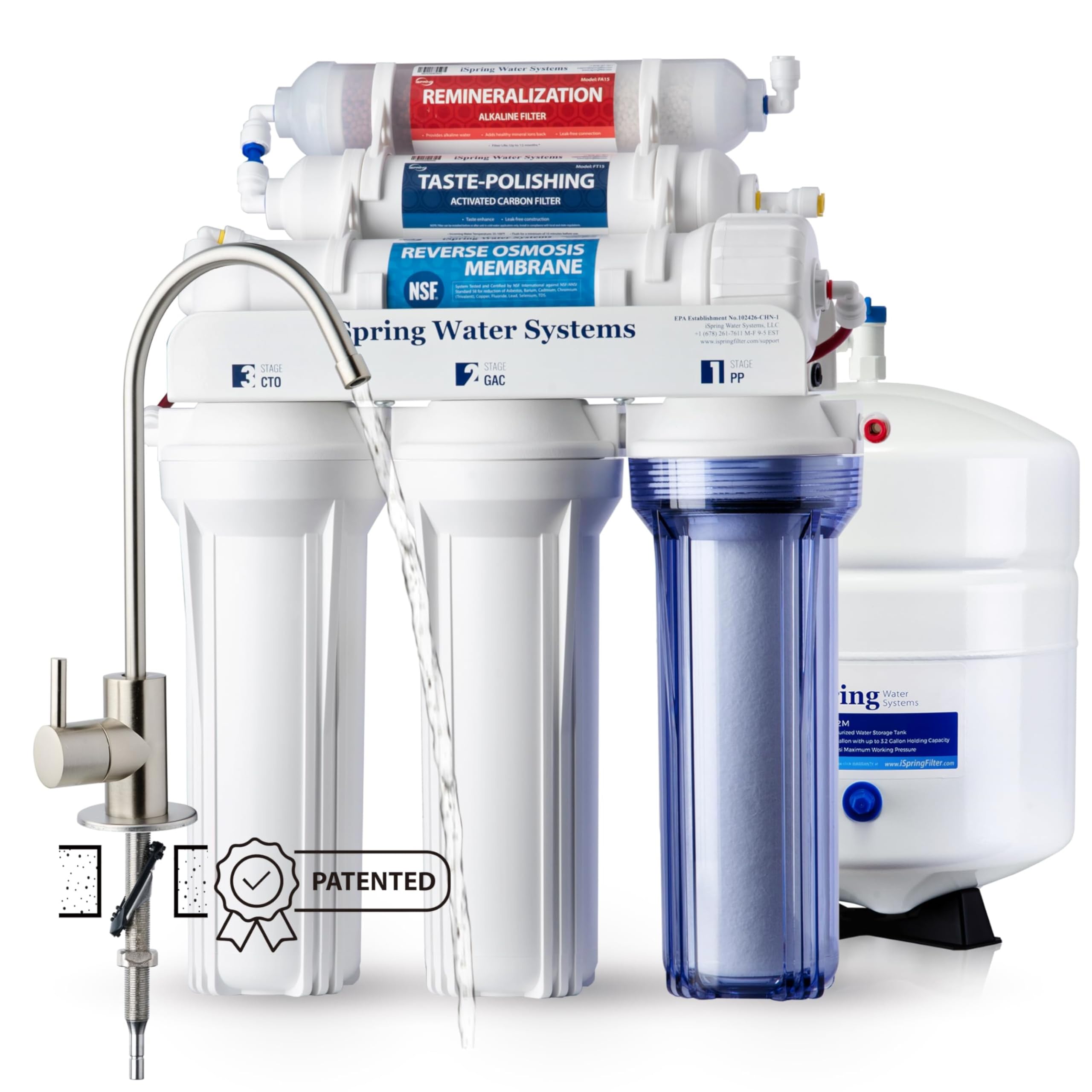
Two lines on this spec sheet carry the decision. The RCC7AK-BN is certified to NSF/ANSI 58 as a complete system rather than component by component, and its sixth stage puts minerals back into water the membrane has stripped bare. The APEC adds minerals on a WQA certification and the Waterdrop certifies to NSF 58 without a mineral stage; this one does both.

That pairing is why it's our default for most kitchens. Straight RO water can taste thin and flat, and the alkaline stage fixes that without a bottled-water habit. The rest of the package is sensible: 75 gallons a day, a 750 ppm ceiling on source water, a brushed nickel faucet and a storage tank, and no electricity at all, because line pressure runs the whole thing. We also like the clear first-stage housing more than we expected to — you can watch the sediment load build before it costs you flow.

The faucet is where these systems get fussy, and it's worth saying plainly. A drip at the spout or a weeping compression fitting is the failure to watch for, and it tends to appear in the first weeks rather than the first year. Installation itself is easier than most: the faucet fastens from above the counter, so you tighten it standing up instead of lying on your back under the trap. Put a paper towel under the fittings, check it after a day and again after a week, and register the one-year warranty — the parts that fail are inexpensive and they ship.

Measure the cabinet before you commit. At 15.5 by 16 by 18 inches plus a tank, this is one of the wider units here and it wants floor space to itself. Anyone with low line pressure should look at the pump version of the same system instead; anyone with no floor space to give should go tankless.

Pros

  • Certified whole system to NSF/ANSI 58
  • Sixth stage restores minerals and taste
  • No electricity
  • Faucet tightens from above the counter

Cons

  • Wide body plus a tank needs cabinet space
Our verdict

The best all-round under-sink RO here: certified as a whole system, remineralizing, and running on water pressure alone — buy it for an ordinary kitchen with a cabinet to spare.

Check Latest Price
2

Best Mineral-Rich Value

APEC ROES-PH75

91 /100
Trail Score Outstanding

Key details

Dimensions
15.5"L x 5.25"W x 17.5"H
Production
75 GPD
Max Source TDS
2,000 ppm
Filtration Stages
6, with calcium remineralization
Check Price on Amazon

Less money than our top pick buys the same core job here: six stages, 75 gallons a day, and calcium put back at the end. We noticed where the corners got cut — a plainer faucet, no clear sediment housing, a simpler bracket — and none of them touch the water. What you're paying for is filtration, and that part is sound.

Two published numbers make it the better call for rough water. It's rated for source water up to 2,000 ppm TDS, among the highest ceilings in this group, and it states a 40 to 85 psi operating range, so you can check your house against it before ordering. At 5.25 inches wide it's also the narrowest of the tank systems we recommend, which matters in a cabinet already holding a disposal and a stack of cleaning supplies.

The mineral stage is calcium-based, and the result tastes clean with a little body rather than the flat nothing of straight RO. Let the tank fill completely before you judge the flow — 75 gallons a day doesn't mean instant, and the first glass out of a half-filled tank is a poor test of anything.

Pros

  • Remineralizes for less than our top pick
  • 2,000 ppm ceiling suits mineral-heavy water
  • Narrow 5.25-inch body fits tight cabinets
  • Publishes a 40 to 85 psi operating range

Cons

  • Factory hose fittings can seep before they seat
Our verdict

If you want minerals put back in the water without paying top-pick money, this is the one we point to — check your line pressure first.

Check Latest Price
3

Best Budget

Express Water RO5DX

93 /100
Trail Score Outstanding

Key details

Dimensions
14"L x 5"W x 15"H
Production
50 GPD
Storage Tank
4 gallons
Filtration Stages
5
Check Price on Amazon

A spare filter set and a leak detector sit on top of the RO5DX when you open the box, and that's most of the argument: it's the least expensive complete kit here, and it arrives with the next round of filters already inside, so the running cost doesn't start for months.

Under the counter it's the narrowest of the tank systems — five inches across, about 15 tall — which slides into the dead space beside a disposal. The tank is steel rather than plastic, a detail we didn't expect at this price, and the faucet is brass. The five stages do the ordinary work. The 50-gallon daily rating is the lowest here, so a run of pitchers empties the tank and you wait while it refills.

For a first system, a tight budget, or a cabinet with no spare width, this is where we start people. The spare set in the box covers the first round of changes, which takes the sting out of year one.

Pros

  • Spare filter set and leak detector included
  • Five inches wide
  • Brass faucet and steel storage tank
  • Cheapest complete kit in this group

Cons

  • Source-water ceiling of 300 ppm limits hard-water homes
  • 31 pounds to lift into the cabinet
Our verdict

The budget pick for a first-time RO buyer: complete kit, spare filters, and a five-inch body that fits a cramped cabinet.

Check Latest Price
4

Best Tankless

Waterdrop G3P600

91 /100
Trail Score Outstanding

Key details

Dimensions
18.12"L x 5.67"W x 17.72"H
Production
600 GPD
Filtration Stages
8
Pure-to-drain Ratio
2:1
Check Price on Amazon

The faucet does something no other pick here does: it reads the TDS of the water passing through it, so the number that tells you the membrane is still working sits above your sink instead of in a drawer next to a test pen. Behind it, the G3P600 hangs on the cabinet wall and leaves the floor clear.

For a kitchen where the space under the sink is already spoken for, this is the pick. The body is about 18 inches long and under six wide, the filters twist out in seconds without moving the unit, and the 600-gallon rating with a 2:1 pure-to-drain ratio is the strongest combination in this group. Of the two figures Waterdrop leads with, we care more about the ratio than the gallon count — it means half the wastewater of the 1:1 units.

Flow is the thing to check in the first week: a tankless pour depends on your line pressure, so a strong supply fills a glass quickly and a weak one doesn't. The premium over a tank system is real, and what it buys is cabinet space and water drawn fresh rather than from a tank that's been sitting.

Pros

  • Faucet displays live TDS readings
  • 600 GPD with a 2:1 pure-to-drain ratio
  • Tankless body frees the cabinet floor
  • Filters change in seconds without moving it

Cons

  • Requires an outlet in the cabinet
  • Pump hum carries in a quiet kitchen
Our verdict

For a full cabinet and a taste for numbers, this is the tankless system to buy — 600 gallons a day, a 2:1 drain ratio, and TDS on the faucet.

Check Latest Price
5

Best for Low Water Pressure

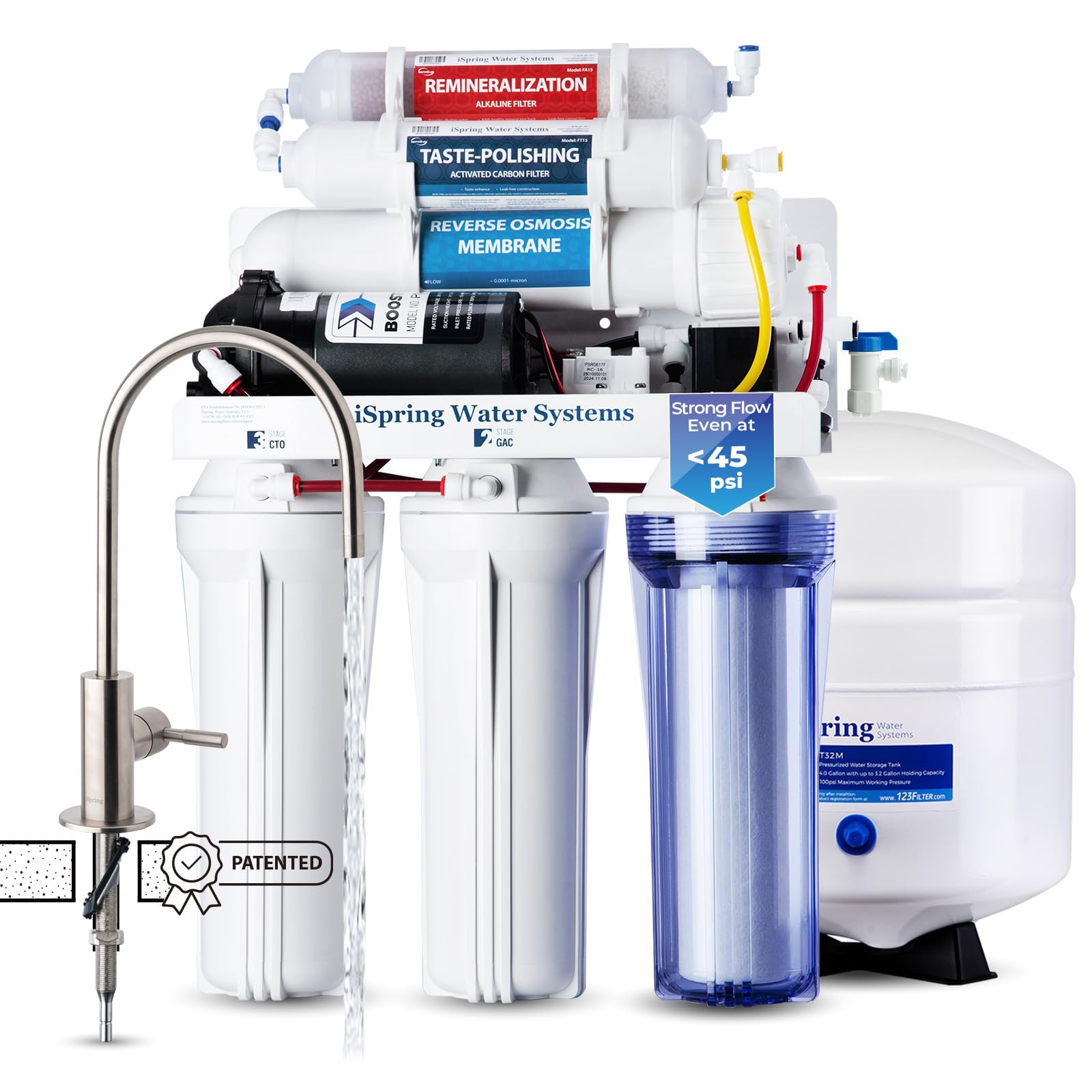
iSpring RCC7P-AK

93 /100
Trail Score Outstanding

Key details

Dimensions
15"L x 8"W x 18"H
Production
75 GPD
Booster Pump
Included
Filtration Stages
6, with alkaline remineralization
Check Price on Amazon

Low pressure is the quiet killer of RO ownership: below roughly 40 psi a membrane barely produces, the tank takes all afternoon to fill, and more water goes down the drain for every gallon made. The RCC7P-AK answers that with a small booster pump bolted to the same six-stage, remineralizing layout as our top pick, and it's the version we recommend to anyone on a well, a top-floor apartment, or an old house with narrow supply lines.

The pump earns its keep beyond pressure. Tank refills come faster and less water is sent to drain per gallon, which is the difference you notice on a meter or a septic system. It runs on a 100-240V adapter, and its source-water ceiling is 2,000 ppm, among the highest here, so mineral-heavy well water is in range.

Pros

  • Booster pump restores output on low pressure
  • Faster refills with less water to drain
  • Six stages with alkaline remineralization
  • 2,000 ppm ceiling handles mineral-heavy water

Cons

  • Booster pump adds a powered part that can fail
Our verdict

The pick for a house with weak water pressure — a booster pump turns a sluggish RO system into one that keeps up.

Check Latest Price
6

Best Countertop

Bluevua RO100ROPOT

92 /100
Trail Score Outstanding

Key details

Filter Life
Up to 24 months
Installation
Countertop, no plumbing
Max Source TDS
1,000 ppm
Filtration Stages
5, with remineralization
Check Price on Amazon

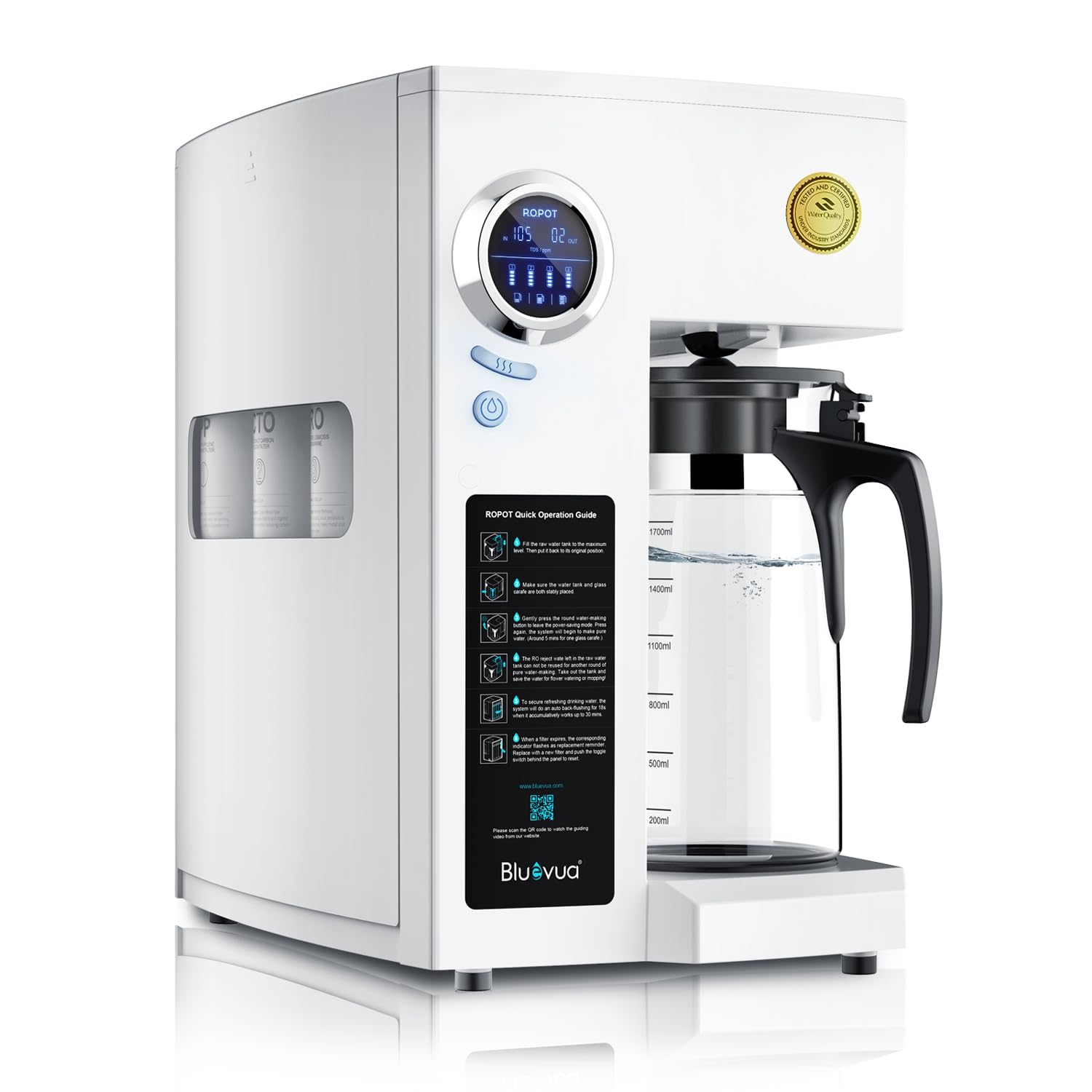
No faucet hole, no drain saddle, no shutoff valve. The ROPOT sits on the counter, plugs into the wall, and fills a glass carafe with RO water, which makes it the only system here that works in a kitchen you're not allowed to modify — a rental, a condo with a stone counter, a place you'll leave in a year.

The trade is pace and batch size. You fill the reservoir, and a carafe comes out over a few minutes; you're not drawing a gallon from a tap. Five stages including a remineralization cartridge, a glass rather than plastic carafe, and a display that counts down filter life instead of leaving you to guess. The cartridges are rated for up to 24 months, which is long for this category and the detail we kept coming back to. There's also a wastewater reservoir to empty, and tipping it over a houseplant is the usual answer.

Where it struggles is volume. A household that cooks with filtered water and fills bottles every morning will be refilling the reservoir constantly, and a couple of carafes at a time is what this is built for. We like it most in a small kitchen where the alternative is nothing at all — it's the difference between actually drinking filtered water and meaning to.

Pros

  • No plumbing or faucet hole required
  • Glass carafe with a remineralization stage
  • Filter life counted down on screen
  • Up to 24 months between cartridge sets

Cons

  • Occupies counter space and needs an outlet
Our verdict

For renters and kitchens that can't be plumbed, this is the RO system to buy — plug it in, fill the carafe, and nothing gets drilled.

Check Latest Price
7

Affordable Tankless

Waterdrop G2

90 /100
Trail Score Outstanding

Key details

Production
400 GPD
Max Source TDS
300 ppm
Filtration Stages
7
Pure-to-drain Ratio
1:1
Check Price on Amazon

Three hundred parts per million is the number that decides this one. That's the ceiling Waterdrop puts on source water for the G2, and plenty of wells and some municipal supplies run above it. Under that line, it's the least expensive route into a tankless system in this group.

What the money buys: a wall-hung body about 17 inches long, 7-stage filtration, 400 gallons a day and a 1:1 pure-to-drain ratio. That last figure is worth understanding before you order — for every gallon of drinking water, a gallon goes down the drain, where the G3P600 sends half as much. On a metered supply or a septic field, that gap adds up over a year.

There's no remineralization stage, so the water tastes like what it is: clean and a little flat. If you've been drinking spring water or a mineral-enhanced brand, that's an adjustment, and it's the main reason to spend more on the iSpring or the APEC instead.

For a small household on water under the ceiling, though, it does what the bigger tankless unit does with a smaller footprint and a lower price. The certification line is worth reading twice: 372 covers lead-free materials rather than filtration performance. Our advice is to buy it, put the difference toward a TDS pen, and enjoy the cabinet floor you just got back.

Pros

  • Least expensive tankless system here
  • 400 GPD in a 17-inch wall-hung body
  • 1:1 pure-to-drain ratio published

Cons

  • 300 ppm source-water ceiling
  • Plain mechanical faucet, no TDS readout
Our verdict

The cheapest way into tankless here, provided your water comes in under 300 ppm — check that before you fall for the footprint.

Check Latest Price

How We Tested Home Reverse Osmosis Systems

To build the shortlist, I started with systems sold for residential kitchens and narrowed by filter stages, treated-water capacity, footprint under the sink, replacement-filter availability, and price. I ruled out units that looked good on paper but required cabinet surgery or proprietary cartridges that were hard to source. That left seven systems, which we ran for nine months in everyday kitchens through morning coffee, pasta-night stockpots, school water bottles, and late-night glasses.

We timed installation with basic tools and noted where the instructions stalled, whether fittings needed extra tape, and how long the first flush took. We measured flow by filling a one-quart container and a stockpot, then watched whether the stream held steady as the tank drained. For leakage, we checked fittings and cabinet floors after startup, after each filter change, and during heavy use; noise got its own test during refills and overnight, when the kitchen was quiet.

Taste and water quality were judged side by side with tap water, at room temperature and chilled, in coffee, and in ice, with notes on chlorine smell, flatness, and any plastic flavor in the first weeks. We tracked filtration performance by logging filter-change intervals, noting sediment color on prefilters, and comparing each system’s published contaminant-reduction claims with what we tasted and smelled. At the end, we added up replacement-filter costs against purchase price, inspected tubing, valves, and housings for weeping, cracks, or mineral buildup, and counted how often each unit needed fiddling.

How to Choose a Home Reverse Osmosis System

Start with the cabinet, not the filter count

A tank system stores a few gallons so you can fill a glass quickly, and it pays for that with floor space. The iSpring takes a 15.5 by 16 inch footprint before you count the tank; the Express Water body is only five inches across. A tankless unit such as the Waterdrop G3P600 hangs on the cabinet wall and gives most of that floor back, but it needs an outlet and a pump that runs whenever you open the faucet.

Watch the word compact. In an RO listing it usually means the cabinet footprint, not the countertop — a countertop model like the Bluevua solves the plumbing problem by taking counter space instead, which is a different trade rather than a smaller one.

Read the certification, not the badge

NSF/ANSI 58 covers a system's reduction performance as a whole; NSF/ANSI 372 covers lead-free materials and says nothing about what the filter removes. A unit can carry 372 without 58 — Waterdrop's G2 materials name 372, while the G3P600 names both.

If contaminant reduction is why you're buying, look for 58 on the full system, then check that the specific contaminant you're worried about appears on the certification. It's a two-minute check that separates a real claim from a decorative one.

Pressure and TDS decide whether it works at all

The tank systems here publish operating ranges that start around 40 psi. Below that, a membrane produces slowly, the tank takes hours to refill and more water goes to drain — which is exactly the case for a booster-pump model like the iSpring RCC7P-AK.

The other figure is the source-water ceiling. Budget units often cap around 300 ppm TDS, while the iSpring and APEC models reach 750 and 2,000. Look up your municipal report or read a TDS pen before ordering, because a system run past its ceiling won't deliver the water it promises.

What RO does to the taste of your water

Reverse osmosis takes minerals out along with the contaminants, and the result can taste thin. A remineralization stage — alkaline in the iSpring, calcium in the APEC, both sitting in the sixth position — puts some back, and most people notice it as a rounder glass of water rather than anything measurable.

It's a preference, not a requirement. If crisp, empty-tasting water is what you're after, the Express Water and the Waterdrop units skip the mineral stage and cost less because of it.

Installation: the part that decides your weekend

Every under-sink system needs a faucet hole, a feed-water adapter on the cold line and a drain saddle, plus a shutoff you can reach. A top-mounted faucet fastener, as on both iSpring models, lets you tighten from above the counter instead of lying on your back with a basin wrench.

Plan for the first week, not the first hour. Drips start at the faucet and the quick connects, so leave a paper towel under the fittings and check it twice in the first seven days. Register the warranty the day you install — replacement faucets and fittings are the usual first request.

Frequently Asked Questions

Final Verdict

Most homes should buy the iSpring RCC7AK-BN. It's certified as a complete system to NSF/ANSI 58, it puts minerals back into water the membrane strips, it runs on line pressure alone, and it costs less than the tankless units. The trade is a wide body and a tank on the cabinet floor.

If your pressure is low, the RCC7P-AK's booster pump is the difference between an RO system that keeps up and one that doesn't. If the cabinet has no floor to give, the Waterdrop G3P600 buys it back, along with a faucet that tells you what the membrane is doing.