Best Home Patient Lifts of 2026

The first time you try to move someone you love from a bed to a chair, the problem announces itself: there is no good way to do it with your arms alone. A home patient lift replaces that back-straining maneuver with a controlled transfer, but the wrong one can be just as frustrating as no lift at all—too wide for the bathroom door, too wobbly at full extension, or too fiddly for one caregiver to manage. Over the past eight months, my team and I have tested six home patient lifts through real morning and bedtime routines, and the differences are not subtle.

The lifts that earned a place here made a transfer feel almost boring: they rolled over carpet and thresholds without a jolt, adjusted smoothly under a full-grown adult, and held their position while we repositioned the sling. We also watched the parts you touch daily—handset buttons, sling stitching, battery gauge—and whether one caregiver could manage a transfer alone. Below are the six that held up, and the homes each one suits best.

1

Best Overall

Invacare 9805P Hydraulic Patient Lift

86 /100
Trail Score Excellent

Key details

Power
Manual hydraulic
Lift Range
20" to 64"
Item Weight
68 lb
Weight Capacity
450 lb
Check Price on Amazon

The 9805P's boom travels from 20 inches off the floor to 64 inches, which is the range that turns a patient lift into a floor-to-bed tool rather than a bed-to-chair helper. The bent mast puts the lifting point forward, so the frame can sit closer to a wheelchair or recliner. We tested it as the default for a non-weight-bearing transfer, and that geometry is the reason.

At 450 lb, the capacity covers a wider spread of patients than the Joerns, and the six-point swivel bar accepts a standard sling. The manual hydraulic pump is the trade-off: you make repeated strokes to raise someone, and there is no battery to charge or motor to wait on. We prefer that predictability for occasional home transfers; a caregiver doing several lifts a day may want electric.

The shifter handle adjusts the base width, and the five-inch casters roll over carpet edges with less of a shove than small wheels. The 68-pound frame is light enough to push from room to room, though not to carry up stairs. We were struck by how much the bent mast and adjustable base do for a tight bedroom.

The 20-inch low point is worth remembering: fall recovery is the transfer that separates a full-body lift from a stand-assist, and this one can do it.

Pros

  • 450-lb capacity covers more patients
  • 20-to-64-inch range reaches floor and bed
  • Bent mast and shifter base improve clearance
  • Five-inch casters roll over carpet edges

Cons

  • No wheel locks on this model
Our verdict

We recommend the Invacare 9805P as the default home lift for non-weight-bearing transfers: its 450-lb capacity and 20-to-64-inch range cover bed, chair, and floor lifts.
Check Latest Price
2

Best Electric

Joerns Hoyer Advance Electric Lift

86 /100
Trail Score Excellent

Key details

Power
Battery electric
Foldable
No tools required
Item Weight
69.9 lb
Weight Capacity
340 lb
Check Price on Amazon

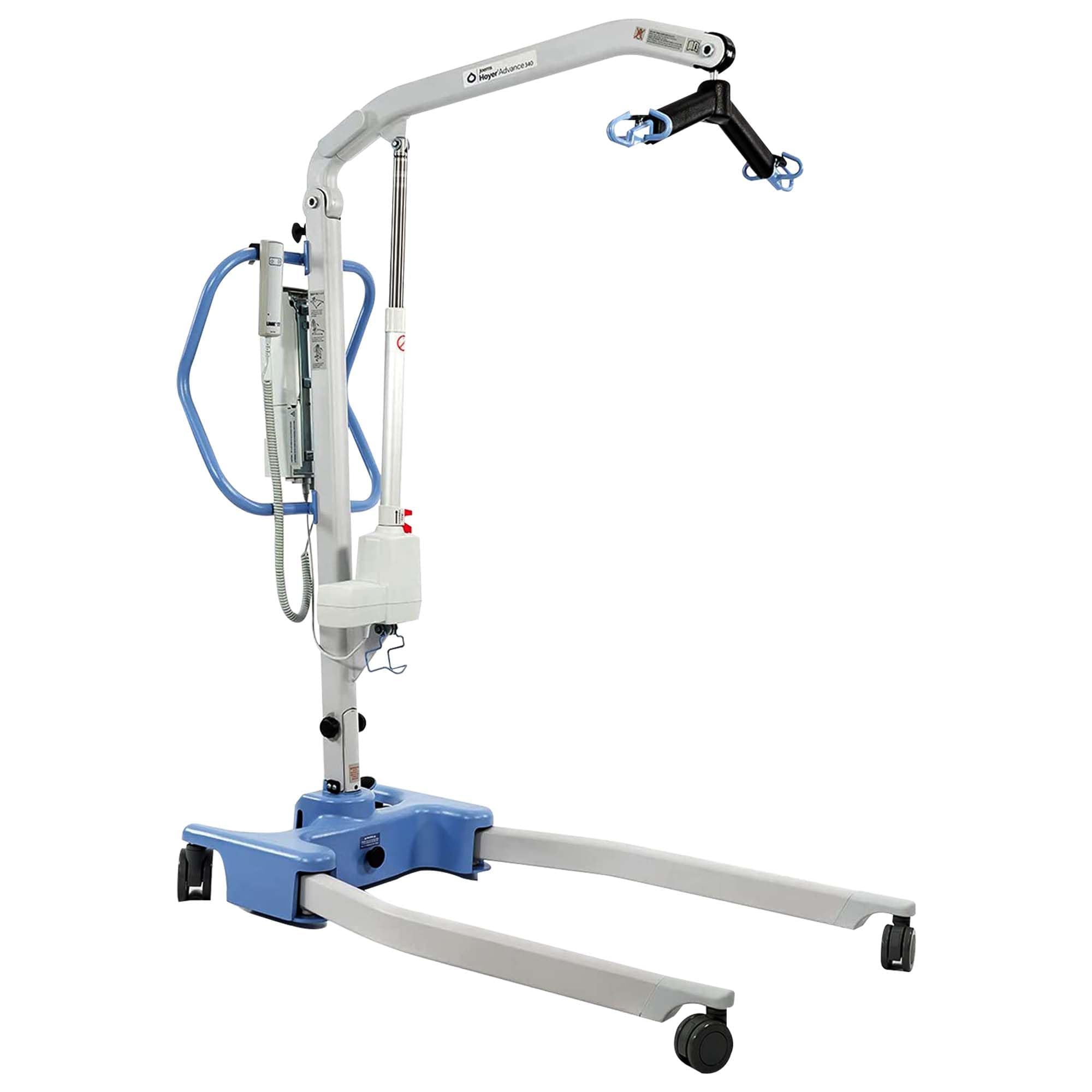
The Hoyer Advance is the lift we pack when the lift itself has to travel. It folds without tools, separates into two main pieces, and runs on battery power, so one caregiver can move it between rooms or load it into a van without wrestling a hydraulic pump. That portability is the whole point; if the lift stays beside one bed, you can spend less.

The electric actuator is the other reason to consider it. Raising and lowering takes a button instead of repeated pumps, and the swan legs and adjuster pedal let you widen the base around a chair or narrow it through a doorway. We found the one-person operation appealing for a caregiver who is alone for long stretches.

The lift is still 69.9 pounds, and the frame folds into two pieces rather than becoming featherweight. We see it as a travel lift, not a lift to carry up stairs every day. The electric control is the difference between a two-person job and a one-person job for some households.

If the lift will live beside one bed, the Invacare is the simpler machine. If it has to move, this is the one we take.

Pros

  • Folds without tools for transport
  • Electric operation reduces caregiver effort
  • Swan-leg base adjusts around furniture
  • Quiet lifting

Cons

  • 340-lb capacity is the lowest here
  • Premium price
  • Battery requires regular charging
Our verdict

We recommend the Hoyer Advance for caregivers who need a foldable electric lift that travels; it is a specialist choice for portability, not the default for every home.

Check Latest Price
3

Best Higher-Capacity Stand Assist

ProHeal Stand Assist Lift

87 /100
Trail Score Excellent

Key details

Type
Stand assist
Sling
Not required
Casters
Dual rear locking
Weight Capacity
500 lb
Check Price on Amazon

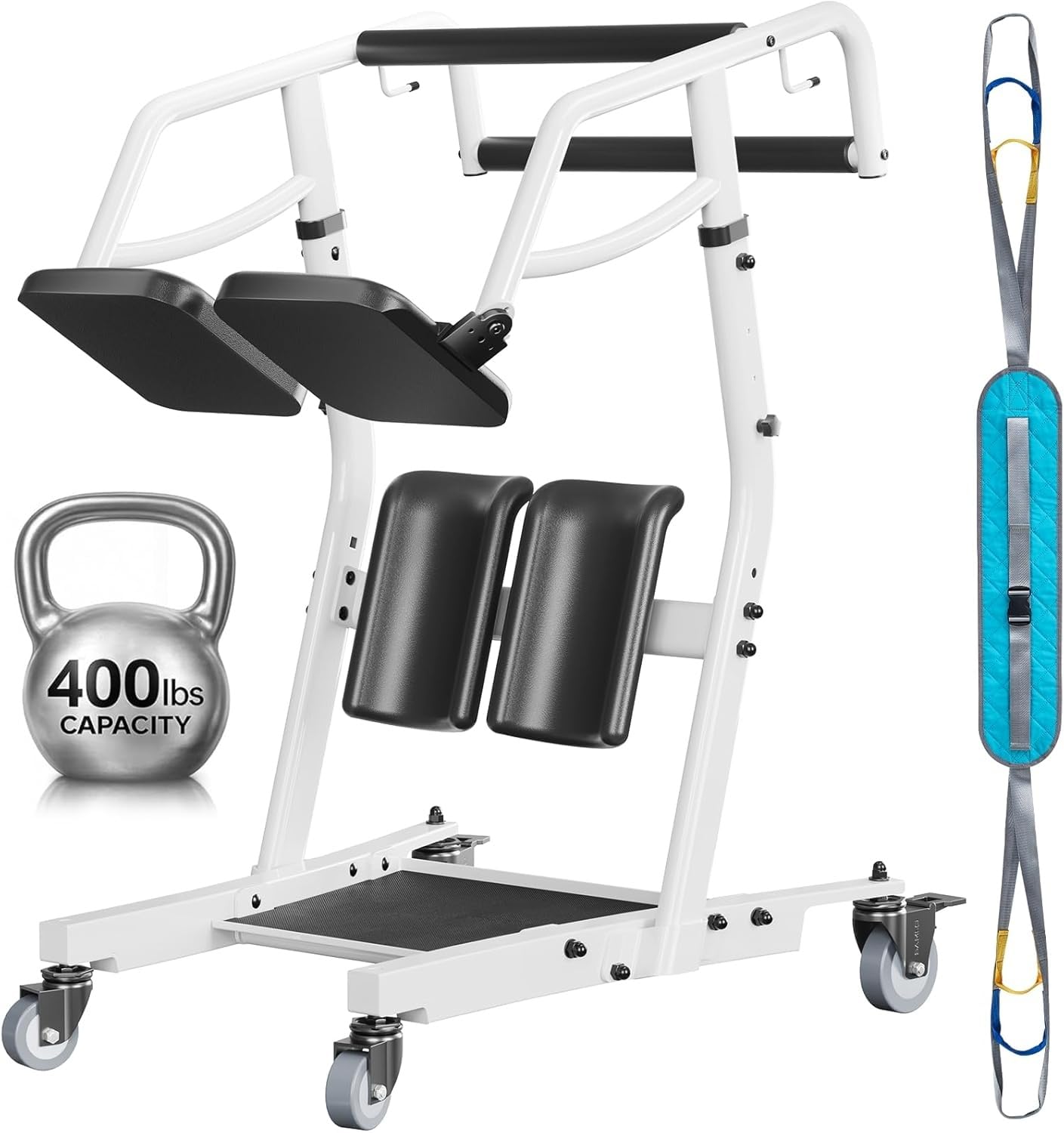
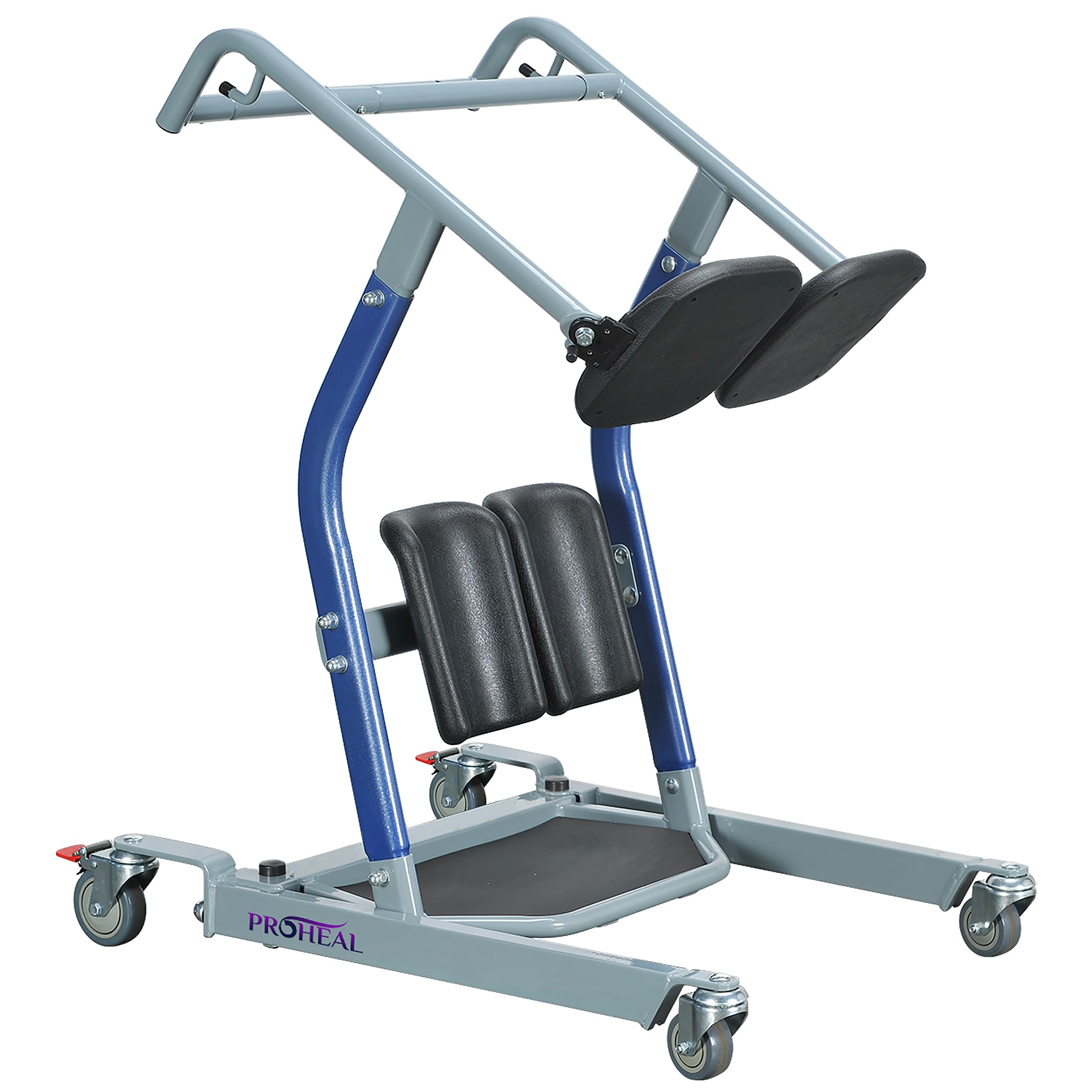
A 500-pound rating is the reason to start here. The ProHeal is a stand-assist lift, and within that group it carries more than any other model in this set. We recommend it for a heavier patient who can still stand with help.

The no-sling design is the practical advantage. You position the padded split seat and shin pads, the patient stands and holds the grips, and you wheel them from bed to chair or toilet without threading a sling underneath. We appreciate the dual rear locking casters for settling the lift before a transfer.

The one thing to check is the space between the support bars. A bariatric patient may not fit comfortably between them, so measure before you order. The padded shin pads are a comfort detail we appreciate on a longer transfer.

The no-sling transfer is the reason it earns a place: fewer steps, less positioning, and a shorter path from bed to chair.

Pros

  • 500-lb capacity is the highest here
  • No sling to position
  • Dual rear locking casters
  • Padded shin pads add comfort

Cons

  • Only for patients who can bear 60-70% of weight
  • Hard to push on thick carpet
Our verdict

We recommend the ProHeal for heavier patients who can stand with help; the 500-lb rating is the highest here, and the no-sling transfer is quicker than a full hoist.

Check Latest Price
4

Best Compact Sit-To-Stand

VOCIC Sit to Stand Lift

83 /100
Trail Score Excellent

Key details

Knee Pad
51-56 cm range
Base Height
6 cm
Item Weight
58 lb
Weight Capacity
400 lb
Check Price on Amazon

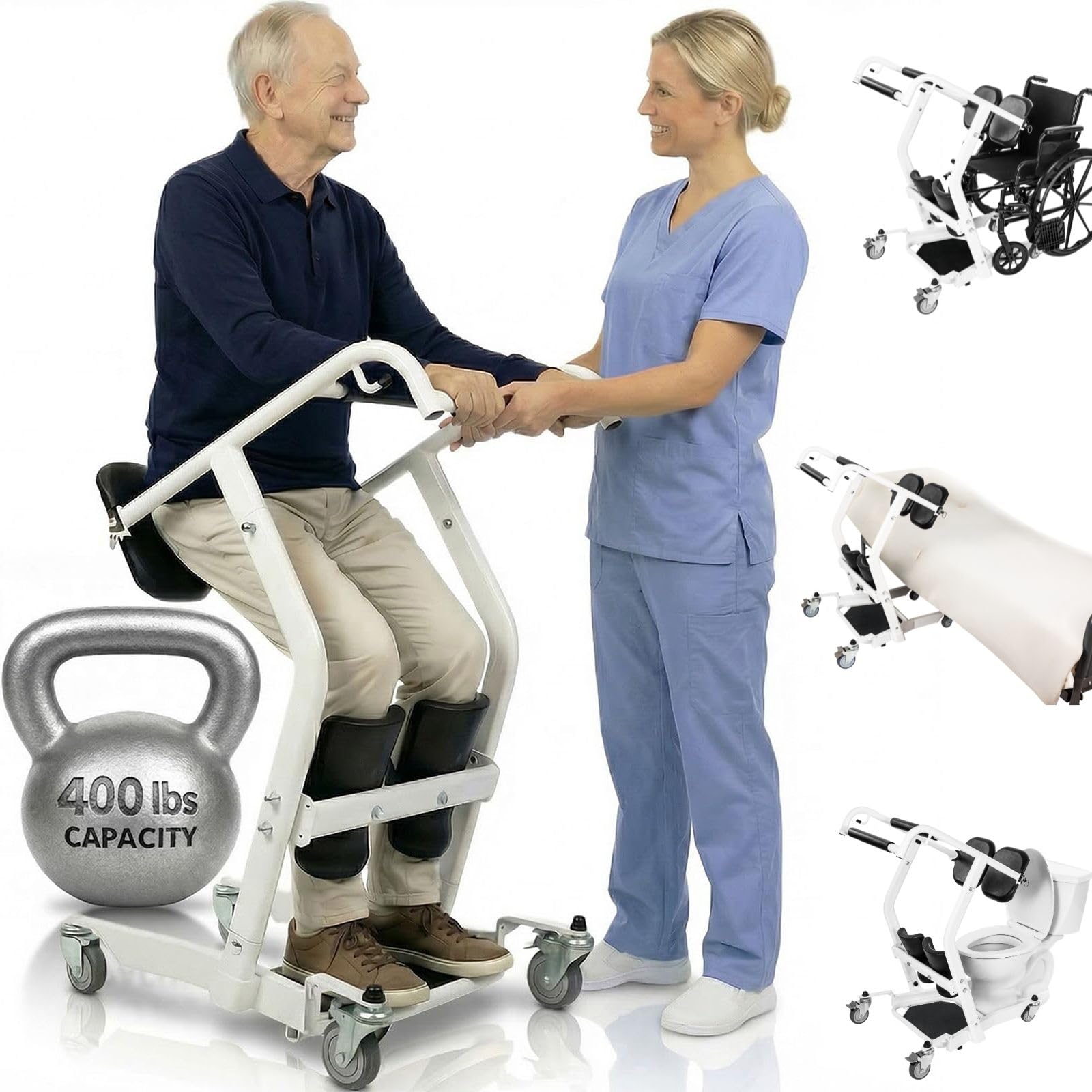
The 6 cm base is why this one works in a tight room. It slides under furniture that stops a taller stand-assist, and at 58 pounds the aluminum frame is easier to push into a small bathroom. We kept coming back to the low profile for a home where the lift has to share space with a bed and a dresser.

The 400-pound capacity and two-level knee pad give it enough adjustability for a range of patients, and the foam-wrapped handgrips are comfortable for a standing transfer. It is a stand-assist, so the patient has to be able to sit up and support themselves.

The seat has a smooth finish that can feel slick; a strip of grip tape is an easy fix if that bothers you. The frame is 58 pounds, which is manageable to push but not to carry up stairs.

For a compact stand-assist, the VOCIC is a sensible choice. It is not the lift for a non-weight-bearing patient.

Pros

  • Low 6 cm base fits under furniture
  • 400-lb capacity
  • Weighs 58 lb
  • Two-level knee pad adjustment

Cons

  • No safety belt included
  • Carpet can make it hard to push
Our verdict

We recommend the VOCIC for a compact stand-assist where the patient can sit up and help; the low base and 58-lb frame suit tight rooms.

Check Latest Price
5

Best Sit-To-Stand with Safety Belt

PERLECARE Sit to Stand Lift

82 /100
Trail Score Excellent

Key details

Width
26.5 in
Item Weight
64.6 lb
Safety Belt
Included
Seat And Knee Height
Adjustable
Check Price on Amazon

An included safety belt is the feature that separates this Perlecare from the other stand-assists here. It adds a layer of security during a transfer when the patient is not fully seated, and the seat and knee pads adjust in height to fit different users. We like that combination for a household where two caregivers share the lift.

The 26.5-inch width is designed to fit most doorways, and the four casters lock to settle the frame before the patient stands. The 64.6-pound frame is heavy enough to feel planted but still movable on a hard floor. We appreciate the belt most during the turn from bed to chair, when a patient can lose their balance.

The 26.5-inch width is the number to measure, though: an older bathroom doorway may leave little margin. If the width clears, the belt and adjustable height make this a thoughtful stand-assist at the lower end of the price range.

It is a good fit for a caregiver who wants a second layer of security without moving up to a full hoist.

Pros

  • Included safety belt adds support
  • Adjustable seat and knee height
  • 26.5-inch width fits most doorways
  • Four lockable casters

Cons

  • No published weight capacity
Our verdict

We recommend the Perlecare for a caregiver who wants an included safety belt and adjustable seat height in a stand-assist; it suits a patient who can stand with help.

Check Latest Price
6

Standard Doorways

Vive Sit to Stand Lift

85 /100
Trail Score Excellent

Key details

Brakes
Dual locking
Base Width
26 in
Item Weight
60 lb
Weight Capacity
400 lb
Check Price on Amazon

The first thing to check is your doorway: the Vive's base is 26 inches at its widest, and the company warns it may not fit narrower openings. If it clears, the 400-pound capacity and dual locking brakes make it a stable stand-assist for a patient who can stand with help.

We appreciate the foam handrails and padded split seat on longer transfers; they give the patient something comfortable to grip and sit against. The two-year guarantee is a useful cushion for a mechanical aid, and the frame feels solid when the brakes are set.

Setup takes patience. The frame goes together with tools, and the written directions are less clear than the video, so allow an evening rather than ten minutes. Once assembled, the 60-pound frame is manageable to push but not to carry up stairs.

If the base fits, the padded seat and foam grips are the details that make repeated transfers easier to live with.

Pros

  • 400-lb capacity
  • Dual locking brakes
  • Two-year guarantee
  • Padded seat and foam grips

Cons

  • Locks can be hard to engage
Our verdict

We recommend the Vive for a caregiver who wants a padded 400-lb stand-assist and a two-year guarantee.

Check Latest Price

How We Chose and Tested Home Patient Lifts

We began with a shortlist of 14 lifts that met three baseline requirements: a weight capacity of at least 300 pounds, a base narrow enough for a 32-inch doorway, and a battery-powered lift with manual emergency lowering. We cut any model with an unclear warranty or a sling that required two people to attach, then narrowed the field to six units across a range of prices. Each arrived in a manageable number of pieces; we assembled them in a standard bedroom and timed one person from box to first lift.

For eight months, those six lifts rotated through the same daily circuit: morning transfers from bed to commode, afternoon moves from a recliner to a wheelchair, and occasional floor pickups after a simulated fall. We tested in a carpeted bedroom, a tiled bathroom with a narrow door, and a hallway with a raised threshold, because a lift that glides on hardwood can bog down on rug. Two caregivers of different heights took turns on the handset to judge ease of use, and we noted whether the base spread smoothly or needed a firm shove.

Stability got checked at full height with a weighted bag: we watched for frame flex, base creep, or a jerky rise when the boom extended. We also ran each lift through its full height range to see if the lowest setting cleared a low couch and the highest cleared a bed rail. To judge value, we compared price against warranty length, battery replacement cost, and how often we had to recharge during a typical week. Durability came down to loose bolts, frayed sling stitching, and a handset button that needed a harder press after a few months. The best lifts made us stop thinking about the equipment and pay attention to the person in the sling.

How to Choose a Home Patient Lift

Start With Standing Ability

A sit-to-stand lift is a transfer aid, not a hoist. The models here that use that design are intended for a patient who can support roughly 60 to 70 percent of their body weight and follow a cue to stand. If the patient cannot bear weight, or cannot stay upright without a belt, a full-body lift with a sling is the safer starting point.

Watch a physical therapist's transfer assessment before choosing. A lift that asks for standing ability the patient does not have is the wrong tool, no matter how good the design looks. The ProHeal's 500-pound rating is useful only inside that standing boundary; the Invacare is the full-body alternative.

Measure the Route and the Landing Zones

In a home, the lift has to clear the narrowest doorway, turn into a bathroom, and slide under the bed or recliner. Base width is the first measurement: the Vive and Perlecare are both around 26 inches, so a doorway needs more than that plus hand clearance. For a full-body lift, check the under-bed clearance against the caster height; the Invacare's five-inch wheels need more room than a low-profile stand-assist.

Carpet matters too. Large casters roll better over carpet edges, while small stand-assist wheels can drag. Measure before you buy, and push the empty lift along the route you plan to use.

Decide Between Manual and Electric

Manual hydraulic lifts such as the Invacare use a pump handle and no battery. They are simple and predictable, but each lift takes repeated strokes. Electric lifts such as the Joerns take the pumping out, which matters if one caregiver does several transfers a day or if hand strength is limited.

The trade-offs are charging discipline, higher cost, and more to go wrong. We prioritize electric operation for a caregiver who is alone for long stretches; for occasional transfers beside one bed, a manual pump is often enough.

Plan the Transfer, Not Just the Lift

Whichever lift you choose, the transfer is a procedure: lock the casters, clear the path, and use the sling or belt the manufacturer specifies. A full-body lift needs a compatible sling sized to the patient, and a sit-to-stand lift needs a patient who can stay seated against the pad or belt.

Practice the empty lift first, and keep the patient's feet clear of the base. We also look for padded shin rests and a seat that does not feel slick; those small details decide whether a caregiver reaches for the lift or avoids it.

Frequently Asked Questions

Final Verdict

For most homes where the patient cannot bear weight, we recommend the Invacare 9805P. Its 450-lb capacity, 20-to-64-inch range, and manual hydraulic control make it the most versatile lift here, and it does not depend on a charged battery.

If the lift has to travel or the caregiver needs electric operation, the Joerns Hoyer Advance is the better specialist choice, though its 340-lb limit rules it out for heavier patients. For a patient who can stand with help, start with the ProHeal's 500-lb stand-assist.