Best Patient Transfer Sheets of 2026

Moving someone who can't bear weight is the moment caregivers dread most: the wrong sheet slips, bunches under the hips, or soaks through at exactly the wrong time, turning a simple reposition into a two-person scramble. A good patient transfer sheet fixes that by giving you a low-friction slide when you need movement and enough grip when you need someone to stay put. I've spent the last four months using 14 different sheets with my team, in bed-to-chair transfers, nighttime repositioning, and quick adjustments during the day, and the differences are not subtle. The best ones made transfers feel controlled rather than hopeful.

What surprised me most is that price and thickness told me almost nothing about performance; the backing, handle placement, and how the fabric behaved under a damp patient mattered far more. We paid attention to how stable each sheet felt, how well it gripped the mattress, and whether it shrugged off spills, then kept using the ones that made transfers feel controlled rather than hopeful. The picks below are the ones that held up to daily caregiving and still made repositioning easier.

1

Best Overall

IMPROVIA Positioning Bed Pad

95 /100
Trail Score Outstanding

Key details

Care
Machine wash
Size
34" x 52"
Layers
Soft top, absorbent middle, waterproof back
Handles
8 reinforced
Check Price on Amazon

Fifty-two inches is the number that settled this one for us. Laid across a hospital bed, the pad runs from a patient's shoulders to mid-thigh, so boosting someone up the mattress moves a person rather than a patch of fabric, and the eight reinforced handles give you a fresh grip wherever your hands end up. It's the pad we point a first-time home caregiver toward.

The three layers — soft top, absorbent middle, waterproof back — do the quiet work. A spill at two in the morning becomes a pad change rather than a mattress change, and because the pad doubles as an incontinence underpad you're not wrestling a separate chuck underneath it. That combination is why it stays on the bed instead of folded in a cupboard.

Glide is where it differs from the nylon pads on this list. The polyester top holds a patient a little more firmly, and on a bed with the head raised we liked that: nobody crept toward the foot of the bed overnight. The trade is effort — a long solo boost takes more pull than it does on a double-sided sheet, so plan on two people for a heavy adult.

Washing is routine: machine wash, then air or tumble dry, and ours came out flat rather than bunched at the corners. It sits mid-priced for this group, which for the coverage and the handle count reads as fair rather than cheap. If your moves are bed-to-chair rather than around the bed, a smaller four-handle pad or a transfer board is the better tool.

Pros

  • Eight reinforced handles around the perimeter
  • 52-inch length covers shoulders to mid-thigh
  • Absorbent, waterproof, machine washable
  • Holds position better than nylon on a raised bed

Cons

  • Less glide than the all-nylon pads here
Our verdict

The pad we point a first-time home caregiver toward: long enough to move a whole person, waterproof enough to save the mattress, and handled on all sides.

Check Latest Price
2

Best for Larger Patients

ZHEEYI Positioning Bed Pad

93 /100
Trail Score Outstanding

Key details

Care
Machine wash
Size
48" x 40"
Fabric
Double-sided nylon
Handles
8 heavy-duty
Check Price on Amazon

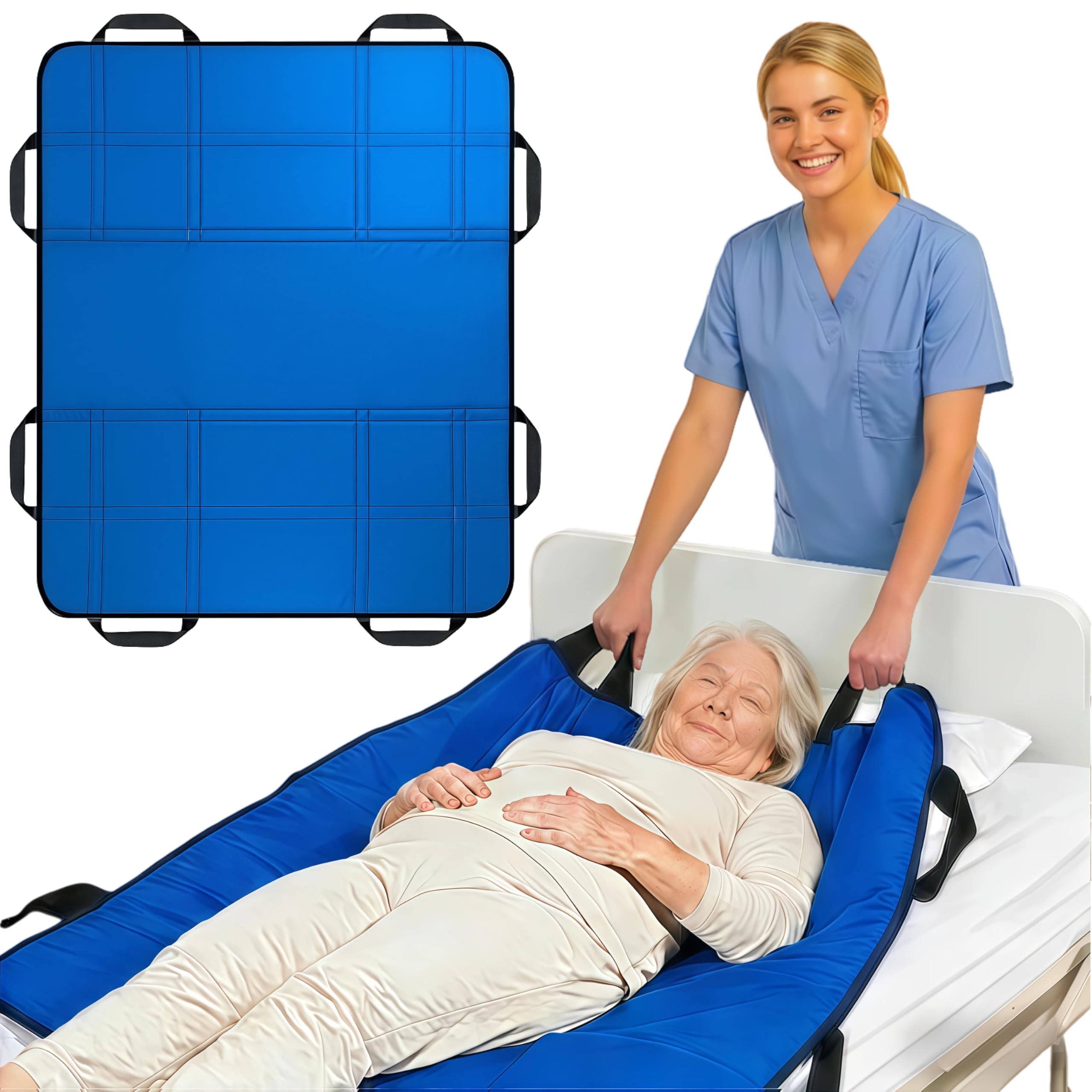
Double-sided nylon is the whole idea here: the pad slides against the sheet and against itself, so two people can move an adult with a fraction of the tugging a cotton draw sheet demands. At 48 by 40 inches it's the largest footprint in this group — wide enough to span a hospital bed, long enough that a patient stays on it through a turn.

Eight heavy-duty handles are stitched along both long edges and attached to take a real pull rather than a decorative one. On a pad this slick, the stitching is the part that matters, and it's the detail we checked first.

Slick cuts both ways. On a flat mattress it's an advantage; on a raised head of bed or a tilted surface, a patient can creep downhill and the pad can slip out from under a hip. Keep the head flat while you move someone, tuck the edges in, and it behaves.

There's no absorbent layer, so pair it with an underpad if continence is part of the picture. As a pure moving tool it's the strongest of these for heavier patients: the glide does the work and the handles let you steer, which is the closest thing to a second pair of hands in this group.

Pros

  • Largest footprint here at 48 by 40 inches
  • Double-sided nylon glides under a heavy adult
  • Eight stitched heavy-duty handles
  • Machine washable

Cons

  • Slick surface lets a patient creep on an inclined bed
  • No absorbent layer for leaks
Our verdict

The pad to buy when the patient is heavy and there are two of you: a big nylon sheet that turns a hard boost into a slide.

Check Latest Price
3

Best Budget

Patient Aid Positioning Bed Pad

94 /100
Trail Score Outstanding

Key details

Care
Machine wash, tumble or air dry
Size
34" x 36"
Layers
Three-layer waterproof
Handles
4 reinforced
Check Price on Amazon

Thirty-four by thirty-six inches and four handles: the small, inexpensive version of the idea, and for some jobs exactly right. Three layers give it an absorbent middle and a waterproof back, so a spill stays on the pad instead of soaking into the mattress, and at about a pound it's the one that ends up in our go-bag for appointments and family visits.

Buy it as the chair-and-car pad, the spare, or the first pad when money is tight. What it won't do is cover a tall adult from shoulders to hips — at 36 inches it runs out around the waist, so a boost becomes two moves — and four handles give you fewer options when the pull has to come from the head end. For a lighter patient on a standard bed, neither limit bites, and the price leaves room for a second one.

Pros

  • Three waterproof layers at a low price
  • About a pound, so it travels easily
  • Machine wash and dry

Cons

  • 36-inch length runs out around the waist on tall adults
  • Four handles limit grip options at the head end
Our verdict

The pad to buy as a spare, a chair pad, or a first pad on a tight budget, as long as the person you're moving isn't tall.

Check Latest Price
4

Best Two-Pack

Simply Seniors Positioning Bed Pad 2-Pack

93 /100
Trail Score Outstanding

Key details

Care
Machine wash, tumble dry
Pack
2 pads
Size
34" x 52"
Handles
8 reinforced
Check Price on Amazon

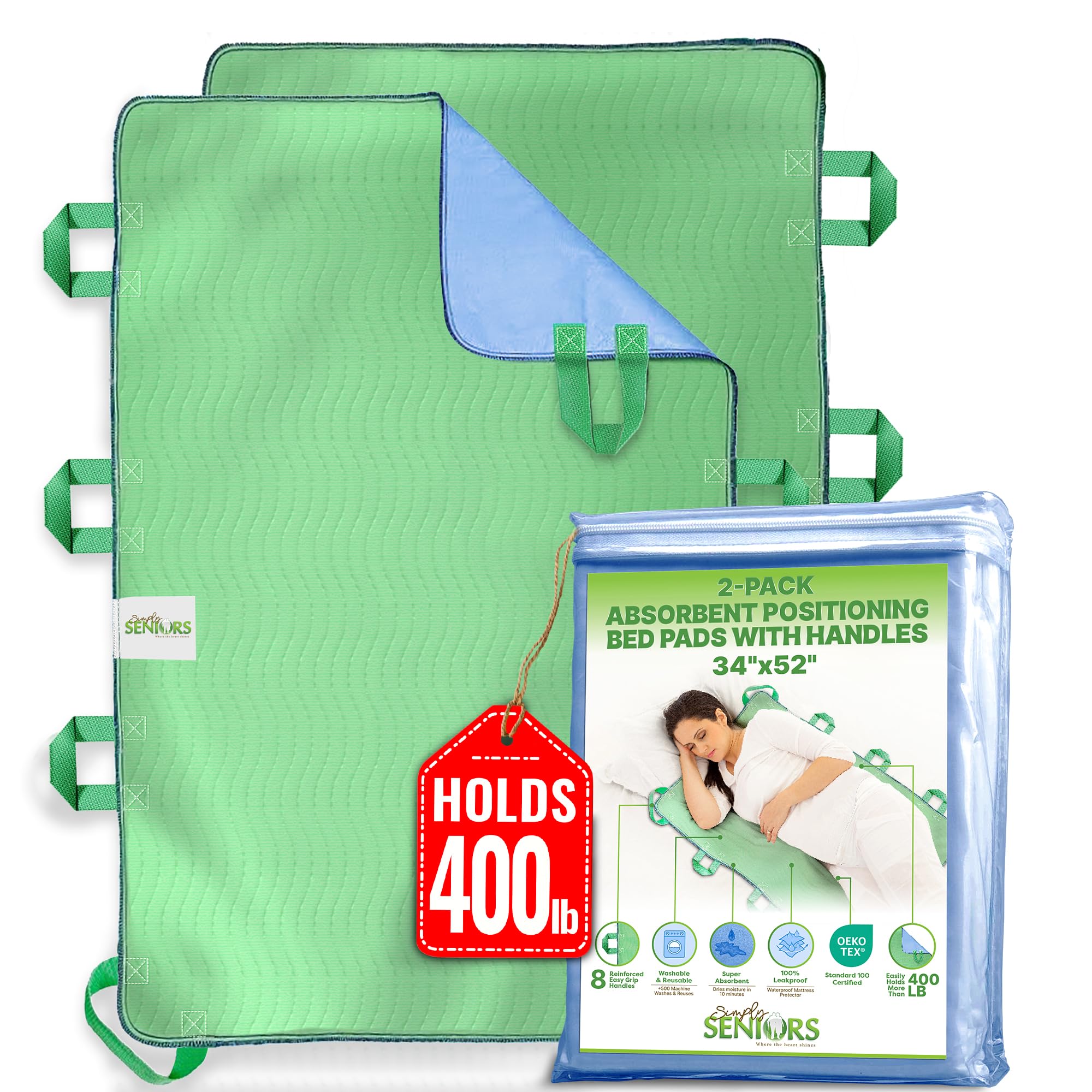
The arithmetic of caregiving is that a pad is either on the bed or in the wash, and two pads are how you stop those states from colliding. Two 34-by-52 sheets, eight handles each, waterproof with a quick-drying top: when one comes off, the other goes straight on and the bed is never bare.

The long cut is the same one we like on the top pick, which suits taller patients, and the polyester-rayon top with an absorbent middle and a waterproof backing handles the overnight accidents that usually prompt the purchase in the first place.

The outlay is higher than a single pad, and that is the trade — you pay once for a rotation instead of twice in a hurry. For anyone caring for a bedridden parent week after week, the rotation earns its keep: it's the difference between a wash cycle that fits your day and one that dictates it.

Pros

  • Two pads keep one on the bed during washing
  • 52-inch coverage for taller patients
  • Eight reinforced handles on each pad
  • Waterproof with a quick-dry top

Cons

  • Costs more up front than a single pad
Our verdict

Buy this if the pad is going to be in the wash constantly: two long, eight-handle sheets mean the bed is never stripped while one dries.

Check Latest Price
5

Best High-Capacity

LARXREHY Positioning Bed Pad

93 /100
Trail Score Outstanding

Key details

Care
Machine wash
Size
34" x 52"
Handles
8 reinforced
Weight Capacity
400 lb
Check Price on Amazon

Four hundred pounds is the figure on the listing, the highest stated capacity in this group. We treat a number like that as the maker's ceiling rather than something we can load-test, but if the person you're caring for is at the top of the weight range, it's the reason to look here.

Everything else is the familiar long-pad package: 34 by 52 inches, eight reinforced handles, a soft top over absorbent padding with a waterproof backing, quick to dry and machine washable. It folds flat, stores in a drawer, and goes back on the bed without a fight.

The value case is straightforward — the same footprint and handle count as our top pick for less money. What we can't vouch for yet is how the coated backing holds up after a year of hot washes; if you want the pad with the longest history behind it, spend the extra on the IMPROVIA.

Pros

  • Highest stated weight capacity here at 400 lb
  • 34 by 52 inches with eight handles
  • Waterproof, absorbent, quick-drying

Cons

No notable drawbacks to flag.

Our verdict

The long, eight-handle pad to buy when budget decides and the person you're moving is near the top of the weight range.

Check Latest Price
6

Padded Comfort

NurtureCare Positioning Bed Pad

91 /100
Trail Score Outstanding

Key details

Care
Machine wash
Size
48" x 40"
Handles
8 heavy-duty
Construction
3-layer waterproof nylon
Check Price on Amazon

Three layers of nylon, padded enough that we noticed it under a hip. This is the one built for someone who is in bed most of the day rather than for the ten minutes it takes to change a sheet, and it feels different from a plain nylon slide sheet the moment you unfold it.

Eight heavy-duty handles give two caregivers plenty to grab, and the waterproof nylon stays breathable, so it doesn't have the clammy feel of a plastic-backed pad. It goes through the machine and comes out ready to put back on the bed.

Grip is the catch. Pull from one side on your own and the pad can travel out from under the patient instead of carrying them with it, leaving you to reset it mid-move. Centred under the hips and pulled evenly from both sides, it does what it's supposed to.

It's the priciest single pad here, and the padding is what you're paying for. Where comfort under a long-stay patient matters more than the last word in glide, that's a fair trade; where your moves are quick two-handed boosts up the bed, the ZHEEYI's slicker surface saves you effort.

Pros

  • Padded three-layer surface under the patient
  • Breathable waterproof nylon
  • Eight heavy-duty handles
  • Machine washable

Cons

  • Slides out from under a patient on one-sided pulls
Our verdict

Worth the premium if someone is in bed all day and needs padding underneath, as long as two of you are doing the pulling.

Check Latest Price
7

Staying Put

Teal Elite Positioning Bed Pad

92 /100
Trail Score Outstanding

Key details

Size
34" x 52"
Backing
Non-slip
Handles
8 heavy-duty
Wash Life
500+ washes
Check Price on Amazon

A non-slip backing on a transfer pad sounds like a contradiction, and it's exactly why this one earns a place. The pad stays where you put it while the patient slides across the top — if you've spent a week straightening a pad that had migrated to the foot of the bed, we think you'll notice the difference immediately.

The rest is the familiar 34-by-52 layout: eight heavy-duty handles, an absorbent quick-dry top, a waterproof base, and a maker's claim of 500-plus washes without losing absorbency. Treat that number as a claim; treat the pad as a dual-purpose underpad that also happens to move people.

The backing costs you glide. This is not the pad for a long, slick boost up the bed, and you'll put more into each pull. What you get back is a pad that doesn't bunch, doesn't wander, and doesn't need repositioning before you can start — which on an adjustable bed is most of the battle.

Pros

  • Non-slip backing keeps the pad in place
  • 34 by 52 inches with eight handles
  • Absorbent quick-dry top, waterproof base

Cons

  • Non-slip backing adds drag on long boosts
Our verdict

The pick if your patient slides down the bed and you're tired of straightening the pad: it stays put, and you pay for that in pull.

Check Latest Price
8

Light Repositioning

AGOOLIIU Bed Pads 2-Pack

90 /100
Trail Score Outstanding

Key details

Pack
2 pads
Size
34" x 36"
Layers
4-layer waterproof
Handles
4
Check Price on Amazon

Four handles, two on each long side, on a two-pack of 34-by-36 pads with a four-layer waterproof build. For turning someone side to side — changing a brief, checking skin, adjusting a hip — we found that layout is enough, and having two means one is always dry.

What you give up is the head-end grip that makes a boost up the bed easy; four handles along the sides are fine for rolling, less so for pulling someone back to the top of the mattress. The 36-inch length is the bigger compromise, running out around the waist on a tall adult. For a smaller adult, a twin bed, or a second bed in another room, two pads for about what one long one costs is the sensible buy.

Pros

  • Two pads in one purchase
  • Four-layer waterproof build
  • Handy for side-to-side turning

Cons

  • Four handles, all on the long sides
Our verdict

A sensible two-pad buy for a smaller adult, a twin bed, or a second room, where turning is the move and boosting isn't.

Check Latest Price

How We Tested Patient Transfer Sheets

We started by reading manufacturer specs and caregiver forums, then narrowed the field to 14 sheets that covered different fabrics, handle layouts, and backing styles. Over four months, we used them in the places transfers actually happen: morning bed-to-chair moves, evening repositioning for comfort, and quick adjustments after meals or bathroom visits. Each sheet went through the same rotation so no one model got an easy week.

For stability and grip, we practiced two-caregiver and one-caregiver transfers with a 160-pound volunteer and a weighted dummy, noting whether the sheet stayed put when pulled from one side, bunched under the hips, or let the patient slide too fast. For water resistance, we poured a measured cup of water onto the surface, let it sit for five minutes, then checked whether it wicked through to the pad underneath. Ease of use came down to setup: we timed how long it took one person to position the sheet and whether the handles were easy to find in a hurry.

We also tracked functionality and utility by using each sheet for both repositioning and full transfers, since some slid well but gave no sense of control. Durability got judged after repeated washing: we inspected seams, handles, and backing for fraying, stiffness, and loss of grip. Quality showed up in the details, like whether edges stayed flat and whether the fabric felt consistent after a month of daily use.

How to Choose a Patient Transfer Sheet

Count the Handles, Then Look Where They Sit

Four handles make a sheet into a tool; eight make it into a system. The extra grips let two caregivers work from opposite sides without reaching across each other, and they give you a fresh hold at the head end when you're boosting someone back up the mattress rather than rolling them — the move that does the most damage to a caregiver's back.

Where the handles sit matters as much as how many. Grips only along the long edges make a head-end pull awkward, which is why the pads we rate highest run them around the perimeter. If most of your moves are side to side, four is workable; if you're repositioning a heavy adult up the bed, count on eight.

Match Length to the Person, Width to the Bed

Measure the patient from shoulder to mid-thigh: that span is the length you need, and it's why 52-inch pads exist. A 36-inch pad covers hips to knees, which is fine for turning and short for boosting, because the person slides off the top edge halfway through the move.

Width is a bed question. Thirty-four inches fits between most bed rails; a 40-inch pad spans a hospital bed and can bunch against the rails on a narrow twin. The trap in the listing is the word compact — it usually means it fits a torso, not that it fits your bed.

Decide Whether You Want Glide or Grip

Double-sided nylon is the slickest option and moves a heavy adult with the least effort. It's also the surface that lets a patient creep toward the foot of the bed when the head is raised. A polyester or layered top holds more firmly, and a non-slip backing holds the pad itself in place.

Neither is wrong; buying the slickest pad for an adjustable bed that spends the day at an angle is. Keep the head flat while you move someone and raise it afterwards, whichever pad you choose.

Work Out Your Laundry Rotation Before You Buy

Plain nylon sheds liquid; a three- or four-layer pad absorbs it and blocks it, so one pad does the job of a transfer sheet and an underpad. That's worth paying for if continence is part of the picture.

It also means the pad is in the wash more often, which is the argument for two. A pair beats one good pad and a towel, and the spare is what keeps the bed dressed between cycles.

Frequently Asked Questions

Final Verdict

Buy the IMPROVIA Positioning Bed Pad. Fifty-two inches of coverage, eight handles, and a waterproof absorbent layer answer the two things a home caregiver actually needs: moving a person without wrenching your back, and not remaking an entire bed at three in the morning. It's the pad we point people to first, and the one we buy again when this one wears out.

If your patient is heavy and the bed stays flat, the ZHEYI 48x40 is the better mover, with a glide nothing else here matches. If laundry is the daily battle, the Simply Seniors two-pack ends it.