Best Heart Rate Monitor Chest Straps of 2026

A chest strap is the most honest heart rate reading you can get — it listens to the electrical signal your heart is actually firing, so it holds the thread through intervals in a way a wrist sensor doesn't. The trade is everything else: a cold, damp band at 6 a.m., a pod that has to talk to your watch, your phone, and the treadmill at the gym, and a battery that dies at the worst possible moment. What a good one buys you is numbers you stop thinking about.

Years of wearing these on the same 5-mile loop taught me that the pod is what you research, but the strap is what gives out. Over eight months we tested 12 straps, from bare-bones bands to pods that broadcast to two devices at once, and most of the differences only surfaced in the last mile. A good strap disappears; a bad one reminds you it's there every time you breathe hard. The picks below are the ones we stopped noticing.

1

Best Overall

Garmin HRM 200

86 /100
Trail Score Excellent

Key details

Data
Heart rate and HRV
Battery
Up to 1 year, replaceable
Strap Sizes
XS–S and M–XL
Water Rating
3 ATM
Check Price on Amazon

The HRM 200 is the strap we reach for by default, and the reason is almost boring: it asks nothing of you. Garmin rates the coin cell at up to a year, so there's no charging cable in the gym bag, the band is machine washable, and the pod carries a 3 ATM water rating that covers sweat, rain and a rinse at the sink. Put it on, wet the electrodes, and it disappears for the rest of the session.

What we watched most closely was the data at the top of a hard effort, where wrist sensors tend to lag. The HRM 200 held a believable curve through intervals, and it broadcasts heart rate variability as well as heart rate, which matters if your app scores recovery. It isn't the most capable sensor Garmin sells — the HRM 600 adds running dynamics and onboard recording — but for heart rate on its own, we didn't find a gap worth paying for.

Two practical notes. The strap comes in XS–S and M–XL, and which one you get depends on the size you order, so measure rather than assume the standard band will cinch down to a smaller chest. And pairing can stall for a moment when you switch to a different activity type; give it a beat before you start the clock and it settles.

If your training is mostly steady and you check the numbers afterward, that's all you need. The extra money in this category buys data and recording features, not a more trustworthy heart rate at the same effort.

Pros

  • Up to a year on a replaceable coin cell
  • Machine-washable strap in two sizes
  • 3 ATM rating handles sweat and rain
  • Sends heart rate and HRV data

Cons

  • No running dynamics or onboard recording
Our verdict

This is the strap we recommend first: a year on one coin cell, a washable band, and steady readings through hard intervals, with nothing to charge and nothing to remember.

Check Latest Price
2

Best for Training Data

Garmin HRM 600

89 /100
Trail Score Excellent

Key details

Battery
Rechargeable, cable included
Strap Sizes
XS–S and M–XL
Running Metrics
Stride length, step speed loss
Onboard Recording
Records without a watch
Check Price on Amazon

Team sports are where the HRM 600 makes its case. Take the watch off for a match or a lifting session and the strap still records — heart rate, calories, speed, distance — then syncs the workout to Garmin Connect once you're back in range of your phone. None of the coin-cell straps here do that, and it's the difference between a sensor and a training log.

The other half of what you pay for is running dynamics: stride length, vertical movement and step speed loss, which measures how much pace you give away when your foot lands. We think the value there depends entirely on whether you'll act on it. If you're rebuilding form or coming back from injury, it's a genuine coaching input; if you just want the number on your watch to match your effort, it's a screen you'll open once.

Day to day it's the most comfortable strap of the group: soft, machine washable, offered in two sizes, and rechargeable rather than coin-fed, with a charge cable in the box. Detaching the pod to charge is the fiddly part — the rivets hold firmly and you have to mean it when you pull — but after two goes it's routine.

At the top of the price range here, this is the one pick we'd call a training tool rather than a sensor. If you have a coach, a form goal or a sport that keeps your watch off your wrist, the extra buys something real.

Pros

  • Records workouts when you can't wear a watch
  • Running dynamics including step speed loss
  • Rechargeable pod with cable included
  • Soft, machine-washable strap in two sizes

Cons

  • Premium price for data many athletes won't use
Our verdict

Worth the premium if your watch comes off mid-training or you chase running form: it records sessions on its own and turns heart rate into something you can coach from.

Check Latest Price
3

Best Rechargeable

Wahoo TRACKR Heart Rate

83 /100
Trail Score Excellent

Key details

Weight
1.06 oz
Battery
Rechargeable, up to 200 hours
Water Rating
IPX7
Bluetooth Connections
3 at once
Check Price on Amazon

The TRACKR sidesteps the classic chest-strap morning: dead coin cell, no spare in the drawer, session cancelled. It's rechargeable — Wahoo rates the battery at up to 200 hours of active use — and the LED on the pod confirms it has found a heart rate and still has a connection before you start. We liked that check-in more than we expected to, because it turns a silent sensor into something you can see is awake.

The real reason to choose it over the Garmins is the radio setup: Bluetooth and ANT+, with three Bluetooth connections at once. A phone app, a watch and an indoor trainer can all see the same beat, which is exactly what a mixed setup needs — Zwift on the laptop, the watch on your wrist, the phone propped on the bars.

The strap is where we'd push back. It comes in one size and runs snug, so a broader chest ends up near the end of its range. And a built-in battery is a single power source: when one stops accepting a charge there's no coin-cell fix, just a replacement. That's the trade for never buying batteries again.

For a heavy indoor week with several devices in the mix, the trade is worth it. For a strap that lives in a bag and comes out twice a month, a coin cell is the lower-risk way to go.

Pros

  • Three Bluetooth connections plus ANT+
  • Rechargeable, up to 200 hours
  • LED confirms connection and battery status
  • Slim, soft strap that stays put

Cons

  • One strap size that runs snug
  • Built-in battery means no mid-season swap
Our verdict

Pick it when your setup spans a watch, a phone and a trainer: three Bluetooth connections at once, a rechargeable battery, and an LED that shows it's live.

Check Latest Price
4

Best Budget

COOSPO H6

85 /100
Trail Score Excellent

Key details

Weight
1.94 oz
Battery
300 hours
Connectivity
Bluetooth 4.0 and ANT+
Water Rating
IP67
Check Price on Amazon

Our top picks cost a fraction-of-a-pair-of-running-shoes more than this one, and for plenty of riders and runners that money won't show up anywhere in the workout. What the H6 delivers is the same basic job: a chest strap broadcasting heart rate over Bluetooth and ANT+, pairing with the apps most people already open — Strava, Zwift, Polar Beat, Wahoo — and holding a plausible curve while you sweat.

This is the strap we'd hand someone who has just bought a Peloton or a turbo trainer and doesn't want to spend more on a sensor than on shoes. It's IP67 rated, specified for 300 hours on its battery, and light enough to forget once it's on. The readings held up during steady work, which is where most of us spend most of our training time anyway.

The honest caveats are about friction. Pairing can take two or three attempts, especially when the pod has been asleep in a bag for a week, and there's no switch to wake it deliberately — you wet the strap and wait. The band is basic: serviceable rather than lovely. Budget straps are wear items, though, and this one is priced so that replacing it isn't a disaster.

If your training is structured and your patience is short, spend more. If you want heart rate on the screen in front of you without a second thought about cost, start here.

Pros

  • Bluetooth and ANT+ at a budget price
  • Pairs with Peloton, Zwift and phone apps
  • 300-hour battery and IP67 rating
  • Light enough to forget mid-session

Cons

  • Pairing can take several attempts
  • Basic band with no wake switch
Our verdict

Our budget recommendation: Bluetooth and ANT+ for Peloton, Zwift and phone apps, with steady readings at a price that makes the whole experiment low-stakes.

Check Latest Price
5

Long Battery Life

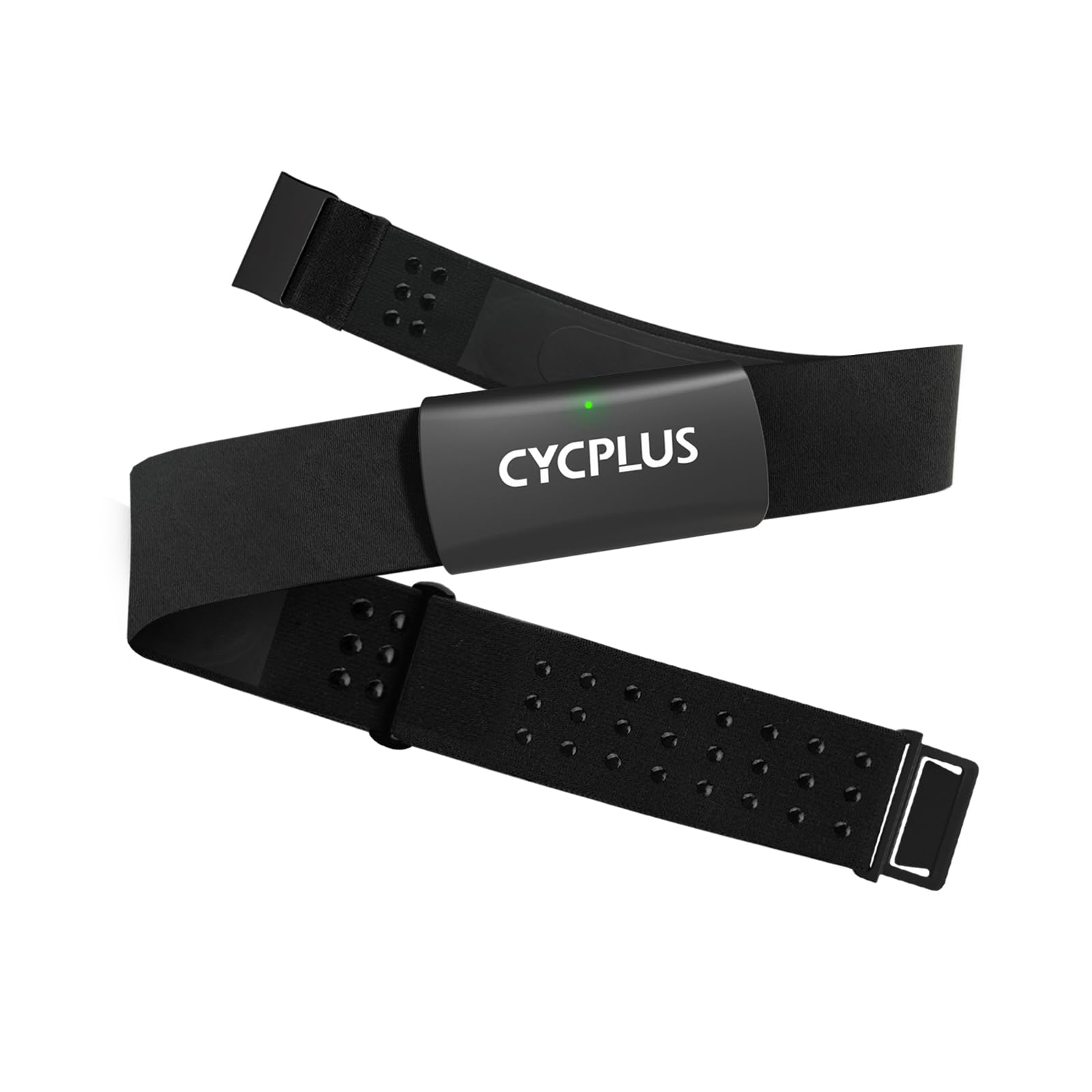
CYCPLUS H2Pro

79 /100
Trail Score Very Good

Key details

Sensor
ECG algorithm with HRV
Weight
21 g pod; 34 g with strap
Battery
500 hours, CR2032
Water Rating
IPX7
Check Price on Amazon

Twenty-one grams is the pod; thirty-four with the strap attached. Over a long run or a four-hour ride, that's the difference between a sensor you notice and one you don't, and it's the reason the H2Pro kept finding its way into our kit for the sessions where comfort mattered more than data.

The battery claim is the other headline: 500 hours from a CR2032. On CYCPLUS's own arithmetic — an hour a day, four days a week — that's roughly two and a half years before you open the battery door. Train more than that and you're still measuring battery changes in seasons rather than weeks.

CYCPLUS leans on an ECG algorithm to filter movement, breathing and muscle noise, and it outputs heart rate variability for recovery apps. On steady efforts we trusted what came back, and the soft strap stayed where we put it through a full session. Connection is the weak spot: pairing took a couple of tries more than once, so treat the first fortnight as a trial and keep the packaging until you're sure.

For a runner or rider who wants a light, long-lived sensor from a smaller brand, it's a real alternative to paying several times as much. If you want one-tap certainty every single session, look further up this list.

Pros

  • 21 g pod, 34 g with the strap
  • 500-hour CR2032 battery
  • HRV output for recovery tracking
  • Soft, breathable, adjustable strap

Cons

  • Pairing can need a couple of attempts
Our verdict

The lightest strap here, with a 500-hour coin cell and HRV output — a quiet, comfortable choice for anyone who can live with an occasional pairing retry.

Check Latest Price
6

Cheapest Entry

GEOID HS500

84 /100
Trail Score Excellent

Key details

Battery
800 hours, CR2032
Connectivity
ANT+ and Bluetooth
Status Light
Flashing LED
Water Rating
IP67
Check Price on Amazon

A chest strap that tells you it's awake is a small mercy. The HS500 blinks an LED when it has a heart rate and a connection, which sounds like a gimmick until you've spent a cold morning re-wetting a silent strap and wondering whether the battery is dead or the pod is simply asleep. That blink answers the question in a second.

It's the least expensive way into the category, and the spec sheet reads generously for the money: 800 hours from a CR2032, IP67, ANT+ and Bluetooth, and a wake-up time under a second. For a treadmill or a gym bike that wants a strap around your chest, that's the whole job — you clip on, the machine finds you, and the number appears where you're already looking.

Where it thins out is support. Setup guidance is minimal, the app it points you toward isn't a reason to buy, and readings can run high when the electrodes aren't making good contact — the fix is a wetter strap and a snugger band, not a new battery. Buy it as a sensor, keep your expectations on the app, and it earns its place as the cheapest strap on this page we'd actually put on.

Pros

  • 800-hour battery on a CR2032
  • Flashing LED confirms power and connection
  • ANT+ and Bluetooth for gym equipment
  • Wakes in under a second

Cons

  • Minimal setup guidance and a thin app
  • Readings can run high with poor strap contact
Our verdict

The cheapest strap we'd recommend: an 800-hour battery, a blinking status light, and both radios for gym equipment and phone apps.

Check Latest Price

How We Tested Heart Rate Monitor Chest Straps

We started by pulling every strap we could find that broadcasts both ANT+ and Bluetooth, since that single spec decides whether a pod will talk to a watch, a phone, and gym equipment without a dongle in between. From there we filtered by price, strap material, and whether the battery was a replaceable coin cell or a sealed rechargeable pod, and cut the list to 12.

Each of the 12 spent eight months in rotation on the same 5-mile loop, through treadmill intervals, into a humid group cycling class, and onto a rowing machine, paired in turn with a watch, a phone app, and a machine's built-in receiver. We noted how many taps it took to get a first reading and whether a strap held the connection when we walked away from our phones. For accuracy, we counted our pulse by hand for 30 seconds at the top of a hard interval and checked whether the strap agreed.

Comfort and durability got the least glamorous treatment: sessions past 90 minutes, then a look for chafe, red marks, and bands that had crept downward. We logged every hour of use and marked when each battery died or needed another charge, and in the final month we compared each elastic band against a fresh one to see how much stretch it had lost. Ease of use came down to one question — could we get it on, wet, and reading while standing in a dim gym at 6 a.m. without looking down.

How to Choose a Heart Rate Monitor Chest Strap

Chest Strap or Wrist Optical?

A chest strap sits over the ribcage and picks up the heart's electrical signal. A wrist sensor reads blood flow through the skin with light. That difference shows up when your heart rate moves fast — the start of an interval, a climb, a set of heavy squats — and when cold hands or a loose watch confuse the optical sensor. If your training is built on intervals or zones, the strap is the upgrade that makes your watch's numbers worth trusting.

For resting heart rate, sleep and all-day steps, the watch on your wrist is already the right tool. A strap earns its place in the sessions you actually analyse afterward.

Match the Radio to Your Gear

Two radios cover almost everything: ANT+, which bike computers, gym equipment and many sports watches speak, and Bluetooth, which phones and most apps use. Then look at how many devices a strap can serve at once. The Wahoo TRACKR holds three Bluetooth connections simultaneously, which is what a mixed setup needs; a strap with a single connection means choosing between the trainer and the phone.

The trap is assuming that because a strap pairs with your phone, it will show up on the treadmill or the gym bike. Those machines usually want ANT+, and sometimes nothing else, so read the equipment list on the listing before buying for a gym you don't control.

Fit, Comfort, and the Strap You'll Actually Wear

A strap you're aware of is a strap you leave in the drawer. Two-size bands fit better at the extremes — both Garmin straps come in XS–S and M–XL — while one-size designs tend to run generous, which is fine on a broad chest and less so on a smaller one. Machine washability matters more than it sounds: a band that goes in with the laundry is one you keep using.

Check the size on the order page rather than the photo, because the same model often ships with more than one band. A strap adjusted to the very end of its range is a reliable way to get a flaky reading.

Battery, Water and What Wears Out First

Coin cells run for ages — 800 hours on the GEOID, 500 on the CYCPLUS — and cost little to swap, but they need a spare in the drawer when one dies. Rechargeable pods, like the Wahoo TRACKR and the Garmin HRM 600, remove that errand and add a cable. Choose the routine that matches your habits rather than the bigger number.

The band usually gives out before the electronics do. Rinse it after sweaty sessions, wash it regularly, and detach the pod to dry. Ratings describe what the pod tolerates — IPX7 and IP67 for sweat and splashes, 3 ATM on the HRM 200 — but none of them stop salt and detergent from eating elastic, which is why the washing habit matters more than the number.

Frequently Asked Questions

Final Verdict

The Garmin HRM 200 is the strap we tell most people to buy. A year on a coin cell, a band that goes in the washing machine, and readings that hold through intervals cover everything a chest strap is for, and nothing about it asks for attention between sessions.

Spend more only for a reason: the Garmin HRM 600 if you train without a watch or work on running form, the Wahoo TRACKR if three devices need to see the same beat at once. On a tight budget, the COOSPO H6 does the core job for a fraction of the cost.