Best Tinnitus Relief Devices of 2026

The hour before sleep is when tinnitus gets loudest. A box fan helps, but then you're rearranging pillows to hear it, and by 2 a.m. the drone has become its own distraction. A good tinnitus relief device gives you a steadier, more controllable sound to rest your attention on—one that can fade into the background instead of competing with the ringing. I've tried 12 of them over the past eight months, and the keepers share clean sound, useful options, a fit you can forget, and controls you can work half-asleep.

More sound options don't automatically mean better relief; most people settle on two or three textures and judge them by whether they sound natural at low volume. I also noted battery life, noise cancellation, leakage, durability, and whether a device reliably turned on at 3 a.m. Value came down to what was included and how often I reached for it. The picks below are the ones that made the ringing less intrusive without becoming the new thing I noticed.

1

Best Overall

Sound Oasis Tinnitus Sound Therapy System

79 /100
Trail Score Very Good

Key details

Power
Rechargeable or charging cable
Connectivity
Bluetooth
Track Length
Up to 12 hours
Tinnitus Tracks
25 built-in
Check Price on Amazon

Twelve hours is the number that decided this one. Most masking machines loop a short clip or stop after eight hours, and the half-second of silence while a track restarts is exactly what wakes you at three in the morning. The Sound Oasis BST-80-20T carries 25 tinnitus and relaxation tracks, with extended versions built to run a full night without a break. For a device whose only real job is standing between you and the ringing until morning, that is not a spec-sheet nicety — it is the reason it is our top pick.

The library is the second reason. These are masking sounds shaped for tinnitus rather than a rain loop with birds in it, and the included booklet and frequency app help you find the track closest to your own pitch. Bluetooth means you can stream something else through the same palm-sized box on a rough night. At two and a half inches and eight ounces it disappears on a nightstand, and it does its best work quietly, which is the whole trick with masking.

The controls are the weak spot. Stepping the volume up or down means pressing through a button while the track plays, which is more fumbling than anyone wants in the dark; set your level before lights out and leave it alone. Power is more forgiving — it plays while connected to the included charging cable, so we keep it plugged in overnight and the battery never becomes part of the decision.

Pros

  • 12-hour tracks run through a whole night
  • 25 masking sounds designed for tinnitus
  • Plays on its charging cable overnight
  • Bluetooth for your own audio

Cons

  • Volume steps are fiddly in the dark
  • Optional app isn't worth paying for
Our verdict

The one we recommend first: purpose-built tinnitus tracks, a full night of continuous sound, and a cable that takes the battery out of the equation.

Check Latest Price
2

Best for Bedside Masking

EasyHome CWN-T6 Sound Machine

92 /100
Trail Score Outstanding

Key details

Sounds
30
Timers
60, 120, 180, 240 minutes or continuous
Night Light
12 colors, 10 brightness levels
Volume Levels
32
Check Price on Amazon

The EasyHome is the machine we point to when the budget decides the purchase. Thirty sounds, 32 volume steps, five timer settings and a night light in 12 colors — the feature list runs longer than devices costing several times as much, and none of it feels bolted on.

What earns it a place is the volume ladder. Thirty-two steps sounds like a marketing number until you are trying to set white noise just under your ringing rather than over it; on a five-step dial that setting often simply does not exist. The three white-noise variants and the two fan sounds are the ones to audition first, because they sit low and steady without the melody that makes rain or birds distracting after twenty minutes. The memory function restores your sound, volume and timer after an outage, which sounds trivial until the alternative is resetting the thing in the dark.

Where it falls short is specificity: nothing in the library was tuned for ringing ears, so you are matching a generic sound to your own tone and hoping it lands in the right band. Start with the white noise and the fans and work outward — it is a search rather than a prescription. The night light, meanwhile, is more than a bedroom needs and exactly right for a hallway at 3 a.m., and it switches off completely if you want black.

Pros

  • 32 volume steps for fine low-level tuning
  • 30 sounds, four timers or continuous play
  • Night light with 12 colors and 10 brightness levels
  • Remembers your sound, volume and timer

Cons

  • No tinnitus-specific sounds; expect trial and error
Our verdict

Our value pick: 32 volume steps and four timers do the masking job for a fraction of the top pick's price, as long as you will audition sounds.

Check Latest Price
3

Best for Travel

Sound Oasis BST-100 White Noise Machine

83 /100
Trail Score Excellent

Key details

Sounds
20 on included microSD card
Battery
Rechargeable lithium polymer
Playback
Bluetooth or microSD playlists
Bluetooth Range
30 feet
Check Price on Amazon

The microSD card is the reason to look at this one. Sound Oasis ships it with 20 sleep sounds and lets you load playlists you put together yourself, which is the most flexible answer in this guide to the loop problem: put one long continuous file on the card and the machine never restarts in the night.

It is also the best travel pick here — 30 feet of Bluetooth range, a rechargeable battery and a body small enough for a dopp kit at 2.75 by 2.5 by 2.5 inches. By day it is a speaker for a hotel room or a picnic; at night it is the masker on the nightstand. The built-in tracks do loop, and a long sleeper meets that seam before morning; the card is the fix.

Our hesitation is power. The unit cannot be charged and played at the same time, so an overnight session depends on the battery being full when you go to bed — a worse arrangement than our top pick's cable. At the highest price in this guide it earns its place as the travel pick rather than the default. Buy it if you want one box that masks at night and plays music by day, and put it on the charger before dinner.

Pros

  • microSD card takes your own playlists
  • Doubles as a Bluetooth speaker
  • Compact and rechargeable for travel

Cons

  • Can't be charged while it's playing
Our verdict

A travel-first pick: load your own long track on the card, use it as a speaker by day, and remember to charge it before bed.

Check Latest Price
4

Best for Light Therapy

YOEYOU Nose and Ear Red Light Device

82 /100
Trail Score Excellent

Key details

Tips
Three washable silicone sizes
Modes
3
Weight
1.41 oz
Auto Shut-Off
30 minutes
Check Price on Amazon

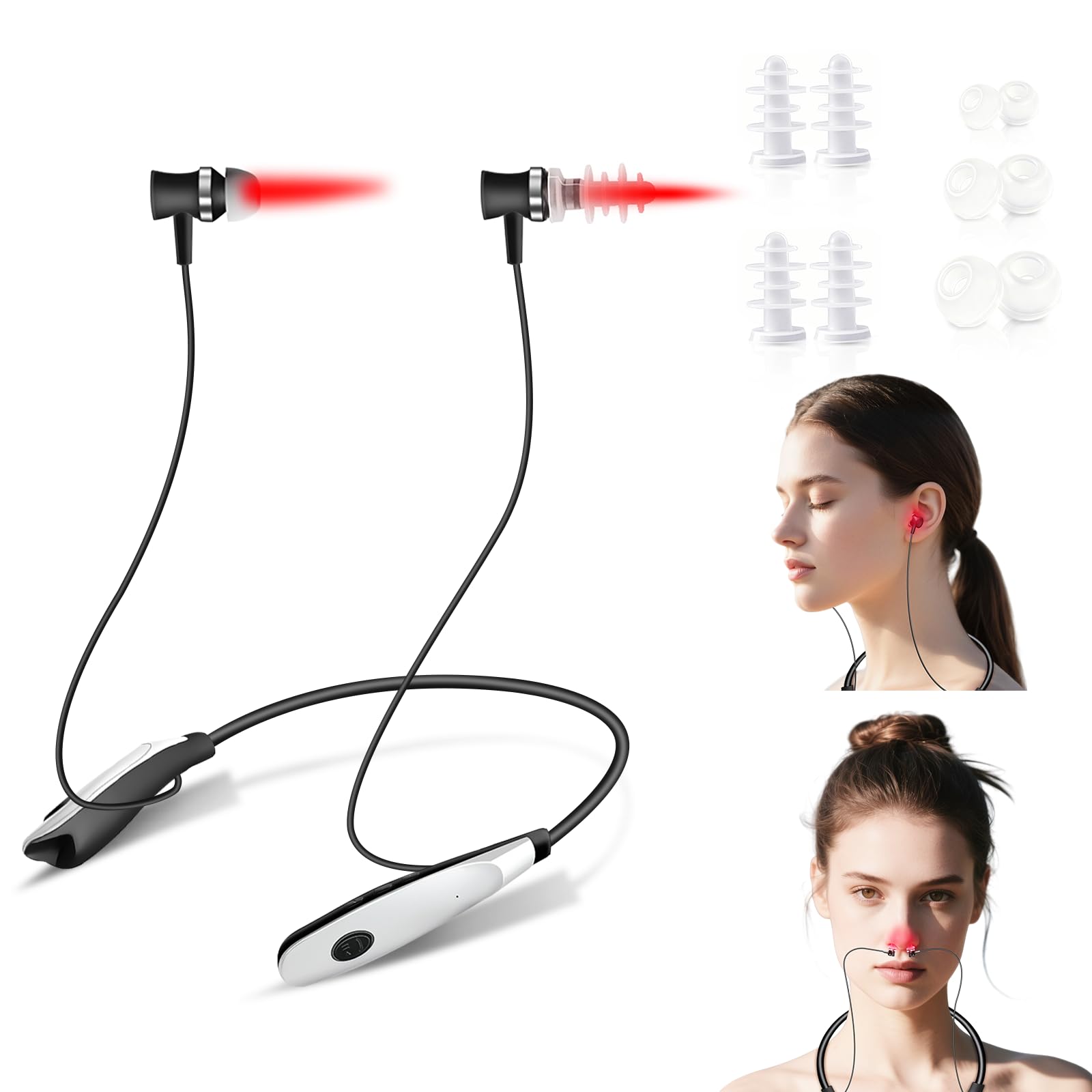
This one does not make a sound, and that is the point of it. The YOEYOU is a light device: a 40-gram pod that hangs around your neck, three modes to choose from — slow flash, fast flash and continuous — and soft silicone tips that sit at the entrance of the ear canal, or a nose fitting if you want to work on sinuses instead. A session runs half an hour and the built-in shut-off ends it for you.

The neck-hanging shape is why it is our light-therapy pick. Three sizes of washable silicone tip fit ears a rigid earbud shell will not, and 40 grams is light enough to forget about while you read. Nothing about operating it is complicated: one button cycles the modes, and it charges like any other small gadget.

Where we land: this is the pick for someone who wants to work on the ear directly rather than cover the noise. Expect a slow build — several days of consistent half-hour sessions, not one evening — and treat the two-week mark as the point where you decide whether to keep going. It will not work for everyone; reduced ringing is the outcome to hope for rather than the one to count on. Two things to respect: the tips warm against tissue and the nasal passage is delicate, so start on the lowest mode and let the auto shut-off end the session, and the tips dull outside sound while they are in, which makes this a sit-still device.

Pros

  • Hands-free neck-hanging design at 40 grams
  • Three washable silicone tip sizes
  • 30-minute auto shut-off ends sessions

Cons

  • Ear tips can come loose; build feels light
  • Results build slowly and aren't guaranteed
Our verdict

The light-therapy pick for a direct approach to ringing ears: hands-free, three tip sizes, and a timer that ends each session for you.

Check Latest Price
5

Discreet Sessions

Maxie Ear Light Therapy Earbuds

79 /100
Trail Score Very Good

Key details

Design
Earbud-style, hands-free
Charging
Rechargeable case
Warranty
1 year manufacturer
Light Modes
7
Check Price on Amazon

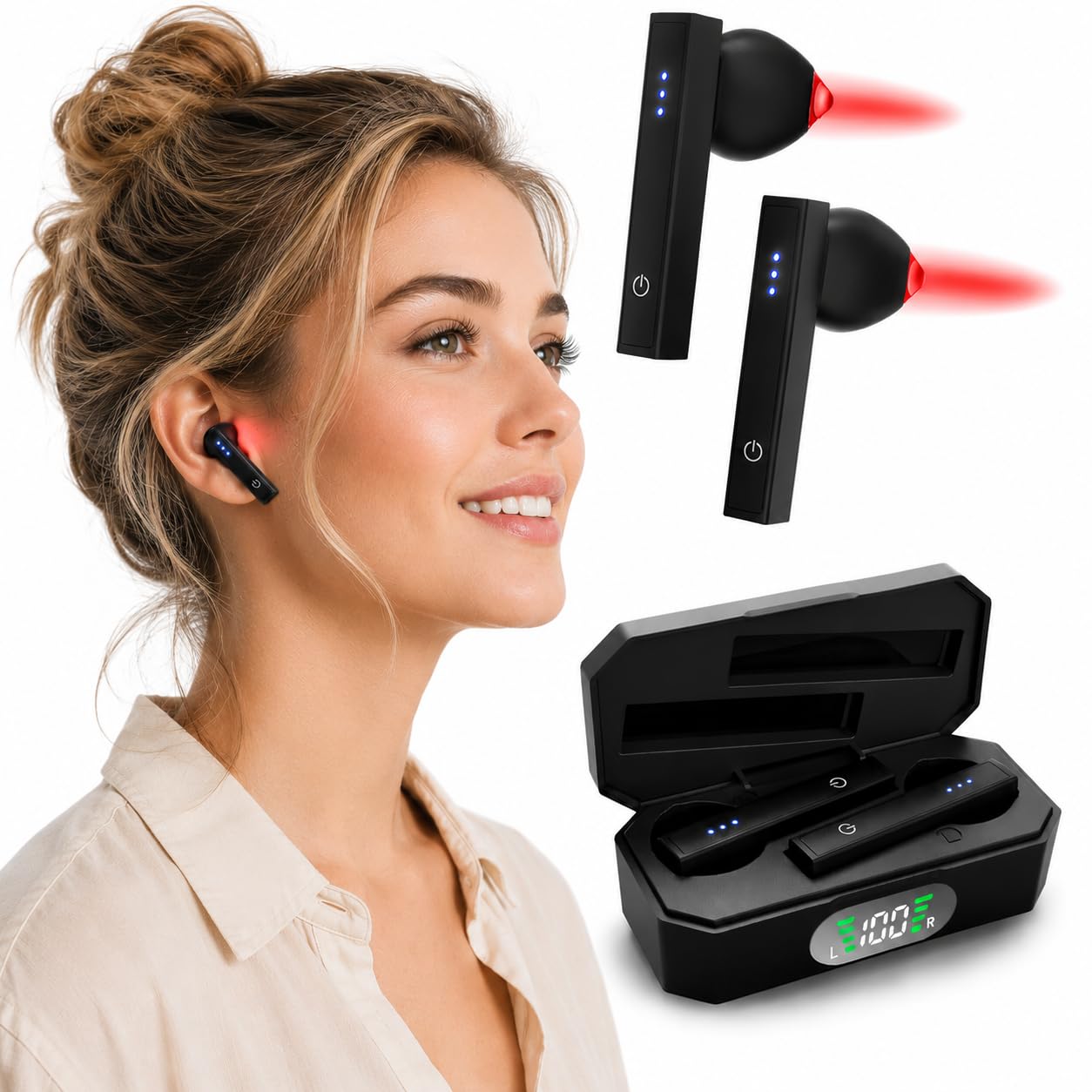
The shape is the idea. Maxie puts its red and blue LEDs into a shell that looks like a wireless earbud — there is no speaker in there, just light — so a session fits into reading, cooking or a commute instead of requiring you to lie down with something round your neck. Seven modes cover three red intensities, three blue and an alternating setting, cycled from a button on the bud. That convenience is what we value here: the device you use is the one that fits into your day.

The kit is put together well. The charging case tops the buds up between charges, the whole set is small enough for a jacket pocket, and Maxie is the only light device in this guide that states a one-year manufacturer warranty. There is no learning curve to it — press, wear, wait, take out.

Fit is the catch, and it is the thing to weigh before buying. An earbud shell that suits one ear canal can work loose in another, and a light that is not seated is not doing much. If your ears hold earbuds well, this is the most wearable light device here; if they do not, the neck-hanging YOEYOU and its three tip sizes are the safer shape.

Pros

  • Earbud shape works into daily routines
  • Seven modes across red, blue and alternating
  • Charging case and one-year warranty

Cons

  • Can work loose if your ears don't hold earbuds
Our verdict

For discreet daytime sessions: an earbud-shaped light device that fits into a commute or a chapter, provided your ears hold it.

Check Latest Price
6

Pressure Spikes

Picksoo Ear Pressure Relief Device

93 /100
Trail Score Outstanding

Key details

Fit
In-ear
Color
Grey
Material
Soft silicone
Check Price on Amazon

The Picksoo is the cheapest way into this category and the only pick that works on the ringing itself rather than around it. It is a single soft silicone in-ear piece in grey: you seat it in the ear canal, the shape applies a gentle pressure, and you take it out. No sound to choose, no timer, no app — the whole experience is a few minutes of pressure, which makes it a daytime tool for spikes rather than something to keep in overnight.

As a low-cost experiment it makes sense. If pressure changes are part of your pattern — on a plane, during a cold, in the car — this is the only device here aimed squarely at that, and the money at risk is small. What it cannot do is the thing most people need at three in the morning, because it masks nothing and the ringing returns the moment you remove it. If silence is where your tinnitus is loudest, put the money toward a sound machine; if it spikes with pressure, start here. And if you have had a perforated eardrum or an active ear infection, ask a clinician before putting anything in the canal.

Pros

  • Low-cost way to test pressure-based relief
  • Soft silicone; no charging or setup

Cons

  • One shape only; fit is whatever your ear allows
Our verdict

A cheap, honest experiment with pressure-based relief — worth trying if your ears react to pressure, useless at bedtime.

Check Latest Price

How We Tested the Tinnitus Relief Devices

We started with devices sold specifically for tinnitus masking—ear-level units, bedside machines, and a few wearable sound generators—then narrowed the list by adjustable volume, replaceable ear tips, battery or corded operation, and controls that didn't require an app just to turn on. We ended up with 12 units and tested them over eight months, not in a lab but in the rooms where tinnitus actually bothers people: a bedroom at night, a home office on deadline, a commuter train, and a kitchen with a humming refrigerator.

I wore or ran each device for at least two weeks, using it during the quietest part of the evening and again at 3 a.m. if I woke. I cycled through every sound option at the lowest usable volume and noted which textures sounded natural after 20 minutes and which turned harsh or hissy. For effectiveness, I tracked whether the ringing felt less intrusive after a session and whether I reached for the device again the next night without forcing myself.

Fit got checked in the least flattering positions: lying on one side, chewing, walking to the mailbox, and rolling over at night. I logged battery life from a full charge to shutdown, including one overnight run, and noted whether a low-battery warning came early enough to matter. Noise cancellation and leakage were tested in a noisy café and a silent bedroom; I listened for added pressure, hiss, or sound escaping enough to bother a partner.

Durability and reliability came from ordinary abuse: dropped from a nightstand, stuffed in a bag, paired and re-paired, and turned on in the dark. I changed volume and programs with my eyes closed, because that's how you'll use it at 2 a.m. Value wasn't about the lowest price—it was whether the included tips, case, and controls made the device easier to live with than simpler alternatives.

How to Choose a Tinnitus Relief Device

Cover It, Treat It, or Release the Pressure

Three mechanisms show up in this category and they answer different problems. Masking — a sound machine playing noise or nature tracks — is the most predictable of the three: it gives your attention something else to hold onto, which makes the ringing less prominent while it plays. Light therapy and ear-pressure tools are bets rather than certainties, and results vary from person to person.

If your tinnitus is worst in a quiet bedroom, buy a masking device first. If it spikes with pressure changes, or you want to work on the ear itself rather than cover it, that is when the light and pressure picks earn their place.

Track Length and the Loop Seam

Almost every masking machine ships with looping audio, and the loop is where the trouble hides. A short clip restarts every thirty seconds; longer tracks restart every few hours, and the half-second of silence at that seam is enough to pull a light sleeper back awake.

Before you buy, check how long the continuous track runs and whether you can load your own audio onto the device. That is why our top pick's 12-hour tracks and the BST-100's memory card matter more than sound counts do. Check the timer too — a machine that switches itself off after an hour is the opposite of what you need at 2 a.m.

A Cord Beside the Bed Beats a Flat Battery

Rechargeable sound machines look tidier on a nightstand, but they behave differently at 3 a.m. A device that plays while connected to its charging cable takes the battery out of the equation entirely; one that cannot be charged and used at the same time turns a forgotten charge into a silent night.

Whichever you choose, put it within arm's reach and make sure you can find the volume and power controls without switching on a light. Because these units run every night of the year, buy from a seller with a straightforward return window.

Set the Volume Under the Ringing, Not Over It

The instinct is to drown the tinnitus out, and it is the wrong instinct. The useful setting sits just at or below the ringing, so your attention settles instead of being shouted at — loud masking is just a second irritant competing with the first.

That is why the number of volume steps matters more than the maximum volume. Fine gradations at the quiet end are what let you land on the right level. Our top pick does its best work at low volume, and the EasyHome's 32 steps give you more room to find that spot than a five-position dial.

Fit Decides Whether an In-Ear Device Gets Used

Light and pressure devices only do anything when they are actually seated on the tissue, so shape matters as much as mode count. Look for interchangeable tips if your ear canals are small or angled, and favor a design that holds itself in place over one you keep pressing back in.

The neck-hanging YOEYOU ships three sizes of washable silicone tip and fits ears a rigid shell won't; the earbud-style Maxie depends on your ears suiting its shape. One is more adjustable, the other more discreet, and only you know which you will actually put on.

Frequently Asked Questions

Final Verdict

Start with the Sound Oasis BST-80-20T. Twelve-hour tinnitus tracks, a rechargeable body that runs on its cable all night, and a library built for ringing ears rather than a nursery make it the closest thing here to a device designed for this exact problem, and it is what we point a first-time buyer toward.

If price is the barrier, the EasyHome masks just as steadily for far less and gives you 32 volume steps to land on the right level. And if you want to work on the ear directly instead of covering it, the YOEYOU is the light device to try first.