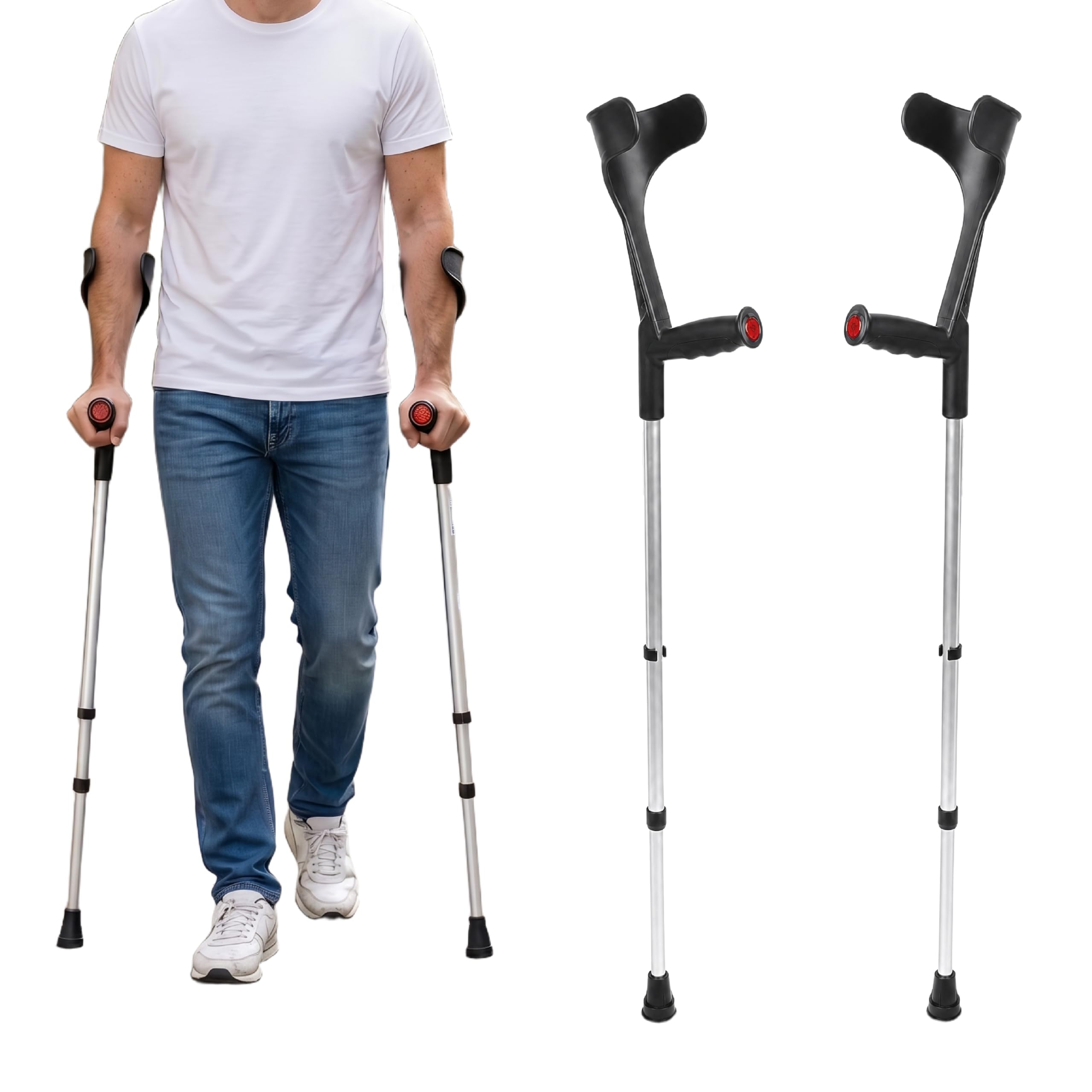
Best Forearm Crutches of 2026

Forearm crutches move weight off your underarms and onto stronger arms, which is why most adults find them a genuine step up from underarm models. But the aluminum tube is rarely the part that decides how well a pair works. The weak links are smaller: cuffs that will not hold a slimmer forearm, handles that turn hard within half an hour, and tips that slide on tile or wood.

Each of those issues has a fix, yet a fix usually means another order for aftermarket pads and larger feet. This guide sorts the options by what actually matters in daily use: a height range that brackets your build, a cuff that stays put, a grip that spreads pressure rather than digging in, and a base that meets the floor with traction.

The smart purchase starts with one honest question about who will use these and where. A frequent flyer needs a pair that folds down into a bag, a heavier adult needs headroom in the weight rating, and anyone with hand sensitivity needs cushioning from the start. Match the crutch to that routine and discomfort stops being a compromise you simply accept.

1

Best Overall

PEPE Open Cuff Adult Pair

89 /100
Trail Score Excellent

Key details

Grip
Unpadded
Cuff Type
Open
Height Range
Handle 28–38 in
Weight & Fold
Non-folding 1.2-lb
Check Price on Amazon

The widest height range and a 275 lb rating in this comparison make the PEPE pair a dependable everyday companion for a broad range of adult builds. Its open-cuff frame routes all support through the forearm, avoiding the underarm chafing that plagues standard crutches. At about 1.2 lb per crutch, the aluminum shaft feels light but solid, and the broad base delivers stable footing across gentle outdoor slopes and between office desks. Push-button pins move in one-inch steps, so you can match both crutches to the same length without fuss.

This pair is built for adults who need a stable walking aid during recovery and will keep it by the couch, on the porch, and at the office. Its 36 to 46 inch total height range fits the average adult, while those taller than about 6'2\" will need a longer frame. The spring-loaded height clips can be stiff on first adjustment and may resist a clean lock; press each button completely and confirm the pin seats before each size change. Since the crutches don't fold, they suit home and office use rather than airline travel or backpack storage.

Pros

  • Provides steady, balanced support during daily recovery walks.
  • Open cuff spares the underarm and spreads load across the forearm.
  • Each crutch weighs about 1.2 lb yet handles up to 275 lb.

Cons

No notable drawbacks to flag.

Our verdict

If you need a stable everyday pair for recovery at home or the office, this is the one to order first.

Check Latest Price
2

Best Foldable / Travel Pair

KMINA Carbon Foldable

89 /100
Trail Score Excellent

Key details

Grip
Rubber grip
Cuff Type
Open
Height Range
Handle 29–39 in
Weight & Fold
Folds to 21.6 in
Check Price on Amazon

About 1.3 lb per side with a 300 lb rating on a carbon shaft, it folds to roughly 21.6 inches and rides inside a carry-on — something the rigid everyday pick in this set cannot do. That weight and compactness make it a genuine commute and airport upgrade, not a clinical standby.

It suits frequent flyers and transit-heavy commuters; the vinyl cuff and grip padding run leaner than the plush-cushioned model here, so comfort-first buyers should choose that one. The fixed forward handle tilt can feel unstable to some, and the folding clamp may show wear under heavy daily collapse cycling, pointing this pair at travel duty rather than round-the-clock use.

💡 Set the cuff height so your forearm rests fully in the cradle with the handle seated in your palm before you step off — that adjustment is what makes daily use feel steady.

Pros

  • Weighs about 1.3 lb per side, keeping arms fresh through long terminals and flights.
  • Folds down to about 21.6 inches and fits cleanly inside an overhead bin, duffel, or closet.
  • Holds up to 300 lb while keeping a rigid, secure feel under heavier weight-bearing.

Cons

  • A fixed forward tilt to the handle can create a feeling of instability for users who prefer a vertical grip.
  • The folding clamp can develop play under heavy daily collapse cycling on longer-term pairs.
Our verdict

If you fly or commute with your mobility aid in hand, the weight and packable fold justify the premium; for someone staying put at home, the everyday open-cuff pair is more than enough.

Check Latest Price
3

Best Cushioned Comfort

KMINA Comfort Grip

88 /100
Trail Score Excellent

Key details

Grip
Padded neoprene
Cuff Type
Open
Height Range
—
Weight & Fold
Non-folding
Check Price on Amazon

Cushioned, washable neoprene hand pads and a 3.5-inch flexible base set this pair apart from plain aluminum frames; on hard floors and longer errands the padding absorbs shock that bare metal passes straight to the wrists, while the broad footing steadies each step. Owners with hand sensitivity or arthritis get noticeably gentler support across an afternoon of use.

This pair suits adults who want all-day cushioning and planted traction more than featherweight portability, and who accept that the soft pad may shift or rotate partway through a long session and need re-centering. A taller user approaching six-three should confirm the maximum height before purchase.

💡 Give the pads a quick center-push every hour during long outings; the shifting is minor and the cushioned support continues.

Pros

  • Wide anti-slip base keeps footing planted and steady on varied floor surfaces.
  • Removable, washable padded grips ease wrist strain on long daily walks.
  • Lightweight aluminum frame with eleven height positions is quick to size.

Cons

  • Cushioned handle runs bulky, which can feel too wide for smaller hands.
  • Soft pad can shift or rotate on the handle mid-session, needing periodic re-centering.
Our verdict

Best for gentle, longer recoveries where plush grip and stable footing matter more than packing weight — not a travel-first pair.

Check Latest Price
4

Best Affordable Folding Option

PEPE Folding Pair

89 /100
Trail Score Excellent

Key details

Grip
—
Cuff Type
Open
Height Range
Handle 32.5–38.5 in
Weight & Fold
Folds to 22.4 in
Check Price on Amazon

This two-piece pair collapses to about 22.4 inches, sliding into a carry-on, a closet, or a car seat between transfers, yet its telescoping aluminum build keeps a solid mid-stride feel rather than a flimsy travel wobble. At about 1.3 lb per crutch it moves smoothly through airport corridors without thunking against luggage.

The fold suits commuters and regular air travelers who prefer crutches out of sight when not in use. Handle height spans roughly 32.5 to 38.5 inches, which plants most adults in the 5'4 to 6'3 band and leaves shorter builds a poor fit for this model.

Pros

  • Folds to about 22.4 inches to tuck into carry-on bags, back seats, or desk corners.
  • At 1.3 lb per crutch, it stays light-handed through airport corridors and stair landings.
  • Open-cuff design spreads pressure off the wrist during longer standing sessions.

Cons

  • Even the lowest setting lands too high for adults near 5'4 and under, so measure your stride before ordering.
Our verdict

Travel-heavy recovery days, whether flights or commutes, are where the folding payoff shows for anyone who fits the 5'4 to 6'3 height window.

Check Latest Price
5

Best for Higher Weight Capacity

Vive Adjustable Arm Pair

84 /100
Trail Score Excellent

Key details

Grip
Hard, unpadded
Cuff Type
Moulded
Height Range
—
Weight & Fold
Non-folding
Check Price on Amazon

A true 300 lb capacity in a genuinely light frame makes this the pair for larger adults, and the one-inch push-button stops reach heights the default open-cuff model can't. Stability reads sturdy under load, handling heavier users without the flex you would expect at this weight.

Heavier and taller adults — up to around six-foot-five — get full capacity without the price jump of more premium pairs. Stock moulded grips run firm on palms, so self-adhesive wraps are worth arranging early; this is not the fit for sensitive hands.

Pros

  • Supports up to 300 lb while staying light enough for all-day handling.
  • One-inch push-button stops extend high enough to fit taller adults.

Cons

  • On rough pavement, stock rubber tips can wear down to bare metal within weeks.
Our verdict

Best for heavier or taller adults who need a higher weight rating without a price jump and are willing to add grip wraps early.

Check Latest Price
6

Larger Forearms

Medline Aluminum Pair

87 /100
Trail Score Excellent

Key details

Grip
Hard, unpadded
Cuff Type
4-in vinyl contoured
Height Range
Fits 5'0–6'2
Weight & Fold
Non-folding
Check Price on Amazon

The heavy-wall aluminum shaft with quiet locking nuts holds up well in clinical use, and the wide contoured 4-inch cuff secures larger forearms more firmly than slimmer pairs. For average or slim arms, though, the fixed vinyl cuffs run large and can slip, and the unpadded grips turn uncomfortable after short distances, so fit and grip must be checked before it becomes a primary pair.

Pros

  • Wide contoured 4-inch cuff holds larger forearms more securely than slimmer pairs.
  • Cost-effective Medline aluminum build with quiet telescoping lock nuts.

Cons

  • Fixed vinyl cuffs run large for average or slim arms and are not adjustable, so fit may slip.
Our verdict

Keep it as a clinical spare or a primary pair only for larger forearms once you have verified the cuff fit.

Check Latest Price
7

Also Great

A 350 lb capacity at a budget price, plus a four-step cuff that tightens around smaller forearms and an aluminum build light enough for full-day use. Even fully extended, it stops short of fitting anyone taller than about 5'5 inches, so its value concentrates with shorter or petite adults and clinics storing spares for smaller patients.

Pros

  • Carries up to 350 lb in a light aluminum build, removing the weight penalty of heavy-duty crutches.
  • Four-step cuff height hugs smaller forearms more closely than fixed-cuff alternatives.

Cons

  • Under heavier weight-bearing, the arm column can feel flexible and reduce support during each step.
Our verdict

A solid fit for shorter adults who prioritize weight capacity over extension range, and for clinics keeping spare pairs stocked for petite patients.

Check Latest Price
8

Occasional Home Use

Antdvao Folding Pair

86 /100
Trail Score Excellent

Key details

Grip
Rubber handle
Cuff Type
Open, anti-drop
Height Range
User 58–73 in
Weight & Fold
Folds in half
Check Price on Amazon

It is the least expensive folding pair in this set, snapping down to about half length for a closet or trunk while feeling sturdier than its low weight suggests. Around the house, the open cuffs make short, casual hops comfortable. Extended heavier strides feel less planted than a fixed rigid frame, so this covers light-duty backup moments rather than full-day weight-bearing.

Pros

  • Genuinely lightweight without feeling flimsy for everyday at-home support.
  • Folds in half to tuck away in a closet, trunk, or suitcase.

Cons

  • Stock tips can slip on slick hardwood and tile, so it is best kept to carpet.
Our verdict

Treat it as an inexpensive backup for light at-home pacing, not as the crutch you lean on through a full recovery.

Check Latest Price

How to Choose Forearm Crutches

Measure Your Fit First

The spec that governs everything else is the handle range and where the forearm cuff settles. In a correctly sized crutch, the handle sits roughly at your wrist line when you stand, and the cuff rests just below the elbow crease. If the lowest setting is still too tall, you walk with your shoulders hitched; if the highest is too short, you lean forward and push strain into your wrists.

Read the handle range in inches instead of trusting a 'fits 5'2 to 6'1' label. Petite adults often find that 'adult' pairs bottom out too tall, while men over six feet need the longest setting. A pair whose range brackets your build works far better mechanically than one most people can squeeze into.

Choose a Cuff That Stays Put

Open cuffs are the standard because they let your forearm slip out quickly when you sit or need to catch yourself. Their grip depends on your forearm tapering enough to keep the cuff seated with each stride. On a very slim arm, an oversized open cuff slides down, and your hand ends up doing the work the cuff should be doing.

Before committing, measure your forearm's largest circumference and compare it with the cuff's opening. If cuffs you have tried feel loose, look for a model with a wider or contoured cuff, or a front strap-style anti-drop design that cinches down. A cuff that grips firmly is a safety feature, not a comfort extra.

Weigh Foldability Against Rigidity

Every fraction of a pound you lift at the hand end is carried with every step, so on a long errand the difference between a 1.2 lb and a 1.4 lb crutch shows up as real fatigue. That is why carbon-fiber foldables around 1.3 lb earn their premium with frequent travelers.

Folding shafts add a joint mid-length, and a two-piece crutch is only as rigid as its locking ferrule. If you spend most of your day in one place, a stiffer one-piece shaft generally offers better stability than a travel pair. Buy the folding feature because you actually board planes or tuck crutches into small cars, not because it sounds convenient.

Don't Skip Handle Padding

A hard plastic grip concentrates your body weight onto a narrow strip across the heel of the palm, right over the tissue that wraps the ulnar nerve. Sit with that load for more than a few minutes and your fingers begin to tingle; keep walking and the numbness can turn into a genuine reason to stop.

Neoprene or silicone sleeves spread the load over more surface and soften each landing, which matters more the longer you stay on your feet. Check whether the padding is wide enough for your palm and whether it rotates or slips on the shaft, because a pad that twists under load creates its own friction. If you already have arthritis or hand sensitivity, buy a pair with cushioned grips built in rather than planning to add them.

Respect the Weight Rating

A crutch's weight capacity describes the load it can support at a standstill, not the force it sees when you stride. Walking sends a single crutch into the ground with your full body weight plus a small impact spike on every contact, so the real working load lands nearer the limit than your scale weight suggests.

If you are around 250 lb, look for a rating of 275 lb or higher rather than a frame that sits exactly at your weight. Folding models add an extra joint that is worth keeping a clear margin of safety on. Pick a pair whose capacity covers you comfortably, and you protect both the frame and the person leaning on it.

Check the Feet Before You Walk Indoors

Factory rubber tips on many budget and mid-range pairs are small and stiff, and on smooth tile, sealed wood, or laminate they provide less traction than the glossy floor suggests. A 3.5-inch-wide base with a flexible edge creates a larger contact patch and grips far better than a tiny domed ferrule.

If the pair you like ships with narrow tips, budget for replacement feet with a wider footprint before you trust them on wet or indoor hard surfaces. One afternoon of testing on your own floors beats discovering the problem the first time you put weight on a crutch in a slick entryway or parking garage.

Frequently Asked Questions