Best Crutches for Adults of 2026

A sprained ankle rarely announces itself. One misjudged curb and you're working out what will hold you up for the next six weeks. Crutches look interchangeable in photos, and they are not. The two main styles split the job differently: underarm crutches take weight through your ribs and palms, forearm crutches through your grip and forearms, and which one feels steadier on day three versus day ten surprises people. What you're really buying is stability, a fit that matches your height, and hardware that doesn't wobble by week two.

I've leaned on crutches after knee surgery and watched a taller friend fight with a borrowed pair, so I know how quickly a bargain set turns into a bruise under the arm. Over four months we lived with 13 sets — folding travel models, adjustable aluminum pairs, a forearm design or two — and the differences came down to cuff size, whether the height locks held, and how much assembly landed on me. The picks below reflect that, and none of the cheapest made the cut.

1

Best Overall

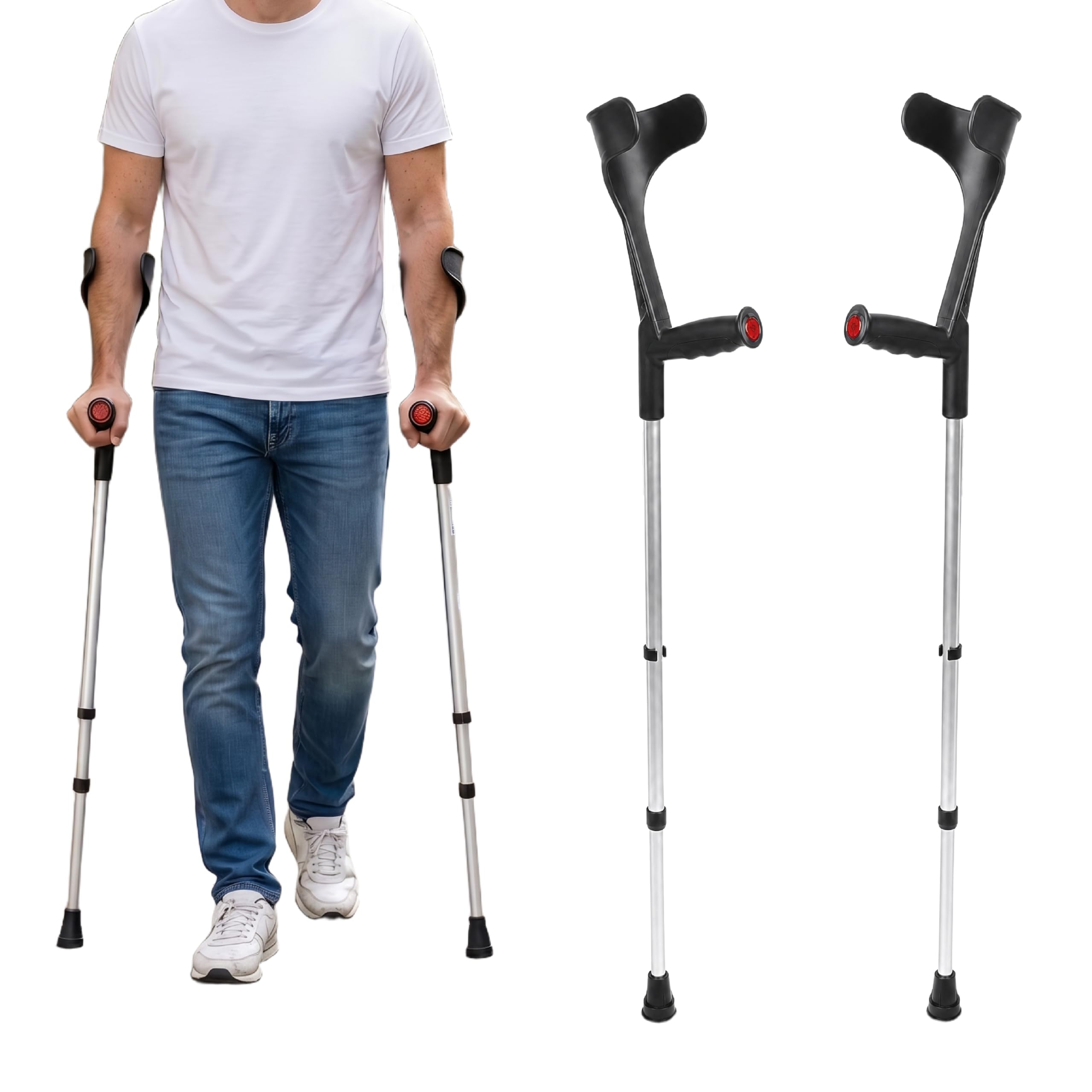
PEPE Mobility Forearm Crutches

88 /100
Trail Score Excellent

Key details

Crutch Length
36 to 46 in
Handle Height
28 to 38 in
Weight Capacity
275 lb
Weight Per Crutch
1.21 lb
Check Price on Amazon

Thirty-six to 46 inches, tip to the top of the cuff, is the window these crutches live in — and it's the first thing to check, before comfort or color or anything else. The handle runs from 28 to 38 inches off the floor, and that figure decides whether your hands land at wrist height or your shoulders end up doing the work. Outside the range, nothing else about the pair matters.

Inside it, this is the pair we point most adults to. Each crutch weighs about 550 grams, light enough that a long day of hopping around doesn't turn your shoulders into the limiting factor, and the open cuff lets you drop your forearm in from above instead of threading a strap. What we appreciate most is where the weight doesn't go: nothing presses into the armpit, so the soreness that makes people dread underarm crutches never enters the picture.

Adjustment is the fiddly part. Eleven settings, and a clip that has to seat fully into its hole before the crutch will hold — the fit is positive once it's in, but it takes a firm push and a second look. Set both crutches to the same hole, press until the clip clicks through, and glance at both before you lean on them.

What they don't do is fold, so they ride in the back seat or lean in a corner rather than disappearing into a bag; the KMINA and the Antdvao are the ones that collapse. For a pair that lives by the front door for six weeks, we don't think that matters, and the two-year warranty is the longest in this group.

Pros

  • About 550 g per crutch, easy on the shoulders
  • Open cuff is quick to step into
  • Keeps weight off the armpits entirely
  • Pair included with 11 height settings

Cons

  • Wide open cuff isn't adjustable for slim arms
  • 275 lb capacity is the lowest of the forearm picks here
Our verdict

We recommend this pair for most adults recovering from a leg injury: it's light, stable, and easy on the armpits, as long as your handle height falls between 28 and 38 inches.

Check Latest Price
2

Best Folding Underarm

Carex Folding Under Arm Crutches

87 /100
Trail Score Excellent

Key details

Folded
Fits an overhead compartment
Weight Capacity
250 lb
Fits User Height
4 ft 11 in to 6 ft 1 in
Weight Per Crutch
4.5 lb
Check Price on Amazon

The fold is the whole argument. Release the catch, the shaft breaks in the middle, and a pair taller than you are turns into something you can drop in a trunk, a closet shelf, or an overhead bin on the way to your seat. For anyone whose crutches have to leave the house — a car commute, a flight, a small apartment with no hall closet — that's worth more than a nicer grip.

First setup takes a little patience: the folding sections have to line up before they'll seat, and it's the kind of job you do once and then forget. After that it's a press and a swing. The padded blue cradles and grips are a step above the bare vinyl on most underarm crutches, which matters when you're on them for weeks rather than days.

Where it beats the forearm picks is the style itself. If your grip is weak, or your balance isn't what it was, an underarm pair puts the load where a hospital pair does — through the palms — and the fold means you're not leaving it in the car. Covering 4-foot-11 to 6-foot-1, underarm fit, folding small, sold as a pair: that combination is why it's here.

Pros

  • Folds small enough for an overhead bin
  • Covers 4-foot-11 to 6-foot-1 of user height
  • Padded cradles and grips instead of bare vinyl
  • Underarm style suits weaker grip

Cons

  • 4.5 lb per crutch makes stairs noticeable
  • 250 lb capacity is the lowest in this group
Our verdict

The pair to get if your crutches have to travel or vanish into a closet: it folds, it's padded, and it suits most adult heights, though it's heavy and capped at 250 pounds.

Check Latest Price
3

Best Underarm Pair

BodyMed Aluminum Crutches

89 /100
Trail Score Excellent

Key details

Weight Capacity
300 lb
Fits User Height
5 ft 2 in to 5 ft 10 in
Height Adjustment
1 in increments
Weight Per Crutch
3.7 lb
Check Price on Amazon

Every crutch decision starts with a fork: the hospital-style pair that goes under your arms, or cuffs on your forearms. If you want the first kind — the one a discharge nurse hands you, no learning curve, weight through your palms — this is the version we hand people. It covers 5-foot-2 to 5-foot-10 in one-inch steps, carries 300 pounds, and arrives assembled.

The adjustability is the strong suit. Push-buttons on the shaft and the grips, one-inch increments, and enough range that a 5-foot-4 teenager and a 5-foot-10 adult can share the same pair with a quick reset. At 3.7 pounds a crutch they're easy to lift and reposition, and the non-skid tips hold tile and hardwood without skating.

The rubber tips are the part to watch. They're the contact point on every crutch, they wear, and a flattened tip on a smooth floor is how people end up on the ground again. Order a spare set with the crutches and check them every couple of weeks — that's the cheapest insurance in this category.

Pros

  • 300 lb capacity with one-inch adjustment steps
  • Arrives assembled and ready to set
  • 3.7 lb per crutch and easy to reposition

Cons

  • Underarm cushions run firm
  • Doesn't fold or break down small
Our verdict

Our pick among conventional underarm pairs: 300 pounds of capacity, one-inch adjustment, and nothing to assemble, with cushions that need breaking in.

Check Latest Price
4

Best for Tall Adults

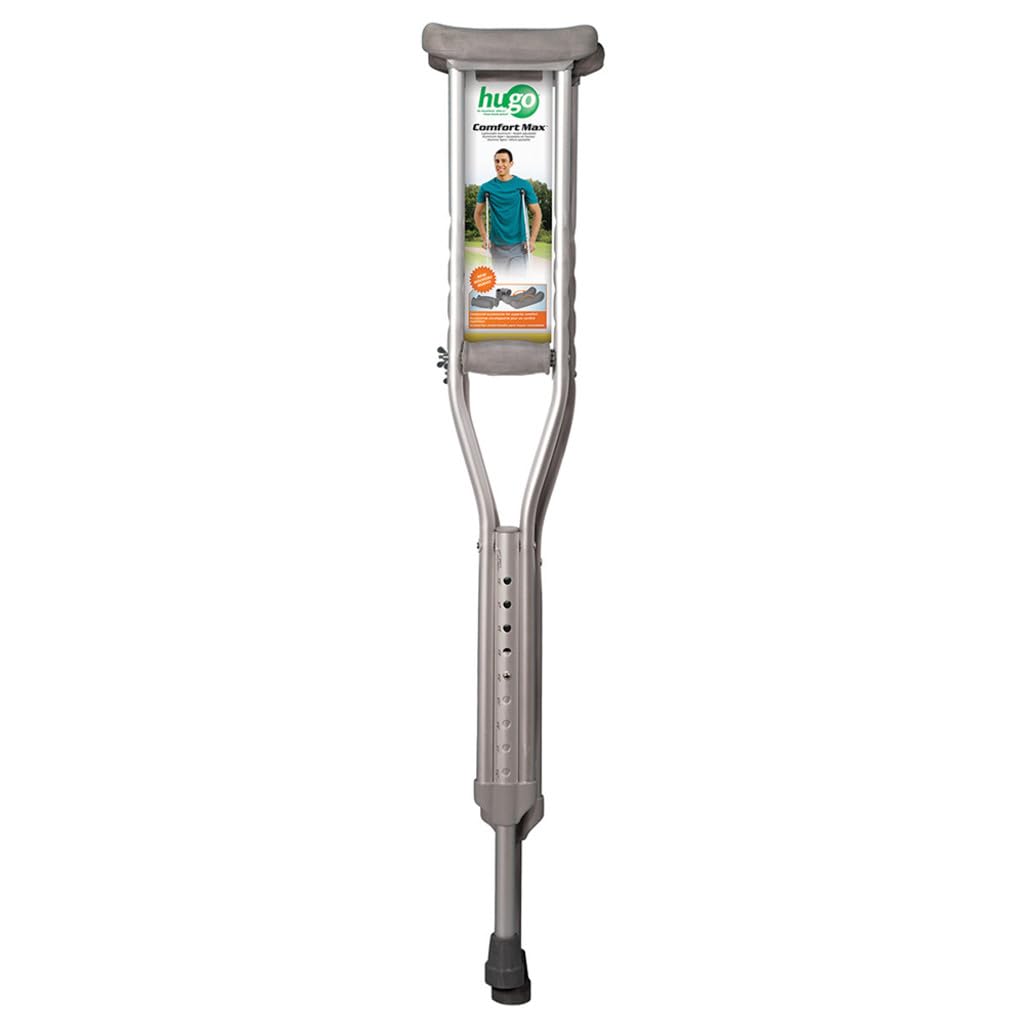
Hugo Mobility Tall Adult Crutches

88 /100
Trail Score Excellent

Key details

Frame
Anodized aluminum
Crutch Length
62 to 70 in
Weight Capacity
300 lb
Weight Per Crutch
4 lb
Check Price on Amazon

Tall bodies are where crutch shopping goes wrong. A pair rated to 6-foot-1 will technically extend for someone who is 6-foot-5, but the handgrips end up at the wrong height and the whole thing feels like walking on stilts. The Hugo tall adult pair is built for that gap: a 62 to 70 inch crutch, a 300-pound rating, and a frame that doesn't flex when a big user leans on it.

That combination is the whole answer for a tall or heavy adult. The pads are natural sponge rather than vinyl, the shock-absorbing handgrips are washable and perspiration-resistant, and the anodized aluminum frame stays planted rather than bowing under a lean. When a buyer tells us standard crutches hurt their shoulders, this is the pair we send them to.

The smaller details are better than the category usually manages. The tips are contoured with a stair deflector and a metal ring at the base — that ring is the piece of engineering that keeps the rubber from splitting at the shoulder, which is where tips fail first on any underarm crutch.

What you trade for the length is a long crutch at every setting. The shortest position is still substantial, so anyone under roughly 5-foot-10 should not buy these as a hedge; the BodyMed or the PCP pair fits better at the bottom of its range. Measure floor to wrist crease before ordering and hold that against the 62 to 70 inch frame — this is one product where the wrong end of the range is obvious immediately.

Pros

  • 62 to 70 inch frame genuinely serves tall adults
  • 300 lb capacity on a rigid anodized frame
  • Sponge pads and washable, perspiration-resistant grips

Cons

  • Item count reads as a single crutch in places
Our verdict

If you're tall enough that standard crutches leave you hunched, this is the pair to buy: a genuinely long frame, 300 pounds of capacity, and sponge padding that doesn't flatten in a week.

Check Latest Price
5

Best for Travel

KMINA Foldable Forearm Crutches

89 /100
Trail Score Excellent

Key details

Folded Length
21.6 in
Handle Height
29 to 38.9 in
Weight Capacity
300 lb
Weight Per Crutch
1.3 lb
Check Price on Amazon

Twenty-one point six inches folded. That's the number that matters here: shorter than a laptop bag, light enough at 1.3 pounds a crutch to sling on a shoulder, and rated to 300 pounds despite the carbon-fiber frame. If your crutches need to disappear into a duffel or an overhead bin, this is the pair that does it without asking you to give up capacity.

Ten settings take the handle from 29 to 38.9 inches, which reaches a little higher than the PEPE pair does, and the soft pads are fiberglass-reinforced plastic with a reflector on the front — a small thing that matters more than it sounds when you're crossing a parking lot at dusk. The fold is a two-part hinge rather than a single joint, and the sections line up and lock without rattle once they're open.

The question we keep coming back to is whether the fold earns its premium. For anyone who folds them weekly — flights, trains, a crutch that has to go into a work bag — it clearly does, because 21.6 inches and 1.3 pounds is a different category of portable. For a pair that will lean by the front door for six weeks and never collapse, the PEPE does that job with a friendlier cuff.

The one thing we can't get comfortable with is the angle of the handgrip. It's set to encourage a straight-arm push, and hands that want a more vertical hold find it awkward, with no adjustment to fix it. If you have wrist or thumb trouble, the rounder rubber grips on the Antdvao pair are the safer bet.

Pros

  • Folds to 21.6 inches, small enough for a carry-on
  • 1.3 lb per crutch with a 300 lb rating
  • Handle adjusts across 10 settings, 29 to 38.9 in
  • Reflectors on the front of each cuff

Cons

  • Hard plastic cuff and grip, with no padding
Our verdict

The folding forearm pair we take when crutches have to travel: 21.6 inches packed, 300 pounds of capacity, and a grip angle you should try before committing to months of use.

Check Latest Price
6

Best for Hands-Free Use

Antdvao Folding Forearm Crutches

86 /100
Trail Score Excellent

Key details

Cuff
Elastic anti-drop band
Height Settings
10
Fits User Height
58 to 72.8 in
Check Price on Amazon

A crutch that stays on your arm is a different kind of tool. The Antdvao pair runs an elasticated band across the open cuff, so when you let go of the grip to open a door, take a stair rail, or sign for a delivery, the crutch hangs from your forearm instead of clattering to the floor. That single detail is why we keep these in the roundup; nothing else here does it out of the box.

The rest is solid rather than special. Ten height settings cover roughly 4-foot-10 to 6-foot-1 of user height, the frame folds down for a carry-on, and the semi-enclosed arm shape keeps the forearm straight so load lands on the cuff instead of the wrist. The handgrips are rubber over the frame, and the base locks by twisting the collar, which stops the tip from working loose mid-stride.

The stock tips are the weak point. They're hard rubber, and on smooth hardwood or tile they slide more than they should — the sort of thing you notice on the first damp morning. Swapping them takes a minute and changes how the crutches behave indoors, so put a replacement set on the order when you buy.

Between this and the KMINA, the choice comes down to the cuff. The KMINA is carbon, folds shorter, and carries more weight on paper; the Antdvao holds onto your arm and gives you a hand back. If you're on crutches for months rather than weeks, that's the more useful trick.

Pros

  • Cuff band keeps the crutch on your arm
  • Folds for a carry-on bag
  • Ten height settings across a broad range

Cons

  • Folding frame flexes more than a fixed pair
Our verdict

Best for anyone who needs a hand free: the cuff band keeps the crutch on your arm through doors and stairs, and the pair folds into a bag when you're done.

Check Latest Price
7

Larger Forearms

Medline Aluminum Forearm Crutches

85 /100
Trail Score Excellent

Key details

Weight
5.1 lb
Cuff Size
4 in
Weight Capacity
250 lb
Fits User Height
5 ft to 6 ft 2 in
Check Price on Amazon

Four inches of cuff is a lot of cuff. The Medline forearm crutches come with a tapered, vinyl-coated arm cuff sized generously, and that one measurement decides who they're for: bigger forearms, heavy sleeves, and anyone who has found narrow cuffs dig in over a long day.

The build is quietly good. Heavy-wall aluminum tubing, internal bushings and external lock nuts at every telescoping joint, and black components that hide scuffs — the payoff is a crutch that doesn't rattle as you walk, and we noticed how much more restful that is over a month of recovery. They cover 5-foot-0 to 6-foot-2.

Wear shows up at the soft parts first. The vinyl coating on the cuff is what splits, and the rubber tips are the other consumable on any forearm pair, so both are worth a monthly look. Neither is a reason to avoid the crutches; both are the reason to keep spares in the hall closet.

So: a sturdy, quiet, generously cut forearm crutch for larger users who want something that feels like hospital equipment rather than a lifestyle product. Smaller frames should look elsewhere, and anyone who needs a lighter carry should too — these earn their place on the strength of that cuff, and only for the arms it actually fits.

Pros

  • Silent telescoping joints, no rattle while walking
  • Generous 4-inch cuff suits larger forearms
  • Heavy-wall aluminum rated to 250 lb

Cons

  • Fixed cuff sits loose on slim arms
  • 250 lb ceiling is the lowest here alongside the Carex
Our verdict

A quiet, sturdy forearm pair built around a generous four-inch cuff — the right buy for larger arms and a poor fit for slim ones.

Check Latest Price
8

Spare Pair

PCP Aluminum Crutches

89 /100
Trail Score Excellent

Key details

Assembly
Arrives assembled
Fits User Height
5 ft 2 in to 5 ft 10 in
Height Adjustment
1 in push-button
Weight Per Crutch
3.48 lb
Check Price on Amazon

Nothing to assemble. The PCP pair arrives with the tips, grips, and underarm pads already on the frame, which sounds like a small thing until you're the one hobbling around a kitchen with a bag of loose hardware and a diagram.

The printed height scale runs up the shaft, and a single push-button moves in one-inch steps — read the number, set both crutches to it, and you're done. The part we like best is the size ladder behind it: the same crutch comes in tall for 5-foot-10 to 6-foot-6, regular for 5-foot-2 to 5-foot-10, and shorter junior and child sizes, so a household with two injured people can buy the same design twice.

At about 3.5 pounds a crutch they're light, and the joints stay quiet — no rattle as you walk. The chrome finish is the trade-off you see rather than feel: bright, easy to wipe, and quick to show scuffs if they live in a car trunk.

Think of these as the second pair. They're the ones to keep in the car, at a parent's house, or in the closet for the next injury, and the printed scale makes them easy for someone else to set correctly. For a primary pair you'll be on for months, the improved padding and longer warranty of the PEPE are worth the step up.

Pros

  • Arrives fully assembled with pads and tips fitted
  • Printed height scale plus one-inch push-button steps
  • Light at 3.48 lb a crutch

Cons

  • Regular size leaves little room at the short end
Our verdict

A sensible spare or second pair: it arrives assembled, the printed scale takes guesswork out of setting height, and it's light enough to keep by the door.

Check Latest Price

How We Tested Adult Crutches

We started with roughly 40 sets sold by major retailers and narrowed them by what the listings actually published: weight capacity, a height range wide enough to fit someone just over 5 feet and someone around 6 foot 4, replaceable rubber tips, and a cuff that could be adjusted or swapped. Anything that hid its height range, or sold tips as a non-replaceable part, got cut. That left 13 sets, which we used for four months.

Testing happened in hallways and on stairs, not on a bench. Two testers, one 5 foot 4 and one 6 foot 2, set each pair to their own height and spent the first week fully off the injured leg and the following weeks partial. We timed how long unpacking and assembly took using nothing but the included instructions. We noted whether the height pins clicked into a positive lock or slid under load, whether the underarm pads dug into the ribs by the end of a hallway, how the forearm cuffs sat on a 9-inch and an 11-inch forearm, and whether a folded pair genuinely fit in a car trunk and a tote bag.

Stability got the harshest treatment: wet bathroom tile, a gravel driveway, and standing up from a low couch, where a flexy frame shows itself fast. Every couple of weeks we checked rivets and joints for wobble and looked at how the rubber tips wore down on pavement. Then we weighed price against whether the tips and pads could be replaced on their own rather than replacing the whole set — a cheaper pair that needed new tips in six weeks was not the better value.

How to Choose Crutches for Adults

Start With Underarm or Forearm

Both styles do the same job and ask different things of you. Underarm crutches carry load through the palms and the ribs, and the pads should sit about two inches below the armpit — never jammed into it, which is what happens when a crutch is set too long. Forearm crutches wrap the arm and want a firmer grip and steadier balance, but they free your hands enough to carry a cup across a room and they never touch the armpit at all.

If your grip is weak or your balance is shaky, choose underarm. If you're facing months rather than weeks, the forearm style is easier to live with, and the cuff design matters more than the frame: an open cuff you step into beats a strap you thread one-handed.

Measure the Handle, Not Just Your Height

Listings advertise the body height a crutch suits, but the number that decides comfort is the height of the handgrip. Stand with your arms hanging and measure from the floor to the crease of your wrist; that is roughly where the grip belongs. Then check the pair's actual range — the PEPE covers 28 to 38 inches, the KMINA 29 to 38.9 — because a product that claims 5-foot-2 to 5-foot-10 can hide a narrow adjustment window.

Near either end of a range, expect to sit on the last hole with nothing left over. That is the moment to pick a different product rather than a different setting.

Two Weight Numbers, One of Them Yours

Every crutch has a capacity, and it should clear your body weight with room to spare — you lean harder on the bad days than on the good ones, and the rating assumes the crutch is correctly adjusted. Then there's the crutch's own weight, which is the figure you feel by mid-afternoon: 550 grams a side is a different week from 4.5 pounds a side on a staircase.

If you're strong and mostly indoors, capacity matters more than grams. If you're covering ground, pay for lightness.

Folding Buys Storage, Not Weight Savings

A folding pair solves a real problem: a crutch that splits in two can live in a trunk, on a closet shelf, or in an overhead bin, and it can go into a restaurant without a coat check. It doesn't come free — folding sections are usually heavier and a little less rigid than a fixed frame — and compact is relative. The KMINA folds to 21.6 inches; the Carex underarm pair stows overhead but won't drop into a tote.

Decide where the crutches will sit when you're not using them, and let that answer pick the style.

Tips, Pads, and Cuffs Are What Wear Out

Frames outlast everything attached to them. Rubber tips flatten and glaze, pads compress, and vinyl cuffs split — a slick tip on a tile floor is how a recovery becomes a second injury. Order a spare set of tips with the crutches and check them monthly.

Cuff fit matters just as much on a forearm pair. A fixed four-inch cuff like the Medline's suits a big forearm and hangs loose on a slim one, while open cuffs are quicker to step into and easier to bulk out with a wrap.

Frequently Asked Questions

Final Verdict

For most adults, the PEPE forearm pair is the one to order: light, stable, and free of the armpit pressure that makes underarm crutches a chore, with a handle window that covers most bodies. Measure your wrist height before checkout, because that's the one number that can rule it out.

Outside that window, the Hugo pair is the answer for tall frames. If the crutches have to fold, the KMINA does it with 300 pounds of capacity, and the Carex pair gives you the same trick in an underarm design.