Best Large-Button Phones for Seniors of 2026

My aunt's kitchen phone has a ringer you can hear from the driveway and buttons the size of postage stamps. That mismatch sums up the category: plenty loud, not nearly easy. A good large-button phone fixes what age tends to fray — seeing the numbers, hitting the right key on the first try, hearing the other person, and knowing who's calling before you pick up. Over six months, my team and I went through 12 of them.

What separates the good ones isn't on the spec sheet; it's how they behave on a counter at 7 a.m. with the kettle going. Keys have to fit stiff knuckles yet sit close enough to dial a number in one motion, the display has to be readable from across the room, and the volume has to be loud without turning a voice to gravel. A few look institutional in a normal kitchen, and the priciest weren't the best. What follows earned its place on all of it.

1

Best Overall

VTech SN5147

81 /100
Trail Score Excellent

Key details

Phone Type
Corded base plus 1 cordless handset
Voice Boost
Up to 50dB
Ringer Volume
90dB
Answering Machine
22 minutes
Check Price on Amazon

The reason this VTech earns the top spot is the two-part design: a corded base that keeps working when the power goes out, plus a cordless handset that can follow your parent into the kitchen or bedroom. The base carries the big buttons, a backlit display, and a full-duplex speakerphone, while the handset gives you the mobility a plain corded phone cannot.

What sold us is how much of the senior-phone job this one system covers. The ringer reaches 90dB and flashes a visual alert, the Audio Assist button adds up to 50dB of incoming volume, and four photo speed-dial slots put family numbers one touch away. We also appreciate the 22-minute answering machine and call blocking for up to 1,000 numbers, because those are the features that let a parent rely on the phone without a caregiver screening every call.

The trade-off is setup. This is not a plug-in-and-forget phone; the menu is deeper than the basic corded models here, and the speed-dial and call-blocking settings take a caregiver's patience. We recommend programming the family numbers, testing the volume boost, and confirming the cordless handset's range before handing it over.

Once that is done, the payoff is a phone that works at the bedside, at the kitchen counter, and during an outage. If nobody will carry a handset from room to room, the simpler corded picks here cover the same keypad and ringer basics.

Pros

  • Corded base works during power outages
  • 90dB ringer with visual alert
  • Up to 50dB voice boost
  • Photo dialing and call blocking

Cons

  • Cordless handset needs AC power
Our verdict

For a parent who still wants to move around the house, this is the senior phone we recommend: a corded base, a cordless handset, a 90dB ringer, and up to 50dB of voice boost.

Check Latest Price
2

Best for Photo Dialing

VTech SN1127

82 /100
Trail Score Excellent

Key details

Voice Boost
Up to 40dB
Ringer Volume
90dB
Photo Speed Dial
8 keys
Answering Machine
22 minutes
Check Price on Amazon

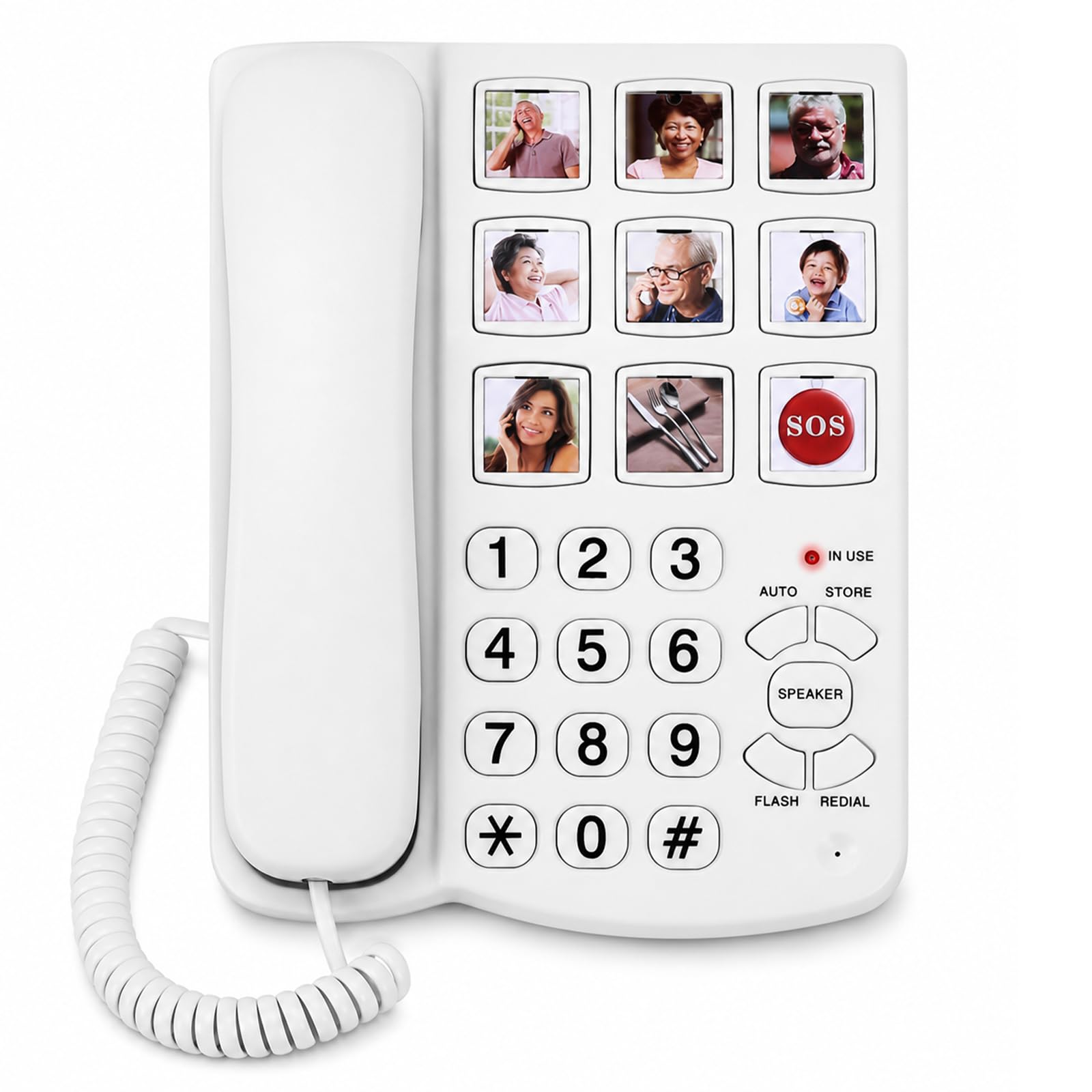
Eight photo speed-dial keys are the reason this VTech is on the list. The idea is simple: put a picture or a name on each large key, store the number, and let a parent call family without dialing. The rest of the phone is built for the same job, with oversized high-contrast buttons, a 90dB ringer, and a visual ring alert.

The 40dB Audio Booster and full-duplex speakerphone make it easier to hear and be heard, and the built-in 22-minute answering machine means missed calls do not disappear into a separate device. The large display and oversized buttons keep the keypad readable, and the corded handset stays put on a bedside or kitchen counter, which is one less thing to charge or lose.

What keeps this near the top of the set is the combination of photo dialing and an answering machine in one corded phone. We think that is the right choice for a parent who can still use a handset but needs the call list simplified. The photo windows take patience to fill, and printed names are a practical fallback that works just as well.

Pros

  • Eight photo speed-dial keys
  • 90dB ringer with visual alert
  • 40dB audio booster
  • Built-in 22-minute answering machine

Cons

  • No cordless handset
Our verdict

If photo dialing is the feature that makes the phone usable, this VTech is the one we point to: eight picture keys, a 90dB ringer, and a built-in answering machine.

Check Latest Price
3

Best Big Display

AT&T CL2940

86 /100
Trail Score Excellent

Key details

Buttons
Extra-large
Display
Extra-large tilt
Volume Boost
Audio Assist
Caller ID History
50 names/numbers
Check Price on Amazon

The display is the reason to choose this AT&T and the reason to pause: it tilts and shows caller ID in big type, but it is not backlit. We think that trade-off is fine for a bright kitchen, hallway, or living room, where the tilt screen and extra-large keys make the phone easy to read at a glance. In a dark bedroom, it is the wrong choice.

The keypad is genuinely oversized, and the Audio Assist button gives incoming sound a temporary boost without making you hunt through a menu. We also like the hands-free speakerphone and the 50-name caller ID history, which are the features that make a corded desk phone feel useful rather than merely basic. The tilt screen is the detail we kept adjusting; it makes the caller ID readable from across the room.

Setup is straightforward, and the corded design keeps basic calls working when the power is out. It is the corded phone we point to when the screen, not the feature list, is the main event.

Pros

  • Extra-large tilt display
  • Extra-large buttons
  • Audio Assist volume boost
  • Caller ID with 50-name history

Cons

  • No built-in answering machine
  • Caller ID needs four AA batteries
Our verdict

This AT&T is the corded phone we reach for when the display matters: large keys, a tiltable screen, caller ID, and an Audio Assist boost make it easy to read and hear across the room.

Check Latest Price
4

Best Budget Big Buttons

Sacumea Big Button

81 /100
Trail Score Excellent

Key details

Power
RJ11 line power
Button Size
1.06 inches
Ringer Volume
110dB
One-touch Dialing
2 keys plus SOS
Check Price on Amazon

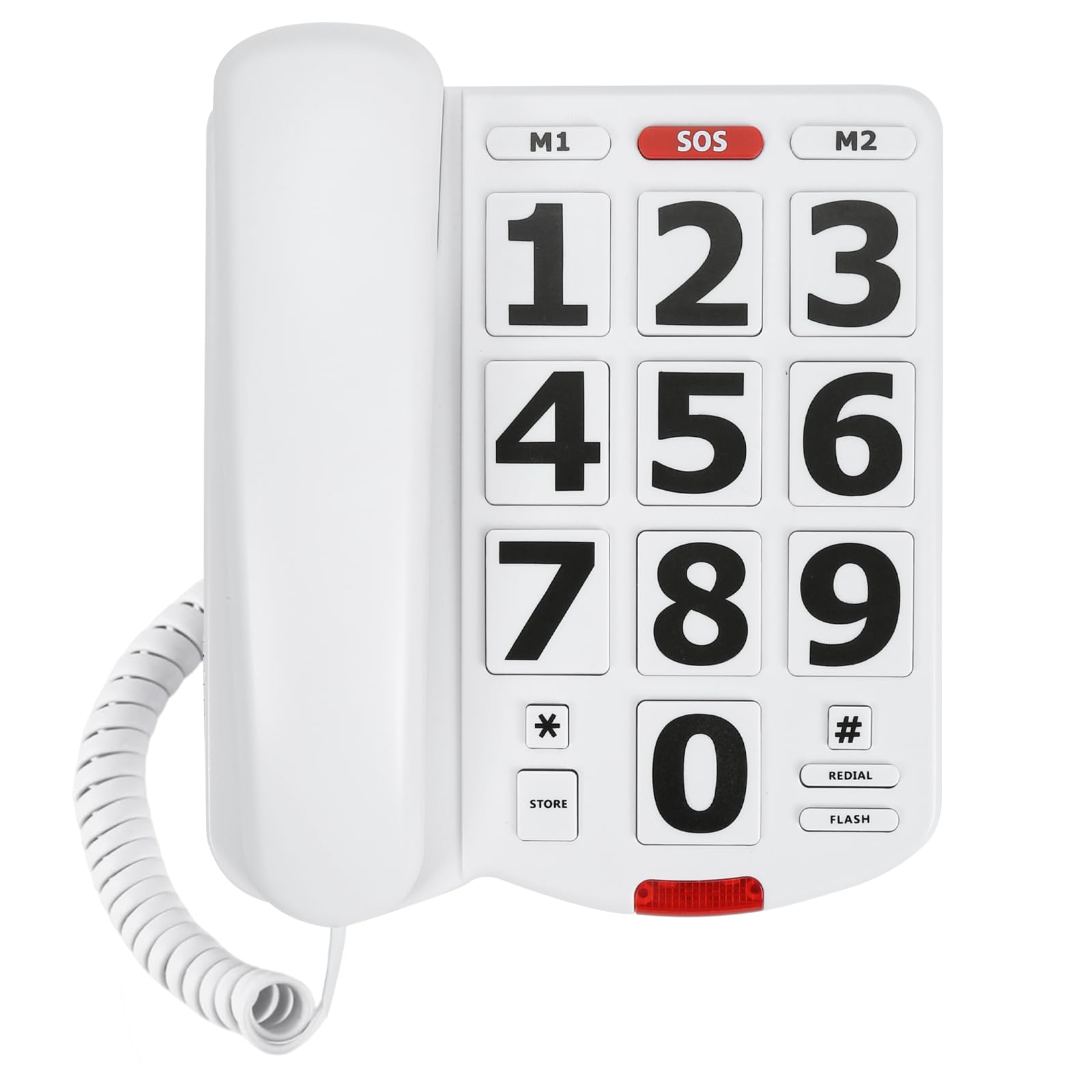
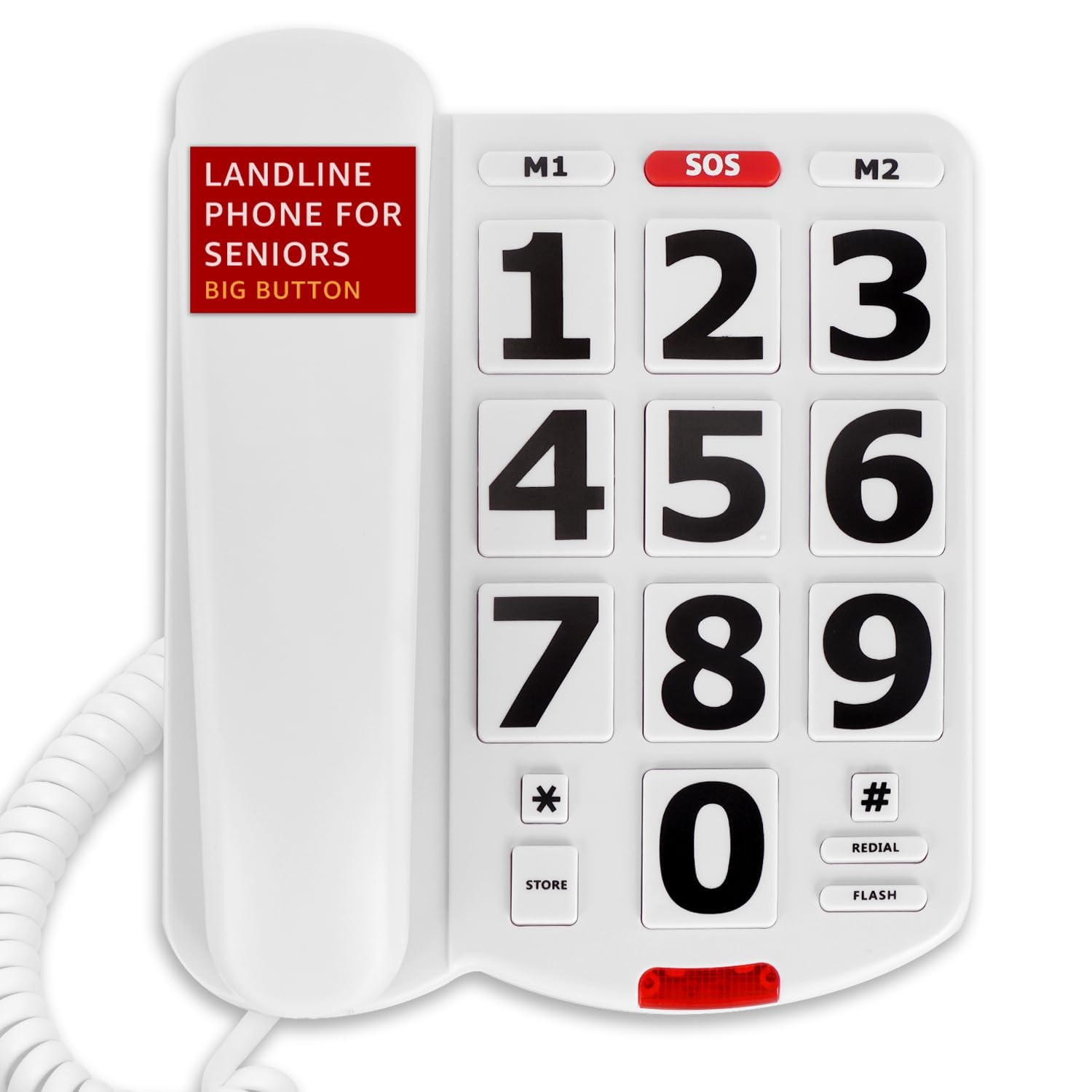
The 1.06-inch number keys are the heart of this Sacumea. They are big enough to see and press without pecking, and the 110dB ringer with a flashing LED is built to get attention from another room. Two one-touch keys and a separate SOS button cover the numbers a parent calls most, and the phone runs on the phone line, so there is no battery to replace.

We think this is the best simple corded phone in the set because it does the core job without a screen or a menu. The setup is minimal: plug in the line, store the two speed-dial numbers, and test the SOS key. That simplicity is the point, and it is why the phone suits a hallway, bedside, or backup location where a parent only needs to pick up and dial.

The phone is at its best where the only job is a quick call or a check-in. It is a dialing-first phone; if you need photo dialing or a larger feature set, the VTech models are the better fit. The line-powered design is the quiet advantage when the power goes out.

Pros

  • 1.06-inch number buttons
  • 110dB ringer with flashing LED
  • Two one-touch keys plus SOS
  • Line-powered, no batteries

Cons

  • Light base can slide when pulling the handset
Our verdict

For a straightforward corded phone with genuinely oversized keys, this Sacumea gives you 1.06-inch buttons, a 110dB ringer, and an SOS key without asking for a battery or a manual.

Check Latest Price
5

Best for Wall Mounting

AT&T 213

83 /100
Trail Score Excellent

Key details

Keypad
Extra-large, lighted
Mounting
Wall-mountable
Phone Type
Corded Trimline
Speed Dial
10 numbers
Check Price on Amazon

A wall phone still makes sense in a kitchen, garage, or hallway, and this AT&T Trimline is the one we choose for that spot. It mounts to a standard wall bracket, keeps the counter clear, and runs on line power, so there is no adapter to plug in or battery to remember.

The keypad is the part that matters: the keys are extra-large, high-contrast, and lighted, with a visual ringer that flashes for incoming calls. Ten speed-dial numbers cover family and a doctor or pharmacy, and the handset has the familiar Trimline shape that many older users already know. We found the ringer loud enough for a kitchen, and the lighted keypad is the detail that makes it usable at night.

What earns it a runner-up spot is the combination of a lighted keypad and a wall-mount design at a budget price. It is not the phone for a parent who needs photo dialing or amplified handset volume; the VTech SN5147 and SN1127 cover those needs. For a second phone where the goal is answering a call without crossing the room, it is the right tool.

Pros

  • Extra-large lighted keypad
  • 10-number speed dial
  • Wall-mountable Trimline design
  • No AC adapter or batteries needed

Cons

  • No answering machine
  • Light plastic body
Our verdict

This is the phone we choose for a kitchen wall or a narrow counter: a Trimline handset, extra-large lighted keys, 10 speed-dial numbers, and no AC adapter to lose.

Check Latest Price
6

Memory Support

ZAMQIU Picture Dial

78 /100
Trail Score Very Good

Key details

Power
RJ11 line power
Button Size
0.88 x 0.88 inches
Photo Dialing
Customizable picture buttons
Ringer Volume
110dB
Check Price on Amazon

The phone is built around picture buttons, which is the right idea for a parent with memory loss: a familiar face is easier to act on than a number. The keypad is labeled with large numerals, the ringer reaches 110dB, and hands-free calling lets someone answer without holding the handset.

The picture keys are only as good as the setup. A caregiver has to label each button, store the number, and test the one-touch dial before the phone goes into service; skipping that step turns the feature into decoration. We like that the phone runs on the phone line, so a power outage does not take the basics with it.

The buttons measure about 0.88 inch square, which is smaller than the 1.06-inch keys on the Sacumea but still large enough for the main numbers. The hands-free speaker is useful for a short call, and the line-powered design keeps the basics working without a battery.

What makes it worth a place is the picture-first layout: it reduces the call to one decision, which is exactly what memory support should do. We think it suits a household where the caregiver can set it up and the goal is a short list of family calls, not a complicated feature menu.

Pros

  • Customizable picture speed-dial buttons
  • 110dB ringer
  • Hands-free calling
  • Line-powered, no battery

Cons

  • High-pitched ring tone
Our verdict

When memory loss is the reason for the phone, this ZAMQIU puts familiar faces on big picture buttons, adds a 110dB ringer, and keeps the whole thing line-powered.

Check Latest Price
7

Simple Speed Dial

Blue Donuts Big Button

80 /100
Trail Score Excellent

Key details

Ringer
Switchable Hi-Lo
Phone Type
Corded
Memory Keys
10 two-touch
Speakerphone
Hands-free
Check Price on Amazon

Ten two-touch memory keys are the reason this Blue Donuts is on the list: they give you a lot of stored numbers for a very simple corded phone. We think that makes it a sensible second phone for a kitchen or for a parent who only calls the same handful of people.

The keypad is large and easy to read, the ringer switches between high and low, and an LED light flashes for incoming calls. The hands-free speakerphone is useful when someone needs to listen without holding the handset, and the phone is powered by the line, so there is no adapter or battery to manage.

The rest is straightforward: store the numbers, label the memory keys, and keep the phone where the flashing light is visible. It is the phone we leave where the only job is making a call, not working through a long feature menu.

Pros

  • 10 two-touch memory keys
  • Large, easy-to-read buttons
  • Switchable Hi-Lo ringer with LED alert
  • Hands-free speakerphone

Cons

  • Handset volume can be inconsistent
Our verdict

A budget corded phone with 10 two-touch memory keys and a switchable Hi-Lo ringer, this Blue Donuts is for the household that wants speed dialing without a screen or a setup project.

Check Latest Price
8

Emergency Dialing

Uvital Big Button

80 /100
Trail Score Excellent

Key details

Phone Type
Corded
Ringer Volume
Up to 120dB
Handset Volume
3 levels
One-touch Dialing
2 keys plus SOS
Check Price on Amazon

The SOS key is the feature that makes this Uvital worth a look. It sits alongside two one-touch memory keys, so a parent can reach help or family without dialing, and the ringer goes up to 120dB with a flashing LED for incoming calls.

The handset volume has three levels, and the phone runs on the phone line with no battery, which keeps the emergency setup simple. We like that combination for a bedside or hallway phone: the buttons are large, the ringer is hard to miss, and there is no charging routine to break.

The phone is a focused emergency phone rather than a household hub. We think it suits a bedside or hallway where the goal is a fast call for help. The line-powered design is the quiet advantage when the power goes out.

What makes it worth recommending is the emergency layout: the SOS key and loud ringer are the features a caregiver can explain in one sentence. If you need photo dialing for a longer list, the VTech SN1127 is the better fit; if the priority is one-button help, this Uvital earns its place.

Pros

  • Dedicated SOS key plus two one-touch keys
  • Ringer up to 120dB
  • Three handset volume levels
  • No battery required

Cons

  • No hands-free speakerphone
Our verdict

The Uvital earns its place with a dedicated SOS key and a ringer that reaches up to 120dB, making it a strong choice when emergency dialing matters more than extra features.

Check Latest Price

How We Tested 12 Big-Button Phones Where People Actually Keep Them

We started with a shortlist of about 30 models pulled from spec sheets and verified buyer reviews, then crossed off anything with undersized keys, a display under an inch, or no volume boost at all. That left 12 phones, a mix of corded and cordless, which we bought at retail and put into circulation.

For six months they lived where phones actually live — kitchen counter beside the coffee maker, nightstand, hallway wall — used by my team plus two relatives in their seventies and a neighbor in her eighties with moderate hearing loss. We dialed ten-digit numbers one-handed with the phone flat on the table, then again without looking. We read caller ID from ten feet in daylight and under a lamp, noting whenever a long name got cut off. We called from a noisy room with the TV on and asked whoever answered which phone sounded like a cell call and which like a drive-thru speaker.

Loudness we measured and then distrusted. Each ringer got logged with a decibel meter at three feet and then judged by ear, because a phone can hit 90dB and still turn a voice to gravel. Every photo and speed-dial button got programmed, timed, and reprogrammed a month later to see if anyone could remember how. Corded models went through a simulated outage with the power strip switched off, and we poked at every key for six months to see if anything loosened up. Each phone also sat out on a counter for a week — some read as a helpful appliance, others as a piece of medical equipment. Value got settled last, by asking whether the extra features were ones anyone would actually use.

How to Choose a Large-Button Phone for Seniors

Start with the keypad and the light

Large is not a standard measurement, so compare the keypad itself rather than the word on the box. The Sacumea's 1.06-inch keys are the largest in this set, while the ZAMQIU's 0.88-inch keys are smaller but still oversized. High-contrast numerals and enough space between keys matter as much as raw size, especially for someone with arthritis or shaky hands.

Check the display separately. A tilting screen can make caller ID easier to read from across a room, but a screen that is not backlit still needs good room light. If the phone will sit on a dark nightstand, look for a lit keypad or a backlit display before you buy.

Match the ringer and voice boost to the person

A loud ringer helps someone hear the phone from another room; it does not make the voice on the other end easier to understand. Look for a separate handset volume boost, such as the up-to-50dB Audio Assist on the VTech SN5147 or the up-to-40dB booster on the SN1127. The Uvital's 120dB ringer is the loudest in this set, but that figure describes the ring, not the call.

Test with a familiar voice. Call from another room, ask which volume setting is comfortable, and check whether the person can hear the first few seconds of the call without asking you to repeat. A visual ring alert is a useful backup for someone who removes a hearing aid at night.

Choose corded, cordless, or both

A corded phone is the simpler choice when the phone stays in one place. It draws power from the phone line, so basic calls keep working in an outage. A cordless handset adds freedom to move around the house, but it depends on its charger and battery. The VTech SN5147 covers both: a corded base for backup and a handset for carrying.

The setting changes the answer. A wall phone like the AT&T 213 suits a kitchen or garage where the goal is answering without crossing the room. A bedside phone should have a readable keypad and a ringer the person can hear at night. If the household has no corded handset at all, make sure one phone can still make a call when the power is out.

Count the memory keys and plan the setup

One-touch and photo keys are only useful after someone programs them. Two one-touch numbers plus SOS, as on the Sacumea and Uvital, cover a short list of family and emergency contacts. Eight photo keys on the VTech SN1127 or the picture buttons on the ZAMQIU go further for someone with memory loss, but they take more time to label and test.

Write the call list before the phone arrives, then program each key and call it once. If a photo is hard to fit, print the person's name instead. The test call is the step that turns a promising feature into something a parent can actually use alone.

Decide how much call handling you need

An answering machine, caller ID, and call blocking add convenience, but they also add buttons and menus. If the household relies on messages, a built-in answering machine such as the 22-minute system on the VTech SN5147 or SN1127 earns its place. A large caller ID display helps screen calls, and call blocking is useful if robocalls are a daily annoyance.

If the person only needs to answer and dial, skip the extras. A simpler corded phone is easier to explain and less likely to be abandoned after the first confusing menu. Match the features to the person who will use the phone, not to the caregiver who sets it up.

Frequently Asked Questions

Final Verdict

Our pick is the VTech SN5147 because it covers the most situations in one system: a corded base for outage calls, a cordless handset for moving around, a 90dB ringer, up to 50dB of voice boost, photo dialing, and call blocking. It is the one we recommend when a parent needs one phone to handle the whole house.

If the phone will live on a wall or a narrow kitchen counter, the AT&T 213 is the better fit; its lighted keypad and Trimline shape matter more there than a big feature menu.