Best Overall
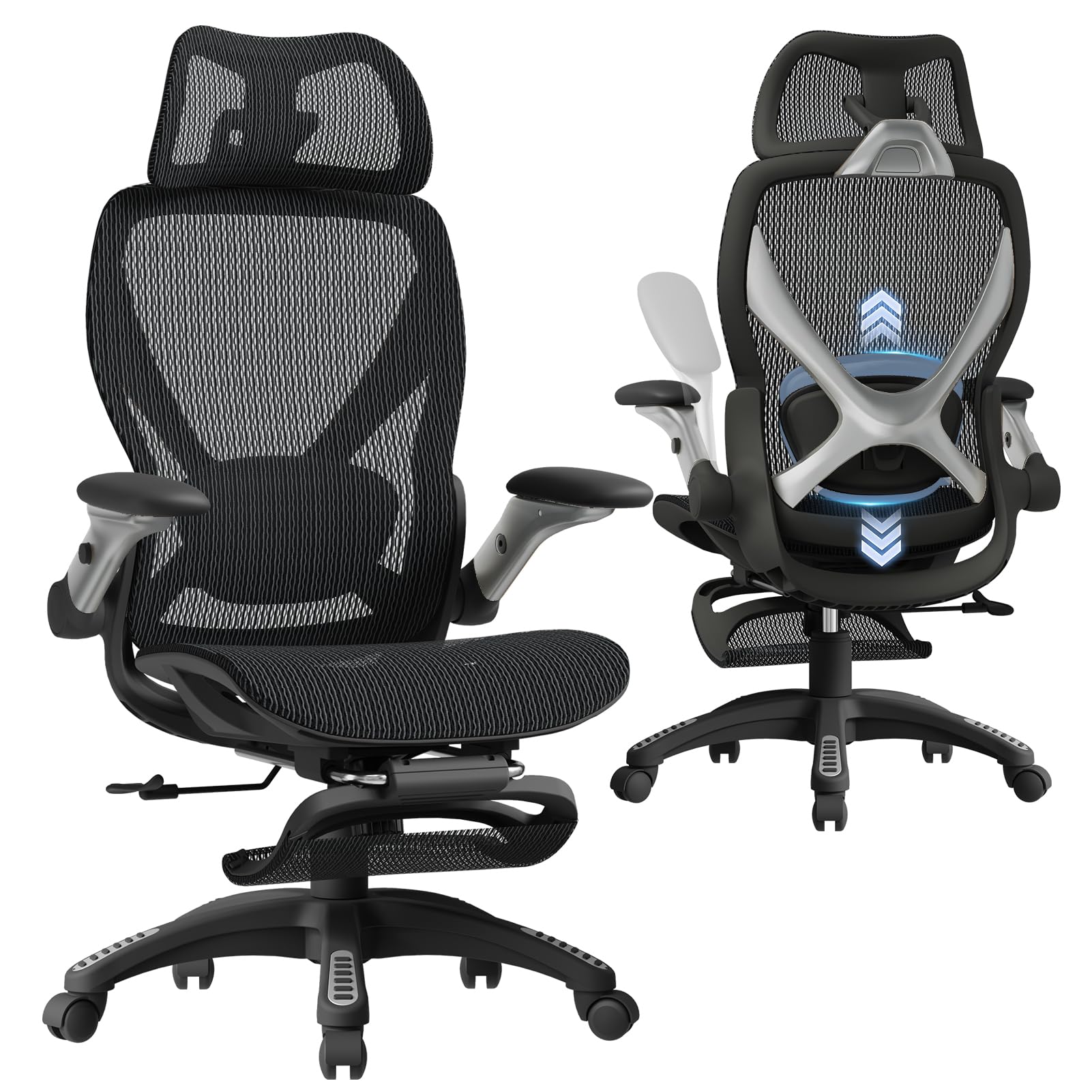
ELABEST X100
Key details
- Recline
- 3 positions with footrest
- Seat Height
- 18.3 inches
- Weight Capacity
- 300 lb
- Lumbar Adjustment
- 3D: depth, height, and 15° rotation
Lumbar support only works if it touches you, and on most chairs the pad is a fixed curve in a fixed place — too high, too low, or too far back to do anything but make you arch around it. The X100's pad rides on spring-loaded tracks that move it roughly an inch and a half in and out, two inches up and down, and 15 degrees of rotation. That's why this is our top pick for back pain: you can set it against your lower back rather than hoping the mold fits you.
Everything around it is built to keep you in the seat long enough for that setting to matter. The armrests adjust five ways and flip up, the headrest moves in three, and the three-stage recline pairs with an 18-inch footrest — the part of back care a pad can't cover, because changing position beats holding one all day. We were struck by how solid it feels for a mesh chair: no creak in the frame, no wobble in the base, and tool-free assembly that doesn't demand a second person.
It's a firm chair, deliberately. The mesh seat gives a little and then stops, which is right if the goal is holding a posture and wrong if you wanted something to sink into with a laptop. The 300-pound rating covers most sitters, and nothing about the build suggests it was built to a price. For eight hours at a desk, that trade is the whole point.
Pros
- Lumbar pad adjusts in depth, height, and rotation
- 5D armrests and a 3D headrest
- Three-stage recline with an 18-inch footrest
- Solid, creak-free frame in daily use
Cons
- Runs narrow for very broad shoulders
If your pain sits in your lower back, this is the chair we point you to: the lumbar pad moves in and out as well as up and down, so it can sit against your spine instead of behind it.