Best Ear Irrigation Kits of 2026

A blocked ear makes everything sound like it's happening behind a closed door—and tugging at your earlobe after a shower rarely helps. I've been there, and so have the friends and family who lent me their ears for this story. The fix isn't a cotton swab, which pushes wax deeper; it's an ear irrigation kit that flushes wax out gently. The right one clears the blockage without pain, keeps water from leaking down your neck, and leaves you hearing clearly again.

Over seven months, we tested 12 kits—manual bulbs, electric irrigators, and hybrids—and the differences in comfort, battery life, and wax removal surprised me. Nozzle shape and pressure mattered: a stream that's too hard stings, while one that's too soft leaves wax behind and tempts overuse. We tracked leakage and solo ease of use—a kit you can't manage on a Tuesday night isn't much of a kit. Value came down to spare tips, sturdy parts, and whether it still felt solid after months. The picks below cleared wax comfortably and didn't make me dread the next blocked ear.

1

Best Overall

Lebbtl Electric Irrigation System

90 /100
Trail Score Outstanding

Key details

Type
Rechargeable electric
Included
Ear basin, 15 tips
Reservoir
500 ml
Pressure Modes
4
Check Price on Amazon

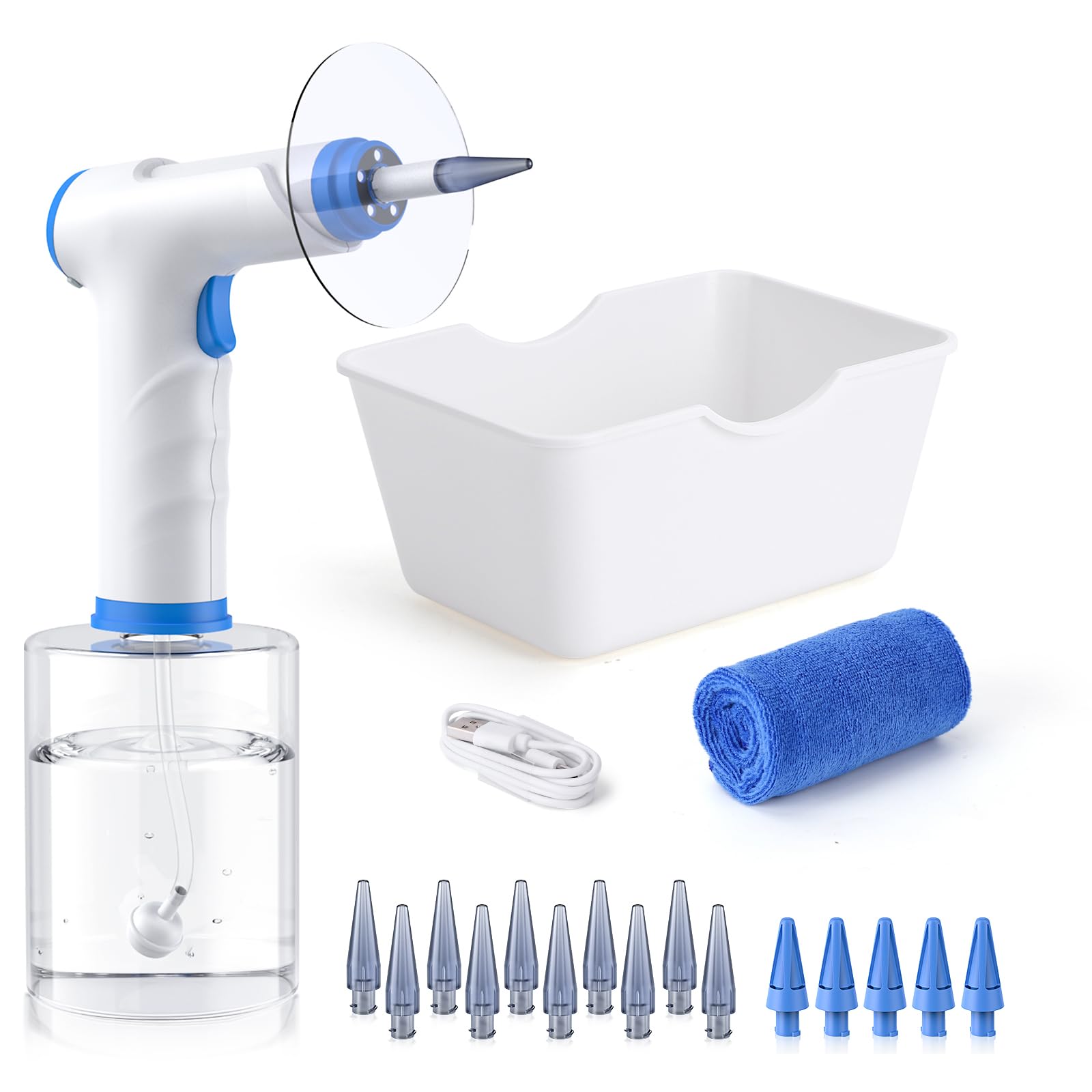
Four pressure modes and a 500 ml reservoir are why the Lebbtl earned the spot we keep coming back to. It sits on the bathroom counter like a small appliance rather than a syringe, and the index-finger start/stop control means you can pause the flow without repositioning the tip. The five LED lights are more helpful than we expected in a dim bathroom, and the two silicone tip styles let you choose a single stream or a five-hole spray. The included basin catches the runoff, which is the difference between a controlled session and a wet bath mat.

The 500 ml bottle is the part that changes the rhythm of a session: you fill it once and work through both ears without stopping to refill. We tried the five-hole tip first because it spreads the water around the canal instead of hitting one spot, then switched to the single-hole tip for a stubborn patch. Neither felt harsh on the lowest setting. The kit comes with 10 single-hole tips and five five-hole tips, so you can keep separate tips for different people without raiding the drawer.

It is a bigger commitment than the manual syringe, but the trade is a steadier stream and much less hand fatigue. If you want a kit that disappears into a travel bag, the 60 ml Medi Grade syringe is easier to stash; the Lebbtl is the one for a bathroom shelf and regular family use. The basin is the detail that earned its counter space, because it catches the water before it reaches the floor.

Pros

  • Four pressure modes adjust to comfort
  • 500 ml reservoir cuts refills
  • Basin and 15 soft tips included

Cons

  • Requires charging between sessions
Our verdict

We keep the Lebbtl electric kit as our default: four pressure modes and a 500 ml reservoir make flushing feel controlled, and the basin contains the mess.

Check Latest Price
2

Best Manual Syringe

Medi Grade 60ml Syringe

88 /100
Trail Score Excellent

Key details

Type
Manual syringe
Nozzle
Quad-stream tip
Capacity
60 ml
Reusable
Yes
Check Price on Amazon

A 60 ml syringe looks modest next to a 500 ml electric reservoir, but the Medi Grade is the manual tool we reach for when we want a short, targeted flush. The quad-stream tip splits the water into four directions instead of one hard jet, and the tip locks onto the syringe so it stays put while you squeeze. The whole thing is small enough to keep in a bathroom drawer, and the reusable design means no battery to charge.

What we appreciate most is the control: you decide when the water goes in and when it stops, and the four-way spray feels less aggressive than a single-hole syringe. It is also the easiest kit here to clean and dry, because there is no bottle, tube, or basin to work around. The locking tip is a small detail that matters when your hands are wet.

This is the one we pack for travel or keep as a backup in a first-aid box. It does not have the steady motorized flow of the top pick, but it also does not need a charger or a counter. The quad-stream tip is the part that makes it feel purpose-built rather than a kitchen syringe.

Pros

  • Quad-stream tip spreads water gently
  • Locking tip stays on while squeezing
  • Compact, battery-free, easy to store

Cons

  • 60 ml barrel needs several refills
  • Firm squeezing can tire your hand
Our verdict

The Medi Grade syringe is our compact manual pick, with a quad-stream tip that feels more precise than a plain bulb and no charger to remember.

Check Latest Price
3

Best Complete Manual Kit

Medi Grade 300ml Bottle Kit

88 /100
Trail Score Excellent

Key details

Type
Manual spray bottle
Capacity
300 ml
Included
Ear basin, spare tips
Spray Heads
2
Check Price on Amazon

The 300 ml bottle and ear basin are the reason this Medi Grade kit is our pick for a longer session. You fill the bottle once, lean over the basin, and keep flushing without the stop-and-refill rhythm of a small syringe. The kit includes two spray heads, four spare tips, and a quad-stream tip, so there is a softer option for sensitive ears and a more direct one for a stubborn plug.

The bottle is heavier than a syringe, but that weight is what makes it stable in one hand. We liked the basin for self-use because it gives you a target and keeps the runoff away from your feet, and it is genuinely useful when someone else is helping. The quad-stream tip is the one we start with; it spreads the water around the canal rather than driving it into one spot.

Where this kit earns its place is family use: the extra tips let each person have their own, and the basin contains the runoff that otherwise ends up on the floor. It is the manual kit we choose when we want fewer refills, not when we want the smallest footprint. If you flush alone in a small bathroom, the syringe is easier to tuck away; if you want a place to catch the water, this is the better manual choice. Label the spare tips so each family member keeps their own.

Pros

  • 300 ml bottle means fewer refills
  • Ear basin catches runoff
  • Multiple spray heads and tips

Cons

  • Several parts to clean after use
Our verdict

Choose the Medi Grade bottle kit when one small syringe means too many refills; we like its 300 ml reservoir, basin, and spare tips for family use.

Check Latest Price
4

Best With Camera

ENIFER Camera Irrigation Kit

90 /100
Trail Score Outstanding

Key details

Type
Rechargeable electric
Camera
1080P otoscope
Included
Ear basin, 15 tips
Pressure Modes
4
Check Price on Amazon

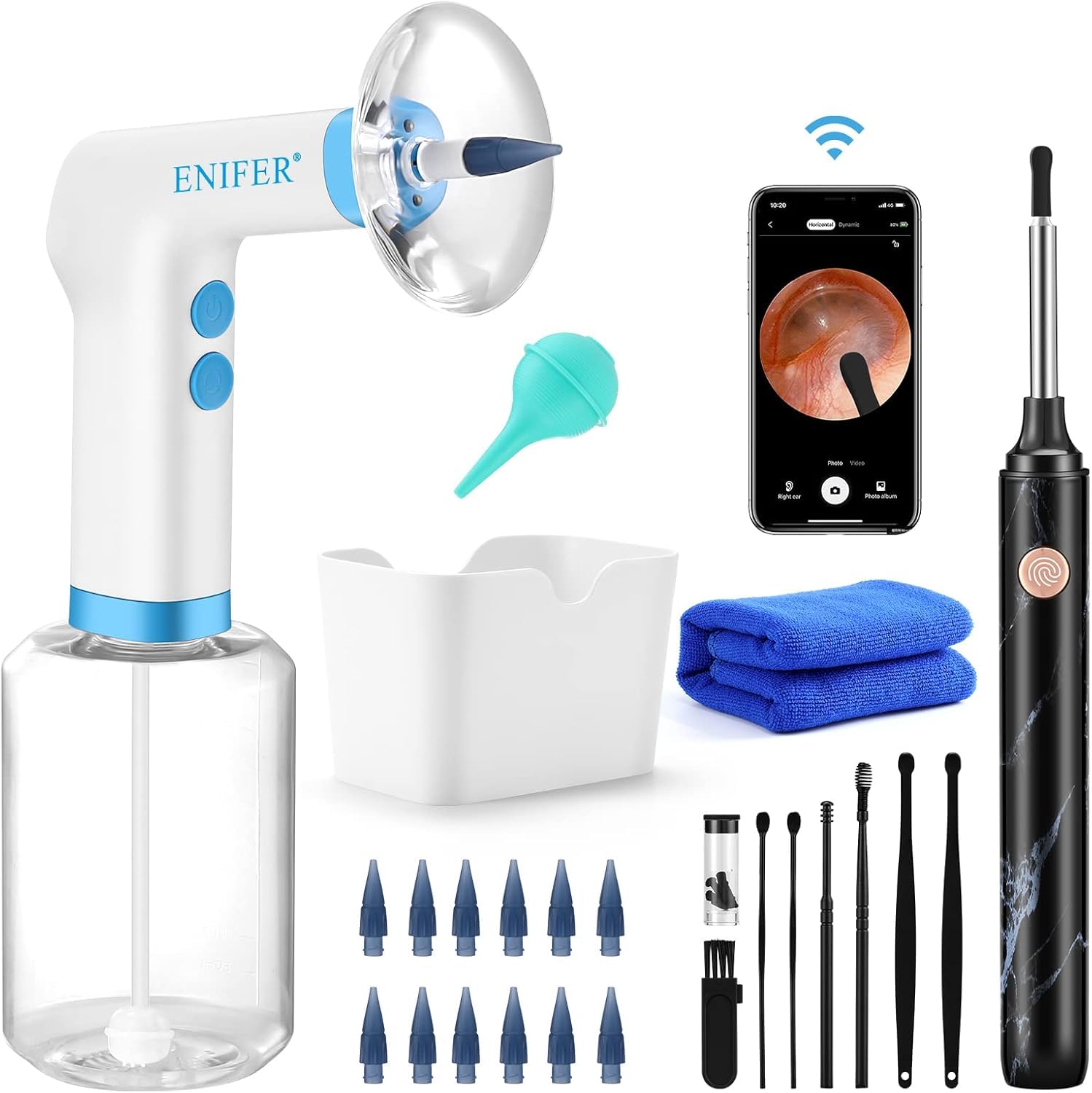
The ENIFER's 1080P otoscope is the feature that separates it from the other electric kits here: you can look inside the canal before you start, then check the result afterward. The camera uses a phone app, and a six-axis gyroscope steadies the image so it does not swim every time your hand moves. The irrigator itself has four pressure levels, a splash guard, and 15 tips, so the camera is an addition rather than a replacement for the flushing hardware.

We found the camera most useful for confirmation, not exploration. It is reassuring to see where the wax sits before aiming the tip, and it makes it easier to stop when the canal looks clear instead of guessing. The phone app connected quickly for us, and the image was steady enough to tell wax from the canal wall.

The irrigation side is capable on its own: four pressure levels and a basin. We used the lower settings first and moved up only when the flow felt comfortable. If you already know how to irrigate and do not care about seeing inside, the simpler Lebbtl is less expensive and has fewer pieces. The splash guard is the unglamorous detail we appreciated most; it kept runoff from running down the handle and onto our wrist.

Pros

  • 1080P camera shows wax before flushing
  • Four pressure levels and 15 tips
  • Splash guard limits runoff

Cons

  • Camera is a separate tool
  • App adds a setup step
Our verdict

We reach for the ENIFER when we want to see inside the canal; its 1080P camera adds confidence, though it is not essential for everyone.

Check Latest Price
5

Best Starter Kit

Debrox Ear Wax Removal Kit

88 /100
Trail Score Excellent

Key details

Age
Over 12 years
Type
Drops and bulb
Drops
0.5 fl oz
Formula
6.5% carbamide peroxide
Check Price on Amazon

Debrox is the kit we suggest when someone wants to start with drops rather than a full flushing system. The box contains 0.5 fl oz of 6.5% carbamide peroxide drops and a soft rubber bulb syringe. The drops are the active part; the bulb is there to rinse the loosened wax out with water.

We used the drops first and flushed with water, which is the sequence the kit describes. The bulb is soft and easy to squeeze, and the kit is small enough to keep in a medicine cabinet. It is a gentle introduction to home ear care, with no battery, reservoir, or app to manage.

The limitation is pressure. A bulb delivers a soft, pulsing rinse rather than the steady directed stream of a syringe or electric kit, so a hard plug may need more than one session. That gentleness is also the reason we keep it for first-timers: it is harder to overdo than a high-pressure bottle.

We see Debrox as the starter kit, not the workhorse. If you have a known plug and want a stronger flush, the Medi Grade syringe or the Lebbtl electric is the better first move. If you have never irrigated before, the drops-first routine is forgiving, and the soft bulb is the part that makes it feel less clinical than a syringe. The drops are the part that does the real work; the bulb just finishes the job.

Pros

  • Drops soften wax before flushing
  • Soft bulb is gentle for beginners
  • Complete low-cost starter kit

Cons

  • Small 0.5 fl oz drop bottle
  • Not for children under 12 without advice
Our verdict

Debrox is our starter kit for a gentle first attempt, pairing softening drops with a soft bulb syringe and no charging routine.

Check Latest Price
6

Best All-In-One Kit

Tilcare Ear Irrigation Kit

86 /100
Trail Score Excellent

Key details

Type
Manual spray kit
Warranty
30-day manufacturer guarantee
Intended Users
Adults, teens, children
Check Price on Amazon

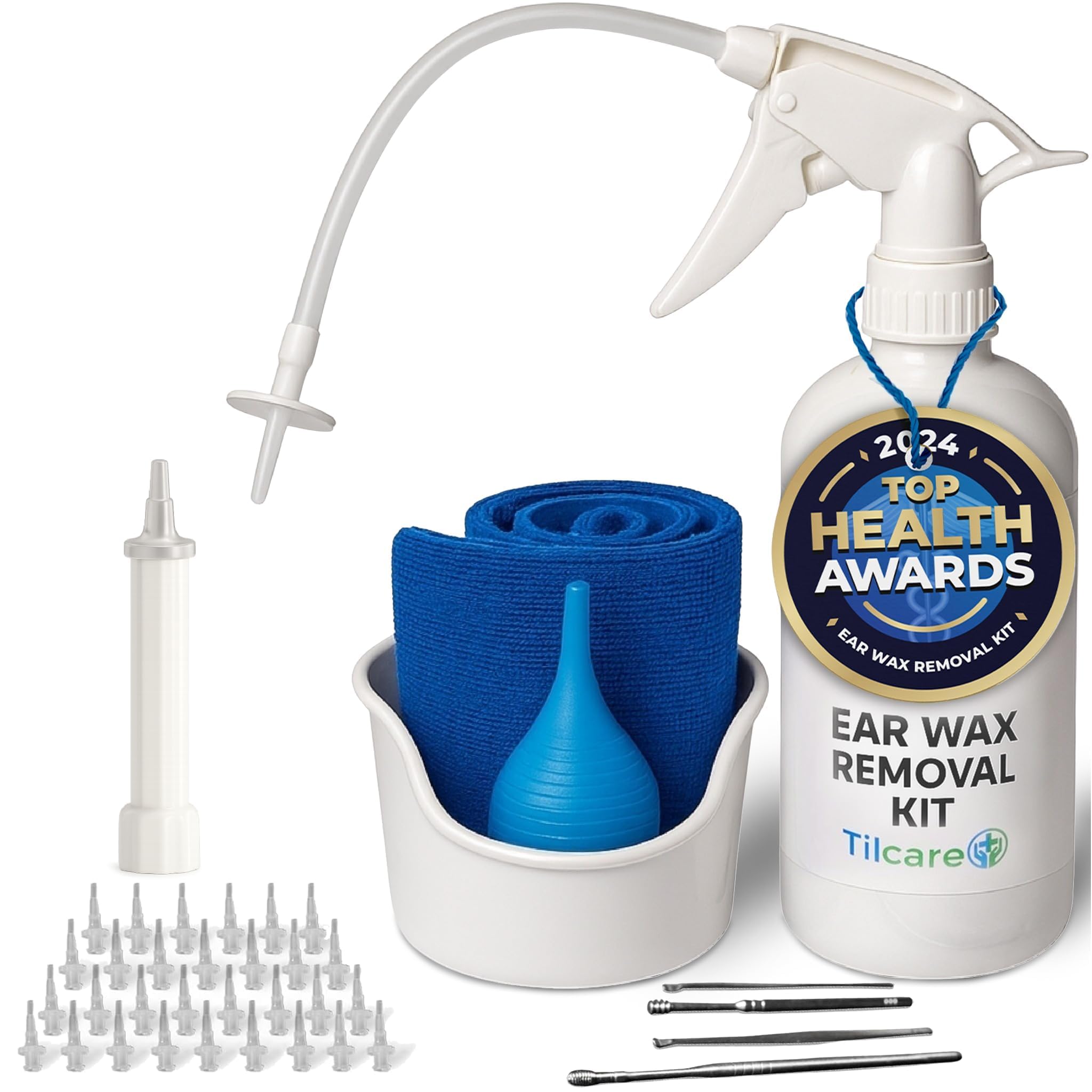
Tilcare's appeal is the complete-kit promise: a manual spray irrigator, a set of ear-cleaning accessories, and a 30-day manufacturer guarantee in one purchase. It is the kit we suggest to someone who wants to try irrigation without buying a battery-powered device or adding a charger to the routine. The spray gives a more directed flush than a bulb, and the manual action means you are never waiting on a charge.

We liked that it is a manual spray rather than a bulb; the stream feels more purposeful, and you can angle the nozzle without squeezing a rubber ball. The kit is aimed at adults, teens, and children, and the 30-day guarantee gives you some room to try it. It is a starter package rather than a refined instrument: the spray is the main tool, and the rest of the kit supports it.

This is the one we hand to someone who wants a simple first attempt and does not want to spend on a camera or a motor. If you already know you have a stubborn plug, the larger Medi Grade bottle or the Lebbtl electric will be less frustrating. The kit arrives complete, so you are not hunting for a missing tip on the day your ear clogs. The low learning curve is the point: you fill the sprayer, set the angle, and go.

Pros

  • Complete manual kit in one purchase
  • Directed spray is easier than a bulb
  • 30-day manufacturer guarantee

Cons

  • Manual pressure varies with your hand
Our verdict

We see Tilcare as the first-time buyer's manual kit: one box, no charger, and a low-cost way to try irrigation without much setup.

Check Latest Price
7

Mess-Free Electric Use

KAUGIC Self-Collecting Irrigator

85 /100
Trail Score Excellent

Key details

Tank
One-piece clean/waste tank
Type
Rechargeable electric
Waterproof
IPX7
Temperature
95°F–102°F indicator
Check Price on Amazon

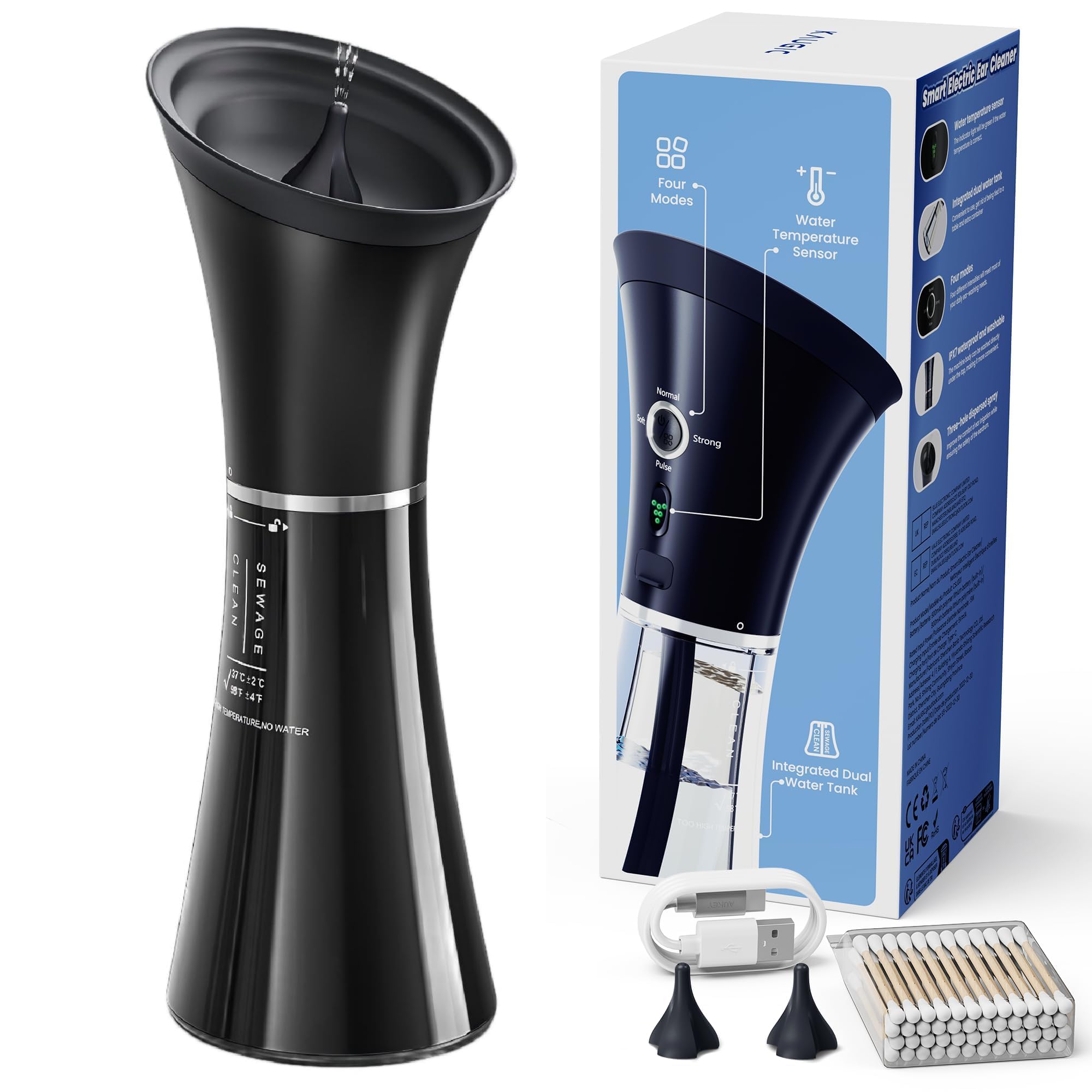
The KAUGIC is the tidiest electric kit here: its one-piece tank dispenses and collects water at the same time, so you are not balancing a separate basin on the edge of the sink. A green light tells you the water is between 95°F and 102°F, and a red light warns when it is outside that range. The unit is IPX7 waterproof, has four pressure settings, and uses a triple jet.

We liked the self-collecting design in a small bathroom, where counter space is the first thing to go. There is less to set down, and the runoff goes into the tank instead of across the vanity. The temperature light is a useful guardrail for anyone who has ever filled a bulb with water that felt fine on the wrist and shocking in the ear.

The higher price is the first trade-off; it sits above the manual kits and the Lebbtl. The handle also takes a little getting used to, especially when you are aiming at your own ear. None of that matters if you want the self-collecting convenience and the temperature check, but it is a lot to pay for a feature you may not need.

We see the KAUGIC as the premium pick for someone who hates the basin routine and wants a clear temperature signal. If you want the simplest electric, the Lebbtl is easier to live with; if you want to spend less, the manual bottle kit is the value. The green/red light is the detail that makes it feel more thoughtful than the average bathroom gadget.

Pros

  • Self-collecting tank reduces mess
  • Water temperature indicator
  • IPX7 waterproof, four pressure settings

Cons

  • Battery life can disappoint
Our verdict

Our premium electric pick is the KAUGIC, whose self-collecting tank and temperature indicator make a tidier session if the price suits you.

Check Latest Price
8

Long Nozzle Supply

QISXROVY 41-Nozzle Kit

86 /100
Trail Score Excellent

Key details

Type
Manual spray bottle
Bottle
BPA-free PET
Nozzles
41 disposable
Capacity
350 ml
Check Price on Amazon

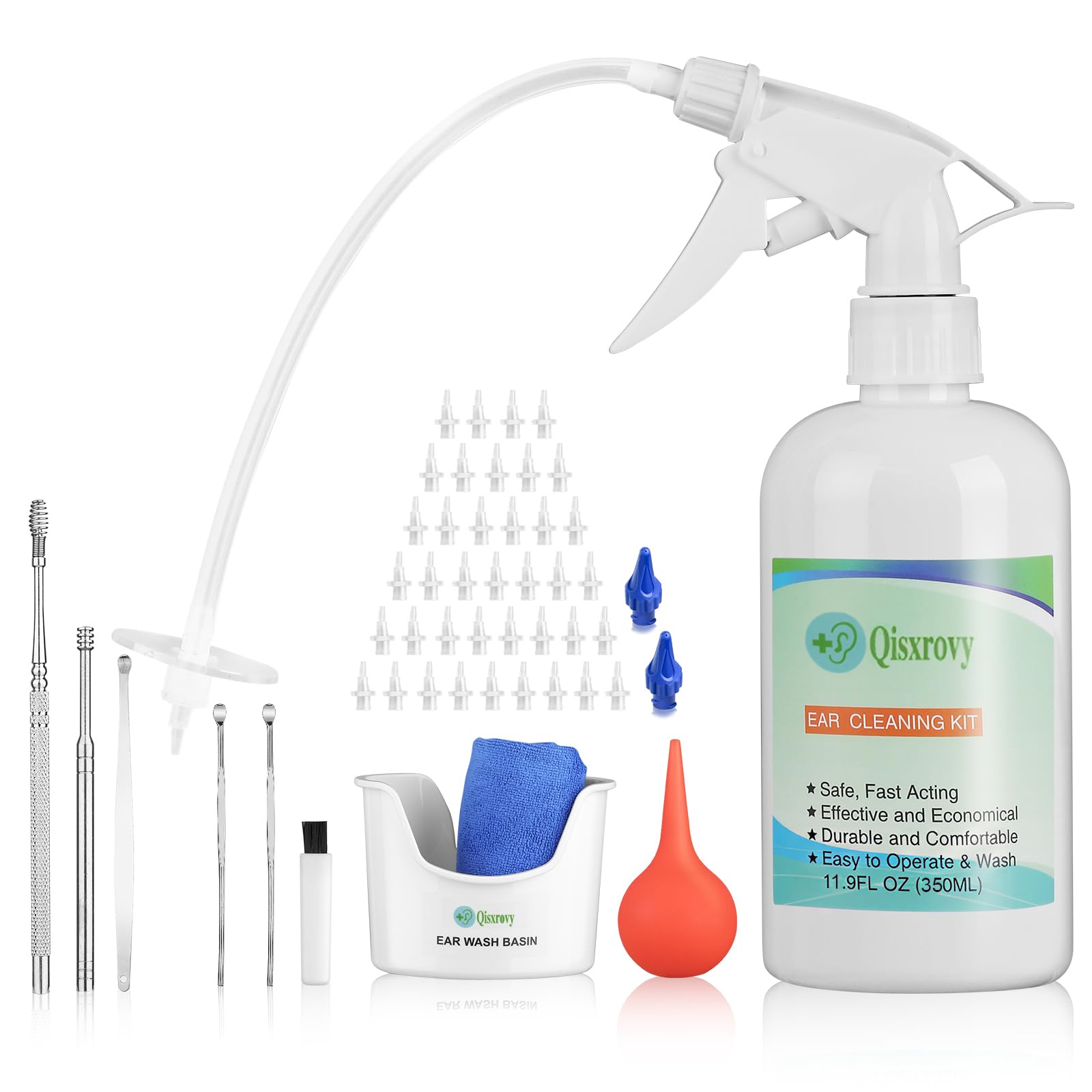
The QISXROVY kit wins on nozzle math: 39 single-jet nozzles for stubborn wax and two four-jet nozzles for a softer flush, plus a 350 ml PET bottle. If you hate reordering tips, this is the kit that disappears into the cabinet and comes back when you need it.

We liked the four-jet tips for a first pass because the water flows along the canal walls instead of straight at the eardrum. The single-jet tips are the strong ones; keep them for a stubborn patch and do not start there. The 350 ml bottle is big enough to avoid constant refills, and the BPA-free PET body feels sturdier than a thin squeeze bottle.

The bottle is bulkier than a syringe, which matters if storage is tight, and the manual pump means you set the pressure with your hand. We see it as the long-haul manual kit for someone who wants a big nozzle stash and does not mind a bottle rather than a syringe. The two four-jet tips are the pair we reach for first, because they feel less like a pressure washer.

Pros

  • 41 disposable nozzles last through many uses
  • Two four-jet tips soften the flow
  • 350 ml bottle reduces refills

Cons

  • Can leak around the handle
Our verdict

The QISXROVY kit is our long-supply manual choice: 41 disposable nozzles and a 350 ml bottle reward anyone who flushes repeatedly.

Check Latest Price

How We Chose and Tested Ear Irrigation Kits

We started by pulling every kit we could find from major retailers—manual bulb syringes, battery-powered irrigators, and pressure-controlled models—then narrowed the list by checking replacement tip availability, reservoir size, and whether the instructions were clear enough to follow without a medical degree. That left 12 kits, which we rotated through seven months of real use: after showers, on weekend mornings when a blocked ear was too annoying to ignore, and on family members who volunteered their ears and their opinions.

Each kit got the same workout. We filled it with lukewarm water and timed how long assembly and filling took, whether we could do it one-handed, and how easy the tip was to position solo. We watched for leaks—water running down the neck, drips from the reservoir, a tip that didn't seal—and noted whether the stream felt sharp or steady against the ear canal. For electric models, we tracked battery life across multiple sessions and marked when a charge died mid-rinse.

The real test was what happened after. We kept a log: did wax actually come out, did hearing feel clearer, and did the ear stay unclogged for the rest of the day? We also checked for soreness or pain in the hours afterward, since a kit that works but leaves you tender isn't a bargain. Value came at the end—spare tips, warranty, and whether the kit still felt sturdy after months of use.

How to Choose an Ear Irrigation Kit

Start With the Flushing Method

The biggest decision is manual versus electric. A bulb is the gentlest and least expensive, a syringe gives a more targeted burst, a bottle holds more water and often comes with a basin, and an electric unit supplies a steadier stream with less hand work. We reach for a bottle or electric kit when we want to flush both ears without refilling, and a small syringe when we want something packable. If your hands tire easily or you are helping someone else, the electric or bottle design is the easier choice. If you are nervous about pressure, start with a bulb or the lowest electric setting.

Match Capacity and Mess Control to Your Routine

A 60 ml syringe is fine for a quick, targeted flush but needs several refills; 300 to 500 ml bottles and reservoirs let you work without stopping. The trade-off is bulk and setup. An ear basin or self-collecting tank matters more than capacity if you flush over a carpeted floor or help a child. We prefer a basin for family use and a compact syringe for travel. Do not choose the biggest reservoir if it means the kit is too awkward to use comfortably.

Prioritize a Gentle, Controllable Stream

Soft tips and multiple spray patterns matter more than raw pressure. A four- or five-hole tip spreads water around the canal, while a single jet is better for a stubborn spot. Adjustable modes help you start low and move up only if the flow feels comfortable. Use lukewarm water, aim the tip along the canal rather than at the eardrum, and stop if you feel pain, dizziness, or a sudden blocked feeling. Stronger is not better; a steady, patient flush is easier on the ear.

Plan for Cleaning and Storage

Reusable syringes and bottles need to be rinsed and dried after use, and tips should be separated so they can air out. Disposable tips reduce cleaning but add waste and replacement cost. A storage box or bag is not a luxury if you flush away from home; it keeps the tip from rolling around a drawer. Check the kit's instructions for how often to replace tips, especially if the silicone cracks or clouds.

Know When to Skip Home Irrigation

Do not irrigate an ear with a perforated eardrum, ear tubes, an active infection, drainage, or recent ear surgery; ask a clinician first. The same goes for sudden hearing loss, severe pain, or a child young enough to need help staying still. Home kits are for routine wax, not for diagnosing or treating an ear problem. If two gentle sessions do not clear the blockage, stop and get advice rather than escalating the pressure.

Frequently Asked Questions

Final Verdict

We recommend the Lebbtl electric kit as the default for most home users. Its four pressure modes and 500 ml reservoir make self-flushing less fiddly, and the basin contains the runoff that makes home irrigation feel messy. If you want a manual tool for travel, the 60 ml Medi Grade syringe is the compact choice; if one small syringe means too many refills, the 300 ml Medi Grade bottle and basin are the family alternative. Skip home irrigation entirely if you have ear tubes, a perforated eardrum, or an active infection.