Best Dumbbell Racks for Home Gyms of 2026

The third time I tripped over a 25-pounder on the way to the treadmill, I stopped calling that pile beside the bench storage and started calling it what it was: a hazard. A rack is the least glamorous purchase in a home gym and the one that quietly decides whether you keep training at home. Get it wrong and you find out within a week — shelves that bow under the heavy end, a frame that walks across the garage floor every time you re-rack, or a footprint that swallows the last walkable square foot you had. Get it right and every set starts with the dumbbell already at chest height.

We spent six months with nine racks, from two-tier A-frames to vertical towers, loading and unloading them the way you actually would. The thing that surprised me most is that capacity ratings tell you less about total weight than about distribution — a rack rated for 400 pounds can still rock when the heavy pairs sit on one end. What follows are the ones that stayed planted, went together without a fight, and were still worth their floor space in month six.

1

Best Overall

Marcy DBR-86 Dumbbell Rack

96 /100
Trail Score Outstanding

Key details

Tiers
3, angled
Footprint
24.75"D x 37"W x 33"H
Frame Weight
43 lb
Weight Capacity
1,000 pounds
Check Price on Amazon

A 1,000-pound rating tells you something before you load a single dumbbell: this frame was designed around a full set, not a starter pair. The Marcy DBR-86 is three angled tiers of commercial-grade steel on rubberized feet, and at 43 pounds it sits exactly where you put it. That's why it's our top pick — it's the rack here we trust with everything from a pair of 5s to the heavy end of a home collection.

The downward tilt does more than look tidy. You can read the number on every handle from standing height, which matters mid-set when you're reaching for a 25 without breaking rhythm. Slot spacing is the thing to check before ordering: hex heads around 50 pounds sit snug, and 2- and 3-pound dumbbells are short enough to rattle in a cradle built for bigger heads. Measure the head width of your heaviest pair and compare it to the gap.

Assembly was the surprise. The holes line up, the hardware is bagged by step, and the frame squares without a fight; a second person speeds it up but isn't required. Load the heavy pairs low — the rack will hold a 50 on the top tier, but it feels more settled with the weight down where the feet are.

What's left is a rack that looks commercial enough for a garage and tidy enough for a spare bedroom, in a footprint of 24.75 by 37 inches. Deep enough that you'll want a little room behind it to swing weights in and out.

Pros

  • 1,000-pound rated steel frame
  • Angled tiers keep the whole set visible
  • Rubberized feet grip and protect floors
  • Hardware and holes line up cleanly

Cons

  • Slot spacing is tight for the widest 50-pound heads
  • Deep 24.75-inch footprint needs clearance
Our verdict

We recommend it for most home gyms: a 1,000-pound frame, three angled tiers, and hardware that lines up, with the fit of the widest hex heads the one thing to check first.

Check Latest Price
2

Best for Mixed Dumbbell Sets

YOLEO Adjustable Dumbbell Rack

90 /100
Trail Score Outstanding

Key details

Tiers
3
Footprint
19.7"D x 37.8"W x 36.6"H
Bar Width Range
2" to 5.1"
Weight Capacity
1,100 pounds
Check Price on Amazon

Most home collections aren't a matched set. There's a pair of 10s from one brand, 25s from another, and a neoprene pair somebody handed down — and when a rack disappoints, it's usually because its cradles were sized for someone else's dumbbells. YOLEO's answer is a bar you can move: four screw holes and two width adjusters on every tier, so the gap runs anywhere from 2 inches to 5.1.

That adjustability is the whole reason this one made the list, and it's the pick we point to when the dumbbells arrived from three different sellers. Set the bars wide for hex heads and narrow for coated neoprene, and nothing rattles or sits proud. The 1,100-pound rating is more capacity than most home sets will ever test; the width range is the number that earns its place.

Assembly asks for one thing the box doesn't supply, which is a second wrench — the lock nuts want holding on both sides. The frame is also easier to square with someone holding it while you tighten, and the triangle base settles flat once you do.

Finish-wise it reads as gym equipment rather than shelving, with a clean matte powder coat. In a room where the rack stays visible between sessions, that counts for more than it should.

Pros

  • Bars adjust from 2 to 5.1 inches
  • 1,100-pound capacity rating
  • Triangle base sits steady on hard floors
  • Fits a hodgepodge collection without sag

Cons

  • Width changes need a wrench and re-bolting
Our verdict

We point anyone with mismatched dumbbells here: the bars adjust from 2 to 5.1 inches, the most direct fix for the fit problem that sinks most racks.

Check Latest Price
3

Best for Large Collections

CAP 3-Tier Dumbbell Rack

90 /100
Trail Score Outstanding

Key details

Footprint
25.6"D x 51.57"W x 37.4"H
Frame Weight
45 lb
Shelf Length
51 inches per shelf
Weight Capacity
1,000 pounds
Check Price on Amazon

Fifty-one inches of shelf per tier is the number that separates this CAP from our top pick. The capacity rating is the same 1,000 pounds, but it's spread across nearly 15 more inches of width — which is what lets a full 5-to-50 set live on one frame instead of two piles against the wall.

The lower two shelves are angled and the top one is flat, a sensible split: the pairs you grab most often sit tilted toward your hands, and the top tier takes the overflow. The steel is heavier in person than the photos suggest, and once the frame is square it doesn't shimmy.

Volume is where it wins. Nothing else here holds a straight run of hex pairs this wide. Where it doesn't win is anything that isn't a dumbbell — kettlebells and Peloton-style handles don't seat well in the cradles — and at 25.6 inches deep it wants a wall rather than a corner.

Assembly has one rule the instructions bury: leave every bolt loose until the frame is standing level, then tighten from the bottom up. Skip that and the rack can settle out of square and rock, which is the difference between a rack that feels commercial and one that feels like flat-pack.

Pros

  • 51 inches of shelf per tier
  • 1,000-pound weight capacity
  • Angled lower shelves speed up loading
  • Heavier gauge steel than the photos suggest

Cons

  • Kettlebells and Peloton handles don't seat well
  • Needs a 51.57-inch wall
Our verdict

We rate it the pick for a full 5-to-50 set — 51 inches of shelf per tier and a 1,000-pound frame — provided you can give it a wall.

Check Latest Price
4

Best for Small Spaces

AKYEN 5-Tier Dumbbell Rack

91 /100
Trail Score Outstanding

Key details

Tiers
5
Footprint
13"D x 15"W x 27.6"H
Dumbbell Range
Up to 35 pounds
Weight Capacity
480 lb
Check Price on Amazon

Five tiers in 27.6 inches of height is the trade. The AKYEN stacks more pairs per square foot than anything else here, and it manages that by sizing its cradles for dumbbells up to about 35 pounds. If your set stops at 30s, that isn't a compromise — it's the reason the rack is only 15 inches wide.

For a small room and a modest set, this is the one we reach for. It stands 15 by 13 inches on the floor, well under half the footprint of our top pick, and the 480-pound rating covers a 5-to-30 run with room left over. At 13 pounds, carrying it upstairs and repositioning it is a one-person job.

Two things to know. The brackets sit close enough that racking a dumbbell with your fingers wrapped around the handle can catch your knuckles; grip the head instead and the problem goes away. And fit depends on shape: hex heads and Peloton handles settle in, while fat neoprene bells and the biggest pairs sit proud of the cradle.

Neither changes the calculation much. If floor space is what you're short of and your set tops out in the 30s, this does the job of racks twice its size, and it stands steady once the bolts are snug.

Pros

  • Five tiers in a 15-by-13-inch footprint
  • 480-pound capacity for a 5-to-30 set
  • 13-pound frame moves easily
  • Slots suit hex and Peloton heads

Cons

  • Rated only for dumbbells up to about 35 pounds
  • Close-set brackets can pinch fingers
Our verdict

We like it best when floor space is the constraint: five tiers, a 480-pound frame, and a 15-by-13-inch footprint for dumbbells up to about 35 pounds.

Check Latest Price
5

Best Budget

pickpiff 3-Tier Dumbbell Rack

89 /100
Trail Score Excellent

Key details

Tiers
3, adjustable bars
Footprint
9.8"D x 31.5"W x 31.5"H
Per-shelf Limit
130 lb
Weight Capacity
390 lb
Check Price on Amazon

Cheap racks usually announce themselves in the gauge of the steel and the shimmy when you set a weight down. This one mostly doesn't. The pickpiff is three tiers of reinforced metal with adjustable cross bars, powder-coated and rated to 390 pounds total — enough for a working home set rather than a token pair.

The adjustable bars are what we care about most. You set the gap between the rails on each tier, so the same rack holds hex dumbbells and a couple of kettlebells without either one rattling. At the small end of this group it's the most shape-tolerant frame going.

The ceiling is honest and worth reading twice: 390 pounds total, 130 per shelf. That covers a 5-to-30 set comfortably and gets tight the moment 45s show up. The payoff is the footprint — 9.8 inches deep and 31.5 wide, so it slips into a corner or beside a bench where nothing else here fits.

Assembly is the pleasant part. The hardware comes bagged by step, the holes line up, and the included tools are enough; nothing needed re-drilling. It's the sort of thing you only notice when it's missing.

Pros

  • Adjustable bars on every tier
  • 390 pounds total capacity
  • Under 10 inches deep
  • Hardware bagged by step, holes align

Cons

  • 130 pounds per shelf limits the heavy end
Our verdict

We think it's the best small rack for a working set: adjustable bars, 390 pounds of capacity, and a corner-sized footprint, with a hard ceiling below a full collection.

Check Latest Price
6

Best Rolling Rack

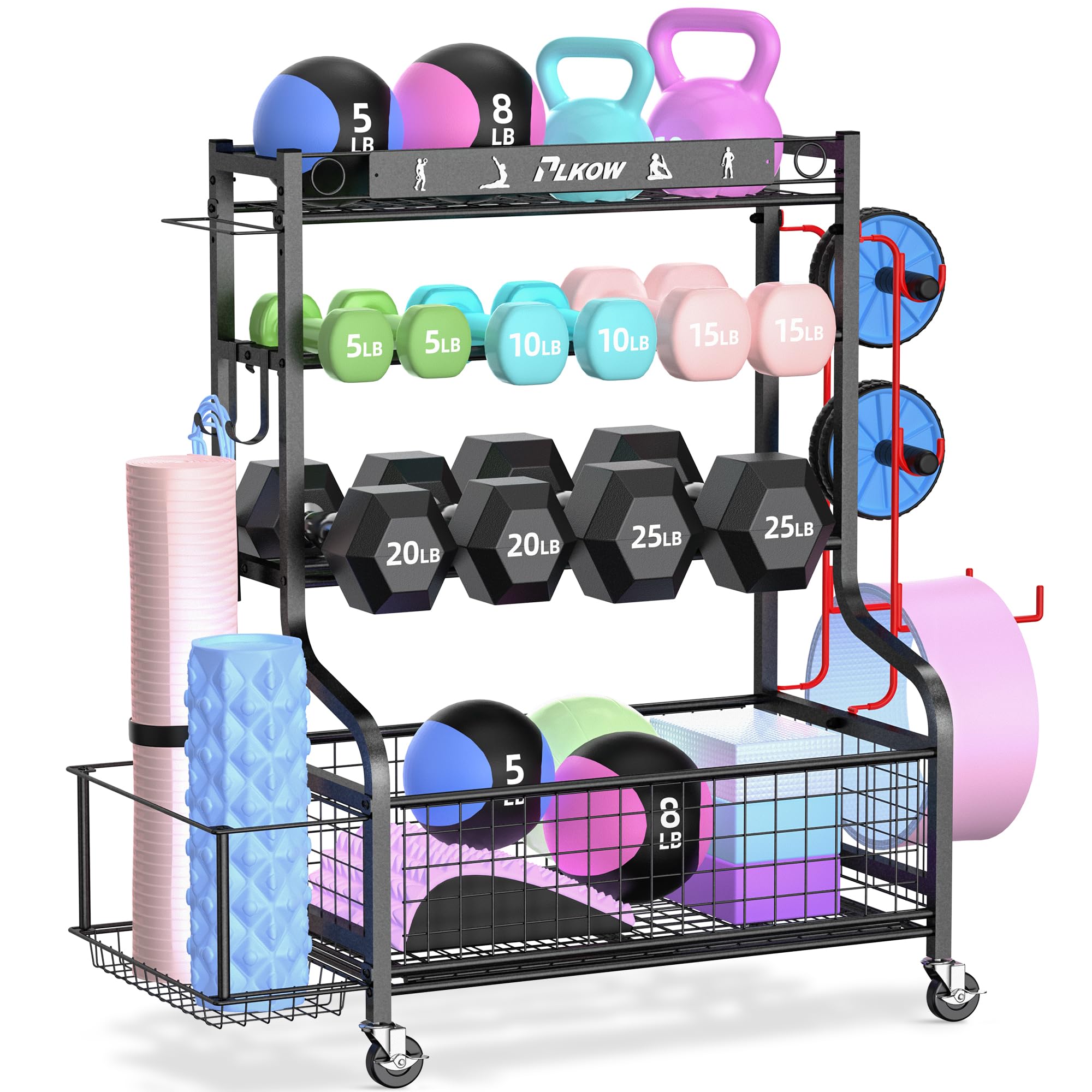
PLKOW Dumbbell Rack with Wheels

91 /100
Trail Score Outstanding

Key details

Storage
3 shelves plus basket and hooks
Mobility
4 casters, 2 locking
Footprint
15.8"D x 41.5"W x 37"H
Weight Capacity
350 lb
Check Price on Amazon

Four casters, two of them lockable, change what a rack can be. This one follows you from the corner of the garage to the middle of the floor and back, which is the argument for it over a rack that stays put.

Three tiers of dumbbell storage sit between a side basket and a row of hooks, so the mat, the bands and the towel have somewhere to go that isn't the floor. The frame is powder-coated against rust and rated to 350 pounds.

Plan around that number. It's a 5-to-25 set plus accessories, not a 5-to-50 wall, and the heavier pairs belong on the bottom tier. Loaded, it rolls easily on a hard floor; the listing's own advice is to keep it off carpet when it's heavy, which tracks with what we found as the rack filled up.

Where it earns its place is a multi-use room. If the gym shares space with a car or a washer, parking the whole set against a wall and pulling it out for a session is worth more than a few hundred pounds of capacity you'll never load.

Pros

  • Four casters, two lockable
  • Basket and hooks for mats and bands
  • Rolls easily on hard floors

Cons

  • 350-pound ceiling suits a 5-to-25 set
Our verdict

For a gym that shares a room with something else, we point to this one: 350 pounds of dumbbell storage plus hooks and a basket, on casters that clear the floor.

Check Latest Price
7

Light Dumbbells

Josmimic 4-Tier Dumbbell Rack

93 /100
Trail Score Outstanding

Key details

Tiers
4
Footprint
3.58"D x 12.99"W x 16.93"H
Frame Weight
7 lb
Weight Capacity
154.3 lb
Check Price on Amazon

Most racks are built for the heaviest pair in the room. This one is built for the pairs you actually reach for on a Tuesday — the 5s, the 8s, the 12s — and it does that in 16.93 inches of height and just under 13 inches of width. That's the whole case for it: nothing else here disappears into a corner the way this does.

The rubber-edged guards are the detail we appreciate most. Light dumbbells are usually the coated ones, and coating is what scuffs first when weights get stacked against bare metal; the slip-on guards take that contact instead. Capacity is 70 kg, about 154 pounds, and the entire rack weighs 7 pounds, so it's easy to lift out of the way when the room goes back to being a room. The coral-inspired frame is either a feature or a distraction depending on your taste; we land on the charming side.

Assembly is short and the hardware comes sorted, which is about all you can ask of four tiers of steel. What it won't do is grow: seventy kilos is a starter set's worth, the cradles are sized for small heads, and a pair of 25s isn't going to live here — at which point you're buying a second rack, not a bigger one.

Pros

  • Fits in 13 inches of width
  • Rubber guards protect coated dumbbells
  • 7-pound frame lifts out of the way

Cons

  • 70 kg capacity limits it to light sets
Our verdict

We keep it for small sets in small rooms: four tiers for 3-to-15-pound pairs, rubber guards for coated dumbbells, and a frame you can lift with one hand.

Check Latest Price
8

Mats and Bands

Mythinglogic Home Gym Rack

93 /100
Trail Score Outstanding

Key details

Storage
3 mesh shelves plus basket and hooks
Mobility
Locking casters
Footprint
15.7"D x 30.5"W x 34.3"H
Weight Capacity
220 lb
Check Price on Amazon

If your home gym is a corner of the living room, the problem isn't only dumbbells. It's the mat that won't stay rolled, the bands in a drawer, and the foam roller behind the sofa. This cart is built for that pile: three mesh shelves, a side basket sized for a mat or roller, and hooks for bands and ropes.

The dumbbell side of the job has a ceiling. The frame is rated to 220 pounds, and the sensible loading is heavy pairs on the bottom shelf with lighter weights and accessories above — advice that applies to every rack here and matters most on this one.

Locking casters make it genuinely useful in a shared room: roll it out, lock it, train, roll it back. Assembly is the weak spot — the instructions take patience and the frame is easier with two people — but the trade is one piece of furniture replacing four piles.

Visibility is where it wins. Everything is on show, so the bands you forgot about get used and the mat stops living behind the door. Iron is where it loses: 220 pounds is a light-to-mid set, and anyone with a run of 30s and 40s should be looking at a dedicated rack instead.

Pros

  • Mesh shelves, basket and hooks for mixed gear
  • Locking casters for shared rooms
  • Keeps everything visible and in use

Cons

  • 220-pound capacity suits lighter sets
Our verdict

We suggest it for the corner-of-the-living-room gym: three shelves, hooks and locking casters that take the mats and bands as well as the weights.

Check Latest Price

How We Tested the Best Dumbbell Racks

We started by pulling together every rack we could find that was sold as a standalone unit rather than a bundle, then narrowed by published weight capacity, footprint dimensions, and whether the tier heights were listed at all — a surprising number of listings don't tell you the clearance between shelves. We also read through assembly complaints to see which brands kept showing up with missing hardware or instructions that skip a step, and we cut anything that cost more per pair of slots than the dumbbells sitting on it.

Nine racks came in and lived in three real spaces: a garage gym on bare concrete, a basement with a slab that slopes toward the drain, and a carpeted spare bedroom. I assembled each one alone with only the included tools and timed it, noting where the instructions stalled and whether the hardware bag matched the parts list. Then came the loading: pairs from 5 to 50 pounds, first evenly, then deliberately piled onto one end to see whether the frame racked or the shelves sagged.

For six months we re-racked dumbbells several times a week and watched for the small failures — frames creeping across the floor, paint chipping where the dumbbell heads land, a 40-pounder that clips the tier above when you pull it out mid-set. We taped out a 10-by-10 footprint on the floor to check how much room each rack actually left us, and we checked welds, powder coat, and whether the feet sat flat on an uneven slab. Value came down to simple arithmetic: price divided by usable slots, with a penalty for any rack we had to shore up or re-tighten.

How to Choose a Dumbbell Rack

Start With Your Dumbbells, Not the Rack

Dumbbell heads vary more than the racks that hold them. A 25-pound hex head from one brand can be wider than a 30 from another, and coated neoprene bells are fatter still, so a cradle that swallows one pair can leave the next sitting proud. The gap between the rails is the specification that decides it, and it's the one listing pages mention least.

Measure head width and handle length on your heaviest and lightest pairs before you buy. If the numbers are all over the place, choose a rack with adjustable bars — YOLEO covers 2 to 5.1 inches — and set each tier for the pairs it will actually hold. The other trap is at the small end: 2- and 3-pound dumbbells are often too short to reach both rails, which is how they end up back on the floor.

Read Capacity as a Ceiling

A total rating is the frame's limit, not a target. A 1,000-pound rack and a 480-pound rack differ in how much of a full set they'll carry, and some racks split that limit per shelf — the pickpiff rates 130 pounds per tier, which is generous for 20s and stingy for 45s.

Load heavy pairs low. Every rack is more settled that way, and it keeps the weights you actually press overhead at waist height instead of above your shoulders.

Choose Between Wall Space and Corner Space

Wide three-tier racks and tall A-frames solve the same problem with different geometry. A 51-inch rack like the CAP stores a full set along a wall; a five-tier frame like the AKYEN stacks ten pairs into a 15-by-13-inch corner. Measure the wall and the corner you have before deciding which one you own.

Watch the depth, too. The deepest racks here run past 25 inches front to back, which is fine against a garage wall and awkward in a hallway. Treat compact in a listing as a description of the assembled footprint, not a promise that it folds away.

Stability Is Mostly Assembly

A rack that rocks is usually a rack that wasn't squared. Wide frames want every bolt left loose until the frame is standing on a level floor, then tightened from the bottom up — CAP prints that instruction, and it applies to all of them.

Feet matter as much as bolts. Rubberized pads grip hardwood and protect it; bare steel slides and marks. If you're choosing a rolling rack, know that loaded casters prefer hard floors to carpet.

Decide What Else It Has to Hold

Storage for mats, bands and rollers is genuinely useful in a shared room, and it usually comes at the cost of dumbbell capacity: the wheeled PLKOW tops out at 350 pounds, Mythinglogic's cart at 220. A dedicated rack of similar size carries two to three times as much iron.

Keep kettlebells in mind, too. Their round bells and offset handles don't seat in narrow dumbbell cradles, so adjustable or flat bars serve a mixed collection better.

Frequently Asked Questions

Final Verdict

The Marcy DBR-86 is the rack we recommend for most home gyms: a 1,000-pound frame, three angled tiers, and hardware that goes together without a fight. Buy it if you have a wall to spare and a set of hex dumbbells that stops around 50 pounds.

If your dumbbells come from three different brands, the YOLEO's adjustable bars solve a problem the Marcy can't. If floor space is the binding constraint and your set tops out near 30, the AKYEN does the same job in a fraction of the footprint.