Best Dip Stations of 2026

The scariest part of a dip isn't the rep — it's the half-second at the bottom when the whole frame shifts under you. I've had a bargain tower walk an inch across the floor mid-set, and I've watched a bar flex enough that I bailed on the last two reps. A dip station really has one job: stay exactly where you put it while your entire bodyweight hangs off the front of it. Get that right and everything else — how wide the handles sit, how fast it folds down, whether it tucks into a spare-room corner, whether you're paying for steel or for attachments — turns into a detail instead of a dealbreaker.

Over the past six months my team and I assembled, adjusted, and trained on 11 of them, from compact folding bars to full power towers, and the pattern showed up early: the units that feel planted in the first 30 seconds usually stay that way. Here's the thing nobody tells a first-time buyer — assembly is the tell. If the bolts go in crooked or the feet need shimming on day one, the wobble only gets worse once you start adding weight. The ones below are the stations we kept coming back to.

1

Best Overall

ProsourceFit Power Dip Station

91 /100
Trail Score Outstanding

Key details

Grip Width
19.5"–26.5"
Item Weight
23.5 lb
Height Range
31"–35"
Weight Capacity
400 lb
Check Price on Amazon

Seven grip widths, an inch apart, spanning 19 ½ to 26 ½ inches — that's the number that made this our top pick. Grip width is where a fixed dip station usually lets you down: narrow enough for one lifter is a strain for the next, and most stations in this group make you choose between two preset positions or none at all. Moving the handles a single inch at a time means you can find the spacing your shoulders actually like, then leave it there.

The rest of the frame is built around the same idea. Height adjusts from 31 to 35 inches, which covers bent-knee dips for most adults and leaves room to add a dip belt later. A steel connector bolts across the base to tie the two halves together, rubber feet keep it planted on concrete or matting, and the iron frame carries a 400-pound rating backed by a lifetime warranty. At 23.5 pounds it takes two hands to move and one person to set up.

Bolt that connector in, every time. It's the piece that turns two separate U-bars into something behaving like one frame, and it's also the piece people leave off in a hurry — without it the halves can walk apart as you shift your weight forward. The rubber feet do their best on an uneven garage slab, but this is a station to position once rather than drag around between sets.

Pros

  • Seven grip widths in one-inch steps
  • Height adjusts from 31 to 35 inches
  • Bolted connector ties the halves together
  • 400-pound iron frame with a lifetime warranty

Cons

  • Firm foam grips are tough on high-rep sets
Our verdict

This is the station we tell most people to buy: seven grip widths an inch apart, a bolted base connector, and a lifetime warranty on a 400-pound frame.

Check Latest Price
2

Best Premium

KAKICLAY Premium Dip Bars

90 /100
Trail Score Outstanding

Key details

Height
35.43"
Grip Diameter
40 mm
Width Settings
6 positions
Weight Capacity
880 lb
Check Price on Amazon

Two bars, a bridge with six width holes, and a matte black powder coat: the KAKICLAY set is the one here that reads as gym equipment rather than a folding accessory. Carbon steel, a stated 880-pound limit, and a 35.43-inch height that puts the handles where an adult can do a full dip without tucking the knees.

The grip is what separates it. Instead of foam, each handle is a 40 mm powder-coated bar finished with grip tape — thicker than most in this group and matte enough to hold chalk and stay put through a sweaty set. We ran them unbolted for L-sit holds and joined them for dips, and the six holes in the bridge give a wide enough spread of hand positions to matter rather than a token second setting. Even the feet get end caps.

What it costs is money and certainty: this is the priciest station we recommend, and the design is newer than the long-running frames from ProsourceFit and Ultimate Body Press, so fewer people have put years on it. For a lifter who wants the bars to feel like a good barbell and doesn't mind paying for that, the trade is easy to make.

Pros

  • 40 mm handles with grip tape, not foam
  • Six width settings on the connecting piece
  • 880-pound rating with lifetime warranty

Cons

  • The priciest pick in this group
Our verdict

We reach for this one when grip quality matters most: 40 mm handles, grip tape instead of foam, and a lifetime warranty.

Check Latest Price
3

Best Portable

Lebert EQualizer Dip Bars

93 /100
Trail Score Outstanding

Key details

Bar Base
21"
Bar Height
31"
Pair Weight
16 lb
Weight Capacity
400 lb per bar
Check Price on Amazon

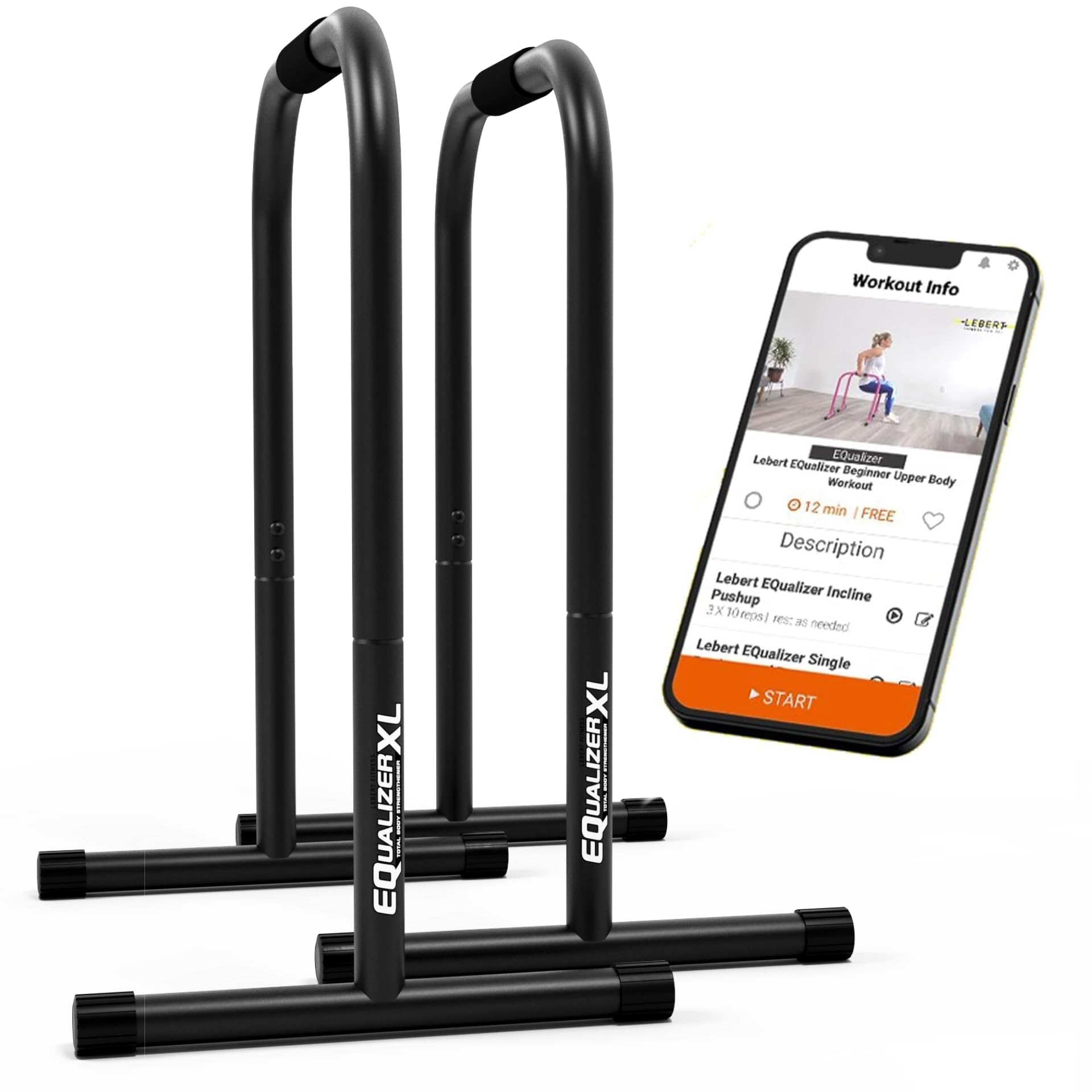
The EQualizer isn't a frame at all — it's two 31-inch bars you set down wherever you want them, and that's exactly why we keep a pair around. Apart, they work as parallettes for L-sits and handstand holds; spaced at shoulder width, they take dips, rows, and leg raises. Each bar weighs 8 pounds on a 21-inch base, so both go in one hand and disappear into a closet when the living room goes back to being a living room.

Construction is solid iron with a 400-pound rating per bar and dense foam on the handles, and the pair ships with a hip resistance band and access to Lebert's coaching videos. That band earns its place: looped around both bars it gives you banded rows and assisted dips without a rack. We also found a single bar useful for split squats and pistol-squat support, which is more than most dip stations can offer.

Set them roughly parallel on a mat and they stay put through a set; a little movement is the design, not a fault, and it's exactly what makes them good for handstand and L-sit practice. If you want a rigid frame that tells you where your hands are every single time, that's a different product. These reward a couple of seconds of attention to setup.

Pros

  • Two independent bars that pack away
  • Works as parallettes for L-sits and holds
  • Hip band and coaching access included

Cons

  • Fixed 31-inch height suits few tall lifters
Our verdict

We keep a pair of these for the days the gym has to disappear — two 8-pound bars that stash in a closet and still take full bodyweight.

Check Latest Price
4

Best for Small Spaces

Ultimate Body Press Dip Station

88 /100
Trail Score Excellent

Key details

Height
36"
Warranty
10-year limited
Footprint
24" x 36"
Weight Capacity
350 lb
Check Price on Amazon

Folding is the whole point of this one. The two side frames snap together with color-coded spring tabs — no tools, no bolts — and fold flat enough to stand behind a door or slide under a bed. At 36 inches tall with a 24-by-36-inch footprint, it's the only station here that breaks down in seconds and the easiest to live with in a room that has another job.

The details show someone thought about lifting in a garage. Quick-adjust leveling feet twist to take up an uneven slab, which matters more than it sounds, because a rocking station is how a lot of dip bars end up leaning against a wall. The grips are angled rather than straight, which takes strain off the wrists when your elbows drift out, and there are two handle widths to choose between at assembly.

What you're paying for is the fold and the 10-year warranty, not the width adjustment. The ProsourceFit costs about the same and moves the grips an inch at a time; this one gives you two positions. For a small apartment, that's a fair trade — a station that stores is a station you'll actually use.

Pros

  • Folds flat with no tools
  • Leveling feet handle uneven floors
  • Angled grips ease wrist strain
  • 10-year limited warranty

Cons

  • 350-pound rating is modest for weighted dips
  • Snap-together joints have some play
Our verdict

If your workout space doubles as something else, this is the one we hand you: it folds flat without tools and levels on an uneven floor.

Check Latest Price
5

Best Budget

Amazon Basics Dip Bar Station

91 /100
Trail Score Outstanding

Key details

Height
38.4"
Footprint
34.25" x 32.5"
Item Weight
22 lb
Weight Capacity
661 lb
Check Price on Amazon

Steel, 38.4 inches to the top of the handles, a stated 661-pound capacity, and a footprint of about 34 by 32 inches: on paper this is the most capacity you get for the least money in this group, and that's the whole pitch.

In use it's a plain, planted frame. The foam grips are wide enough to find without looking, and the two floor pads kept it from skating on our rubber matting. The height puts the bars where most adults can do a full dip with bent knees, and it takes push-up rings or straps across the top if you want to vary the load without buying more equipment.

Where it earns its place is the value: nothing about the frame feels flimsy when you're hanging off it, and you're not paying for adjustments you won't use. The 34-inch width is the practical catch — it won't thread through a standard interior door, so build it where it's staying and leave it there. Treated as a permanent fixture, it does everything a pricier station does.

Pros

  • 661-pound capacity at the lowest price here
  • Foam floor pads stop it skating
  • Takes push-up rings or straps

Cons

  • Paint chips, and some units arrive with rust spots
Our verdict

For the smallest budget here, we point you to a 661-pound frame that stays planted — just expect the paint to take a beating.

Check Latest Price
6

Compact Rooms

Fuel Pureformance Dip Station

88 /100
Trail Score Excellent

Key details

Height
35.63"
Footprint
26.77" x 22.05"
Item Weight
17 lb
Weight Capacity
300 lb
Check Price on Amazon

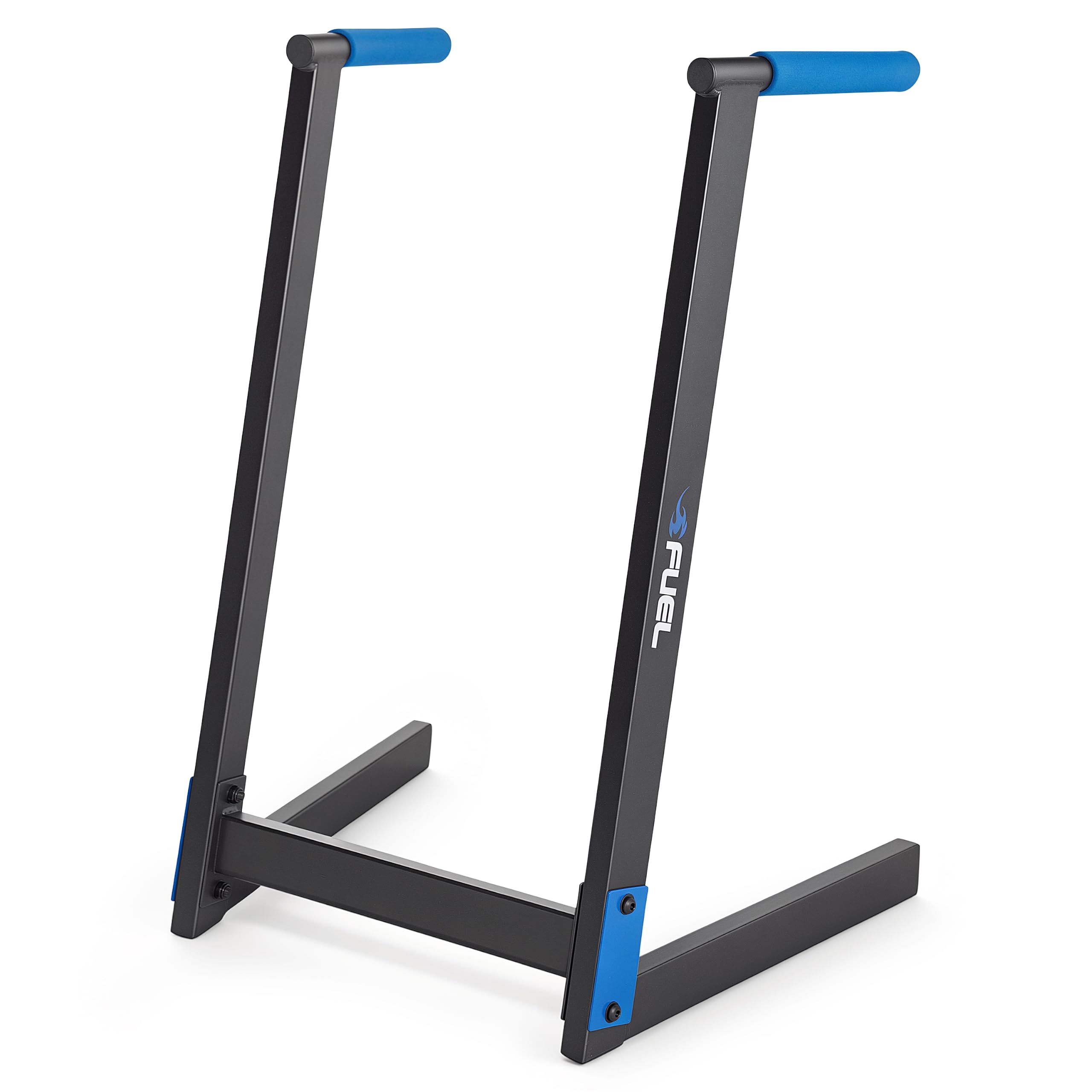
There's no crossbar between the handles and nothing in front of your shins, and that open, pass-through design is what makes the Fuel Pureformance useful for more than dips. At 35.63 inches tall with a 26.77-by-22.05-inch base, it's the most compact full-height station here, and at 17 pounds it slides out of the way between sessions.

We noticed the open front the first time we did knee raises — nothing to clip a foot on. Chest dips, inverted rows, and hanging knee raises all work because your body passes through the frame instead of around it. The angled, padded grips sit naturally under the heel of the hand, and the 14-gauge steel feels more planted than 17 pounds has any right to.

The limits are the rating and the paperwork. At 300 pounds it's the lowest capacity here, so do the arithmetic before you add a belt or a vest, and the 30-day manufacturer warranty is short next to the lifetime coverage on our top pick. Taller lifters should also expect a low bar: at 35.63 inches there isn't much room for a straight-legged L-sit.

Pros

  • Open pass-through frame frees your knees
  • Compact 22-inch depth for small rooms
  • Angled padded grips

Cons

  • 300-pound rating is the lowest here
  • 30-day warranty is short for the money
Our verdict

We like it for small rooms and open-frame work — chest dips, rows, and knee raises with nothing in front of your shins.

Check Latest Price
7

Tied-Together Frame

YOLEO Adjustable Dip Bar

87 /100
Trail Score Excellent

Key details

Height
35"
Footprint
40.5" x 24"
Tube Thickness
1.5 mm
Weight Capacity
1,100 lb
Check Price on Amazon

Two connecting bars tie the halves of the YOLEO together at the base, and those steel links do more for the feel of the thing than any other part of the design — they stop the two sides splaying when you shift your weight forward over a dip.

The frame is 1.5 mm alloy steel tube with a stated 1,100-pound capacity, padded handles, and both height and width adjustment. Assembled it measures 40.5 inches long, 24 wide, and 35 tall, so it wants a longer stretch of wall than the compact stations here, but it's light enough to shift on your own.

Assembly is a few minutes with the hardware in the box, and the frame stays tight if you snug the bolts in stages rather than cranking one corner down at a time.

Set against the ProsourceFit, the YOLEO gives up the inch-by-inch width range and the lifetime warranty and asks a little less money. What it keeps is the double connection, which is the thing we want under us on a smooth garage floor, plus enough adjustment that two people of different sizes can share one station. It's the sensible middle of this group.

Pros

  • Two base connectors reduce tipping
  • Height and width both adjustable
  • 1.5 mm steel tube at a midrange price

Cons

  • Width joints can bind if the bolts are overtightened
Our verdict

A tied-together frame without the top-pick price: two base connectors, adjustable height and width, and 1.5 mm steel — that's why we include it.

Check Latest Price
8

Tall Lifters

Bongkim Dip Bar

89 /100
Trail Score Excellent

Key details

Grip Length
About 48"
Height Range
37"–48"
Height Levels
7
Weight Capacity
800 lb
Check Price on Amazon

Seven height settings between 37 and 48 inches, two inches apart: the Bongkim is the tallest station here by a wide margin, and that ladder is the reason to look at it. At 37 inches you get a conventional dip; at 48 there's room for a straight-arm L-sit, and tall lifters finally get their knees off the floor at the bottom of a rep.

The frame is heavy steel with a triangular brace at each upright and rubber feet on all four corners, rated to 800 pounds. The handles run long — close to 48 inches in total — so you can slide your hands along them to shift the angle of a dip or set up for front-lever work.

It's also a big piece of equipment. The uprights are tall, the base is wide, and it wants a permanent corner rather than a spot that gets folded away — this is the pick for a garage or a spare room, not a living room. Check ceiling height before you plan L-sits or handstand work on it.

For anyone over six feet, or anyone chasing L-sits and straight-arm holds, the extra height is the difference between a station that fits and one that doesn't, and that's who we point at it. The 800-pound rating also leaves room for a weight belt on top of bodyweight.

Pros

  • Seven heights up to 48 inches
  • 800-pound rating with braced uprights
  • Long grips for hand position changes

Cons

  • Fixed grip width sits wide
  • No stated warranty at this price
Our verdict

Tall lifters and L-sit chasers, this is yours: seven heights up to 48 inches, an 800-pound frame, and grips long enough to slide your hands along.

Check Latest Price

How We Tested: Assembly First, Then Six Months of Hard Use

We built a shortlist from every freestanding dip station and power tower we could find that had a real steel frame rather than a door-mounted bar, filtering on construction (welded versus bolted joints, steel gauge, stated weight capacity), footprint, adjustability, and price, then ordered 11 of them. Assembly came first because it's the clearest early signal. We timed each build solo, using only the tools in the box, and noted whether the bolt holes actually lined up, whether the frame sat flat on the floor without shimming, whether the hardware felt like it would strip, and how much of the job one person could do alone.

Each station then lived where it would live in a home — a garage, a spare-bedroom corner, the edge of a living room — for six months. We chalked the feet and ran controlled sets, slow negatives, and some swinging knee raises to see how far the frame crept on concrete and on carpet. A 6-foot-2 tester and a 5-foot-4 tester both used the same units so we could judge adjustability honestly, and we paid attention to where the handles landed in their hands, whether the padding still felt supportive on the last few reps, and whether the grips rotated under load. We measured the footprint open and folded, checked whether each one cleared a standard doorway, and noted how much ceiling a full pull-up needed.

Every few weeks we checked the welds, the powder coating at the joints, and the bolts — some needed retightening by week three, others never budged. We also ran each station through the movements it claimed to support, from dips and knee raises to band work, to see how much it replaced versus how much it just nominally listed. And we weighed whether the extra money bought a genuinely sturdier frame or simply more attachments bolted to the same one.

How to Choose a Dip Station

Start With Grip Width, Not Overall Width

The distance between the handles is the spec that decides whether dips feel smooth or grinding. Most stations here fix it at the factory; the ones that don't sell the adjustment as a feature. The ProsourceFit moves the bars in one-inch steps between 19 ½ and 26 ½ inches, and the KAKICLAY uses a six-hole bridge to do something similar.

Measure across your shoulders, then pick a station that can land within an inch or two either side of that number. The trap is the listing that quotes a 40-inch frame — that's the footprint, not where your hands go. A wide base with narrow grips and a narrow base with wide grips are entirely different purchases.

Height Sets What You Can Actually Do

Bar height runs from 31 inches on the Lebert bars to 48 inches on the Bongkim, and the difference isn't cosmetic. Under about 35 inches, tall lifters end up with their knees near the floor at the bottom of a dip and no room for a straight-leg raise. Around 36 to 38 inches suits most adults for dips, rows, and knee raises.

Forty inches and up opens L-sits and straight-arm holds, but it also means a taller, tippier frame and a ceiling to clear. If you're over six feet, start your search at the taller end of the range rather than trying to make a short station work.

Stability Lives in the Base and the Connector

Dip stations wobble for two reasons: the floor isn't flat, or the two halves aren't tied together. Almost every station here ships with a connector, bridge, or brace across the bottom — bolt it in every session. The Lebert bars are the exception, and their independence is the design, not a defect.

Leveling feet, like the quick-adjust ones on the Ultimate Body Press, are worth having on an old garage slab. Check the feet too: bare steel on smooth concrete slides, so a rubber mat under the station protects the floor and stops the walk.

Footprint, Storage, and Weight Headroom

Measure the spot before you order. Depth runs from about 22 inches on the Fuel Pureformance to a 40 ½-inch overall length on the YOLEO, and anything around 34 inches wide won't thread through a standard interior door — a station that lives in the garage should stay in the garage. If the room has to revert to being a room, the Ultimate Body Press folds without tools and the Lebert bars come apart in your hand.

Then compare the stated capacity with what you'll actually lift. If you dip with a belt or a vest, add it to your bodyweight and leave headroom; the difference between a 300-pound and a 661-pound rating is real. Warranty length varies just as widely, from 30 days to lifetime, and it's worth reading before the frame is assembled.

Frequently Asked Questions

Final Verdict

Most people should buy the ProsourceFit Power Dip Station. Seven grip widths an inch apart is the adjustment that makes it fit more shoulders than any fixed frame here, the 31-to-35-inch height covers dips, rows, and knee raises for average adults, and the bolted connector makes the two halves behave like one piece.

If grip feel is worth paying for, the KAKICLAY is the upgrade. And if the station has to disappear between workouts, the Lebert bars or the folding Ultimate Body Press are the ones that store.