Best Cable Machines for a Home Gym of 2026

A cable machine can replace a rack of dumbbells, a lat pulldown, and half the accessories cluttering your floor — if it's built straight. A wobbly frame or a pulley that snags mid-rep makes every exercise feel worse than the free-weight version it was meant to improve. I learned that with a bargain model that walked across my garage. What you're really buying is smooth resistance, stable geometry, and enough attachment range to avoid one-trick-machine regret.

We put six cable machines through nine months of home training — morning pull days, weekend supersets, awkward first-time assemblies. We noted how each felt under load, how clear the instructions were, and whether it earned its footprint once the novelty wore off. Value is how much use you get before something rattles loose.

1

Best Overall

GDLF LAT Pull Down Machine

90 /100
Trail Score Outstanding

Key details

Max Load
500 lb
Footprint
59"D x 26"W
Pulley Stations
High and low
Installed Height
77 in
Check Price on Amazon

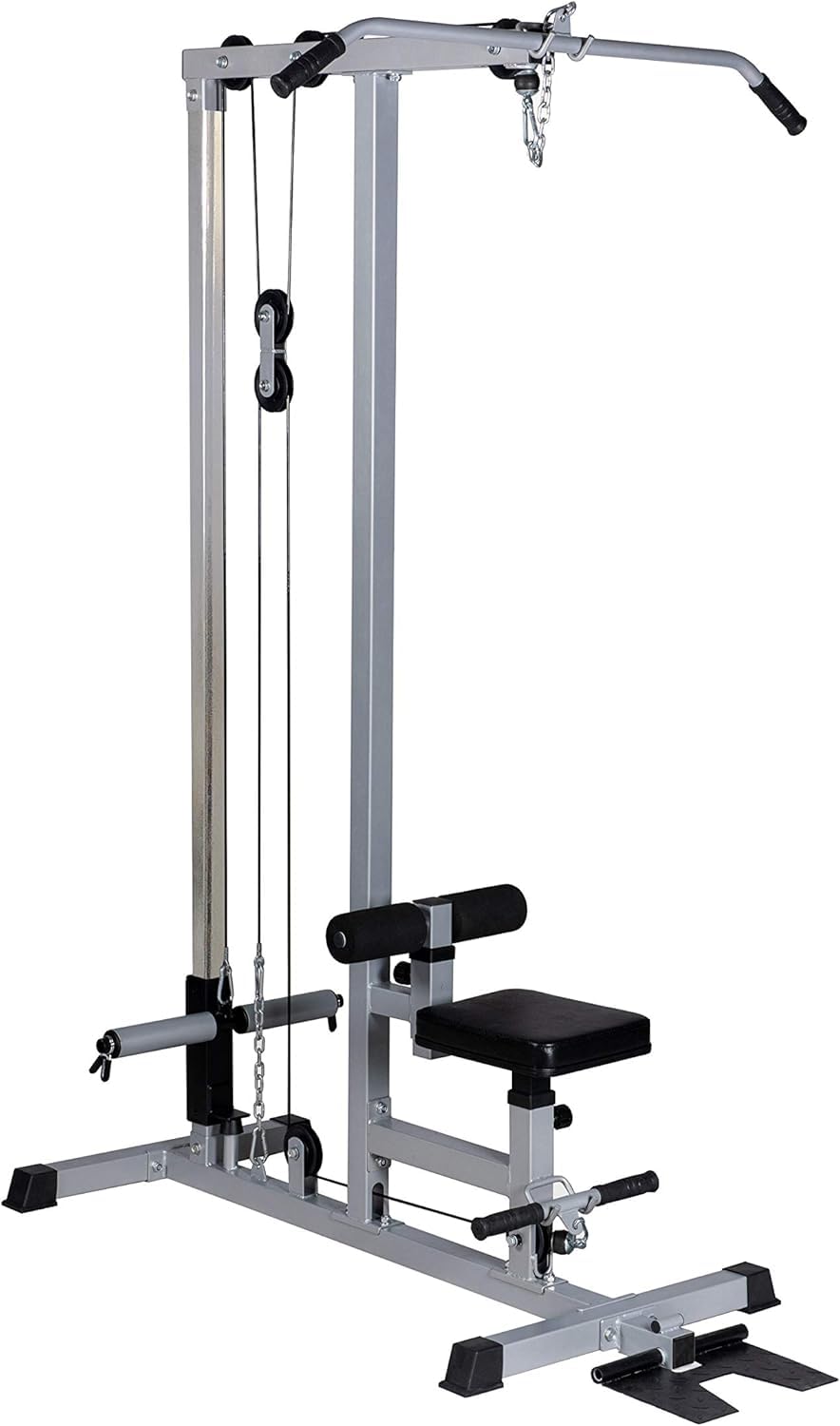
Seventy-seven inches of frame is what makes this tower easy to live with. Under a standard eight-foot garage ceiling it leaves about 19 inches of headroom, and it stands 59 inches out from the wall — deep enough that you should mark the footprint on the floor before you build, shallow enough to sit against a garage wall without blocking the door.

It earns the top spot because it covers the two movements most home gyms are actually built around — lat pulldowns and seated rows — from one freestanding frame that needs no wall anchor, no ceiling mount, and no built-in stack. The resistance comes from your own plates, which is how a 72-pound frame carries a 500-pound rating. The high station pairs a four-position seat with a four-position set of thigh rollers, adjusted separately, so you can pin your legs down and still sit where your arms want to be. That sounds fussy; in practice it is the difference between a pulldown that feels right and one you work around.

The low pulley sits near the floor for rows, curls, and face pulls. Assembly is an afternoon rather than an hour: the parts are labeled and the hardware comes bagged by step, but the printed instructions skip parts of the cable routing, so give yourself time and a second pair of hands.

Taller lifters should know what they are buying. At six feet and up, the pulldown travel runs out before the bar reaches your chest in a full stretch; dropping the seat a notch or widening your grip is the workaround. That is the geometry of a 77-inch tower rather than a fault, and it is the price of fitting under a normal ceiling.

Pros

  • Clears a standard eight-foot ceiling
  • High and low stations cover pulldowns and rows
  • Seat and thigh rollers adjust independently
  • No wall anchor or ceiling mount needed

Cons

  • Cable coating can wear where it runs over the guide
Our verdict

We think this is the cable machine most home gyms should start with: it clears a standard ceiling, needs no wall, and does pulldowns and rows properly.
Check Latest Price
2

Best for More Exercises

Goimu LS01 LAT Pulldown

88 /100
Trail Score Excellent

Key details

Max Load
800 lb
Footprint
3.12 sq ft
Pulley Stations
3
Installed Height
83.46 in
Check Price on Amazon

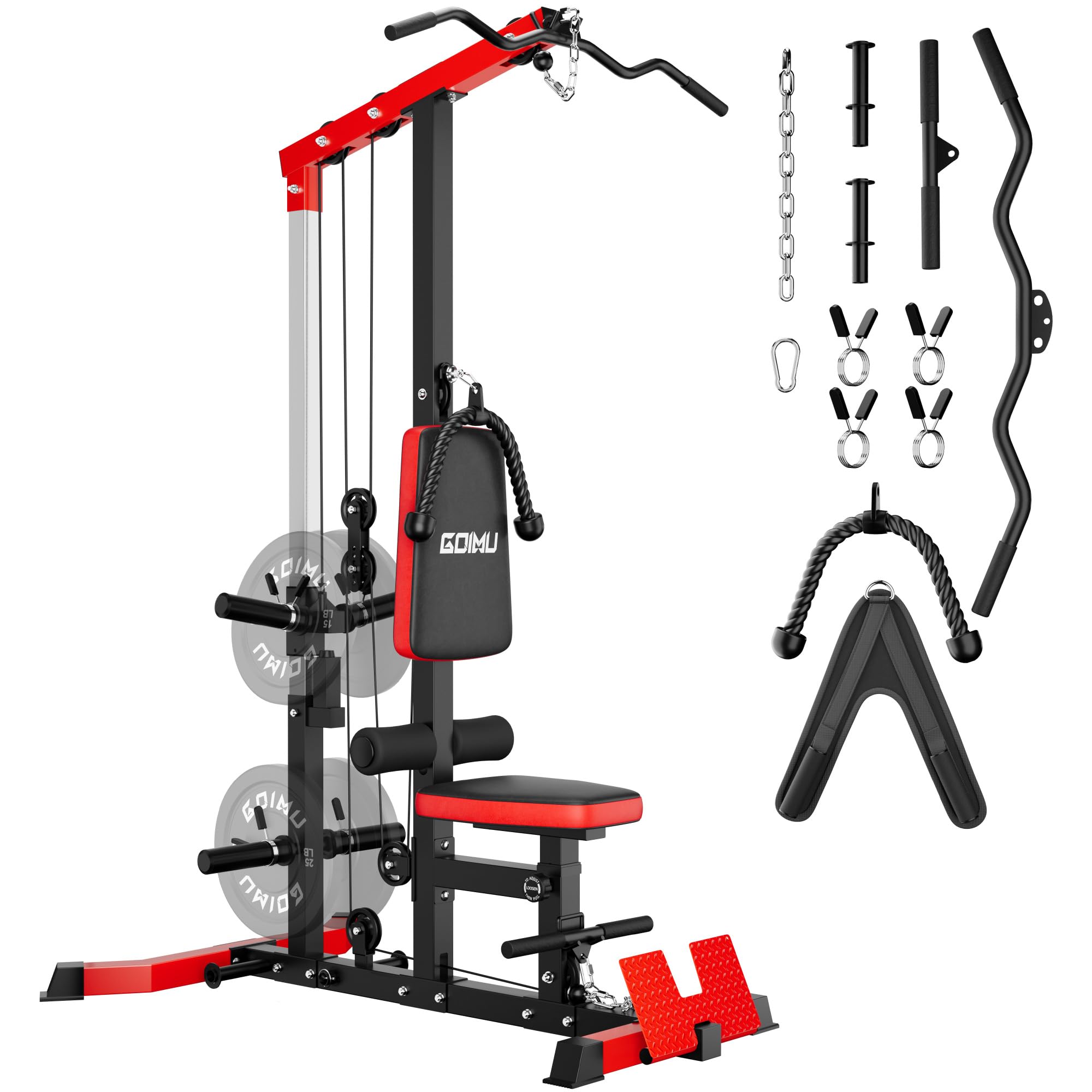
A third station is what makes this tower worth its extra height: alongside the high and low pulleys there is a padded ab-crunch station, and we think that is the right thing to spend money on once pulldowns and rows are covered. Crunches are the movement most cable setups leave out, and you cannot reproduce a loaded crunch with a band and a door frame.

The frame is 2mm steel tube rated to 800 pounds, the highest working limit here, and it stands on a footprint of about three square feet. The high pulley handles pulldowns and overhead work, the low pulley covers rows and curls, and the box includes a lat bar, a cable bar, and a tricep rope, so nothing else needs buying before the first session.

Height is the catch. At 83.46 inches it wants close to seven feet of ceiling; an eight-foot garage leaves about a foot above the frame, which works, but a low door track or badly placed light fixture does not. The seat moves through three fixed heights — enough for most households, coarser than the four-position seats on the lat towers here.

Band pegs are the detail we did not expect: you can run resistance bands alongside the plates so the top of a rep gets heavier than the bottom, an option usually reserved for bigger commercial frames. The padded seat and the red finish also make it read as equipment rather than scaffolding, which counts in a room you actually spend time in.

Pros

  • Ab-crunch station adds a movement most towers skip
  • 800-pound frame rating is the highest here
  • Band pegs add accommodating resistance
  • Narrow footprint suits a spare-room corner

Cons

  • 83.46-inch height needs close to seven feet of ceiling
  • Seat adjusts in three steps only
Our verdict

Buy this one if you want an ab station and an 800-pound frame, and you have close to seven feet of ceiling to give it.

Check Latest Price
3

Best Wall-Mounted

Mikolo M-G3 Wall Mount Station

86 /100
Trail Score Excellent

Key details

Mount
Wall (concrete or masonry)
Max Load
400 lb
Installed Height
82 in
Pulley Positions
19
Check Price on Amazon

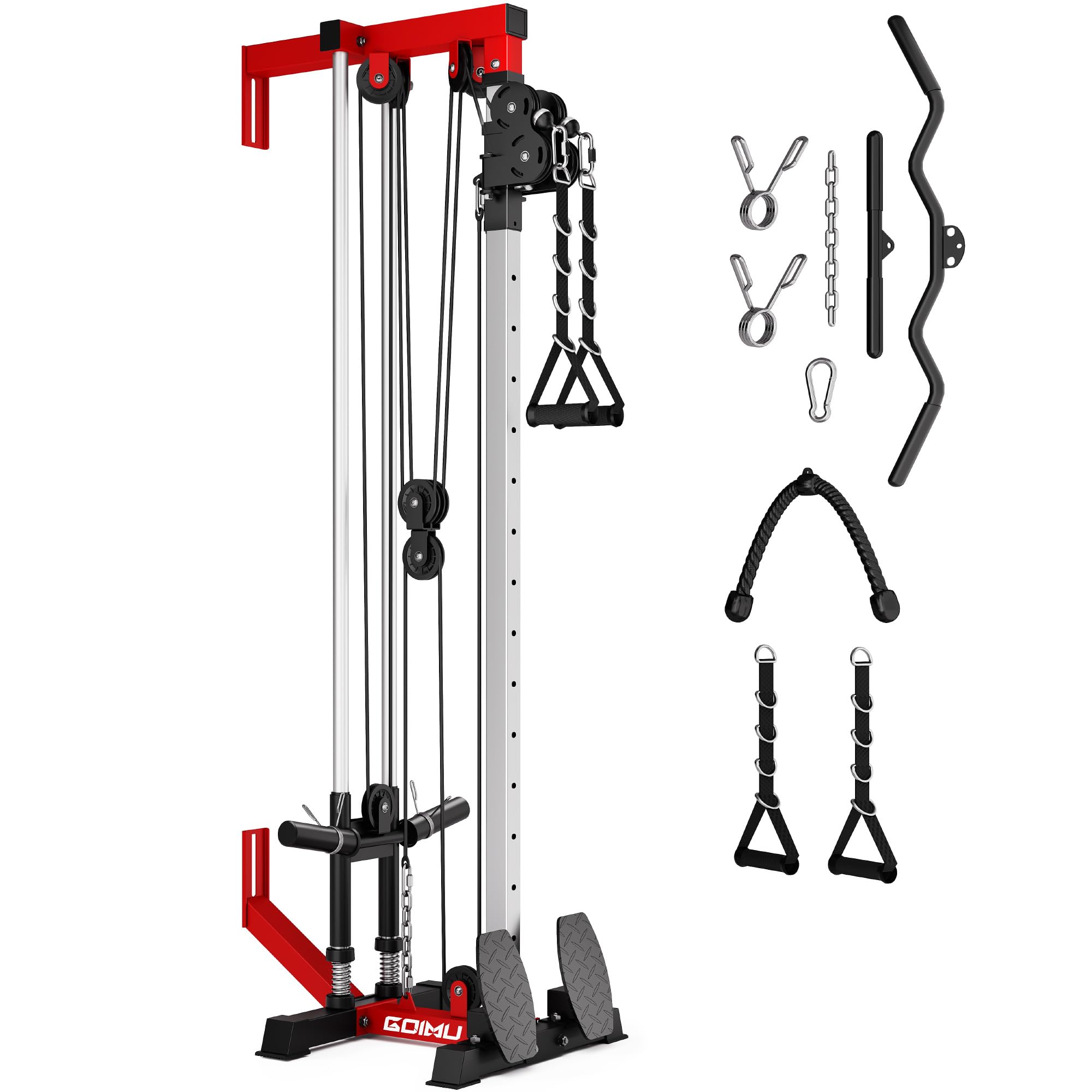
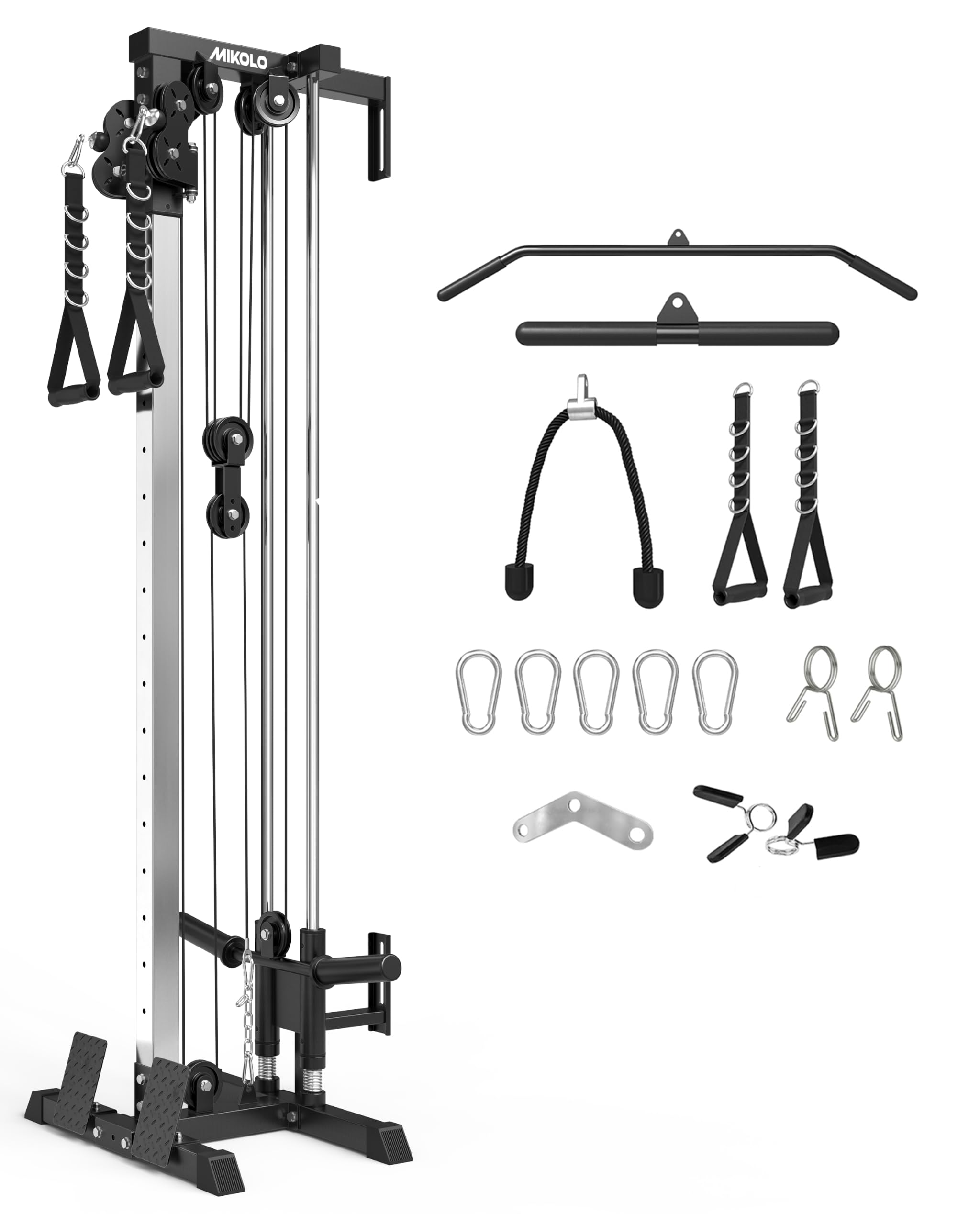
Wall-mounted is a commitment, and this station makes that plain: it bolts to masonry or concrete, hangs there, and gives back the floor a freestanding tower takes. The frame is 25.6 inches wide and 26.9 inches deep, the smallest footprint here that is not a pair of pulleys in a bag.

What you get for the wall is two adjustable pulleys running through 19 height positions, so one side can sit high for pulldowns while the other sits low for rows, and you can work both arms without re-rigging between sets. The base carries a large footboard for seated cable rows — bracing your feet turns a row from a balance exercise into a back exercise. The weight pegs sit at an upward 10-degree angle to stop plates sliding off mid-set, and the sleeves detach so the station takes both 1-inch and 2-inch plates.

We rate it the best wall-mounted machine here because the capacity matches the design: a 14-gauge powder-coated frame, nylon-coated cable rated to 2,200 pounds of tensile strength, and a 400-pound working limit that covers what a home gym asks of a cable. The component replacement window runs eight months, shorter than the frame deserves, so register the purchase and keep the receipt.

One thing to plan for: the pulleys are plastic, and the pull can run dry until the cable path gets a little silicone lubricant. That is a five-minute job at assembly rather than a reason to look elsewhere — do it once before you judge how smooth the machine is.

Pros

  • Two independent pulleys on 19 height positions
  • Footboard makes seated rows possible
  • Takes both 1-inch and 2-inch plates
  • Frees up all of the floor

Cons

  • 400-pound working limit trails the higher-rated towers here
Our verdict

For a masonry wall and a small room, this is the wall station we recommend: two independent pulleys, a row footboard, and a 400-pound working limit.

Check Latest Price
4

Best Premium

Inspire FTX Functional Trainer

88 /100
Trail Score Excellent

Key details

Footprint
54"D x 40"W
Resistance
Two 165 lb stacks
Frame Weight
544 lb
Installed Height
82 in
Check Price on Amazon

Two independent 165-pound stacks are the whole argument for this machine. Each pulley has its own weight, so crossovers, single-arm rows, and alternating presses behave the way they do on a gym floor — no sharing one stack between two handles, no re-pinning between sides.

It is 40 inches wide and 54 inches deep, small for a functional trainer and the reason it works in the corner of a room that is not a gym. The pulleys slide rather than index into holes, so you set a height once and move it in small increments instead of hunting for the next notch. Inspire includes a tricep rope, two D handles, a dual-hook curl bar, and a chin/dip belt, plus a shelf for a phone and a rack on the back for the handles.

Assembly is the pleasant surprise: two people can have it standing in an evening, and the instructions hold up better than most in this category. The 544-pound frame is the other side of that — once it is built it stays built, and the floor under it needs to carry it.

We think of this as the machine for someone who has decided the home gym is permanent and wants cable work to feel finished rather than improvised. Everyone else gets most of the same exercises from the wall stations here, which are cheaper and take up less floor.

Pros

  • Two independent 165-pound stacks
  • 40-inch width fits a spare-room corner
  • Four attachments, phone shelf, storage rack
  • Straightforward two-person assembly

Cons

  • 165-pound stacks top out for very strong lifters
  • 544 pounds makes it a permanent installation
Our verdict

If the home gym is permanent and you want cable work that feels commercial, this is the one — provided 165 pounds a side is enough resistance for you.

Check Latest Price
5

Best Heavy-Duty

Body-Solid Powerline PFT100

88 /100
Trail Score Excellent

Key details

Warranty
10 years frame / 1 year parts
Footprint
42.3"D x 62.6"W
Max Resistance
210 lb
Installed Height
83 in
Check Price on Amazon

Ten years on the frame and one on the parts tells you where the company expects wear to land: on the pulleys and cables, not the steel. That matches what we found. The frame is oversized, the powder coat is applied electrostatically, and the parts that move are the parts you will eventually service.

We send heavy users here because the two stacks are independent, so isolateral work — one arm at a time, both sides loaded the same — is the default rather than something you rig with a single handle. The 62.6-inch width and 83-inch height mean it wants a long wall and a full ceiling, and at 476 pounds before anyone touches the stacks it is a permanent installation.

Assembly is a project: two people, an evening, and a clear floor. The reward is a machine that glides — the pulleys run quiet, the cable path is straight, and resistance stays even through the middle of a rep where cheaper setups go sticky. Adjustable handles change the angle without changing the attachment, the sort of thing you stop noticing because it never gets in the way.

Pros

  • Ten-year frame warranty
  • Independent stacks allow true isolateral work
  • Quiet, even pull through the rep
  • Adjustable handles change the angle quickly

Cons

  • 62.6-inch width needs a long wall
  • One-year parts cover trails the ten-year frame
Our verdict

We point heavy daily users here: independent stacks for true isolateral work, backed by a ten-year frame warranty and a very large footprint.

Check Latest Price
6

Best for Two Lifters

Yes4All LAT Pull Down Machine

86 /100
Trail Score Excellent

Key details

Included
Lat bar, clamps, spare cable
Max Load
500 lb
Seat Adjustment
4 positions
Installed Height
76.5 in
Check Price on Amazon

There is a spare pulley cable in the box, and that inclusion says something useful: the cable is the part that wears, and Yes4All ships a replacement rather than pretending otherwise. A frayed cable is what takes a home cable machine out of service for a week, so a spare on the shelf is worth more than a cosmetic upgrade.

Adjustment is the other reason to look. Seat and knee support each move through four heights independently, so two people of very different builds can share one machine without either of them lifting at the wrong angle, and 76.5 inches of frame clears a standard ceiling with plenty to spare.

What it is not is a crossover. You get a single cable path through high and low pulleys, so two-handed flys and cable crossovers are out; if your list is pulldowns, rows, face pulls, and triceps — and for most home gyms it is — that costs you nothing, and it is why we think this is the tower to buy when two people share it.

The pull itself is smooth and unremarkable in the way a good cable should be: no snatch at the top, no chatter on the way down. The solid steel frame is rated to 500 pounds, a lat bar and barbell clamps come in the box, and assembly is a straightforward evening with the parts laid out.

Pros

  • Spare pulley cable included in the box
  • Seat and knee pads adjust independently, four levels each
  • 76.5-inch frame clears a standard ceiling
  • 500-pound steel frame rating

Cons

No notable drawbacks to flag.

Our verdict

This is the tower we recommend for a two-person household: independent seat and knee adjustment, a spare cable in the box, and a frame that clears a standard ceiling.

Check Latest Price
7

Small Wall Spaces

Goimu WM1 Wall Mount Station

86 /100
Trail Score Excellent

Key details

Mount
Wall (concrete or masonry)
Max Load
300 lb
Installed Height
78.74 in
Pulley Positions
17
Check Price on Amazon

A switch between a 1:1 and a 2:1 pulley ratio is what makes this small wall station worth its brackets. In 2:1 the cable travels twice as far as the load, so a plate feels about half its weight at the handle and a long set of lateral raises becomes possible; in 1:1 you get the full plate and a shorter, heavier pull. We like having both on a station this size, because the same machine covers a warm-up and a working set.

It hangs on 3.28 square feet of wall, stands 78.74 inches tall, and runs 17 height positions on the pulley carriage. The 14-gauge frame is rated to 300 pounds and carries a two-year warranty, and the box includes a lat bar, a cable bar, a tricep rope, and a dual handle grip.

Mounting is the part to plan carefully. Goimu specifies concrete or masonry, so a drywall partition or a rental wall is not the place for it; if you cannot drill, a freestanding tower is the honest alternative. Once it is up, this is one of the least intrusive ways to own two-pulley cable work.

Pros

  • Switchable 1:1 and 2:1 pulley ratios
  • Two-year warranty
  • 17 height positions on the carriage

Cons

  • 300-pound working limit is the lowest in this group
Our verdict

We like this for a tight wall: switchable 1:1 and 2:1 pulley ratios on a small frame, as long as 300 pounds and a masonry wall suit you.

Check Latest Price
8

Racks and Bars

FitBeast Pulley System

89 /100
Trail Score Excellent

Key details

Pulley
360-degree rotating
Included
Rope, handle, lat bar
Max Load
330 lb
Cable Lengths
70 in and 90 in
Check Price on Amazon

There is no frame here and no stack. This is a pair of pulleys and two cables that hang from something you already own — a pull-up bar, a rack crossmember, a garage beam — and it turns that anchor into a cable station.

The hardware is better than the idea suggests. The pulley rotates a full 360 degrees so the cable does not twist as you change angles, the loading pin is longer than most so you can stack more plates before you run out of pin, and the 6-strand steel cable is rated to 330 pounds, which covers curls, triceps, and face pulls with room to spare.

Two cable lengths, 70 and 90 inches, come in the box along with a tricep rope, a single handle, and an adjustable lat bar. That last one makes pulldowns possible if you can hang the kit high enough, though the cable has to run close to vertical and the bar has to clear your head — measure your anchor height before you count on lat work.

We rate it the cheapest useful way to add cables to a gym that already has a rack, and the wrong purchase for an empty room. Hung properly, it covers triceps, curls, face pulls, and single-arm work in about the space of a shoebox, and it comes down again when you want the bar back.

Pros

  • 360-degree pulley keeps the cable from twisting
  • 330-pound rating on a 6-strand steel cable
  • Two cable lengths and three handles included
  • Extra-long loading pin takes more plates

Cons

  • No seat or leg brace for heavy lat work
Our verdict

We recommend this to people who already own a rack or a pull-up bar, not to anyone starting an empty room — it needs an anchor to do anything.

Check Latest Price

How We Tested Six Cable Machines at Home

We started by pulling together the cable machines that show up repeatedly in home-gym forums and retailer listings, then filtered that list by footprint, pulley-height range, attachment bundle, and whether replacement parts were actually available. That left six machines. Each was assembled by one person using only the manufacturer's instructions; we timed the process, noted where the diagrams went vague, and flagged steps that seemed to demand a second set of hands.

Over nine months, the machines lived in a garage gym and a spare-room setup, handling morning pull days, weekend supersets, and a steady parade of family members who wanted to try a set. We did lat pulldowns, seated rows, cable crossovers, triceps pressdowns, and low-to-high woodchops, moving the pulley between exercises to see how much usable range of motion each design gave us.

Smoothness was easy to judge with a loaded stack: we listened for cable rub, felt for the jerk when a pulley caught, and noted whether slow and fast reps felt equally controlled. We swapped every attachment — ropes, handles, bars, ankle straps — and checked whether the carabiners and cable ends still felt secure after repeated changes.

For durability and lifting mechanism, we inspected cables and pulleys for fraying or flattening, rocked the frame to check for wobble, and paid attention to how the resistance curve felt at the top and bottom of each rep. Build quality showed up in the small stuff: loose fasteners, plastic covers that shifted, and handles that twisted under load. Functionality and home-gym utility came down to whether one machine could replace a few other purchases without eating the whole room; value came down to included attachments and build relative to the footprint it demanded.

How to Choose a Cable Machine for a Home Gym

Start With Your Ceiling, Not Your Budget

Installed heights in this group run from 76.5 to 83.46 inches. A standard eight-foot ceiling is 96 inches, so everything here clears it — but a garage door track, a light fixture, or a low soffit can eat that margin quickly, and you want hand clearance above the pulley at the top of a pulldown. The trap is the word compact: in a listing it usually describes footprint, not height, and a machine that hugs the wall can still stand nearly seven feet tall.

Measure floor to the lowest obstruction and subtract a few inches for your hands. If you come up short, a wall station or a pulley kit hung from a rack keeps cable work in the room without the tower.

Freestanding, Wall-Mounted, or Hung From a Bar

Freestanding towers need no drilling and can move with you, but they claim depth — the GDLF stands 59 inches out from the wall, which is more floor than most people picture when they order. Wall-mounted stations hand that floor back and take away the ability to relocate; they need masonry, concrete, or properly braced framing, so renters should plan around them. Pulley kits are the third path: they need an anchor you already own, and without one they do nothing at all.

Plate-Loaded or Weight Stack

Plate-loaded machines run on the plates you already have, so resistance is limited by your collection and by what the frame is rated to hold, and changing weight means walking to the pin. A weight stack changes faster between sets and arrives with the machine, but it adds cost and shipping weight — the two stack trainers here weigh 476 and 544 pounds empty. If you own plates, plate-loaded is the better use of money; if you are starting from nothing, price the plates into the decision before you commit.

Count the Pulleys, Then Check the Travel

Two independent pulleys are what separate a functional trainer from a lat tower: with a cable on each side you can do flys, crossovers, and single-arm work without re-rigging. A high and low station on one cable path covers pulldowns, rows, and curls, which is what most home gyms actually use. Travel matters as much as count — a shorter tower gives a shorter pull, and tall lifters feel it at the top of a pulldown. Over six feet, favour the taller frames and check the pulley's top position against your reach.

Plan an Evening for Assembly

Every machine here arrives flat-packed, and the honest range is a couple of hours with two people to most of an evening with a parts diagram. Hardware usually comes bagged by step, which is the single biggest help; manuals that skip cable routing are where builds stall. Lay the parts out, route the cable before you tighten anything, and recruit a second pair of hands for the frame sections — a tower is awkward before it is a tower.

Frequently Asked Questions

Final Verdict

The GDLF lat tower is the machine we point most people to. It fits an eight-foot ceiling, needs no wall, and covers the pulldowns and rows that make up most home cable work — a hard combination to beat as a first machine.

If you want the ab station and the 800-pound rating and have close to seven feet of ceiling, the Goimu LS01 is the upgrade worth paying for. If floor space is the thing you cannot spare, the Mikolo M-G3 is worth drilling masonry for.