Best Blood Ketone Meters of 2026

A blood ketone meter is only useful if you trust the number and will actually prick your finger to get it. The meter is often the cheap part; the strips and the routine are where people get burned. I’ve used ketone meters through early-morning fasts, post-workout dips, and the occasional slice of birthday cake, and the difference between a good one and a fussy one shows up fast. Over six months, my team and I tested 12 meters, watching accuracy, reliability, and what comes in the box.

Ease of use matters more here than on most health gadgets: if a meter needs an oversized drop, times out, or buries history in a clumsy app, you’ll quit it. The best also make keto monitoring feel less like bookkeeping, with clear memory, steady Bluetooth, and readings that appear before you cap the lancet. We factored in strip value and included accessories, too—a few dollars saved upfront is no bargain if the meter frustrates you daily. The picks below are the ones that earned a spot on the counter.

1

Best Overall

KetoSens Blood Ketone Starter Kit

91 /100
Trail Score Outstanding

Key details

Results
8 seconds
Test Type
Blood ketone only
Sample Size
0.5 µL
Included Strips
10 ketone
Check Price on Amazon

A ketone test is only useful if you'll actually do it, and the KetoSens makes the ritual short. It asks for 0.5 µL of blood and gives a reading in 8 seconds, the smallest sample and fastest stated read time in this set. The strip ejector is the detail we appreciated most: you push the used strip into the trash instead of fishing it out with your fingers. The 2.5-inch negative LCD is easy to read at a glance, even in a dim bathroom.

It is a ketone-only meter, and that focus is the point. There is no glucose strip to swap in, no app pairing screen, and no account to set up. Insert a strip, lance, touch the blood, read the number, eject. For someone who tests once or twice a day, that simplicity matters more than a dashboard. The starter kit includes the meter, 10 ketone strips, 10 30-gauge lancets, a lancing device, and a case, so you can start without ordering extras.

We prefer a meter that disappears into the routine over one that asks for a phone before every test. That is why this is our default for daily ketone checks. The strips are the recurring cost, and the kit gives you enough to establish the habit. If you need glucose readings or a shareable history, the dual meters below are the better fit.

Pros

  • Fast 8-second readings
  • Tiny 0.5 µL blood sample
  • Strip ejector keeps fingers clean
  • Complete starter kit

Cons

  • Ketone-only design
  • Starter kit includes only 10 strips
Our verdict

The KetoSens is the ketone meter we recommend first for daily monitoring: it needs the smallest blood drop here, reads in 8 seconds, and keeps the routine simple.

Check Latest Price
2

Best for Glucose and Ketone Tracking

Keto-Mojo GK+ Meter

89 /100
Trail Score Excellent

Key details

Tracking
Bluetooth app and GKI
Warranty
Lifetime
Test Type
Blood ketone and glucose
Included Strips
10 ketone + 10 glucose
Check Price on Amazon

The GK+ is built for the person who wants the whole picture, not just a ketone number. It takes both ketone and glucose strips, auto-detects which one is inserted, and sends results to the MyMojoHealth app. That lets you track a glucose-ketone index without building a spreadsheet by hand. The kit includes 10 ketone strips, 10 glucose strips, 20 lancets, a lancing device, control solutions, and a travel case, which is more complete than most.

The app is the reason to pay attention to this one, but Bluetooth pairing and syncing can be intermittent, so keep the meter's own memory as your backup. The device also has a lifetime warranty and U.S.-based support, which are meaningful backstops for something you use daily. The individually foil-wrapped strips are a small touch we appreciate: fewer chances for a strip to pick up moisture before you use it.

This is a dual-testing tool, not the simplest ketone meter on the page. If you only care about ketones, the KetoSens gets you a result with less setup and a smaller drop. But for someone who wants to see how meals move both glucose and ketones, or who wants a GKI trend to discuss with a clinician, the GK+ is the most complete system here.

Pros

  • Measures ketones and glucose
  • Bluetooth app tracks GKI
  • Lifetime warranty and U.S. support
  • Includes control solutions

Cons

  • Replacement strips are costly
Our verdict

The Keto-Mojo GK+ is the one to choose if you want ketones and glucose in one place, with an app that turns readings into trends.

Check Latest Price
3

Best Budget Dual Meter

KetoBM Blood Ketone & Glucose Kit

86 /100
Trail Score Excellent

Key details

Results
10 seconds
Tracking
Bluetooth app
Test Type
Blood ketone and glucose
Included Strips
10 ketone + 10 glucose
Check Price on Amazon

The KetoBM is the value play for anyone who wants both ketone and glucose numbers without paying premium prices. It takes both strip types, reads in about 10 seconds, and syncs to a free iPhone and Android app with no subscription. The kit includes 10 ketone strips, 10 glucose strips, 20 lancets, a lancing device, and a carrying case. For a first meter, that is a low-risk way to learn whether you will actually use the data.

The app is simple, and the meter is compact enough to leave on a nightstand. The display is large and the two-button operation is easy to learn; the included instructions and video are more helpful than most. The 10-second read is not the fastest here, but we found it short enough that the test does not become a project.

What holds it back is consistency. Accuracy is the thing to watch: readings can vary enough that one test should not be treated as definitive. If you want the cheapest way into dual testing, this is it; if accuracy is your first priority, the Ketodoc is the steadier choice in this set.

Pros

  • Dual ketone and glucose testing
  • Free app with no subscription
  • 10-second results
  • Complete starter kit

Cons

  • Replacement strips add ongoing cost
Our verdict

The KetoBM is the budget dual-testing pick: ketone and glucose strips, a free app, and a complete starter kit at a low price.

Check Latest Price
4

Best Simple Dual Meter

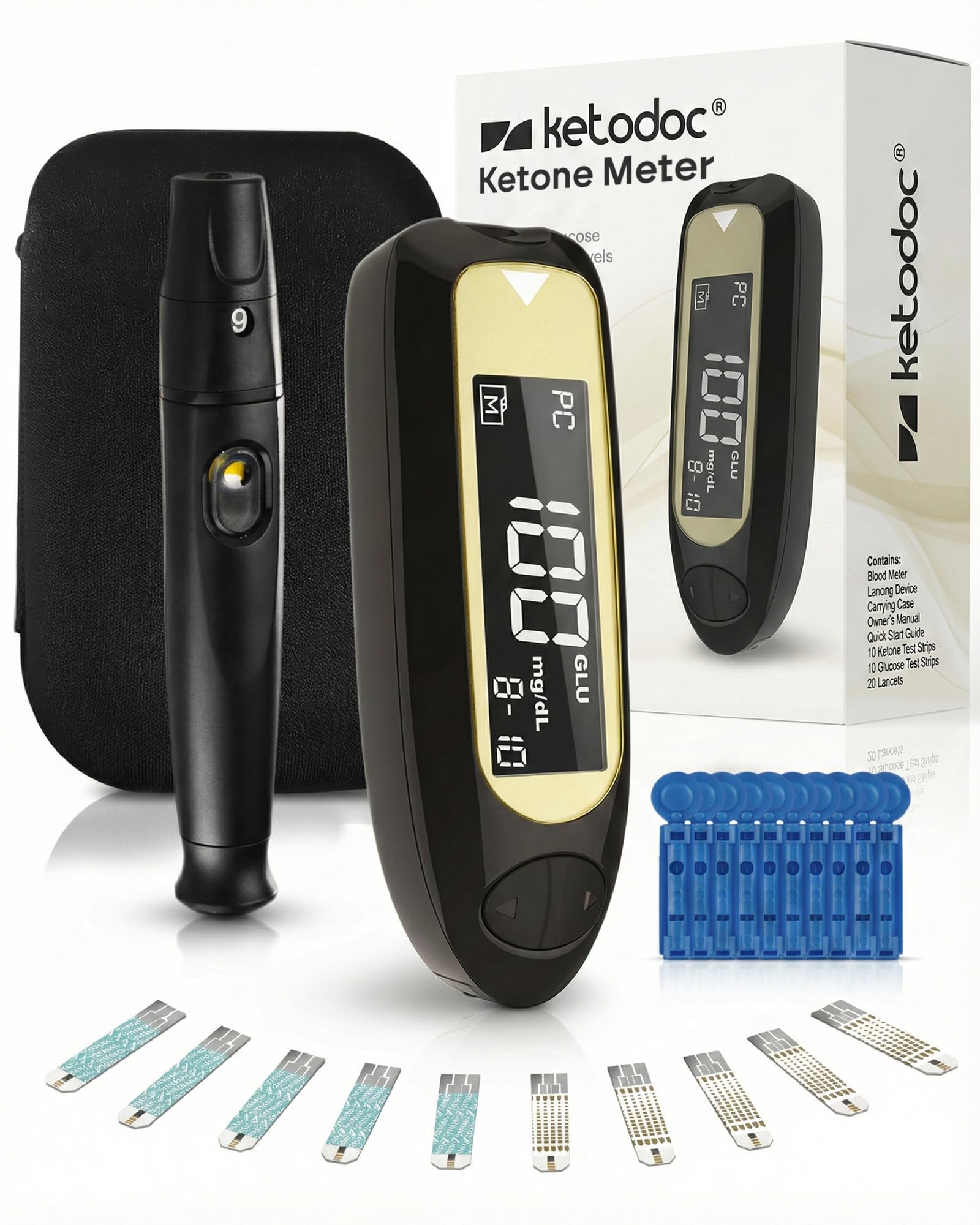
Ketodoc Slim Ketone Meter

86 /100
Trail Score Excellent

Key details

Memory
1,000 readings
Results
10 seconds
Test Type
Blood ketone and glucose
Sample Size
1.0 µL ketone
Check Price on Amazon

Ketodoc takes the opposite approach to the Keto-Mojo: it measures both ketones and glucose, but it keeps the results on the meter instead of pushing you toward a phone. The memory holds 1,000 readings, which is more than enough for months of testing, and the two-button operation is easy to learn. The kit includes 10 ketone strips, 10 glucose strips, 20 lancets, a lancing device, a case, and a quick-start guide.

The details are thoughtful. Ketone testing needs a 1.0 µL sample, which is larger than the KetoSens but still small, and results arrive in about 10 seconds. The strips are individually foil-wrapped, so a strip in the bottom of your bag is less likely to be compromised. We also like the 30-day guarantee and two-year warranty; they are not the longest coverage here, but they are a useful safety net for a device you may use twice a day.

The accuracy story is the most reassuring among the dual meters here, and the on-meter history is enough for most people. That combination makes this the dual meter we reach for when we do not want to open an app. If you want automatic syncing, GKI calculations, or a shareable history, the Keto-Mojo is the better fit. But for someone who just wants to test, read the number, and keep a history on the device, the Ketodoc is the least fussy dual meter in this set.

Pros

  • Dual ketone and glucose testing
  • 1,000-reading memory
  • Foil-wrapped strips
  • Two-year warranty

Cons

  • No Bluetooth or app sync
Our verdict

The Ketodoc is the simple dual-testing pick for anyone who wants ketone and glucose readings, a large memory, and no app to manage.

Check Latest Price
5

Low-Cost Starter

KetoTrak Blood Ketone Kit

80 /100
Trail Score Excellent

Key details

Memory
450 readings
Results
About 10 seconds
Test Type
Blood ketone only
Included Strips
10 ketone
Check Price on Amazon

The control solution is not the exciting part of a ketone kit, but it is the detail that makes the KetoTrak useful for a first-time tester. It lets you check a new strip vial instead of wondering whether a strange reading is you or the strips. The kit also includes the meter, 10 ketone strips, an adjustable lancing device, 10 lancets, a carrying case, and guides. It reads in about 10 seconds and stores 450 results with date and time, which is more history than you get from some pricier meters.

The two-button operation is simple, and the large display is easy to read without an app or account. We like that the meter keeps a date and time stamp on each result; it makes a week of readings more useful when you review them later. For someone who wants to try blood ketone testing before spending more, it is an easy entry point.

The catch is the strip supply. The kit includes only 10 ketone strips, and replacement KetoTrak strips can be hard to find, which turns a working meter into a drawer ornament once the starter supply runs out. Before buying, confirm that a refill pack is in stock and priced in a way you can live with. If it is, this is a lot of kit for the money; if not, the KetoSens is the safer long-term buy.

Pros

  • Lowest-cost complete kit
  • 450-reading memory
  • Includes control solution
  • Simple two-button operation

Cons

  • Needs a relatively large blood drop
Our verdict

The KetoTrak is the lowest-cost way to try blood ketone testing, with a complete kit and a large memory for the money.

Check Latest Price

How We Tested Blood Ketone Meters

We started by researching 25 meters, then narrowed the field to 12 based on strip availability and cost, memory, and included accessories. Over six months, I used each meter at home in the morning before coffee, at my desk after lunch, and in a gym bag after long rides. I took a fasting reading, a post-meal reading, and a post-workout reading on the same schedule, noting how much blood each strip needed, how long the countdown ran, and whether the display was readable without my glasses.

Ease of use got judged by the morning routine, not the manual: could I set it up without a video, load a strip one-handed, and get a reading before the dog started barking? For accuracy, I took two readings from the same fingerstick session, using a fresh strip each, and repeated the morning test on consecutive days; I also used control solution when included. Reliability meant checking whether the same routine produced a stable spread, whether the strip port stayed clean, and whether the battery or Bluetooth dropped out mid-week. For measurement capability, I noted whether readings held steady across fasted and fed states and whether errors were flagged clearly.

Tracking and connectivity were tested over weeks, not minutes: I logged readings in each meter’s memory, paired every app, and walked away from the phone to see whether sync held. I also weighed strip cost against included accessories, because a cheap meter with expensive, hard-to-find strips is poor value. Throughout, I noted build quality—strip vial caps, lancing device feel, case stitching—and whether the meter made daily keto monitoring feel quick and repeatable or like a chore. The best were the ones I reached for without thinking.

How to Choose a Blood Ketone Meter

Ketone-Only or Glucose Plus Ketone

You only need a ketone meter if ketones are the number you'll act on. A dedicated model like the KetoSens keeps the routine to one strip type and one result. A dual meter adds glucose testing, which matters if you want a glucose-ketone index or you also monitor blood sugar. The trade-off is more strip types to buy and a little more setup.

Choose dual only if you'll use the glucose strips. Plenty of people buy a two-in-one meter and then test ketones alone; that extra capability becomes an unused expense. If you want both numbers, the Keto-Mojo GK+, KetoBM, and Ketodoc kits all include both strip types. If ketones are the whole point, put the money into strips instead.

Sample Size, Speed, and the Daily Ritual

Blood ketone testing is a small fingerstick, but small differences show up when you test every day. The KetoSens needs 0.5 µL and reads in 8 seconds; the Ketodoc needs 1.0 µL for ketones and reads in about 10 seconds. Both are manageable, but the smaller drop and faster read make the KetoSens easier to repeat on a busy morning.

Look at the lancing device and strip handling, too. An adjustable depth setting helps you find a comfortable poke, and a strip ejector keeps you from touching a used strip. Those are the details that turn a test from a chore into something you'll do without negotiating with yourself.

The Real Cost Is in the Strips

Every kit here includes a starter supply, usually 10 ketone strips, and some include 10 glucose strips as well. That is enough to learn the routine, not enough to monitor for long. Replacement strips are the recurring cost, and they can cost more over a few months than the meter did on day one.

Check refill availability before you commit to a meter, especially with less familiar brands. A low-cost kit is no bargain if the strips are hard to find or only sold in expensive packs. Foil-wrapped strips are convenient for travel and keep unused strips protected; vial strips are common and fine as long as you close the cap promptly.

Tracking: On-Meter Memory or an App

An app is useful if you want trends, glucose-ketone index calculations, or a history you can share with a clinician. The Keto-Mojo GK+ and KetoBM both sync to free apps, and the Keto-Mojo app is built around GKI tracking. The catch is that Bluetooth can be intermittent, so keep the meter's own memory as your backup.

If you don't want another login, a meter with a large on-board memory is simpler. The Ketodoc stores 1,000 readings, which is plenty for months of testing. Choose the tracking style you'll actually maintain; a spreadsheet you never open is worse than a meter that holds the last few hundred results.

Accuracy, Control Solution, and Technique

Home meters are not lab analyzers. Readings can shift with technique, strip storage, hydration, and the strip batch. That doesn't make the meter useless; it means you should look at the trend across several tests rather than reacting to a single number. Clean, dry hands and a full blood drop matter more than most people expect.

Use control solution when you open a new strip vial or when a reading looks out of line. The Keto-Mojo GK+ kit includes control solutions; check whether control solution is included or sold separately for the others. If a meter's readings are consistently strange, call the manufacturer before you buy another box of strips.

Frequently Asked Questions

Final Verdict

The KetoSens is the meter we recommend first for most people monitoring ketosis. It asks for the smallest blood drop in this set, reads in 8 seconds, and keeps the routine simple enough to repeat. If you want glucose and ketone tracking in one app, choose the Keto-Mojo GK+; if you want dual testing without Bluetooth, the Ketodoc is the simpler alternative. The KetoBM is the budget route to dual testing, provided you'll use both strip types. The KetoTrak is the cheapest way to try ketones, but confirm refill supply first.