Best Blood Glucose Meters of 2026

A blood glucose meter asks for blind trust. It hands you a number in five seconds, and nothing on the kitchen counter tells you whether that number is right — you find out at your next A1C, weeks later. So what a good meter can actually fix isn't the diagnosis; it's the friction around the test, so you check when you should instead of skipping it because the strip won't seat one-handed or the case is buried in a drawer.

Over six months, my team and I tested 12 meters, from bare-bones models to app-connected ones, and the pattern was consistent: the fastest meters with the simplest strips got used every morning, and the fiddly ones stayed in the drawer. One thing worth knowing before you shop: the meter is the cheap part. Strips and lancets are the real expense — four tests a day for a year costs far more than the device — so check what your insurance covers before you fall for a fancy screen. The picks below are the ones we kept reaching for.

1

Best Overall

CareSens N Feliz Kit

90 /100
Trail Score Outstanding

Key details

Test Time
5 seconds
Sample Size
0.5 μL
Lancets Included
100
Test Strips Included
100
Check Price on Amazon

The CareSens N Feliz arrives as a kit you can open and use: meter, 100 test strips, 100 lancets, lancing device, control solution, and a travel case. It asks for 0.5 μL of blood and shows a result in about 5 seconds, and the meter is stated to meet ISO 15197:2013. The case is small enough to live in a bag, and the backlight helps with early-morning or late-night checks.

That complete package is why we recommend it as the best overall kit here. The 100-strip supply gives you room to settle into a routine, the control solution lets you check the meter instead of assuming it is right, and the small sample is easier on fingers that are already tired of being pricked. The accuracy picture is mixed, as it is for most meters in this set, so we treat the ISO claim as a starting point rather than a promise: run the control solution, and compare a fasting reading with a lab result before you rely on one meter alone.

The Feliz is not the meter for someone who wants automatic phone logging or a coaching app; the CONTOUR NEXT GEN and OneTouch Verio Reflect are the picks for that. For a straightforward kit that covers the first few months of testing without a second shopping trip, it is the one we keep coming back to. The 100-strip head start is the real luxury: you can follow a testing schedule without rationing strips in the first month.

Pros

  • Complete 100-strip, 100-lancet kit
  • Small 0.5 μL sample and 5-second read
  • Control solution included
  • Backlit display and travel case

Cons

  • Sometimes needs a second stick for enough blood
Our verdict

We recommend the CareSens N Feliz as the best overall kit for most people starting at-home testing because it pairs a 100-strip supply with a small sample, fast read, and control solution.
Check Latest Price
2

Best for App Tracking

CONTOUR NEXT GEN Kit

90 /100
Trail Score Outstanding

Key details

Connectivity
Bluetooth
Range Indicator
SmartLIGHT
Lancets Included
10
Test Strips Included
20
Check Price on Amazon

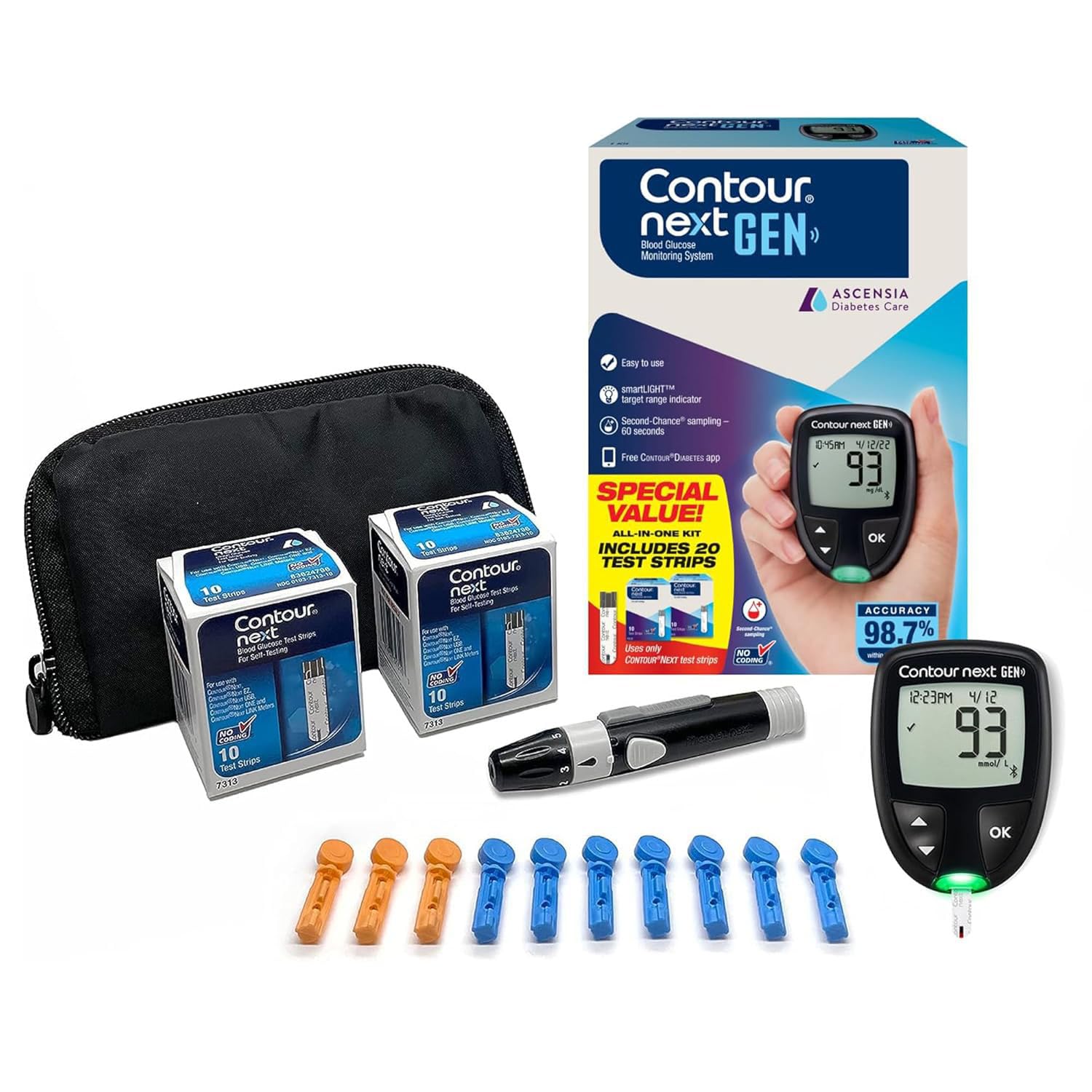
The CONTOUR NEXT GEN makes its case with the reading, not the box count. It has the most convincing accuracy record in this set, and it adds Bluetooth syncing and a SmartLIGHT indicator that turns a number into an immediate above, below, or in-range cue. For anyone who wants to see patterns without copying numbers into a notebook, that combination is the reason to choose it.

The kit itself is deliberately small: 20 test strips, 10 lancets, a lancing device, and the meter. We appreciate the second-chance sampling feature, which lets you add blood to the same strip within 60 seconds instead of throwing it away and starting over. The SmartLIGHT is genuinely useful at 6 a.m., when a color cue is faster to read than a small number. The meter is compact, and the app sync is the kind of convenience that makes daily logging more likely to happen.

The 20-strip kit is a starter supply, not a month's worth for frequent testing, so plan the first reorder. Early reliability is the other thing we watch: test the meter the day it arrives and keep the packaging until a few readings have gone through cleanly. For someone who wants a phone log and a clear target indicator, the earlier reorder is the only real trade-off.

Pros

  • Most convincing accuracy record here
  • Bluetooth app syncing
  • SmartLIGHT target-range cue
  • Second-chance sampling saves strips

Cons

  • Only 20 test strips included
Our verdict

The CONTOUR NEXT GEN is our pick for app-minded testers because it pairs Bluetooth logging and a SmartLIGHT range indicator with a compact 20-strip starter kit.

Check Latest Price
3

Best Meter-Only for Accuracy

Accu-Chek Guide Meter

91 /100
Trail Score Outstanding

Key details

Display
Backlit LCD
Connectivity
Bluetooth
Kit Contents
Meter, case, batteries
Strip Ejector
Push-button
Check Price on Amazon

The Accu-Chek Guide arrives as a meter, case, and batteries—no strips and no lancets. The hardware is aimed at people who test in low light or with tired hands: a backlit display, a strip-port light, Bluetooth logging, and a push-button strip ejector that keeps you from handling a used strip. You need to add Guide test strips and a lancing device before you can test.

The strip ejector is the detail we appreciate most. It means you can release a used strip into the trash without pinching it, which matters when you are testing in a bathroom or at a desk and don't want to chase a stray strip. The backlight and port light are similarly practical: they let you test without turning on a lamp and waking the house. The meter is small enough to live in a bag, and the case keeps the hardware together.

The Guide earns its place as our meter-only accuracy pick. Its accuracy record is the most positive in this set, and the hardware removes several small frictions that make daily testing easier. The catch is the one that matters at checkout: no strips, no lancets, and no lancing device in the box, so the first test costs more than the meter suggests. If you already have a strip source and want a well-designed meter, this is the one we choose; if you need a complete kit today, start with the Feliz.

Pros

  • Most positive accuracy record here
  • Backlit display and strip-port light
  • Push-button strip ejector
  • Bluetooth logging

Cons

  • No test strips or lancing device included
Our verdict

The Accu-Chek Guide is the meter we point to when accurate readings matter more than a box of extras, though you need to buy strips and lancets separately.

Check Latest Price
4

Best Compact Kit for Fast Results

TRUE METRIX GO Kit

89 /100
Trail Score Excellent

Key details

Test Time
4 seconds
Sample Size
0.5 μL
Lancets Included
100
Test Strips Included
100
Check Price on Amazon

The TRUE METRIX GO gets its name from the way it travels: the meter, a strip vial, and lancets fit into a small case, and the meter can sit on the cap of the strip vial while you test. The specs are just as travel-minded—0.5 μL of blood, a result in as fast as 4 seconds, and a 100-strip, 100-lancet kit that includes control solution and a log book. For someone who tests at work, in a car, or while traveling, the package is unusually complete.

We recommend it as the compact kit here because it doesn't make you choose between portability and a full supply. The 4-second read is quick enough to fit into a busy morning, and the 0.5 μL sample is small enough that the finger stick feels less like an event. The log book and control solution are the kind of extras that matter in the first month, when you are still learning how your meter behaves.

Accuracy and reliability are the caveats. The accuracy picture is mixed, and early failure is possible, so we test this one immediately and keep the receipt until a few readings have gone through cleanly. The small display is the other trade-off: it keeps the meter pocketable, but it can be harder to read in dim light. If you want a larger screen or a longer strip supply, the CareSens N Feliz is the easier everyday choice; if compactness and speed are what get you to test consistently, the GO is worth it.

Pros

  • Complete 100-strip, 100-lancet kit
  • 0.5 μL sample and 4-second read
  • Compact case and travel-friendly design
  • Control solution and log book included

Cons

  • Small display can be hard to read
Our verdict

The TRUE METRIX GO is our pick for a compact, fast complete kit, with a 0.5 μL sample and a 4-second read that make repeated testing less of a chore.

Check Latest Price
5

Best Budget Kit with Voice Guidance

Prodigy AutoCode Kit

93 /100
Trail Score Outstanding

Key details

Test Time
7 seconds
Voice Languages
4
Lancets Included
10
Test Strips Included
100
Check Price on Amazon

The Prodigy AutoCode talks. It speaks in English, Spanish, French, or Arabic, walking you through the test and announcing the result, and that one feature changes the meter for anyone with low vision or shaky hands. The kit also includes 100 test strips, a lancing device, 10 lancets, a carrying case, and a log book. The meter stores 450 results with date and time, and a standard USB port lets you download them.

We recommend it as the budget pick here because the voice guidance is not a gimmick; it lets you keep your eyes on your finger instead of the screen, and it gives a spoken result you can act on without squinting. The memory and USB port are useful for keeping a record, though the software is basic. The accuracy picture is mixed, as it is for several kits here, so treat the first few readings as a settling-in period and compare a fasting result with your clinician's lab.

The 7-second read is slower than the TRUE METRIX GO and CareSens Feliz. That is a real trade-off, but it doesn't erase the value: for a budget kit with spoken guidance, a large result memory, and a USB record, the AutoCode is the one we point to.

Pros

  • Speaks in four languages
  • 100 test strips included
  • 450-result memory and USB download
  • Low upfront kit cost

Cons

  • Only 10 lancets included
Our verdict

The Prodigy AutoCode is the budget kit we recommend when spoken prompts and a low upfront cost matter more than the fastest read or the smallest sample.

Check Latest Price
6

Coaching and Trends

OneTouch Verio Reflect Kit

91 /100
Trail Score Outstanding

Key details

Test Time
5 seconds
Connectivity
Bluetooth
Kit Contents
Meter, lancing device, batteries
Range Indicator
ColorSure
Check Price on Amazon

The OneTouch Verio Reflect is less of a strip kit and more of a coaching meter. It has a ColorSure range indicator, a Blood Sugar Mentor feature that looks for patterns, and Bluetooth syncing with the OneTouch Reveal app; it is also compatible with Fitbit and Apple apps. The box includes the meter, a lancing device, and batteries, but no test strips, so you need to order OneTouch Verio strips before your first test.

The coaching angle is genuinely useful if you are new to testing. ColorSure turns a number into a quick color cue, and the app can show patterns over time instead of leaving you with a page of isolated readings. The 5-second read is quick, and the meter is easy to set up. We found the guidance more helpful than a bare readout when you are trying to understand what a number means, not just record it.

The accuracy picture is mixed, and the meter can throw error messages, so we test it consistently and keep the manual handy. If you want a complete kit with strips, the CareSens N Feliz is the easier start; if you want a meter that nudges you toward patterns, the Reflect is the one we choose. The ColorSure cue is the part we miss when we go back to a bare meter.

Pros

  • ColorSure range indicator
  • Blood Sugar Mentor pattern guidance
  • Bluetooth app and Fitbit/Apple sync
  • 5-second read

Cons

  • No test strips included
Our verdict

The OneTouch Verio Reflect is the pick for someone who wants coaching and app trends, but the box has no test strips, so budget for them before you buy.

Check Latest Price

How We Tested Blood Glucose Meters

We started with about 30 meters sold at pharmacies and online, then cut anything whose strips are hard to find or rarely covered by insurance. That left 12 meters, and each one was used for six months in ordinary conditions — bedside table, kitchen counter, desk drawer, backpack.

Testing followed a normal week rather than a lab bench. Every meter handled a fasting check before coffee, a reading two hours after a starch-heavy dinner, a mid-afternoon test at a desk, and a handful of checks while traveling. To judge accuracy, we took readings from several meters on the same drop of blood and cross-checked a batch of fasting numbers against a lab draw, noting which meters drifted and in which direction. We also ran control solution through each one at the start and end of the six months to see whether the readings held steady.

Ease of use came down to timing: how many seconds it took to open a vial and seat a strip one-handed, how many tries it took to get a large enough drop, and whether the countdown was long enough to look away. We logged what arrived in each box — lancing device, lancets, control solution, carry case, readable instructions — since a meter missing half of that ends up costing more than it saved. Compactness was judged by whether the case actually fit a jacket pocket next to keys.

Connectivity got checked the boring way: we paired each app-capable meter, took ten readings, and compared the app's log against the meter's own memory to see if anything dropped. Value we worked out per year rather than per box — four tests a day times the price of a strip, which is where these meters really separate from one another.

How to Choose a Blood Glucose Meter

Put Accuracy Before Features

A meter can meet a standard and still disagree with a lab result, so treat accuracy as a filter rather than a badge. Look for a stated standard such as ISO 15197:2013, and choose a meter that offers a control solution so you can check a new strip vial before you trust it. The Accu-Chek Guide has the most positive accuracy record in this set; the CareSens N Feliz includes control solution, which gives you a way to check the meter from the first week.

No home meter replaces a lab test. If you are new to testing, compare a fasting reading with a lab result taken around the same time, and ask your clinician how much variation matters for your treatment plan. A meter that reads consistently is more useful than one with a long feature list.

Count the Strips, Then the Strip Cost

The box price is not the ownership cost. Test strips are model-specific, so the meter you choose locks you into a particular strip supply and a recurring expense. A 20-strip starter kit such as the CONTOUR NEXT GEN is enough to learn the routine, but a 100-strip kit such as the CareSens N Feliz or TRUE METRIX GO is a better fit if you test daily.

If you already have a strip source, a meter-only pick such as the Accu-Chek Guide can make sense. Otherwise, compare the cost per test for the strips you will actually use, not just the cost of the meter. A cheap meter with expensive strips is not a bargain.

Match the Sample and Speed to Your Fingers

Sample size and test time matter most when testing is a chore. A 0.5 μL meter such as the TRUE METRIX GO or CareSens N Feliz asks for a small drop, which can help if your hands are cold or your circulation is poor. A 4- or 5-second read is quick enough for most people; a 7-second read such as the Prodigy AutoCode is not slow, but it is noticeable when you test several times a day.

Pay attention to the lancing device, too. An adjustable depth setting makes it easier to get a sample without pricking deeper than you need. If your fingers are callused, a small sample and a good lancing device will do more for your routine than a one-second difference in read time.

Choose the Record You Will Actually Keep

A meter can store hundreds of readings, but the record only helps if you use it. If you review numbers with a clinician or want to spot patterns, Bluetooth logging and an app are worth the extra setup; the CONTOUR NEXT GEN and OneTouch Verio Reflect are the strongest picks here for that. If you prefer paper, a log book and a clear display matter more.

Look for a backlit display and a strip-port light if you test before dawn or after lights-out. The Accu-Chek Guide and CareSens N Feliz are easier to use in low light than a bare screen. A large display helps, but it often makes the meter bigger; decide whether pocketability or readability matters more.

Frequently Asked Questions

Final Verdict

For most people setting up at-home testing, the CareSens N Feliz is the kit we recommend. It gives you 100 strips, 100 lancets, control solution, a 0.5 μL sample, and a 5-second read in one box, so you can start a routine without a second shopping trip. The accuracy picture is mixed, so use the control solution and compare a fasting reading with your clinician's lab; that is true of every meter here, not just this one.

If app logging and the strongest accuracy record matter more than a long strip supply, choose the CONTOUR NEXT GEN. If you already have strips and want a well-designed meter, the Accu-Chek Guide is the accuracy-first alternative. The right meter is the one you will actually use consistently and verify, not the one with the longest feature list.