Best Peak Flow Meters of 2026

A peak flow meter is about as low-tech as medical equipment gets: a plastic tube, a sliding marker, one hard, fast breath. That breath measures how quickly air leaves your lungs — often the number you and your doctor use to decide whether an asthma plan is holding or starting to slip. The bar is simple and weirdly hard to clear: the same reading twice in a row, and a device pleasant enough that you don't skip it. Get that right and a vague "I feel fine" becomes a baseline you can actually act on.

My team and I have spent four months blowing into 14 meters — mornings, evenings, mid-cold, after the stairs. Two of the cheapest were the most consistent; one app-connected model lost me by week two, when syncing got fussy, and a meter you don't log tells you nothing. A thing nobody tells a first-time buyer: technique beats hardware — same time of day, standing, three blows, best of the three. The picks below make that routine easy.

1

Best Overall

Microlife PF 100 Deluxe Kit

84 /100
Trail Score Excellent

Key details

Weight
5.3 oz
Measures
PEF and FEV1
Data Transfer
USB to computer
On-device Storage
240 readings
Check Price on Amazon

A peak flow meter is only as useful as the record it leaves behind. Most of the cheap ones show you a number, you write it on a card, and three weeks later the card is somewhere in a kitchen drawer. The PF 100 holds 240 readings in its own memory with the date and time attached, so the history exists whether or not you ever connect it to anything.

That is the reason it is our top pick, and the rest of the kit backs it up. You get three mouthpieces and a two-tier case that keeps the meter and the spares apart, and the mouthpiece and measuring tube lift out for washing. The traffic-light zones turn a number into something you can act on before you feel a wheeze coming, and FEV1 arrives in the same blow as PEF, which is the more revealing of the two figures when you are tracking obstruction. All of it runs on two AAA batteries with no phone in sight.

Certification matters here as well. The meter is built to ATS and ERS accuracy standards, so the numbers you carry to an appointment mean something to the person reading them. It is not a pocket device: the cased kit measures roughly 7.5 by 5.5 by 4 inches and weighs 5.3 ounces. That is a case you toss in a bag for a trip rather than something you keep in a jacket.

The bundled Asthma Analyzer software is the weak link. It is dated and has never been comfortable on a Mac, so Windows households get more from it than Apple ones. We treat it as optional: the meter already holds months of readings and shows them on screen, so you can hand the device itself to your clinician. If you want the app to be the whole experience rather than a bonus, the MIR Smart One does that for a serious premium.

Pros

  • Stores 240 dated readings with no phone needed
  • PEF and FEV1 from a single blow
  • Removable mouthpiece and tube for cleaning
  • Three mouthpieces and a two-tier case included

Cons

  • No Bluetooth; transfer is USB only
  • Cased kit is bulky next to pocket meters
Our verdict

Our pick if you want a meter that keeps a proper record: it stores 240 dated PEF and FEV1 readings and works entirely without a phone.
Check Latest Price
2

Best App-Connected

MIR Smart One

86 /100
Trail Score Excellent

Key details

Weight
2.14 oz
Measures
PEF and FEV1
Dimensions
4.29 x 0.82 x 1.92 inches
Data Transfer
Bluetooth to iOS/Android app
Check Price on Amazon

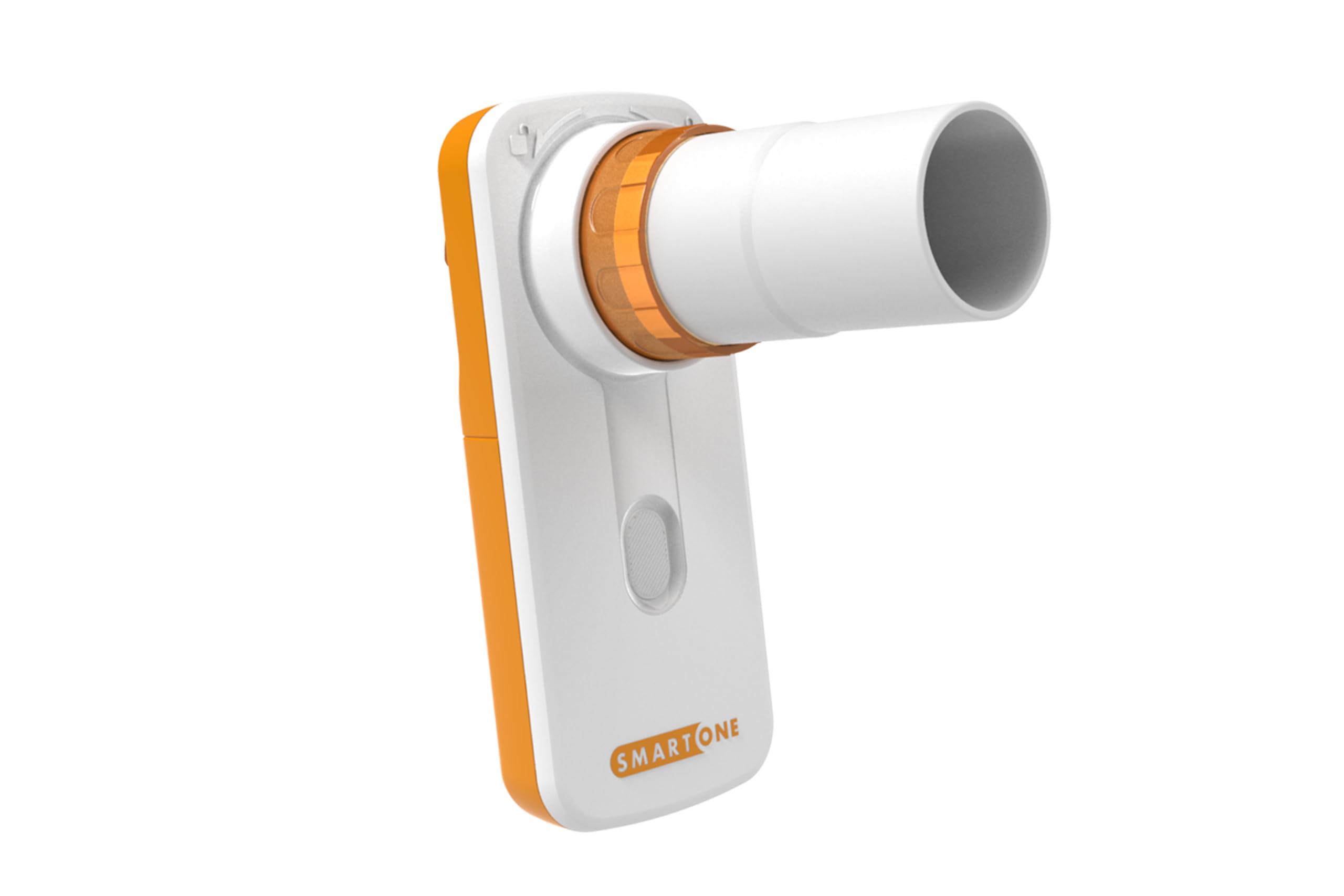
At 2.14 ounces and about the size of a small phone, the Smart One is the only meter in this group that genuinely disappears into a pocket, and it is the one we carry when we are away from home. You blow, and the result lands in the app on your phone or tablet, where it is trended, dated, and ready to email to your clinician.

When everything is working, it is the nicest experience here. The app is simple enough to operate half-awake before an inhaler, readings flow into Apple Health on an iPhone, and a test is quick enough that you will actually do it twice a day. Being able to hand a respiratory nurse a clean month of data, rather than a card of pencil numbers, is worth real money to some people.

The catch is that the phone is not optional. No app, no reading, and the whole record lives somewhere you do not control. A dropped Bluetooth pairing or a new handset can interrupt a streak you were relying on, which is why we do not make this the default for everyone. It also asks a serious premium over the Microlife, and you are paying most of it for the software rather than the sensor.

One practical detail we appreciated: the meter itself runs on a single AA battery, so the weak point in the chain is your phone's charge, not the device's. If you travel with a battery pack anyway, this is the meter that earns its place in the bag. If you want something that keeps working when the phone does not, look at the Microlife instead.

Pros

  • Pocket-sized at 2.14 ounces
  • App trends results and sends them to your doctor
  • PEF and FEV1 in one breath

Cons

  • Nothing works without the phone and app
  • Premium price over the top pick
Our verdict

We recommend it for anyone who lives on their phone and travels with their lungs in mind; the app does the tracking and the meter disappears in a pocket.

Check Latest Price
3

Best Budget

Nascool Peak Flow Meter

85 /100
Trail Score Excellent

Key details

Weight
4.97 oz
Measures
PEF and FEV1
Dimensions
2 x 1.7 x 4 inches
Mouthpiece
Built-in, no disposables needed
Check Price on Amazon

Cheapest of the five here, the Nascool still measures PEF and FEV1 in a single blow and puts the result on a digital screen that is easy to read at a glance. No calibration out of the box, no disposable mouthpieces to keep buying, and a body small enough at 2 by 1.7 by 4 inches and under five ounces to live in a bathroom drawer between uses.

The app is where it comes apart. Pairing with a phone is unreliable enough that we treat this as a standalone meter with a paper diary, which is exactly what the box gives you: a sheet to write your numbers on. That is not a disaster. Three blows, the highest one written down, and a note about how you felt that day gets you most of what a clinician needs from a two-minute conversation.

So the case for buying it is straightforward. If you want a number each morning and you are not going to build a spreadsheet, this delivers the least expensive version of that, and the reading is easy to see and easy to clean afterward. If you want a trend line your doctor can scroll through, put the money into the Microlife, which stores the history itself without asking anything of your phone.

One more thing worth knowing: the instructions do not say which reference scale the readings follow, whether ATS, Wright or ERS, and those scales do not agree with each other. That matters if you are lining its numbers up against a clinic figure. Track your own percent of personal best instead, and the ambiguity stops being a problem.

Pros

  • PEF and FEV1 at the lowest price here
  • Clear digital display that is easy to read
  • No disposable mouthpieces or calibration needed

Cons

  • App pairing is unreliable in practice
  • No cover for the mouthpiece
Our verdict

Buy this one if you want a readable daily number for the least money here and do not need an app to make it work.

Check Latest Price
4

Quick Color-Coded Checks

Sonmol Digital Peak Flow Meter

83 /100
Trail Score Excellent

Key details

Ages
5 and up
Zones
Red, yellow and green arrow
Measures
PEF and FEV1
Dimensions
2.2 x 1.6 x 6 inches
Check Price on Amazon

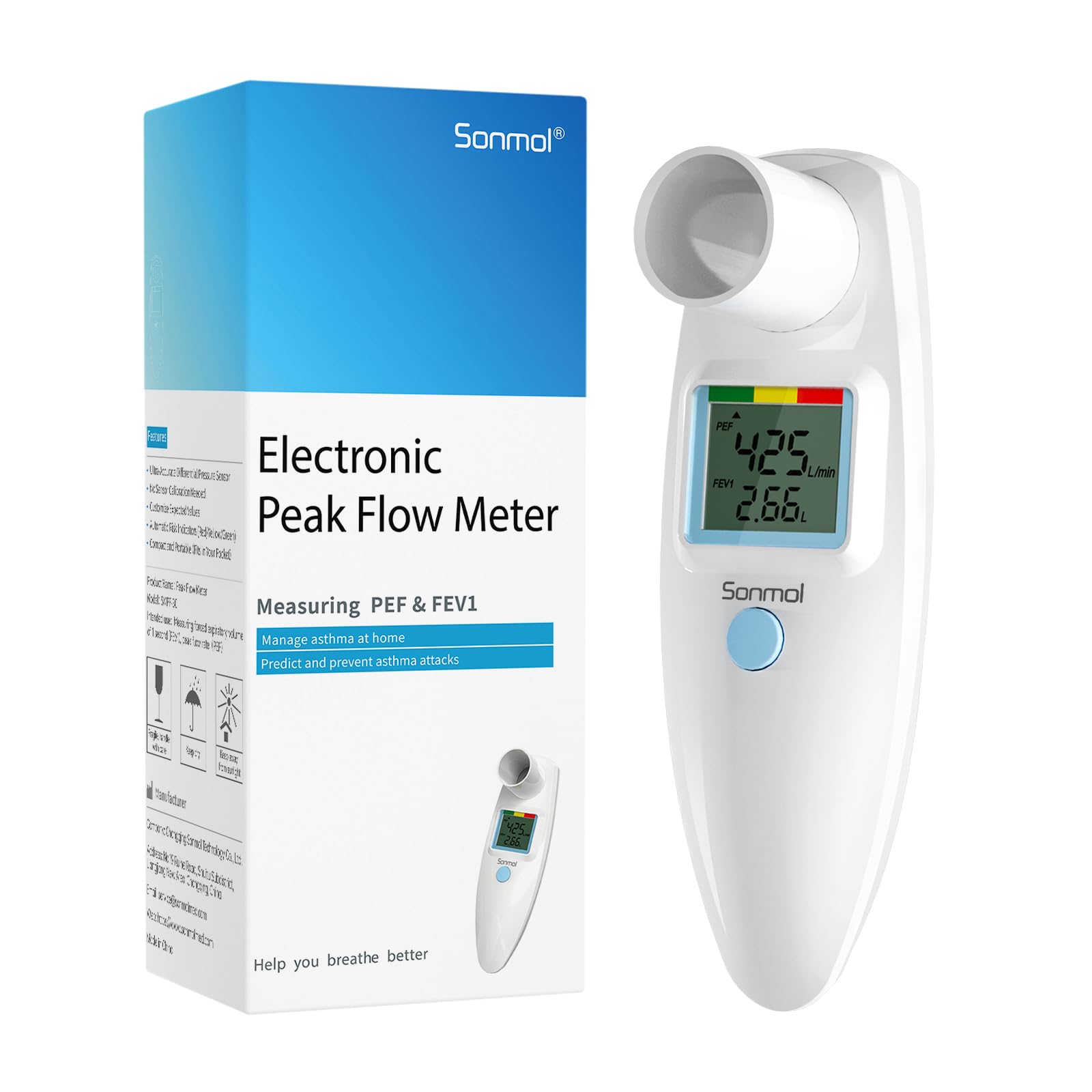
No app, no Bluetooth, no account to create. The Sonmol is a screen, a sensor and a colored arrow, and for a lot of people that is the entire feature list they want from a peak flow meter.

We like it for exactly that reason. Scan the QR code once and it works out your expected PEF from your age, sex, height and weight, and after each blow an on-screen arrow points into the red, yellow or green zone, so the answer to is this a bad morning is a glance rather than a spreadsheet. Both PEF and FEV1 appear after a single breath, and the meter is rated for adults and children from five up.

The single screen means the interesting part happens while you are standing there. You blow, you see the number and the zone, you know. Nothing to sync, nothing to pair, and nothing that stops working because a phone updated overnight. In a household where the meter gets passed between an adult and a school-age child, that simplicity is worth more than any log.

What you give up is the archive. This meter is built for the reading in front of you rather than the history behind you, so a month of morning and evening numbers means writing them down yourself. That is a fair trade if the color zones are what actually keeps you measuring. If you want the record kept for you, the Microlife is the modest step up that does it.

Pros

  • Color zones give an answer at a glance
  • PEF and FEV1 from one blow
  • Personal expected value from a QR scan
  • Rated for adults and children from five

Cons

  • History is yours to write down
Our verdict

We like it for households that want a color-coded answer after each blow and nothing else to manage.

Check Latest Price
5

Bluetooth Data Logging

Nascool Bluetooth Peak Flow Meter

80 /100
Trail Score Excellent

Key details

Weight
8.48 oz
Measures
PEF and FEV1
Data Transfer
Bluetooth to ePEF app
On-device Storage
300 readings
Check Price on Amazon

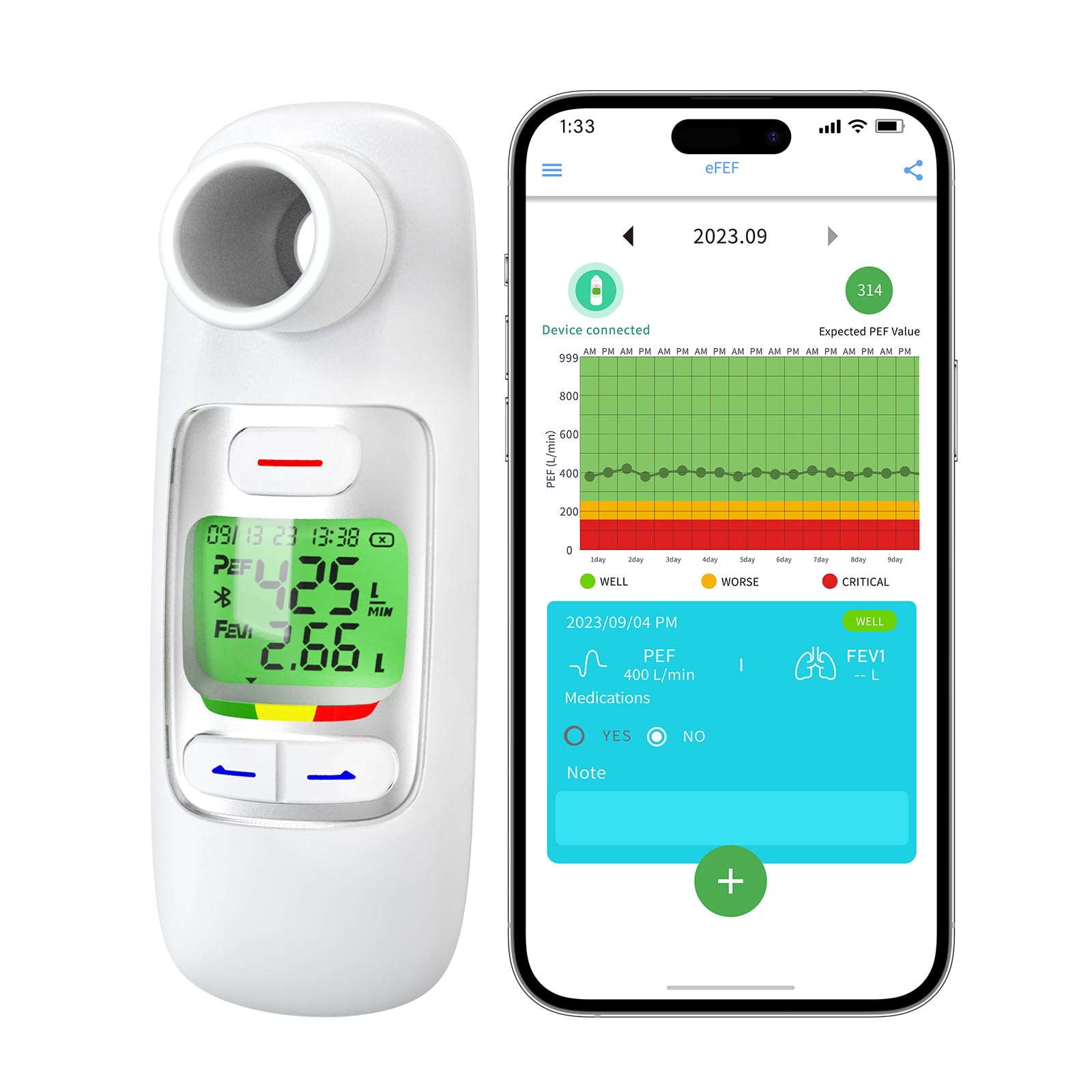
Three hundred readings sit in this meter's memory before you ever open the app, and that is the number that makes it the most useful of the mid-priced meters here. It logs PEF and FEV1 from one breath, shows the same green-yellow-red indicator, and lets you attach symptoms, medications and triggers to each saved reading, so the record reads like a diary rather than a column of figures.

The app is what earns the extra over Nascool's own cheaper meter. Real-time sync over Bluetooth, no cable, and notes pinned to a specific date turn a list of numbers into something a clinician can absorb in a couple of minutes. If your motivation for measuring is a specialist appointment every few months, this is the most persuasive version of that case in the group.

What gives us pause is accuracy. A meter that reads low against a mechanical unit produces a trend that looks like you are getting worse when you are not, and that is the kind of error that gets an action plan rewritten for no reason. Before you build decisions on this one, blow it alongside a meter you already trust and check that the two agree at your usual effort. It is also worth keeping the sensing orifice clear of dust, since a partly blocked port is the sort of thing that quietly shifts a number.

Size is the other consideration. At 8.48 ounces and around six and a half inches long, it is the heaviest of the small meters and noticeable in a jacket pocket, though perfectly reasonable on a bedside table where most measuring actually happens. If pocketability is the point of buying a digital meter at all, the MIR does that job better.

Pros

  • 300 readings stored on the device itself
  • Notes per reading for symptoms and triggers
  • Real-time Bluetooth sync with no cable

Cons

  • Readings can run low against a known-good meter
  • Heavier and longer than pocket meters
Our verdict

A good fit if you want a Bluetooth log with notes attached and will check its readings against a meter you already trust.

Check Latest Price

How We Tested the Best Peak Flow Meters

We started by pulling every adult peak flow meter we could find with published specifications — scale range, mouthpiece size, whether it stored readings, what it cost, and how easy it was to find replacement parts — then cut that list down to 14, spanning plain mechanical tubes to app-connected digital meters. Anything that never stated its measurement range, or whose paperwork skipped correct technique entirely, was dropped before we blew into it.

Testing ran four months across two households, with readings taken morning and evening, during a head cold, and right after climbing a flight of stairs. Every meter got the identical routine: stand up, three hard blows, best of the three written down. To check accuracy, we blew into each meter and a reference meter back to back in the same session and compared the numbers, then watched for drift as the weeks went on — noting whether the marker slid back to zero cleanly, whether it dragged along its track, and whether the scale was readable without hunting for glasses.

We handed each meter to a 9-year-old and a 68-year-old and timed how long it took them to produce a usable reading without help. Readings went into paper diaries and into each meter's own memory, and we checked a week later whether the numbers had survived a battery change, a jostle in a gym bag, and a drop onto bathroom tile. Connected models were paired with phones repeatedly, and we logged crashes, forced account sign-ups, and whether a month of readings could be exported without a manual. We read every instruction booklet cover to cover, washed each meter weekly to see if the window fogged or the marker stiffened, and asked plainly whether the app and the storage actually earned their extra cost.

How to Choose a Peak Flow Meter

Start With the Record, Not the Reading

A single peak flow number, on its own, tells you very little. What a clinician wants is today's reading against your personal best, plus the shape of the last few weeks. That makes storage the first thing to check: the Microlife keeps 240 dated readings inside the meter, the MIR Smart One keeps everything in its app, and the cheaper meters expect you to write each blow on a card. All three approaches work; only some of them survive a busy week.

Where the meter lives matters too. A device that ends up in a drawer gets used for a fortnight and then forgotten, so a case you can leave in a bag, or a body small enough for a pocket, is a genuine feature rather than a nicety.

PEF and FEV1: What Each Number Tells You

Peak expiratory flow is the fastest blast you can produce. FEV1 is how much air you get out in the first second, which gives a steadier picture of how narrowed the airways are on a given morning. Every digital meter in this guide reports both from a single breath, and that is a good reason to skip the mechanical tube meters, which give you PEF only and ask you to eyeball a sliding marker.

If a meter you are considering lists PEF alone, you are giving up a second measure of obstruction for very little saving. Check the spec sheet for the words FEV1 before you buy.

How the Numbers Reach Your Clinician

There are three routes: an on-board log you read out or hand over, a USB cable to a computer, or Bluetooth to an app. Each fails differently. The Microlife's bundled software is dated and has never been happy on Macs, so Windows households get more out of it, though the meter itself works perfectly well without it. The MIR is app-first, which is delightful until a phone upgrade or a dropped pairing takes the log with it. Nascool's Bluetooth model holds 300 readings before it ever syncs, a sensible hedge against exactly that.

Pick the route you will actually use on a Tuesday morning. If you know you will not plug in a cable, do not buy on the promise of software; if you change phones often, weight on-board storage more heavily.

Mouthpieces, Cleaning, and Shared Use

A peak flow meter goes in your mouth, so hygiene is a design feature. The ones we rate highest have a mouthpiece and measuring tube that lift out for washing, and come with spares; the Microlife includes three mouthpieces in a two-tier case. A built-in mouthpiece wiped between uses is fine for one person and awkward for a household, where each user needs their own mouthpiece or, better, their own meter.

Before you commit, check whether the mouthpiece is removable and what replacements cost. Disposable mouthpieces are an ongoing expense worth pricing up front.

Frequently Asked Questions

Final Verdict

If you are going to buy one meter, buy the Microlife PF 100. It measures PEF and FEV1, holds 240 dated readings without a phone, and arrives as a proper kit with a case and three mouthpieces, which is the combination that makes two weeks of measuring worth something at your next appointment.

The MIR Smart One is the better buy if the app is the point. It is the only meter here that disappears into a pocket, and its log reaches your doctor without you doing anything. Just know that a dead or replaced phone takes the record with it.