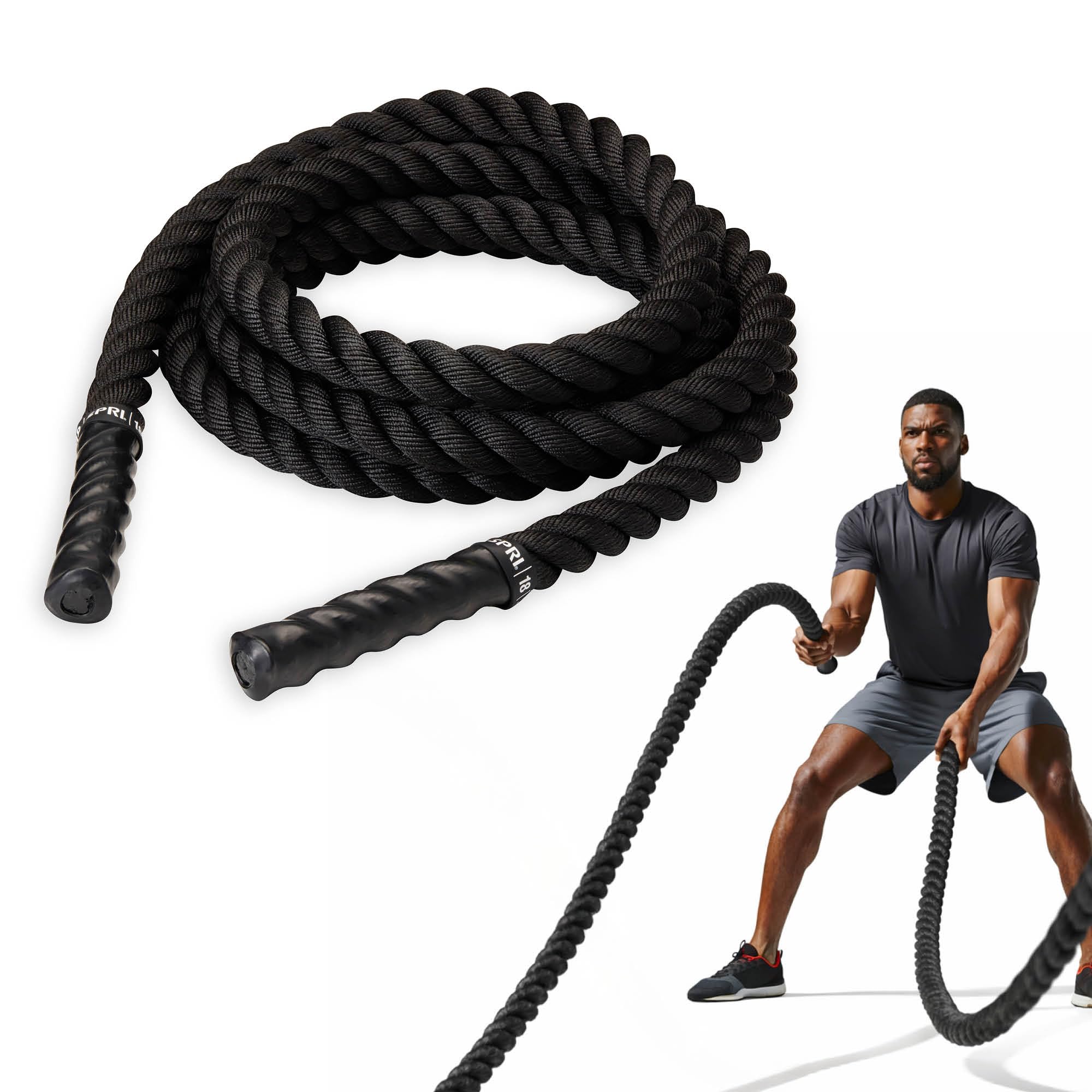
Best Battle Ropes for Home Gyms of 2026

A battle rope is one of the few pieces of home gym equipment that delivers a brutal conditioning session from a space no bigger than a bath mat. The catch is the tradeoff nobody mentions: the thicker and heavier the rope, the more power it demands — and the harder it is to hold once your forearms light up. I've watched cheap ropes shed black fuzz across a garage floor within a month; I've also used ones that still whip the same two years in. What you're buying is a rope that survives being dropped, dragged, and wrapped around a squat rack, and that doesn't turn slick the moment you start sweating.

We spent six months with 12 ropes, on concrete and rubber matting, in bare hands and sweaty ones. The ones worth owning share a few traits: ends that don't unravel, a listed weight that matches the real one, and a texture that bites instead of slipping. Ten minutes of hard waves with the right rope does more for your engine than half an hour on the treadmill; the wrong one leaves your grip shot and your floor covered in fuzz.

1

Best Overall

Perantlb Battle Rope with Anchor Kit

94 /100
Trail Score Outstanding

Key details

Rope Weight
7.94 kg (17.5 lb)
Anchor Strap
Included
Protective Sleeve
Nylon
Diameter And Length
1.5 in x 30 ft
Check Price on Amazon

The anchor strap and carabiner come in the box, and that's the detail that put this rope at the top of our list. A battle rope needs a fixed point before it does anything, and most of us solve that problem after the rope arrives — with a borrowed ratchet strap, a loop around a kettlebell, or a trip to the hardware store. Perantlb's strap goes around a rack upright or a post in about a minute, the carabiner pivots freely, and you can train the day the box lands.

The middle of the rope wears a stitched nylon sleeve, which is exactly where a battle rope takes its worst abuse — the section that drags the floor and rubs against the anchor. Ours has stayed intact. At 1.5 inches and about 17.5 pounds it's heavy enough to punish sloppy waves without turning a session into a grip contest, and the 8.66-inch heat-shrink handles are the longest in this group, long enough that your hands stay off the bare braid when you're sweating.

Thirty feet is the length we steer most garages toward: enough for alternating waves, double slams, and grappler throws, short enough to coil into a bin afterward. If you plan to bolt hardware into a stud rather than wrap a strap around something solid, the included anchor won't suit every wall — a rack, a post, or a loaded bar is the simpler route.

Pros

  • Anchor strap and carabiner included
  • Nylon sleeve guards the high-friction middle
  • Longest handles here at 8.66 inches
  • 30-foot length suits a one-car garage

Cons

  • Sleeve covers the middle, not the rope ends
Our verdict

This is the rope we point most home gyms to: a sleeved 1.5-inch 30-footer that comes with its own anchor strap, so you can train the day it lands.

Check Latest Price
2

Best Heavy-Duty Upgrade

POWER GUIDANCE Battle Rope

95 /100
Trail Score Outstanding

Key details

Diameter
1.5 in
Anchor Strap
Included
Length Options
30, 40, or 50 ft
Protective Sleeve
Double-layer nylon
Check Price on Amazon

The POWER GUIDANCE sits at the top of this group's price range, and it's fair to ask what the extra money buys. Start with the cover: instead of a single stitched sleeve, the middle carries a double-layer nylon wrap, and the anchor strap is wider than the kits most ropes ship with — the two places a battle rope gives out first. Handles run 7.5 inches, shorter than the Perantlb's but still long enough to keep a sweaty grip off the rope.

What settles it is the warranty. Two years is the longest here, and the durability record is as consistent as anything in this set: the double cover and the wide strap are aimed squarely at the friction that ends a rope's life, and at 7 kg in the 30-foot length it swings like the top pick. We think it's the right buy for someone training with ropes three or four times a week who doesn't want to think about a replacement.

The size range is where it pulls ahead of the cheaper ropes: 30, 40, or 50 feet, all at 1.5 inches. A 50-footer at that diameter is a serious conditioning tool rather than a starter rope, and it's the option to pick if you have a long wall or a driveway and want the rope to outlast your enthusiasm. It also coils down smaller than its length suggests — a laundry basket keeps it out from underfoot.

Pros

  • Double-layer nylon cover at the friction point
  • Anchor strap wider than standard kits
  • Two-year warranty, longest in this group
  • Available up to 50 feet

Cons

  • Highest price in this group
Our verdict

We recommend it for anyone training with a rope several times a week: the double-layer cover, wide anchor strap, and two-year warranty are the most protection in this group.

Check Latest Price
3

Best 40-Foot Rope

Brobantle Battle Rope 40 ft

93 /100
Trail Score Outstanding

Key details

Handles
Heat-shrink
Rope Weight
15.5 lb
Protective Cover
Nylon
Diameter And Length
1.5 in x 40 ft
Check Price on Amazon

Forty feet is the whole argument. A longer rope gives each wave more rope to travel through, so the movement gets slower and heavier without your buying a thicker diameter — the reason big commercial gyms hang long ropes rather than short fat ones. In a two-car garage or on a driveway, the Brobantle delivers that feel for a good deal less than the premium pick.

The listed weight is 15.5 pounds, lighter than the 30-foot ropes in this group, so a longer rope doesn't automatically mean a harder one. What you get instead is a rope that keeps moving in long, rolling waves without the drag you'd expect from the extra length. The nylon cover protects the middle, the heat-shrink handles are comfortable bare-handed, and the box includes a strap and gloves, so you can anchor it without a second order.

We rank it behind the top pick only because most home spaces can't use the extra ten feet well — in a single-car garage, 40 feet turns into a wall-hitting liability. Where the floor is there, it's the better training tool of the two lengths: slams and alternating waves feel closer to the gym version.

Pros

  • Extra ten feet for longer, slower waves
  • Lighter per foot than the 30-foot picks
  • Nylon cover over the middle
  • Strap and gloves in the box

Cons

  • Needs a bigger clear floor area than 30 feet
Our verdict

We reach for this one when 30 feet feels short: the extra ten feet slow the waves down, and the nylon cover plus heat-shrink handles make it complete out of the bag.

Check Latest Price
4

Best Budget

Amazon Basics Battle Rope

95 /100
Trail Score Outstanding

Key details

Material
Poly Dacron
Rope Weight
15.8 lb
Protective Sleeve
600D Oxford
Diameter And Length
1.5 in x 30 ft
Check Price on Amazon

The cheapest rope in this group that still arrives with real protection in the middle, the Amazon Basics is where we send anyone building a first garage gym. A 600D Oxford sleeve covers the high-friction section, the ends are capped in heat-shrink, and a tracking line is woven through so you can see at a glance whether the rope is wearing evenly. For something that will spend its life on a concrete slab, that's the right set of features.

At 15.8 pounds and 1.5 inches by 30 feet, it swings like a standard gym rope — heavy enough for slams and alternating waves, light enough that a beginner can finish a set. The three-strand poly dacron has a bit of give, which helps when you fold the rope back on itself for double slams.

Set it against the Fitvids, which costs about the same and has no sleeve at all, and the case for this one is simple: the sleeve is the part that decides how long a rope lasts on a floor. The trade is range. Amazon Basics sells this rope in one size, where the Fitvids covers seven combinations of diameter and length. If you already know you want 2 inches or 40 feet, buy accordingly; if you're starting out, this is the safer first rope.

Pros

  • Lowest-priced sleeved rope in this group
  • 600D Oxford sleeve and heat-shrink end caps
  • 15.8 pounds swings like a standard gym rope
  • Tracking line shows wear at a glance

Cons

  • Braid near the handles frays before the middle
Our verdict

We point first-time buyers here: the cheapest rope in this group with a real protective sleeve, though the braid near the handles wears before the middle does.

Check Latest Price
5

Mats and Turf

Fitvids 1.5-Inch Battle Rope

89 /100
Trail Score Excellent

Key details

Handles
Heat-shrink ends
Warranty
2 years
Package Weight
6.52 kg (14.4 lb)
Diameter And Length
1.5 in x 30 ft
Check Price on Amazon

No sleeve, and that shapes everything about this rope. The Fitvids is a bare three-strand polyester braid with heat-shrink ends — the simplest version of the tool, and the one that folds most sharply when you drop into double slams. Without a stitched cover the middle stays supple, which is why it rolls up small enough to tuck on a shelf.

We keep it on the list for a specific buyer: someone training indoors on rubber mats or turf, where a sleeve buys you less than it does on a garage slab. At 1.5 inches and 30 feet it matches the working size of our top pick, and the two-year warranty is longer than most in this group.

Seven size combinations — 1.5 or 2 inches, 30, 40, or 50 feet — mean you can order the same rope in a bigger version later. One note on that: the jump from 1.5 to 2 inches is bigger in the hands than the numbers suggest, so spend a few weeks with this one before you size up.

Pros

  • Bare braid folds sharply for slams
  • Coils small for storage
  • Two-year manufacturer warranty
  • Seven diameter and length combinations

Cons

  • Bare braid wears directly on concrete floors
Our verdict

We keep this on the list for mat-and-turf training: a plain 30-footer with no sleeve, a two-year warranty, and seven size combinations to grow into.

Check Latest Price
6

Color Choice

Glitenniy Battle Rope 30 ft

88 /100
Trail Score Excellent

Key details

Colors
Black, pink, red, green, grey
Handles
Non-slip grip
Protective Sleeve
Nylon
Diameter And Length
1.5 in x 30 ft
Check Price on Amazon

Five colors — black, pink, red, green, and grey — is more choice than any other rope here gives you, and in a home gym that doubles as a spare room, that isn't trivial. A battle rope is a permanent, visible object, and being able to pick a color that doesn't shout gym equipment is worth something.

The rest of the rope is conventional: 1.5 inches by 30 feet, a nylon sleeve over the middle, and a non-slip handle at each end. Ours has stayed intact, with the sleeve doing its job where the rope meets the anchor, and the braid swings the way a 1.5-inch rope should.

We rank it behind the top pick because of the details you give up for the color: the handles are a plain non-slip grip rather than the long heat-shrink ones we prefer for sweaty hands. That's not a dealbreaker if the color is what gets the rope out of the bin and into your week. Worth knowing too: all five colors come in the one size, so if you need 40 feet or 2 inches, you're back to a black rope.

Pros

  • Five colors, more than any rope here
  • Nylon sleeve over the middle
  • Non-slip handle with a hand guard

Cons

  • Costs more than the top pick at the same size
Our verdict

We like it for the one thing the others don't offer: five colorways, so the rope hanging in your spare room doesn't have to be black.

Check Latest Price
7

Tight Spaces

SPRI Conditioning Rope

87 /100
Trail Score Excellent

Key details

Material
Polyester
Rope Weight
10.7 lb
Handle Material
TPE
Diameter And Length
1.5 in x 18 ft
Check Price on Amazon

Eighteen feet is roughly half the length of everything else here, and that changes what the rope is for. Anchored at the middle, each hand works about nine feet of rope — enough for alternating waves and quick slams, not enough for the long rolling waves a 40-footer gives you. In a low basement or a narrow garage bay, that shorter reach is the difference between a rope you can use and one that hits the wall on every rep.

The build is gym-grade. At 1.5 inches and 10.7 pounds it feels denser than the budget ropes, the grip at each end is firm, and SPRI's care note — towel-dry after use, store somewhere cool and dry — is more specific than most of this category gets. That's a rope built to be kept rather than left out in the yard.

What's missing is the kit: there's no sleeve over the braid and no anchor strap in the box, so you're supplying your own way to fix it to a rack or post. If you already own a rack or a heavy plate stack, neither absence costs you a thing. Starting from nothing, plan on buying a strap with it.

We think it earns its slot as the tight-space option rather than a first choice for a full garage. At the same money as 30-foot ropes that arrive sleeved and with hardware, you're paying for compactness, not value — and in a corner where 30 feet would be a hazard, that's the right trade to make.

Pros

  • 18 feet fits rooms that can't take 30
  • Dense gym-grade build at 10.7 pounds
  • Specific care guidance for longevity

Cons

No notable drawbacks to flag.

Our verdict

We keep this one for tight rooms: 18 feet of 1.5-inch rope that still gives real waves in a basement corner or a short driveway.

Check Latest Price

How We Picked and Tested the Best Battle Ropes for a Home Gym

We started with the listings a home gym owner would actually land on, filtering by diameter, length, and material, then reading through the one- and two-star reviews for the complaints that kept repeating: ends fraying within weeks, ropes arriving stiff enough to stand up on their own, and weights that didn't match the label. Price stayed in the conversation the whole way, since most of these end up in a garage getting dragged across concrete. That narrowed things to 12 ropes.

For six months those ropes lived where people actually use them: a garage with a rubber mat, a driveway, and a basement with just enough ceiling clearance. We anchored each one around a squat rack post and, when the weather cooperated, a tree out back, working through 30-second sets of alternating waves, double slams, and sidewinders until our forearms quit, three or four sessions a week.

Durability got checked the unglamorous way. After every session we inspected the ends for unraveling, ran a hand down the weave to feel for flat spots, and swept the floor to see what had shed. Grip was tested bare-handed first, then again with sweaty hands after a round of burpees, noting whether the rope twisted, slipped, or burned against the palms. We hung each one on a scale to compare its real weight to the advertised number and paid attention to how fast the heavier ropes gassed us versus the lighter ones. Finally, every rope got coiled and hung on a wall hook after use, which showed us which ones kept a stubborn kink and which relaxed back into a straight line.

How to Choose a Battle Rope for a Home Gym

Length and diameter set the difficulty

A battle rope's resistance comes from the weight you're throwing around, and that's diameter, length, and braid density working together. For most home gyms, 1.5 inches by 30 feet is the sweet spot: heavy enough for slams and alternating waves, light enough that your technique doesn't fall apart in the last twenty seconds of a set. Two-inch ropes add resistance per foot and are the step up once 1.5 starts to feel easy.

Longer doesn't automatically mean harder. A 40-foot 1.5-inch rope can be lighter per foot than a 30-foot one, which gives you slower, longer waves rather than more weight — the reason commercial gyms hang long ropes instead of short fat ones. Measure your floor first: anchored at the middle, each hand works half the rope, so a 30-footer gives you two 15-foot ends and needs clear space to send waves down most of that.

The sleeve is what decides how long it lasts

Battle ropes die at the friction points: the middle, where the rope drags the floor and rubs the anchor, and the ends, where the braid meets the handle. A stitched nylon or Oxford sleeve takes that wear instead of the rope. On concrete, a sleeve is worth paying for. On rubber mats or turf it matters less, and a bare rope is cheaper and folds more sharply for double slams.

Whichever you pick, most sleeves cover the middle only — the sections near the handles still meet the floor — so how you store the rope matters as much as which one you bought.

Plan your anchor before the rope arrives

Every battle rope needs a fixed point. The simplest is a strap and carabiner looped around a rack upright, a structural post, or a loaded plate stack; bolting a bracket into a stud holds firmer but commits you to one spot. Check two things before you train: that the anchor can take a hard horizontal pull, and that the rope pivots freely without rubbing a sharp edge.

Some ropes here ship with a strap and carabiner — the Perantlb and the POWER GUIDANCE both do — and buying that separately is a small errand you skip by choosing a kit.

Handles, storage, and the small stuff

Grips matter more than they look. Heat-shrink covers of roughly 7.5 to 8.66 inches keep your hands off the bare braid when your palms are wet; short collars don't, and a rope that slips is a rope you stop using. Storage is the other thing people underestimate: a 30-foot rope coils into a laundry basket, a duffel, or a wall hook, but leave it on a patio and sun and grit will shorten its life faster than any workout will.

Frequently Asked Questions

Final Verdict

The Perantlb is the rope we recommend. At 1.5 inches by 30 feet it suits most garages and basements, the nylon sleeve covers the section that wears out first, the 8.66-inch grips are the longest here, and the anchor strap and carabiner come in the box — so the only thing between you and a first workout is a rack upright or a post.

If you train hard several times a week and want the double-layer cover, the wider anchor strap, and the only two-year warranty in this group, step up to the POWER GUIDANCE. If your floor takes 40 feet without hitting a wall, the Brobantle is the better rope for the space.