Best Athletic Tape for Ankles of 2026

A good ankle tape job should be the quiet kind of support — enough structure to trust your ankle on a cut or landing, but not so stiff that you're thinking about the tape instead of the game. The wrong roll makes itself known fast: edges lift inside a sweaty sock, the adhesive pulls at skin, and removal leaves a sticky, angry outline. What you want is tape that sticks through movement, supports without pinching, and comes off cleanly enough that you'll actually use it again tomorrow.

Over the past three months, I've worked through 14 rolls of ankle tape — taping before runs, pickup games, and long gym sessions, then checking how each one held up and came off. The differences are practical, not cosmetic: some tear cleanly by hand and stay put through sweat, while others fray, slide, or irritate skin after an hour. The best rolls make application feel simple and give enough support to settle a cranky ankle without turning it into a brick. Below are the ones that earned a spot in my gym bag.

1

Best Overall

Leukotape P Strapping Tape

95 /100
Trail Score Outstanding

Key details

Tearing
Hand-tearable
Roll Size
1.5 in x 15 yds
Tape Type
Rigid zinc oxide strapping
Water Resistance
Waterproof
Check Price on Amazon

Fifteen yards of tan zinc oxide tape that has no interest in coming off — that's the short version of why Leukotape P is our top pick for ankles. It's a rigid strapping tape, so it holds the joint instead of moving with it, and of everything in this guide it's the roll we trust to keep an ankle locked from warmup to the final whistle.

In testing we wrapped ankles over a layer of underwrap, and that turned out to be the right call: the adhesive is the most aggressive here, and bare skin under it takes a beating on removal. Put it on properly and it does not budge. The 1.5-inch width is the standard for ankle work, the roll tears across by hand without scissors, and the waterproof backing shrugged off sweat and a wet field. Fifteen yards also goes further than it sounds — an ankle wrap plus a couple of figure-eights doesn't eat much tape.

The grip has a price, and most of it is paid at removal. Work the tape off slowly, along the skin rather than away from it, and a bit of oil on the last few inches saves the skin underneath. If you've reacted badly to zinc oxide tape before, test a short strip on your forearm before you wrap a whole ankle.

Match-day strapping is exactly what this roll is for. If you want tape that lets the joint move while it works, rigid strapping is the wrong tool — KT Tape Original is the elastic answer in this guide.

Pros

  • Grip that holds through sweat and weather
  • Rigid support that limits ankle movement
  • Tears by hand mid-wrap

Cons

  • Leaves a sticky residue on skin
  • Aggressive adhesive pulls hair and skin on removal
Our verdict

The stickiest, most supportive rigid tape in this guide — our pick for strapping an ankle before a game or a hard practice.

Check Latest Price
2

Best Precut Kinesiology Tape

KT Tape Original Cotton

91 /100
Trail Score Outstanding

Key details

Format
20 precut 10 in strips
Adhesive
Latex-free, hypoallergenic
Tape Type
Elastic kinesiology
Wear Time
1 to 3 days
Check Price on Amazon

Ten inches, precut, with rounded corners: KT Tape Original is the tape for people who tape their own ankles in a parking lot five minutes before practice. No scissors, no measuring, and no ragged edge to curl up under a sock.

It's kinesiology tape, which means it stretches and moves with the joint instead of locking it down. We like it for the ankle that feels fragile but still has to run, and for anyone who finds rigid strapping too restrictive to play in. The cotton is comfortable against skin, and the adhesive is built to stay on through a day or two of normal wear, showers included.

The edges are where it gives up first. On a clean, dry ankle with no lotion underneath it holds well; under a tight sock that rubs at the border, a corner can lift before the session ends. Give each strip a firm rub after application to warm the adhesive, and round off any corner you cut yourself. Reactions to the adhesive show up often enough to be worth a patch test on sensitive skin.

Pros

  • Precut strips apply in seconds
  • Elastic support that allows full range of motion
  • Latex-free and dermatologist tested

Cons

  • Adhesive can irritate sensitive skin
Our verdict

The elastic option we reach for when an ankle needs support without being locked — and the precut strips make self-taping genuinely quick.

Check Latest Price
3

Best for Everyday Rigid Taping

Hampton Adams Athletic Tape

91 /100
Trail Score Outstanding

Key details

Residue
Low-residue adhesive
Tearing
Hand-tearable
Material
100% cotton
Tape Type
Rigid cotton
Check Price on Amazon

Hampton Adams sells this roll on a low-residue promise, and that's the trade you're making: it peels off clean after practice, and it doesn't bite down as hard as Leukotape. For anyone taping the same ankle five days a week, that's a trade worth making — a tape you dread removing is a tape you stop using.

It's rigid 100% cotton, so it still does the job of limiting movement, and it tears across by hand without reaching for scissors. We found it comfortable over prewrap and well behaved around the bony parts of the ankle, coming off in one piece rather than shredding into strips. It's also one of the least expensive rolls here, which matters when you're using a couple of yards a day.

Where it stops is the hard, sweaty session. The hold is the first thing to go on a wet ankle, so treat this as practice tape and training-room volume rather than match-day strapping — and reach for a fresh piece instead of trying to press a lifting edge back down.

Pros

  • Peels off with no sticky film
  • Tears by hand without scissors
  • Rigid cotton support at a low price

Cons

  • Hold softens on a wet, sweaty ankle
Our verdict

The rigid tape to buy if you tape every day and want it off clean — less bite than our top pick, far less cleanup.

Check Latest Price
4

Best Multi-Roll Value

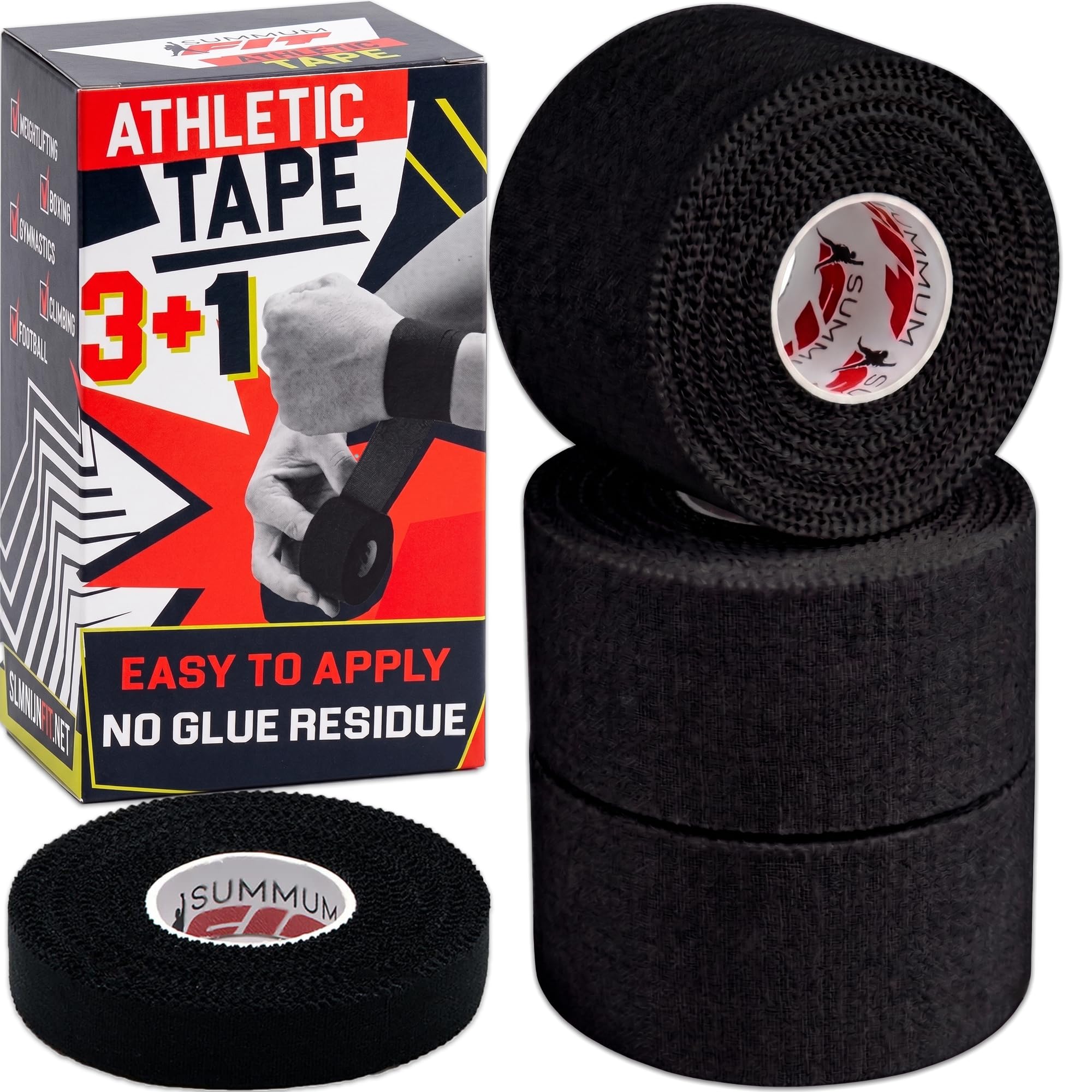
Summum Fit 3+1 Athletic Tape

94 /100
Trail Score Outstanding

Key details

Edge
ZigZag easy-tear
Rolls
3 x 1.5 in x 33 ft + 1 x 0.5 in x 33 ft
Adhesive
Latex-free
Tape Type
Rigid zinc oxide
Check Price on Amazon

Three wide rolls and one narrow one — the 0.5-inch finger roll is the part of this set that gets lost in the description and used constantly in a gym bag. Jammed fingers, taped thumbs, and a thin strip to lock down the end of an ankle wrap all come out of that little roll.

For ankles, the three 1.5-inch rolls do the work. They're zinc oxide rigid tape with a zigzag edge that tears across by hand cleanly enough to do it between rounds, and the black finish hides gym grime better than white. Three 33-foot rolls plus the finger roll is a lot of taping in one box, which is exactly why this set earns a spot over single-roll options.

It isn't the strongest hold in this guide. On a heavy sweat the edges start to roll, which matters less in grappling and training where you're re-taping between rounds anyway. Some rolls also tear a little too eagerly when you pull against tension, so pinch and tear slowly rather than yanking.

Pros

  • Four rolls including a narrow finger tape
  • Zigzag edge tears by hand
  • Latex-free zinc oxide grip in black

Cons

  • Tears too eagerly when pulled tight
Our verdict

A four-roll set that covers ankles and fingers, and the value pick if you're taping several times a week.

Check Latest Price
5

Best Bulk Case for Teams

Cramer Team Color Athletic Tape

91 /100
Trail Score Outstanding

Key details

Case
32 rolls
Latex
Latex-free
Roll Size
1.5 in x 15 yds
Tape Type
Rigid athletic tape
Check Price on Amazon

Thirty-two rolls in one box. Cramer's case isn't aimed at a single athlete with one cranky ankle; it's aimed at the trainer's table, the team kit bag, and the coach who is tired of reordering every few weeks.

What you get is standard training-room tape: 1.5 inches by 15 yards, latex-free, white enough to write on, and easy to tear across. Fifteen yards is a long roll, and 32 of them covers a serious amount of ankle and wrist work. The white takes a marker, which matters more than it sounds when you're labeling a strip for a return-to-play date or sorting one athlete's tape from another's.

The catch is the commitment. It's the biggest single outlay in this guide, it only comes in white rigid tape, and if you want elastic kinesiology or precut strips you're buying something else as well. Per roll it works out cheaper than anything else here, and that's the whole argument for the case.

Pros

  • 32 rolls in a single case
  • Standard 1.5 in x 15 yd rolls
  • Latex-free and easy to tear

Cons

  • White rigid tape only, in a large case
Our verdict

The case to buy when you're taping a whole team rather than one ankle — 32 standard rolls of white 1.5-inch tape.

Check Latest Price
6

Precut Daily Taping

Care Science Copper Kinesiology Tape

89 /100
Trail Score Excellent

Key details

Format
40 precut strips (2 rolls)
Adhesive
Wave-pattern adhesive
Tape Type
Elastic kinesiology, copper-infused
Water Resistance
Water resistant
Check Price on Amazon

Forty strips in the box against KT Tape's twenty is the first thing to notice about Care Science's precut kinesiology tape. For someone taping an ankle or a knee every morning before work, strip count is most of the argument.

The strips are precut, water resistant, and use a wave-pattern adhesive meant to keep air moving through. In practice it wears the way kinesiology tape should: flexible, low-profile under a sock, comfortable enough to forget about for a day. The copper infusion is a label detail we can't vouch for; the strip count and the adhesive are what you're actually buying.

Consistency is where it falls behind. Some strips hold for days, others start peeling at the corners within a session. Removal is the rougher end of the range too, so work slowly, along the skin, and use oil on the last few inches rather than ripping it off after a shower.

Pros

  • 40 precut strips across two rolls
  • Water-resistant elastic support
  • No cutting or measuring before application

Cons

  • Adhesion varies from strip to strip
  • Leaves residue and pulls on removal
Our verdict

Two rolls and 40 precut strips — a sensible volume buy if you tape the same joint every morning and don't want to cut anything.

Check Latest Price
7

Custom Ankle Strips

WINIOM Kinesiology Tape

88 /100
Trail Score Excellent

Key details

Latex
Latex-free, hypoallergenic
Roll Size
2 in x 16.4 ft, uncut
Tape Type
Elastic kinesiology
Wear Time
3 to 5 days
Check Price on Amazon

Most people taping their own ankle for the first time get the technique wrong before they get the tape wrong, which is why the step-by-step guide bundled with WINIOM's roll matters more than the tape itself. The roll is decent too: 2 inches wide, 16.4 feet long, and uncut, so you cut the length your technique actually needs instead of working around a strip someone else sized.

That extra half-inch over a standard 1.5-inch roll gives you more coverage per pass around the ankle, and for kinesiology-style work that's a real convenience — fewer strips, less overlap, a cleaner edge line. The adhesive is a water-resistant acrylic and the roll is latex-free.

The catch is that uncut means scissors; there's no tearing this one cleanly by hand, so it lives in a kit rather than a pocket. Patch test before you wrap a whole ankle, too. Adhesive reactions are the most common problem with tape generally, and this roll is no exception.

Pros

  • Taping guide and app access included
  • 2-inch width for fewer passes
  • Water-resistant, latex-free cotton

Cons

  • Needs scissors to cut
  • Hold is inconsistent between rolls
Our verdict

The roll we suggest for a first-timer: two inches wide, uncut, and sold with a step-by-step taping guide.

Check Latest Price

How We Tested Ankle Tape During Runs, Games, and Gym Sessions

We started with a shortlist of ankle tapes sold for team kits and personal gym bags, narrowing by width, backing cloth, adhesive type, and whether user reviews repeatedly mentioned residue or skin irritation. From there, 14 rolls went into rotation over three months, with each one used for the same basic stirrup-and-figure-eight wrap.

I taped my own ankle and a teammate's before runs, pickup basketball, and lifting sessions, noting whether the roll unwound evenly, whether it tore by hand without stretching into a narrow string, and whether the edges stayed flat when layered. During and after each session, I checked if the tape had shifted inside a sock, bunched at the heel, or frayed along the edges.

After activity, I looked at how the tape released: whether it pulled hair, left sticky patches, or reddened skin, and whether residue came off with a warm washcloth. I also asked how the ankle felt on cuts and landings — supported but not locked up, and less achy afterward — and whether any roll pinched or needed retaping midway through. The rolls that scored best tended to tear cleanly, hold through sweat, and come off without a fight; the weaker ones either went gummy at the edges or felt flimsy after a single session.

How to Choose Athletic Tape for Ankles

Rigid or Elastic Comes First

Rigid tape — the zinc oxide sports tape in Leukotape P, Hampton Adams, Summum Fit, and the Cramer case — is built to limit joint movement. That's what sideline ankle taping usually means, and what you want before a game on an ankle that has rolled before. Elastic kinesiology tape stretches with the skin, supports without restricting range of motion, and is worn for a day or more rather than a session.

Pick rigid for stability during play, elastic for support you keep on afterwards. Just don't expect elastic tape to stabilize an ankle the way a rigid wrap does — it isn't designed to, and no amount of careful application changes that.

Adhesion Is Mostly Preparation

Almost any tape here sticks well on a clean, dry, lotion-free ankle and badly on a damp one. Wipe the skin, let it dry completely, overlap each strip by about half its width, and rub the tape firmly after application — friction is what activates most pressure-sensitive adhesives. A low-residue formula like Hampton Adams' needs a cleaner surface than a zinc oxide tape does, because it has less grip to spare.

Sock lines, ankle socks left half on, and a layer of sunscreen are the usual reasons tape lifts at the edges before a session is over.

Width, Length, and How Far a Roll Goes

Ankles are usually taped with 1.5-inch tape; 2-inch rolls cover more ground per pass and suit larger joints or kinesiology work, and half-inch rolls are for fingers. Length matters as much as width, and it's where the value maths gets slippery: a 33-foot roll is 11 yards, shorter than a standard 15-yard training-room roll, so a cheap multi-pack isn't automatically more tape than one long roll.

Estimate your own use before comparing pack sizes — an ankle stirrup plus a couple of figure-eights eats more than most people expect. If more than one person is taping, the bulk case wins on cost per roll by a wide margin.

Precut Strips or a Roll You Cut

Precut strips buy speed and consistency: 10-inch strips with rounded corners go on without scissors, which is exactly why KT Tape is so easy to self-apply, and the rounded corners resist curling under a sock. Uncut rolls buy fit — you cut the length your technique needs, which matters for heel locks and long figure-eights, and you generally pay less per foot.

If you tape the same joint the same way every day, precut is worth it. If your taping changes as an injury settles, buy the roll and carry scissors.

Skin Tolerance and Wear Time

Adhesive reactions are the most common problem with tape generally, ranging from an itch at the edges to blisters on the skin. Test a short strip somewhere unglamorous before you wrap a whole ankle, especially with the high-grip zinc oxide tapes. Latex-free doesn't mean adhesive-free, so an underwrap layer is a better answer than switching brands if your skin is reactive.

Rigid tape comes off after the session; kinesiology tape can stay a few days, but not if it itches.

Frequently Asked Questions

Final Verdict

Leukotape P is the tape we point people to first, because an ankle that needs taping usually needs it to stay put: rigid, waterproof, and the most stubborn adhesive in this guide. If you tape daily and want a clean peel instead of a fight, Hampton Adams is the more livable version of the same idea.

If what you want is elastic support that moves with the joint, KT Tape Original's precut strips are the easier self-application. Buy Cramer's case only when you're taping more than one person.