Best Sacroiliac Belts of 2026

Sacroiliac joint pain is oddly specific and hard to describe: a deep ache on one side of your lower back that flares when you stand from the couch, swing a leg out of the car, or roll over at 3 a.m. A belt won't cure it, but the right one does something a stretch can't — it presses the joint back into place and holds it there while you get on with your day.

I've worn these through desk marathons, long walks, and afternoons up and down off the floor with a toddler. Over the past six months my team and I tested 14 belts, from slim elastic straps to wide wraparound designs, and what separates one you keep wearing from one that lives in a drawer comes down to fit and whether it stays put. A belt even slightly too large rides up instead of supporting, so measure your hips, not your waist. The picks below held their position — and a few of them got us back to a normal week.

1

Best Overall

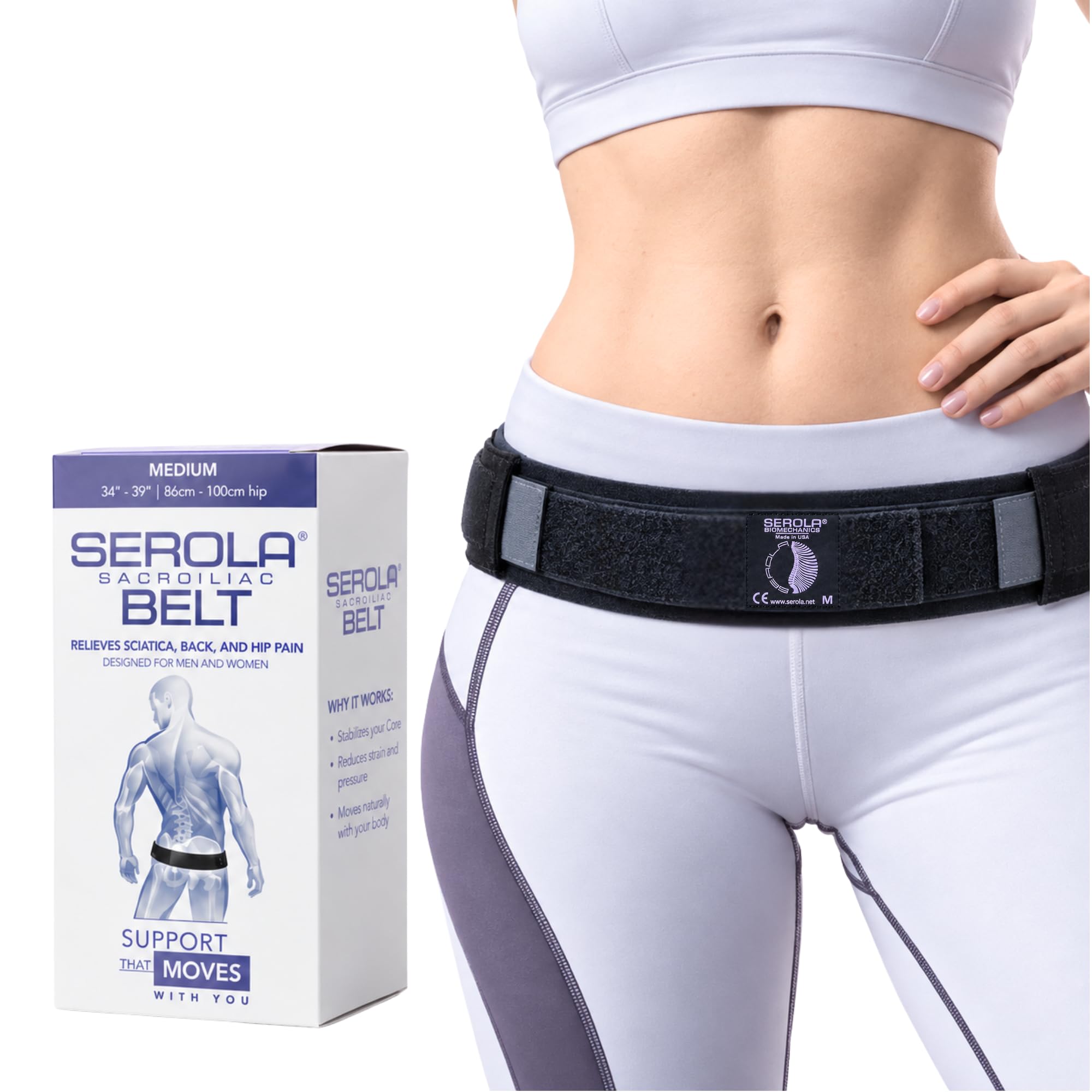
Serola Sacroiliac Belt

89 /100
Trail Score Excellent

Key details

Weight
4 oz
Closure
Hook-and-loop
Size Range
Medium, 34-39 in hip
Support Layer
Non-elastic primary layer
Check Price on Amazon

The Serola's defining feature is a non-elastic primary layer backed by a secondary elastic compression layer. That's a different proposition from the all-neoprene wraps that dominate this group: the belt is trying to limit excess motion at the SI joint first and add compression second. It sits low around the hips, and the listed Medium is sized by hip circumference, not waist measurement. We wore it under a sweater and over a thin base layer, and it stayed low-profile enough that the band didn't announce itself through clothing.

That firmness is the reason it's our top pick. We noticed the support as a steady, broad pressure rather than a soft squeeze, and it made us more aware of keeping the pelvis level when we stood up or shifted weight. It is not a cushiony belt. If you want something that disappears into a soft waistband, the Pro Enrichment is friendlier; if you want a deliberate, stabilizing feel, the Serola is the one we reach for.

The fit is where to slow down. The Medium range is narrow, and the belt is designed to sit around the hips, so a waist measurement will send you to the wrong size. We also found that the firm band can feel intrusive after a long stretch in a chair; loosening it slightly for desk work helped, and re-centering it after standing is worth the few seconds.

For someone who wants a dedicated SI belt rather than a general back wrap, the Serola is the most purpose-built option here. It isn't the softest or the easiest to dial in, but the two-layer design gives it a clear reason to be the default. If your hips sit outside the Medium range, don't force it; the fit is the support.

Pros

  • Non-elastic layer gives firm SI support
  • Low-profile enough to wear under clothes
  • Hip-based sizing keeps the fit deliberate

Cons

  • Narrow Medium size range
  • Hand wash only
Our verdict

Our top pick for dedicated SI support, with a non-elastic stabilizing layer and a precise hip-based fit; it's the one to start with if you want firm, low-bulk support.

Check Latest Price
2

Best for Petite Frames

Vriksasana SI Joint Belt

88 /100
Trail Score Excellent

Key details

Material
Perforated neoprene
Belt Width
3.75 in
Size Range
XS, 26-31 in hip
Belt Length
37 in
Check Price on Amazon

The Vriksasana is the pick for a genuinely small frame: the extra-small is listed for 26 to 31 inch hips, with a 37-inch belt and a 3.75-inch band. That sounds like a narrow niche until you've tried to cinch a regular SI belt down on a petite pelvis and watched the overlap bunch up. We found the smaller footprint easier to center low across the sacrum, and the dual adjustment let us set the compression without cranking the whole band.

The inner belt is perforated neoprene with silicone strips, and the secondary straps are there to fine-tune tension. We liked that the belt can be worn under clothing without a rigid panel digging in; the trade-off is that the silicone grip and neoprene can feel warm on a humid day. The belt is designed for long wear, but it's worth taking it off for a break and letting the skin breathe.

The stay-put behavior is the question mark. The silicone strips help, but the belt can ride up when you sit for a while, especially if you wear it over smooth clothing. Starting it low and against skin or a snug base layer made a bigger difference for us than pulling it tighter. If you're outside the extra-small range, the PlayActive covers a much broader hip span.

Pros

  • XS sizing for 26-31 inch hips
  • Dual straps fine-tune compression
  • Silicone strips resist sliding

Cons

  • Only the extra-small size is covered here
Our verdict

This is the SI belt for a small frame: the extra-small sizing and dual straps make it easy to center low without a bulky overlap.

Check Latest Price
3

Best for Wide Hip Range

PlayActive SI Joint Hip Belt

88 /100
Trail Score Excellent

Key details

Material
Neoprene and nylon
Belt Width
3.6 in
Size Range
Regular, 32-47 in hip
Belt Length
46 in
Check Price on Amazon

PlayActive's regular belt is listed for 32 to 47 inch hips, which is one of the broader single-size spans in this group. The band is 3.6 inches wide and 46 inches long, with an anti-slip inner material and two elastic tension straps. On paper it's a simple design; what matters is whether that wide range can still hold a firm, centered fit without buckling at the overlap.

We tested it on walks and through a normal workday, and the anti-slip face did its job better than the smooth neoprene belts here. It stayed low and didn't roll into a rope the way a narrow elastic band can. The trade-off is a firmer, wider feel than the soft comfort picks; if you're sensitive to pressure across the front of the hips, give it a short trial before committing to a long day.

The 32-to-47 range is the reason to consider it. It gives a lot of adults a workable fit without jumping to a plus-size listing, and the two tension straps let you set compression independently of the main band. Measure at the hips rather than the waist, because the overlap is wide and a waist measurement will put you in the wrong part of the range.

For walking, errands, and days when you're up and down, the PlayActive is the belt we choose when we want the anti-slip security and don't need the Serola's non-elastic layer. That grip is the detail that keeps it in the rotation when a plain elastic belt starts to wander.

Pros

  • Wide 32-47 inch hip range
  • Anti-slip inner face stays centered
  • Dual tension straps adjust compression

Cons

  • Runs large for very slim hips
Our verdict

A broad-fitting, anti-slip belt for walks and busy days, with enough adjustability to suit a wide range of hip sizes.

Check Latest Price
4

Best Budget

PARPERNA SI Hip Belt

87 /100
Trail Score Excellent

Key details

Closure
Dual hook-and-loop
Material
Perforated neoprene
Plus Range
44-55 in hip
Size Range
Regular, 30-45 in hip
Check Price on Amazon

The PARPERNA is the budget option we kept recommending because it doesn't strip out the useful parts. You still get a broad hook-and-loop closure, a second elastic strap for tension, and a perforated neoprene inner belt with a non-slip face. The regular is listed for 30 to 45 inch hips, and the listing also shows a plus size for 44 to 55 inches. At the low end of this group, that's a lot of belt for the money.

We found it easy to put on and adjust, and the dual straps gave us a more controlled fit than a single wide band. The support feels more elastic than the Serola's non-elastic layer, so it's a compression-first belt rather than a firm block. For a first SI belt, or a spare to keep in a bag, that's a sensible trade.

The weakness is staying centered. On a long walk it held, but after a stretch of sitting and standing it needed a re-set, and the smooth outer surface doesn't have the same grip as the silicone-strip belts. It's a sensible first belt, not the last word in lock-down.

Pros

  • Dual-strap adjustment for controlled tension
  • Non-slip inner face helps it stay put
  • Regular and plus-size range listed

Cons

  • Fit is least secure at the ends of the range
Our verdict

The budget pick to beat here: dual-strap adjustment and a non-slip face without the premium price.

Check Latest Price
5

Best for All-Day Comfort

Pro Enrichment SI Belt

87 /100
Trail Score Excellent

Key details

Weight
10.2 oz
Included
Travel bag
Material
Neoprene and nylon
Size Range
Regular, 30-45 in hip
Check Price on Amazon

The Pro Enrichment belt is the comfort-first pick. The inner face is soft against bare skin, the dual straps are easy to find and pull, and the whole thing goes on and off without a wrestling match. We noticed that difference most on days when we were taking the belt off and on between desk work and walking; it's less fussy than the firmer, more technical belts here.

It's listed for 30 to 45 inch hips, with a perforated neoprene inner belt and a secondary elastic strap. The belt comes with a travel bag and a one-year manufacturer warranty, which is useful if it's going in a work bag or a carry-on. The support is more of a steady hug than a rigid hold; if you want the Serola's non-elastic feel, this isn't that belt.

The belt is built for comfort more than maximum hold, and the broad 30-to-45-inch range means the fit is less precise than a narrowly sized belt. It's the one we choose for desk days, travel, and errands; for a long hike or a hard workout, choose the PlayActive or Serola.

Pros

  • Soft inner face for bare-skin wear
  • Easy to put on and take off
  • Travel bag and one-year warranty

Cons

  • Soft band can shift during active movement
Our verdict

The soft, easy-on pick for long days at a desk or in transit, with dual straps and a travel bag included.

Check Latest Price
6

Low-Profile Wear

OPTP SI-LOC Belt

84 /100
Trail Score Excellent

Key details

Weight
1.41 oz
Closure
Dual hook-and-loop
Material
Nylon with grip pads
Size Range
S/M, 30-46 in pelvic
Check Price on Amazon

The OPTP SI-LOC is the lightest, least obtrusive belt in this group. It's a thin nylon band with grip pads and dual hook-and-loop closures, and the small/medium is listed for a 30 to 46 inch pelvic circumference. We noticed the low profile first: it sits flat under a shirt and doesn't add a rigid panel across the back.

The grip pads are the reason it can stay put without a lot of bulk. They hold the band in place on the skin or a snug layer, and the dual closures let you set tension from both sides. We liked that for travel and for wearing under clothes that don't hide a wider wrap.

Fit is the real question. The S/M range is broad, and the band can slide out of position if it's worn over smooth clothing or not centered low enough. We had to take a little more care with placement than with the anti-slip neoprene picks, and the closure needs a firm press to stay put. For a low-profile belt, that's the trade: less bulk, less margin for a sloppy fit.

Pros

  • Very light and low-profile
  • Grip pads resist rolling
  • Dual closures adjust from both sides

Cons

  • Little padding for bony hips
Our verdict

The low-profile pick for wearing under clothes: very light, with grip pads and dual closures, though the thin band offers little padding.

Check Latest Price
7

Firm Compression

YCSHUNDONG SI Belt

87 /100
Trail Score Excellent

Key details

Anti-slip
7 silicone strips
Belt Width
5 in
Size Range
M/L, 36.2-46.5 in hip
Support System
7 plates and 8 compression strips
Check Price on Amazon

The YCSHUNDONG belt is the most compression-focused design here: seven support plates, eight compression strips, four one-sided straps, and seven silicone anti-slip strips. The M/L is listed for 36.2 to 46.5 inch hips, and the belt is 5 inches wide. This is not a minimalist band; it's a system you adjust around the pelvis.

The payoff is a fit you can shape. The extra straps let you tighten the top and bottom independently, and the plates spread pressure instead of concentrating it in one narrow strip. We found it stayed secure during walking and bending, and the wide panel felt more stable than the simple elastic wraps. It also feels more mechanical, with more edges and overlap to manage.

The stiffer panel is the trade. It is noticeable under slim clothing, and the wide 5-inch band doesn't disappear the way a narrow elastic belt can. If you want a belt you can forget you're wearing, this isn't the one; if you want firm, dialed-in compression, it's worth the extra structure.

It's a specialist pick rather than the default: the buyer who has tried a simple belt and wants more control over compression will get the most from it. If you want the easiest everyday option, the Serola or Pro Enrichment is a better place to start.

Pros

  • Highly adjustable multi-strap fit
  • Support plates spread pressure
  • Silicone strips resist slipping

Cons

  • More straps to center than simple belts
Our verdict

The high-compression specialist: seven support plates and a multi-strap fit for someone who wants firm, dialed-in support.

Check Latest Price

How We Chose and Tested 14 Sacroiliac Belts

We started with a list of roughly 40 belts pulled from physical therapy forums, clinical write-ups on pelvic support, and brand sizing pages, then cut it down by adjustability range, breathability, return policy, and whether the manufacturer published real hip measurements instead of vague small-medium-large labels. Fourteen made it through to testing.

Each one got worn for at least a week of ordinary life: eight-hour desk days, dog walks, grocery runs, stairs, the driver's seat, and the moment that separates a good belt from a bad one — rolling over at 3 a.m. We kept a running log of how often we had to re-tighten, whether the band crept upward when we sat down or bent to pick something up, and where the seams and closure landed after an hour in a chair.

Relief and support were judged on function, not feel: whether the ache eased within the first hour, whether we could stand up from a low chair without bracing a hand on the armrest, and whether the belt still felt supportive on day ten as the elastic relaxed. Comfort meant wearing it eight hours under jeans and noting scratchy edges, sweat, and bulk. For quality, we fastened and unfastened every closure dozens of times and checked stitching and elastic recovery at the end of the run.

Fit got its own pass, since that's where most returns come from. We compared each size chart against actual hip measurements and had two testers with different body types wear the same size; a belt that only worked on one of them didn't make the list.

How to Choose a Sacroiliac Belt

Measure at the Hips, Not the Waist

An SI belt is meant to sit low, across the sacroiliac joints and the top of the hips, so waist size is the wrong starting point. Measure around the fullest part of your hips or pelvis, following the maker's landmark. Serola, for example, asks for a hip measurement and lists its Medium for a relatively narrow span. If you're between sizes, don't assume the larger belt will cinch down; a big overlap can bunch and lose grip.

Choose the size that puts you in the middle of the listed range when you can, and check the return policy before ordering. If you're at the very top or bottom of a range, the belt has less room to hold its shape, so measure twice.

Decide How Much Give You Want

All-elastic neoprene belts are comfortable and easy to tension, but they compress more than they limit movement. A belt with a non-elastic stabilizing layer, like the Serola, is the better match for someone who wants firm support and less give. A soft elastic belt, like the Pro Enrichment, suits long desk days and easy on/off.

Neither is better in the abstract: match the construction to whether you need restraint or comfort. If you have significant instability or a recent injury, ask a clinician which style fits your situation.

Plan for Staying Put

Anti-slip strips, silicone dots, and a wide band help, but placement does more than grip. Put the belt low over the sacrum, not around the waist, and wear it against skin or a snug base layer if it slides over smooth trousers. Sitting is the common test: a belt that stays put on a walk can still ride up in a chair. Re-center it after standing.

If you're choosing between two, favor the one with the grip surface and width that match your clothing and activity. A belt that needs constant fussing will end up in a drawer.

Keep Closure and Comfort in Check

Hook-and-loop is the standard closure because it lets you fine-tune tension, but it can snag knitwear and lose grip when lint fills the hooks. Press the tabs firmly, keep them clean, and check the closure before each wear. Breathable perforated neoprene is cooler than a solid wrap, though no belt is truly invisible under slim clothes; a 5-inch panel will show more than a 3.6-inch one.

Hand wash and line dry when the maker specifies it. If the belt leaves deep marks, numbness, or skin irritation, loosen it or stop wearing it.

Frequently Asked Questions

Final Verdict

After testing the group, the Serola is the belt we recommend first for dedicated SI joint support. Its non-elastic layer gives it a firmer, more deliberate hold than the elastic wraps, and the hip-based sizing keeps the fit honest. If you have a small frame, the Vriksasana XS is the better starting point; if budget is the limiter, the PARPERNA covers the basics. The Serola is the one to buy when you want the most purposeful support here.