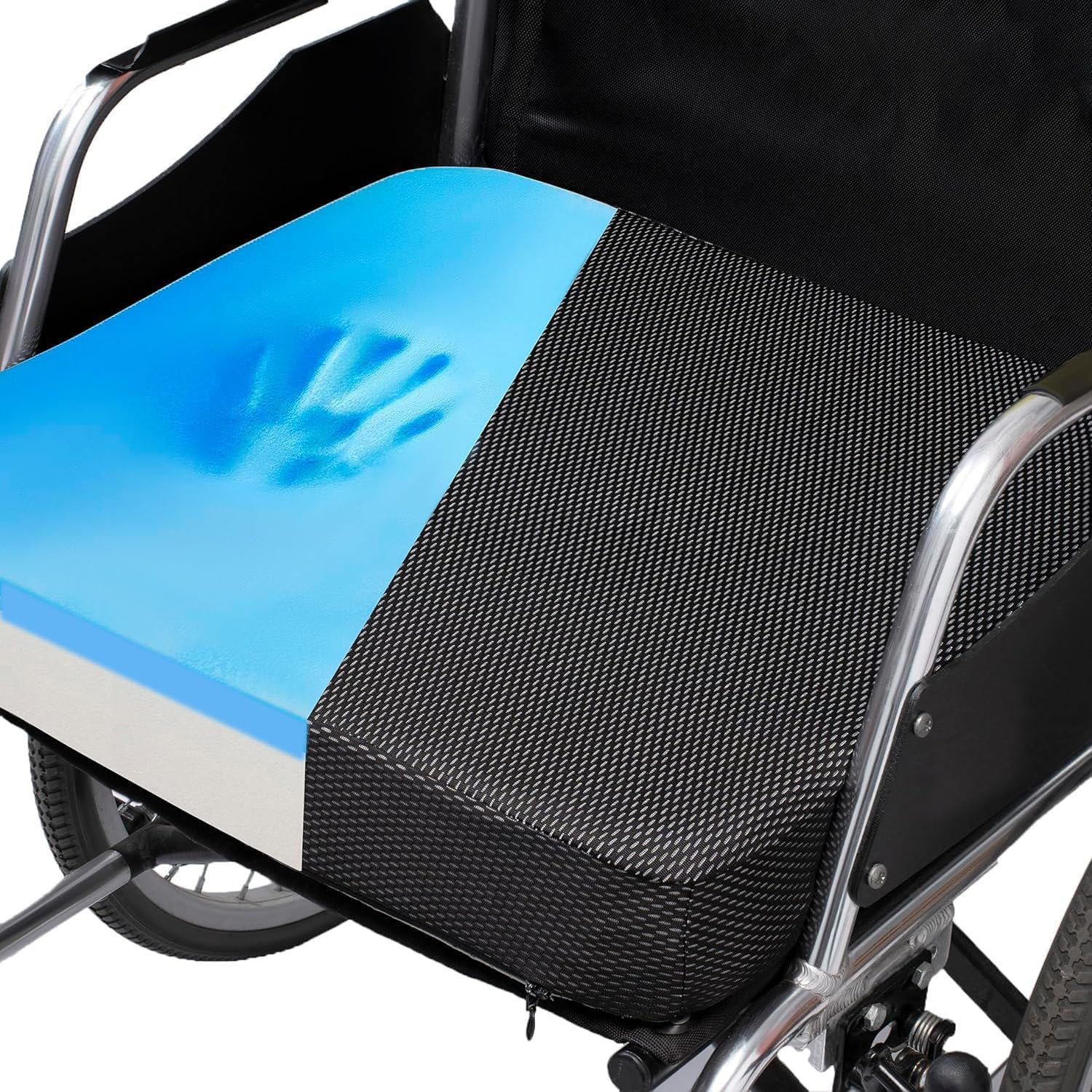
Best Wheelchair Cushions for Pressure Sores of 2026

A pressure sore can start in an afternoon — a few hours in the same spot, a seam pressing into the sit bone, and the damage is underway before anything hurts. A good cushion buys time: it spreads weight off the ischial tuberosities, cuts the shear of every transfer, and stays supportive long enough for skin to recover between shifts. What it can't do is forgive a bad fit. I've watched a family member burn through three cushions in a year — one so firm it left him perched and unsteady, another that flattened by mid-morning.

Over the past eight months my team and I have weighed, sat on, and swapped out 10 cushions, from basic foam wedges to adjustable air cells, and the differences came down to things you won't find on the box. Firmness has to match body weight — what saves a 130-pound sitter bottoms out under a 250-pound one — and a quarter inch of extra width decides whether a cushion stays put or slides. There's a pick below for maximum offloading and one for a comfortable, affordable backup.

1

Best Overall

Everlasting Comfort Wheelchair Cushion

91 /100
Trail Score Outstanding

Key details

Base
Rubberized non-slip
Fill
Gel memory foam
Cover
Removable, machine washable
Footprint
18 x 16.9 in
Check Price on Amazon

A wheelchair's own seat is a vinyl sling with almost no give in it, so a cushion is not an accessory. It is the only thing between your sit bones and the frame. Of the cushions we recommend here, this is the one we hand to most people first, because it gets three basics right at once: a gel-foam core that spreads load, a ventilated top layer aimed at heat, and a rubberized base that keeps the whole thing from migrating when you shift your weight.

The gel is what earns the recommendation. Memory foam on its own compresses under a seated adult and leaves you close to the seat pan again; the gel displaces sideways instead, so weight spreads across the cushion rather than pooling under the sit bones. Around that, the details are sensible: the cover unzips and machine washes, the fabric is certified to OEKO-TEX Standard 100, and the footprint lands at roughly 18 by 17 inches, which suits a standard adult chair. Comfort and support are where this one separates from the rest of the group.

The cover is the one place to think ahead. It is breathable mesh, so it handles sweat and washes clean, which is a different job from blocking fluid. If incontinence is part of the picture, the AUVON gel below is built for it. For everyone else this is the right cover: it unzips, washes cold and air-dries without fuss.

Pros

  • Gel foam spreads load instead of bottoming out
  • Ventilated gel layer aimed at heat build-up
  • Rubberized base resists sliding on the seat pan
  • Cover unzips and machine washes

Cons

  • Grip comes from the rubberized base alone
  • 18 x 16.9 in footprint needs a matching seat
Our verdict

The one we point most wheelchair users to first: gel foam that spreads load, real venting and a base that stays put, with nothing to learn.

Check Latest Price
2

Best for Moisture Protection

AUVON Gel Wheelchair Cushion

89 /100
Trail Score Excellent

Key details

Fill
Gel memory foam
Size
18 x 16 x 3 in
Cover
Waterproof membrane, washable
Security
Non-slip base plus strap
Check Price on Amazon

Start with the cover, because it is the part most wheelchair cushions treat as an afterthought. AUVON puts a waterproof membrane under the fabric, so sweat and spills stop at the surface and the foam core, which can never be washed, stays dry. Under that sits a gel layer roughly 16.4 by 14.9 inches over memory foam, with a U-shaped cutout at the back for the tailbone and a buckle strap working alongside the textured non-slip base.

That combination is why this is our pick for anyone dealing with moisture as well as pressure. The strap matters more than it sounds: a cushion that shifts sideways mid-transfer can leave you sitting on an edge or on the sling, and that is worse than no cushion at all. Construction is the strongest of the group in this set, and the U-cutout genuinely takes weight off the coccyx rather than just denting around it.

What you notice first is the height. Three inches lifts you in the chair, and while that is not dramatic, it is enough that your feet land differently on the footrests and your transfers feel slightly changed. Set it on the chair and try both before you commit, especially if you push yourself with your feet.

Pros

  • Waterproof membrane keeps the foam core dry
  • Buckle strap plus textured base holds it in place
  • U-cutout takes pressure off the tailbone
  • Gel layer over memory foam spreads load

Cons

  • Gel-foam runs firm and can stiffen with months of use
Our verdict

If moisture is part of the pressure problem, this is the one to buy: a fluid-proof cover, a strap that holds, and gel where you need it.

Check Latest Price
3

Best Budget Gel

Drive Medical 14886 Gel Cushion

89 /100
Trail Score Excellent

Key details

Fill
Gel bladder in foam shell
Size
18 x 16 x 3 in
Cover
Fluid-resistant coated nylon
Weight Capacity
275 lb
Check Price on Amazon

Drive's 14886 is the closest thing here to the cushion a wound-care clinician pictures: a viscous gel bladder suspended inside a polyurethane foam shell, a urethane-coated nylon top, and a waterproof vinyl base. Gel does not spring back the way foam does. It flows away from the point of highest load and stays there, which is the behavior you want under a sit bone that cannot take much more.

It is also the least expensive way to get real gel under you, and we like that it does not cosset. There is no contoured hump, no pillow top, nothing to bottom out, just gel, foam and a shell. At 18 by 16 by 3 inches it drops into a standard chair, and the 275-pound capacity is stated outright, which we appreciate: capacity is a number you can plan around.

The coated nylon top is the detail to weigh. Slick cuts both ways. It reduces friction on skin, which is the point, but it also lets you slide forward when you push up out of the chair, and a cushion you slide on is a cushion that ends up under your thighs instead of under you. If you transfer on your own several times a day, a grippier cover will serve you better than the extra gel does.

Pros

  • Gel bladder redistributes load instead of rebounding
  • Stated 275 lb weight capacity
  • Cheapest true gel cushion in this group
  • Fluid-resistant top and waterproof base

Cons

  • Over six pounds, so it stays in the chair
Our verdict

The budget pick, and a real gel cushion rather than foam pretending: buy it if the chair is where it lives and you can live with a slick top.

Check Latest Price
4

Best for Moving Between Chairs

CYLEN Ifoam Gel-Infused Cushion

90 /100
Trail Score Outstanding

Key details

Fill
Gel-infused foam over high-density foam
Size
18 x 16 x 3 in
Weight
1.3 lb
Weight Guidance
Over 200 lb: choose 4 in or thicker
Check Price on Amazon

CYLEN is the only maker here that tells you when to buy something else. In the care instructions they suggest anyone over 200 pounds choose a cushion four inches thick or more. We appreciated that. It is the kind of plain statement that saves a heavier sitter from a three-inch foam cushion that flattens by mid-afternoon.

What is left is a well-mannered cushion. Gel-infused memory foam sits on a high-density polyfoam base, the mesh cover comes off for washing, the bottom is textured to grip, and it weighs about a pound and a third, so moving it from the wheelchair to the car seat to the dining chair is not a chore. At 18 by 16 by 3 inches it fits the same standard chairs as everything else here.

We rate it as the second-cushion pick: one strapped into the chair, this one in the bag for the car and the kitchen table. The gel infusion softens the surface more than it changes the underlying behavior, so it is about feel rather than a different kind of pressure relief. At this weight it is the easiest of the group to live with, which is exactly what a cushion that moves should be.

Pros

  • Light enough to move between chair and car
  • Gel-infused foam over a firm polyfoam base
  • Removable mesh cover for washing
  • Maker states a clear weight limit

Cons

  • Slips on smooth seat pans and vinyl slings
Our verdict

The one to buy if the cushion travels with you: light, tidy and honest about its own weight limit, as long as your seat pan is not slippery.

Check Latest Price
5

Car and Home

AUVON Ventilated Seat Cushion

92 /100
Trail Score Outstanding

Key details

Fill
Ventilated memory foam
Size
18 x 16 in
Cover
Waterproof, removable
Ventilation
30 air holes
Check Price on Amazon

Eighteen by sixteen inches is the standard adult footprint, and AUVON's vented cushion fills it completely. On a 16-inch transport chair or any narrow seat, that is the whole story: the foam overhangs, bunches against the side rails, and puts a ridge under your thigh. On a standard 18-inch chair the fit is right, and the anti-slip base keeps it from wandering across a plastic seat pan.

The design detail worth paying for is the ventilation. Thirty air holes are punched through the foam, the cover is waterproof and removable, and there is a carry handle sewn in. Memory foam is a warm material to sit in for hours, and heat is unkind to skin that is already compromised; the perforations do not turn this into a mesh sling, but they give heat somewhere to escape. The velour surface feels better against skin than a vinyl pad, too.

Where it lands for us is as the cheap second cushion: the car, the kitchen table, the chair in the back room. It is the least expensive of the group, so keeping one folded in the car costs very little, and the handle makes moving it painless. Think of it as the spare, not the one that carries a full day.

Pros

  • Perforated foam with 30 air holes for airflow
  • Waterproof, removable cover
  • Carry handle makes it easy to move
  • Cheapest cushion in this group

Cons

  • Soft foam compresses under a heavier sitter
Our verdict

A cheap, well-vented cushion that works on a standard chair for a lighter sitter, and not the one to buy for a heavy, long-day wheelchair user.

Check Latest Price

How We Picked and Tested These Cushions

We started with the cushions that show up most often in occupational therapist recommendations and wheelchair-forum threads, then filtered by weight capacity, seat-width options, and price — dropping anything with a cover that couldn't be replaced or a warranty under a year. Ten made the cut, and we spent eight months with them, rotating each through full workdays, long movies, bus rides, and the car transfers where a cushion shows its weaknesses. We're not clinicians and we didn't run pressure mapping; what we did do is check skin after every long sit and note where redness appeared.

Firmness got the most attention, because it's the thing that quietly fails. I pressed a closed fist into the center of each cushion and noted how far it sank, then sat for four-hour stretches and paid attention to whether my sit bones ever reached the base — the moment a cushion bottoms out is the moment it stops doing its job. Stability came down to transfers: we leaned to reach a counter, swung in and out of a chair, and watched for side-to-side slide. Every cushion went on a kitchen scale, because weight matters when you're lifting it one-handed while holding a chair steady. Fit meant checking each against a 16-, 18-, and 20-inch seat, noting whether covers bunched or the cushion crept forward after an hour.

Quality showed up in the seams and the foam's memory — after a week of daily use we pulled each cushion off, let it rest an hour, and measured how much height came back. Covers that pilled or zippers that stuck got marked down. Value wasn't a price-tag comparison so much as what came in the box: a pump, a spare cover, a warranty that covers flattening. The cushions that scored best were rarely the most expensive ones.

How to Choose a Wheelchair Cushion for Pressure Sores

Start With the Seat Pan, Not the Cushion

The most common mismatch is a cushion that does not fit the chair. Standard adult wheelchair seats run about 16 to 20 inches wide and 16 to 18 inches deep, and the cushion should sit inside those edges rather than overhang them, because foam that bunches against a side rail puts a hard ridge under your thigh. Thickness matters just as much: every inch of cushion raises you in the chair and changes where your feet land on the footrests. Three inches is the common middle ground, and if you use a narrow transport chair, buy a 16-inch-wide cushion rather than squeezing an 18-inch one in.

What the Fill Actually Does Under You

Foam compresses. Under a seated adult, a soft memory-foam topper thins to almost nothing and leaves you back on the sling, which is why pressure relief on the label tells you very little by itself. Gel displaces sideways and holds its position, so load spreads around the sit bones instead of pooling. Air cells conform best of all, but they need a pump and a routine for leaks, and a cushion that quietly loses inflation is worse than a gel one that never had any.

For most people, gel over a firm foam base is the practical middle. If you weigh more than about 200 pounds, treat thickness as part of the specification and check the stated capacity before anything else.

Shear and Slip: The Part Transfers Expose

Pressure is only half the problem. The other half is friction, and most of it happens when you get in and out of the chair. A cushion that slides forward mid-transfer can leave you perched on its edge or on the bare sling. Two things help: a textured or rubberized base, and a strap that fastens around the chair frame. If you transfer independently several times a day, buy the strap.

Cover material cuts both ways. A slick nylon top reduces drag on skin but lets you slide forward, which is the trade-off on the Drive gel cushion; a grippier fabric holds you in place and asks more of your arms.

Moisture, Covers and the Foam You Cannot Wash

Every cushion here has a core that must not go in a washing machine; only the cover comes off. That makes the cover the hygiene decision. Breathable mesh handles sweat and washes clean, which is enough for most people. A waterproof membrane is the better answer if incontinence is part of the picture, because urine reaching the core turns a pressure-relief cushion into something you cannot clean. A spare cover is worth buying, and plan on air-drying rather than tumbling.

Frequently Asked Questions

Final Verdict

Buy the Everlasting Comfort if you want one cushion that handles the whole job: gel to spread the load, venting for heat, and a base that stays where you put it. Choose the AUVON gel instead when a fluid-proof cover and a strap matter more than a soft feel, which is usually the case if you are managing incontinence alongside a sore.

And if the chair is stationary and money is tight, the Drive's gel bladder does the core job for less than either, as long as you can live with a slick top and six pounds of cushion that stays put.