Best Weighted Jump Ropes of 2026

A weighted jump rope looks like a simple upgrade—until you're 30 seconds into a set and the rope is dragging your wrists down while the handles threaten to slip. The right weight gives you feedback and turns a quick warm-up into a real workout; too much, badly placed, and you'll fight the rope instead of finding a rhythm. What you're really buying is control: a rope that spins smoothly, stays comfortable in sweaty hands, and holds up when you miss.

I've kept a few ropes by the garage door for years, and my team recently put 12 weighted jump ropes through three months of regular sessions—warm-ups, interval circuits, and longer steady sets. We noted which ones kept their shape after being coiled in a bag, which handles stayed grippy once our hands got slick, and which felt worth keeping after the novelty wore off. A weighted rope is a small purchase with an outsized effect on rhythm and joint comfort, so the differences matter. The picks below are the ones we kept reaching for.

1

Best Overall

Redify Weighted Jump Rope 1 lb

91 /100
Trail Score Outstanding

Key details

Length
120 in, adjustable
Handles
Aluminum with silicone grip
Rope Weight
1 lb
Ropes Included
9mm cotton and 9mm PVC
Check Price on Amazon

Two ropes come in the box — a 9mm braided cotton one and a 9mm solid PVC one — and both mount to the same pair of aluminum handles. That's why this is the rope we hand people first. You get a softer, quieter rope for indoor work and a firmer one for the garage, and a built-in lock lets you set the length anywhere up to 10 feet instead of cutting a cable and living with the result. Swapping between the two takes a minute and no tools.

The weight sits in the rope rather than the handles: 1 lb for the whole rope, with the cotton section alone listed at 0.46 lb. That distinction matters more than it sounds. A rope-weighted rope arrives over the top with real momentum, so your shoulders and forearms do the work while your wrists stay loose — the reverse of a plastic speed rope with lead in the grips. The aluminum handles carry a raised silicone pattern that gives sweaty hands something to hold, and the double ball bearings turn without the hitch you feel on cheap swivels.

Set the length before your first real set. At 9mm this rope carries enough momentum that an over-long loop will find the back of your legs, and the adjustment is quick enough to redo mid-session. Wear is the thing to expect over months: the cotton is the part that ages, which is exactly why having the PVC rope as a spare is worth more than it looks on paper.

Pros

  • Two rope types on one handle set
  • Adjusts to 10 ft without cutting
  • Aluminum handles with a grippy silicone texture
  • Weight carried in the rope, not the grips

Cons

  • At 1 lb, not a strength-training rope
Our verdict

Our default pick: 1 lb of rope-weighted resistance, two swappable ropes, and 10 feet of adjustment make it the most useful weighted rope in this group.

Check Latest Price
2

Best Weighted Rope System

Crossrope Get Lean Set

95 /100
Trail Score Outstanding

Key details

Extras
Workout app
Length
96 in, ordered by height
Handles
PVC with urethane grip
Ropes Included
1/4 lb and 1/2 lb
Check Price on Amazon

It's easy to look at this set as one very expensive rope. It isn't. What you're buying is a pair of slim handles that clip onto either a 1/4 lb or a 1/2 lb rope in a couple of seconds, ordered in a size matched to your height, so there's no trimming, no excess cord to whip past your ear, and no second handle set rattling around in a drawer.

Build quality is where it earns the money. The handles are textured, weighted, and shaped so the grip lands in the same place every time, and the ropes turn without the flat spots that show up on cheaper swivels. The app is a real part of the package rather than a leaflet with a QR code on it — hundreds of guided workouts, with the rope pairing matched to what you're doing. If you follow programming, that's worth a lot. If you don't, it's ballast.

We rate the Get Lean as the best-built set here and the most pleasant to train with. The swaps are what make it: dropping to the light rope for a fast interval and clipping the heavier one back on for the last thirty seconds is a genuinely different way to train, and no single rope here replicates it. The buyers who end up happiest with it are the ones using the sizing, the swaps, and the app together, rather than the ones who wanted one rope to swing.

Pros

  • Clip system swaps rope weights in seconds
  • Ordered by height, so nothing needs trimming
  • Handles feel solid and stay grippy
  • Structured workouts included in the app

Cons

  • Ropes top out at 1/2 lb
Our verdict

If you'll use the app and want to switch rope weights mid-workout, this is the set worth paying for — just don't expect heavy strength work from it.

Check Latest Price
3

Best for Heavy Strength Work

Proud Panda Heavy Jump Rope

90 /100
Trail Score Outstanding

Key details

Rope
Three-strand polyester
Length
110.4 in, fixed
Handles
Plastic with rubber grip
Rope Weight
2.8 lb
Check Price on Amazon

Two point eight pounds doesn't sound like much until it's orbiting above your head. The first round is a surprise: the rope comes over slowly, the load lands in your shoulders and forearms, and by the time a normal rhythm arrives you're already breathing hard. That's exactly what this rope exists to do, and it's the pick we point to when the session is meant to be strength rather than cardio.

The rope is three-strand polyester, thick and slightly rough, which is why it resists tangling and why it shrugs off being dragged across a garage floor. The handles are soft plastic with a rubber grip, and the swivel is basic but up to the job — at this weight the rope carries itself through the turn, so it doesn't ask much of the bearings.

One thing to know before you order: this is a rope you grow into rather than one you pick up and flow with. The first week is humbling, and that's the point — the drag is the resistance, and the strength shows up in your forearms and grip before it shows up anywhere else.

Pros

  • 2.8 lb builds shoulder and grip strength fast
  • Thick three-strand rope resists tangling
  • Soft handles with a rubber grip
  • Holds up to regular training

Cons

  • Fixed 9.2 ft length runs short for tall jumpers
Our verdict

For pure strength and shoulder work at a fair price, this 2.8 lb rope delivers — provided you're not much over six feet tall.

Check Latest Price
4

Best Light Rope for Speed

Hererope Weighted Jump Rope

90 /100
Trail Score Outstanding

Key details

Rope
6mm PVC-coated steel cable
Length
108 in, four sizes
Handles
Faux leather grip
Rope Weight
1/4 lb
Check Price on Amazon

Four sizes, S through XL, matched to your height: that's the part of this rope worth paying attention to. Instead of trimming a cable and hoping, you order the length you need, which matters more on a steel cable than on cotton because there's no clean way to shorten one at home.

The cable is 6mm PVC-coated steel on dual ball bearings, and it turns fast, quietly, and without the wander you get from a stiff rope that hasn't relaxed yet. A quarter pound of weight in the rope gives you feedback — you can feel where the cable is without watching it, which is the whole game when you're learning double-unders. For someone who already jumps and wants speed work with a little more feel than a bare cable, this is the pick.

The handle end is where a rope like this eventually gives out, so it's worth glancing at the cable where it enters the handle every few weeks. A coated cable on concrete or asphalt also wears through its coating quickly; put a mat down or keep it indoors. Neither is a reason to skip it — they're the running costs of a cable instead of cotton.

Pros

  • Four sizes fit your height without trimming
  • Dual ball bearings turn fast and smooth
  • Weighted cable gives feedback at speed

Cons

  • Only 1/4 lb, so no strength benefit
Our verdict

A light, well-made weighted cable for speed work and double-unders — sized to your height, and not the rope for building strength.

Check Latest Price
5

Stepping up Weight

Kuzaro Weighted Jump Rope 1.5 lb

89 /100
Trail Score Excellent

Key details

Rope
Polymer fiber
Length
110 in, fixed
Handles
Anti-slip TPE
Rope Weight
1.5 lb
Check Price on Amazon

One and a half pounds is the weight nobody markets and most people actually need. It's heavy enough that you feel the rope on every turn and light enough to string together a hundred jumps, which is why this is the one we point to for someone stepping up from a 1 lb model without going all the way to a battle rope.

The handles are TPE with an anti-slip surface, the rope is a polymer fiber that turns smoothly enough for continuous singles, and the pink version is genuinely nice to look at. We won't pretend that last part doesn't matter: a rope that looks good is a rope that stays on the hook by the door instead of in a cupboard.

Length is the compromise. At 110 inches it lands well around average height; taller jumpers will find it short and shorter ones end up holding further down the handles. It's a fit decision rather than a quality one, and the other thing to expect over months is fraying where the rope meets the handle.

Pros

  • 1.5 lb is a genuinely usable middle weight
  • Anti-slip TPE handles
  • Finish you'll want to keep visible

Cons

  • Fiber rope frays where it meets the handle
Our verdict

The sensible step up from a 1 lb rope: 1.5 lb, grippy handles, and a finish that makes you want to pick it up.

Check Latest Price
6

Combat-Sport Work

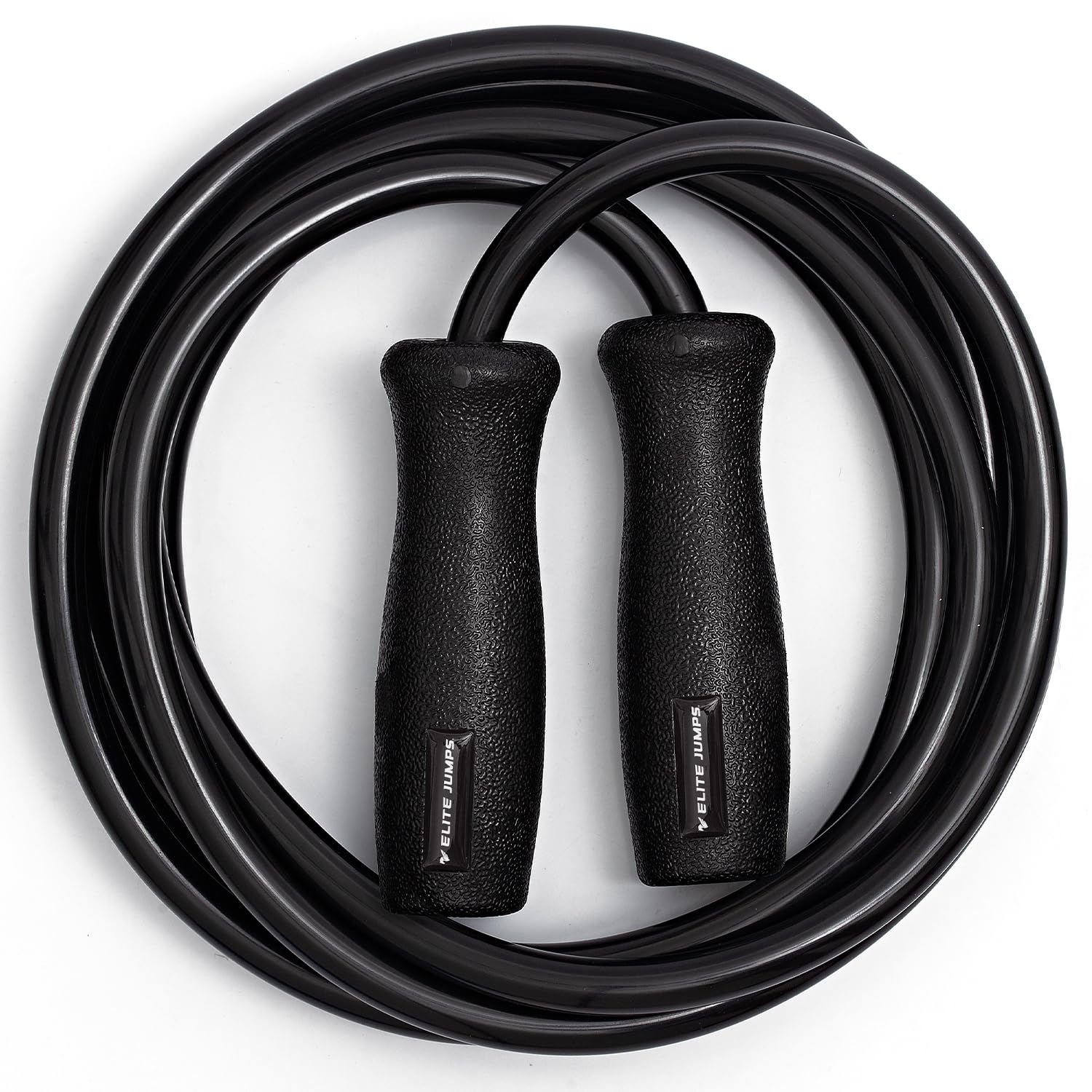
Elite Jumps Muay Thai 2.0

91 /100
Trail Score Outstanding

Key details

Rope
Heavy-duty PVC
Length
10 ft, fixed
Handles
Molded plastic, EVA foam grip
Rope Weight
1.3 lb
Check Price on Amazon

Most weighted ropes here adjust. This one doesn't: it arrives at a fixed 10 feet, sized for athletes between 6'2" and 6'5", and that's the entire proposition — a rope built for one kind of jumper and then left alone. In a category obsessed with adjustability that's an odd choice, and for the right buyer it's the reason to buy.

The rope is 1.3 lb of heavy-duty PVC, roughly three times a standard speed rope, with the mass in the rope rather than the handles. It turns on internal ball bearings, the molded handles are wrapped in EVA foam, and the whole thing is built like a power cord — it takes being dropped on a gym floor without complaint, and the PVC outlasts the nylon ropes that fuzz up after a month of hard use.

Stiffness is the break-in period. PVC at this thickness has memory: it arrives coiled and stays that way longer than cotton or coated cable, and the kinks can catch your feet until the rope relaxes. A few sessions and a hook to hang it on solve most of it.

For Muay Thai, boxing, and MMA conditioning, this is the rope we reach for first. The weight is honest, the turn is smooth and unhurried, and jumping with it feels like using equipment rather than a gadget. Repetition is what it rewards — the rope keeps its shape and its timing, session after session, which is more than most weighted ropes manage.

Pros

  • 1.3 lb puts real load on the shoulders
  • Heavy-duty PVC takes gym-floor abuse
  • Ball bearings keep the turn smooth

Cons

  • Fixed 10 ft length fits only tall jumpers
Our verdict

A 1.3 lb rope built for tall combat athletes — inside its height band, nothing here turns better or takes more abuse.

Check Latest Price
7

Heavy Strength Work

HPYGN Weighted Jump Rope

92 /100
Trail Score Outstanding

Key details

Rope
Polymer synthetic fiber
Extras
Carry bag
Length
9.2 ft, fixed
Weight Options
2.8, 3.8, or 5 lb
Check Price on Amazon

The pitch here is range: this rope comes in 2.8, 3.8, and 5 lb, so you choose how much it fights back. That's the widest spread in this group, and the 5 lb version is a genuinely different tool from a 1 lb rope — slow, deliberate, and closer to a conditioning circuit than a skipping session. The 2.8 lb version we looked at is the sensible entry point.

It's built from a thick polymer synthetic fiber with anti-slip polyolefin handles, and the construction holds up: the fiber is dense enough that it won't kink on itself, and the whole rope coils into the carry bag for a gym commute. For raw strength work without spending much, it's a fair call — the resistance is honest and the swing feels like work from the first turn.

What you give up is refinement. The finish is utilitarian — plain fiber, plain handles, a simple bag — and nothing about it feels expensive in the hand. At 2.8 lb that's a fair trade, because the rope does the same job as the pricier heavy options here without the niceties, and it's the version most people should start with.

Pros

  • Comes in 2.8, 3.8, and 5 lb
  • Thick polymer fiber resists kinking
  • Carry bag included

Cons

  • Handles turn slick with sweaty hands
  • Fixed 9.2 ft length is short for tall jumpers
Our verdict

Choose this if you want to train heavy — up to 5 lb of honest resistance for strength work, with a length that suits average heights.

Check Latest Price

How We Tested Weighted Jump Ropes

We started by scanning reviews and spec sheets for weighted jump ropes sold at outdoor retailers, fitness shops, and direct-to-consumer sites, then narrowed the list by weight range, adjustable length, handle material, and price. We ended up with 12 ropes, from light 1/2-pound models to heavier 3-pound options, and used each one for three months.

Testing happened mostly in a garage gym and on a concrete driveway, with a few sessions on a rubber gym floor and a backyard patio. Each rope got used for 10-minute warm-ups, timed 60-second interval sets, and a couple of 20-minute steady sessions per week. We adjusted every rope to each tester's height and noted how easy the length changes were, whether the rope kept coiling after storage, and if the cable or weighted inserts stayed straight through repeated misses.

We paid attention to grip first: after five minutes of jumping, we noted whether handles turned slick, rubbed against the thumb, or made us squeeze harder to keep control. Thickness and stiffness got checked in hand and in motion—some ropes felt whippy and fast, others felt dead or cumbersome. Durability came down to weekly inspections of handles, bearings, and cable coatings, especially after use on concrete, and we compared what each rope cost against how it performed and held up.

At the end of each session we rated the workout itself: whether the rope made us want to keep going, whether it was easy to settle into a rhythm, and whether the weight helped or hindered our form. The ropes that scored best were not always the heaviest; they were the ones with balanced weight distribution, secure grips, and enough durability to survive regular training.

How to Choose a Weighted Jump Rope

Choose the weight around the workout, not the other way round

A quarter- to half-pound rope is a speed tool with some feel to it: the right choice for double-unders, intervals, and long continuous sets. One to one and a half pounds is the all-round range, heavy enough to load the shoulders and light enough to hold a rhythm for several minutes. Two and a half pounds and up is strength work — the rope comes over slowly, the shoulders and forearms take the load, and the rounds get short fast.

Where the weight sits changes the feel. Rope-weighted designs such as the Redify and the heavy Proud Panda swing with momentum and leave your wrists free, while handle-weighted ropes load the grip more directly. Watch what the number measures, too: a rope sold as 1 lb might be quoting the rope alone, the handles, or the whole package. The Redify is 1 lb in total, with the cotton rope itself listed at 0.46 lb.

Match the length to your height before anything else

Weighted ropes come in three arrangements: fixed lengths around 9 to 9.5 feet, adjustable ropes that reach 10 feet, and ropes ordered in sizes. Fixed is the trap. A 9.2-foot rope suits an average-height jumper and comes up short for anyone much over six feet, and there's nothing you can do about it afterwards. If you're tall, buy an adjustable rope or a sized one.

Adjustment isn't automatic either. On some ropes you feed the excess back into the handle, where it can work loose; on others you cut a cable you can't put back. Set the length with the classic check — stand on the middle of the rope, bring the handles up to your armpits — and if you're between sizes on a sized rope, go up and shorten.

Handles and bearings matter in opposite directions

A heavy rope carries itself through the turn, so a basic swivel is enough. A light rope lives or dies on its bearings, which is why the quarter-pound picks here lean on ball bearings while the 2.8 lb ropes get away with something simpler. Grips work the other way round: the heavier the rope, the sooner you notice a slick handle, and textured rubber or silicone beats smooth plastic once your hands are wet.

Handle material is mostly about durability and feel. Aluminum handles like the Redify's won't crack if you drop them, plastic ones are lighter and cheaper, and foam covers are comfortable right up until they wear through.

Expect the rope to wear before the handles do

Cotton frays, coated steel cable snaps at the handle entry, and thick polymer fiber abrades against concrete. The failure point is predictable: the handle end, where the rope bends hardest. Check there every few weeks, and put a mat under you on rough ground, because a coated cable on asphalt is gone in weeks.

This is where a spare rope earns its place. The Redify ships with two rope types on one handle set, so when the cotton ages you aren't shopping again. Check the warranty before ordering, since wear at the handle is the usual failure and not every maker covers it.

Frequently Asked Questions

Final Verdict

For general training, the Redify is the rope we recommend: 1 lb of resistance carried in the rope, two rope types on one handle set, and 10 feet of adjustment that most ropes here don't offer. It's the one that fits the widest range of heights and workouts, and the spare rope means the wear point isn't a replacement purchase.

Spend more only if you want the system — the Crossrope's clip-in ropes and programming are worth the premium to someone who will swap weights mid-session. And if strength is the whole point and you're not tall, the Proud Panda's 2.8 lb is the harder workout for less money.